
How the Live Music Industry is Engineering the Zero-Carbon Stadium Tour
Driven by climate data and fan pressure, the world's biggest artists are replacing diesel generators and plastic waste with kinetic dance floors, battery arrays, and plant-based logistics.
By Factlen Editorial Team
- Industry Pioneers
- Mega-artists and sustainability nonprofits argue that immediate, highly visible interventions can catalyze industry-wide change.
- Academic Evaluators
- Climate scientists emphasize that systemic, data-driven overhauls matter more than visible green initiatives.
- Music Business Analysts
- Industry experts focus on the financial viability and scalability of green touring across all tiers of music.
What's not represented
- · Independent Artists
- · Local Venue Operators
- · Touring Crew Members
Why this matters
The live entertainment industry is quietly undergoing a massive infrastructure overhaul that will change how fans buy tickets, travel to venues, and experience shows. By proving that massive stadium tours can decouple from fossil fuels, top artists are forcing a new standard that will eventually trickle down to local theaters and arenas.
Key points
- The live music industry is undergoing a massive decarbonization effort led by top touring artists.
- Kinetic dance floors and recycled battery arrays are replacing highly polluting diesel generators at major shows.
- A recent MIT study found that fan travel and food consumption are the largest sources of concert emissions.
- Transitioning to plant-based menus can reduce a live event's food-related carbon footprint by up to 70 percent.
- The ultimate goal is standardizing venue infrastructure so smaller artists don't bear the financial burden of hauling gear.
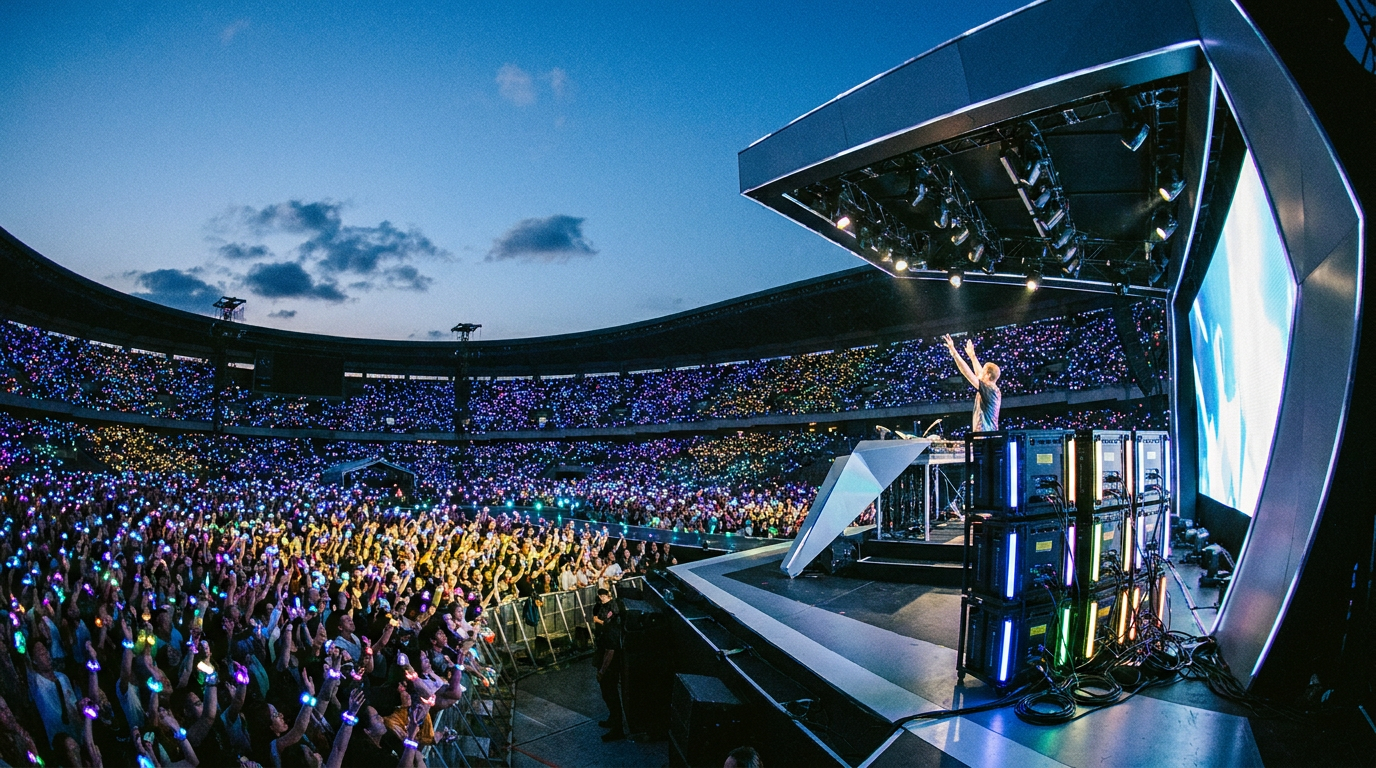
The spectacle of a global stadium tour has long come with a hidden, heavy cost: a massive carbon footprint. For decades, the live music industry relied on a highly polluting formula to deliver entertainment to the masses. Off-grid diesel generators roared behind the stages, private jets ferried talent between continents, and fleets of idling trucks hauled thousands of tons of steel, lighting, and audio equipment from city to city. It was an environmental toll that fans rarely saw, obscured by the dazzle of lasers and pyrotechnics.[5][7]
But a radical, industry-wide shift is now underway. Driven by a combination of acute climate anxiety, pressure from a younger generation of fans, and a desire to future-proof their businesses, the world's biggest artists are fundamentally re-engineering how they hit the road. This is no longer about simply purchasing carbon offsets to assuage guilt; it is about actively decarbonizing the physical infrastructure of live entertainment.[5][7]
The scale of the problem they are trying to solve is vast. A comprehensive study published by the Massachusetts Institute of Technology's Climate Machine calculated that the live music industry in the United States alone emits up to 17.3 million tonnes of carbon dioxide equivalent annually. While that represents a fraction of total national emissions, the cultural visibility of the music sector gives its actions an outsized influence on public behavior and corporate standards.[1]

To combat this massive footprint, artists are targeting the most visible and easily controllable source of emissions first: power generation. Historically, outdoor festivals and stadium gigs required immense amounts of electricity that local grids simply could not supply, necessitating the use of dirty, inefficient diesel generators.[7]
Recent global pop tours have served as high-profile laboratories for alternative energy over the past few years. By deploying tourable battery systems made from recycled electric vehicle batteries, leading productions have managed to reduce their direct carbon emissions by an impressive 59 percent compared to previous global outings.[3]
These tours also introduced interactive energy generation to the masses, installing kinetic dance floors and stationary power bikes in the general admission areas. These allow fans to literally pedal and jump power into the concert's secondary stages, generating an average of 17 kilowatt-hours of clean electricity per show while turning sustainability into a tangible, engaging activity.[3]

Meanwhile, other pioneers have taken a more systemic, academic approach to the problem. The Bristol-based collective Massive Attack partnered with the Tyndall Centre for Climate Change Research at the University of Manchester to create an open-source "Roadmap to Super Low Carbon Live Music," designed to be shared freely across the industry.[2]
Meanwhile, other pioneers have taken a more systemic, academic approach to the problem.
This rigorous roadmap culminated in the "ACT 1.5" festival, a massive outdoor event that achieved an astonishing 81 to 98 percent reduction in power emissions. The entire festival ran on battery arrays charged exclusively from renewable sources, which were then transported to the site by a fleet of electric trucks, proving that fossil fuels are no longer a technical requirement for large-scale audio and visual production.[2]

Yet, while artist travel and stage power are highly visible targets, the data reveals a much more stubborn challenge: the fans themselves. The MIT researchers identified audience travel as the single largest contributor to a concert's overall climate footprint, dwarfing the emissions of the artists and their freight.[1]
Addressing this requires behavioral engineering and complex logistical partnerships. Tours are increasingly working with local transit authorities to bundle public transportation passes with ticket sales, subsidizing electric buses, and utilizing mapping apps to incentivize carpooling and low-carbon travel routes for attendees.[1][6]
Beyond transportation, food and beverage consumption represents the second-largest emissions bucket for any live event. Here, the industry is seeing a rapid shift away from traditional stadium fare toward heavily curated, low-impact menus.[1][4]
During recent major tours, organizers partnered with nonprofits like Support+Feed to deliver the equivalent of millions of plant-based meals. Environmental researchers note that transitioning a venue to a low-carbon, plant-forward menu can lower a live event's food-related emissions by 40 to 70 percent, making it one of the most effective levers available.[1][4]

Strict backstage and front-of-house rules are also eliminating vast amounts of physical waste. By mandating free water refill stations and requiring venues to serve drinks in their original containers rather than pouring them into disposable cups, recent major tours have successfully avoided the use of hundreds of thousands of single-use plastic bottles.[4][6]
Despite these triumphs at the top of the billboard charts, significant uncertainty remains about how these practices can scale down to independent artists playing mid-sized club venues. The economics of touring are already notoriously difficult for emerging acts, and the upfront costs of green technology can be prohibitive.[7]
Smaller acts simply lack the financial leverage to enforce "green riders" on struggling local venues. A neighborhood theater operating on razor-thin margins cannot easily afford to upgrade its HVAC systems, install solar microgrids, or overhaul its supply chains just because an indie band requests it.[1][7]
Ultimately, the long-term goal of the decarbonization movement is a "plug-and-play" model. If venues worldwide standardize their in-house lighting and audio equipment, it would drastically reduce the need for artists to haul heavy rigs across continents, shifting the burden of sustainability from the touring musician to the permanent infrastructure of the cities they visit.[2][7]
How we got here
2019
Massive Attack commissions the Tyndall Centre to research live music decarbonization.
2021
The Tyndall Centre publishes the Roadmap to Super Low Carbon Live Music.
2022
Coldplay launches the Music of the Spheres tour with a pledge to cut emissions by 50%.
August 2024
Massive Attack hosts the ACT 1.5 festival, achieving unprecedented emissions reductions.
December 2025
An MIT study reveals fan travel and food are the largest sources of concert emissions.
Viewpoints in depth
Industry Pioneers
Mega-artists and sustainability nonprofits argue that immediate, highly visible interventions can catalyze industry-wide change.
Acts like Coldplay and Billie Eilish use their massive cultural leverage to force vendors and venues into compliance. By deploying kinetic dance floors and demanding plant-based catering, they prove that sustainable touring is not only logistically possible but also highly engaging for fans, setting a new baseline for what audiences expect.
Academic Evaluators
Climate scientists emphasize that systemic, data-driven overhauls matter more than visible green initiatives.
Researchers at institutions like MIT and the Tyndall Centre point out that the unglamorous aspects of touring—specifically fan travel and freight logistics—make up the vast majority of a concert's carbon footprint. They argue that true decarbonization requires structural changes, such as localized routing and public transit integration, rather than just offsetting emissions or swapping out plastic cups.
Music Business Analysts
Industry experts focus on the financial viability and scalability of green touring across all tiers of music.
While stadium acts have the capital to invest in custom battery grids and sustainable aviation fuel, analysts note that the economics look very different for independent artists. The long-term success of this movement relies on venues adopting standardized 'plug-and-play' equipment, which would relieve smaller bands from the financial burden of hauling heavy gear and meeting complex environmental mandates.
What we don't know
- It remains unclear how quickly independent, mid-sized venues can afford to upgrade their infrastructure to meet new green standards.
- We do not yet know if fan behavior regarding travel and carpooling will shift permanently without heavy financial incentives.
- The long-term durability and lifecycle of the tourable battery arrays used in these massive productions are still being studied.
Key terms
- Kinetic dance floor
- A specialized surface that converts the physical energy of human footsteps and dancing into usable electricity.
- Scope 3 emissions
- Indirect greenhouse gas emissions that occur in an event's value chain, such as audience travel to a concert.
- Green rider
- A set of environmental requirements added to an artist's contract, mandating that a venue provide sustainable options like recycling or plant-based catering.
- Plug-and-play venue
- A concert venue equipped with standardized, high-quality in-house lighting and audio, reducing the need for touring artists to transport heavy gear.
Frequently asked
Why is fan travel the biggest source of concert emissions?
Tens of thousands of people traveling individually by car or plane to a single location generates vastly more carbon than the artist's own tour buses and freight trucks.
Can smaller bands afford to tour sustainably?
It is currently difficult, as independent artists lack the financial leverage to demand venue upgrades. However, industry roadmaps aim to standardize green venue infrastructure so the burden doesn't fall entirely on the touring act.
Do kinetic dance floors generate enough power for a whole concert?
No. While they engage fans and generate enough electricity to power smaller acoustic stages (about 17 kWh per show), the main stage still requires larger battery arrays or grid power.
Sources
Source coverage
7 outlets
3 viewpoints surfaced







[1]Green QueenAcademic Evaluators
Fan Travel & Food the Largest Sources of Live Music's Climate Footprint, Finds Coldplay-Backed MIT Study
Read on Green Queen →[2]University of ManchesterAcademic Evaluators
Massive Attack deliver lowest-carbon concert with Tyndall Centre roadmap
Read on University of Manchester →[3]Coldplay OfficialIndustry Pioneers
Music Of The Spheres World Tour: Sustainability Initiatives
Read on Coldplay Official →[4]REVERBIndustry Pioneers
Billie Eilish: Hit Me Hard and Soft Tour Impact
Read on REVERB →[5]InformaMusic Business Analysts
The music industry to play its part in reducing climate change
Read on Informa →[6]XS NoizeIndustry Pioneers
Billie Eilish's Hit Me Hard and Soft Tour: A Blueprint for Green Touring
Read on XS Noize →[7]Factlen Editorial TeamMusic Business Analysts
Synthesis by Factlen editorial team
Read on Factlen Editorial Team →
Every angle. Every day.
Get entertainment stories with full source coverage and perspective breakdowns delivered to your inbox.