
How Precision Fermentation is Brewing Real Dairy Without the Cow
A new wave of biotechnology is using programmed microbes to produce bio-identical milk proteins, promising to solve the taste gap in vegan cheese while slashing the environmental footprint of dairy.
By Factlen Editorial Team
- Food Tech Innovators
- Focuses on the technological breakthroughs that allow microbes to produce bio-identical dairy proteins, solving the taste and texture gaps of plant-based alternatives.
- Market Analysts
- Tracks the rapid commercialization, massive venture capital investment, and B2B scaling potential of the animal-free dairy sector.
- Environmental Advocates
- Emphasizes the staggering reductions in greenhouse gas emissions, land use, and water consumption achieved by removing cows from the protein supply chain.
- Scientific Community
- Evaluates the safety, molecular equivalence, and regulatory frameworks required to bring genetically engineered microbial proteins to the public market.
What's not represented
- · Traditional Dairy Farmers
- · Conventional Agriculture Lobby
Why this matters
Precision fermentation offers a rare win-win for the global food system: it allows consumers to enjoy the exact taste, melt, and nutrition of real dairy while reducing the water, land, and greenhouse gas emissions associated with industrial animal agriculture by up to 99%.
Key points
- Precision fermentation uses programmed microbes to brew bio-identical dairy proteins without cows.
- The technology solves the melting and stretching limitations of plant-based vegan cheeses.
- Recent FDA clearances for casein and lactoferrin are accelerating mainstream commercialization in 2026.
- The process requires up to 99% less water and land than conventional dairy farming.
- Because the proteins are identical to cow's milk, products must carry mandatory dairy allergen warnings.
For decades, the holy grail of the alternative dairy industry has been a vegan cheese that actually melts, stretches, and tastes like the real thing. Plant-based milks made from oats, almonds, and soy have captured significant market share, but when it comes to complex dairy products like mozzarella or brie, plant-derived starches and oils consistently fall short. The missing ingredient has always been the specific proteins that give dairy its unique molecular structure. Now, a rapidly maturing technology is solving that problem by producing those exact proteins without a single cow.[8]
The technology is called precision fermentation, and 2026 is shaping up to be its breakout year. Rather than trying to mimic dairy with plants, food scientists are using programmed microorganisms to brew bio-identical milk proteins from scratch. Over the past year, a wave of biotechnology companies—including Formo, All G, and Verley—have received "No Questions" letters from the U.S. Food and Drug Administration (FDA), granting their animal-free proteins Generally Recognized As Safe (GRAS) status and clearing the path for mainstream commercialization.[3][8]
The mechanism behind precision fermentation is conceptually similar to brewing beer, but vastly more sophisticated. Scientists begin by identifying the specific genetic sequence in a cow's DNA that codes for a desired milk protein, such as whey or casein. They then insert this genetic instruction manual into the DNA of a microorganism, typically a specialized strain of yeast or fungi.[3]

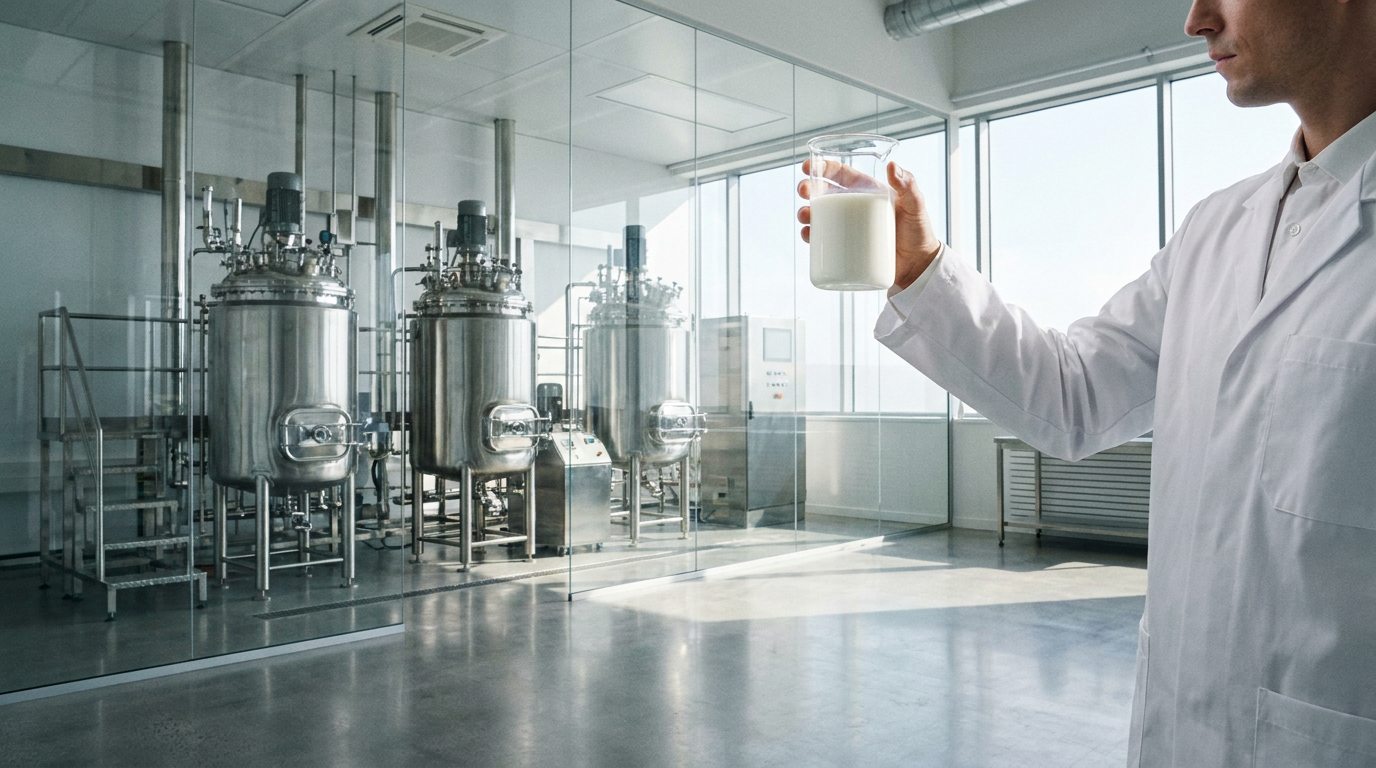
These programmed microbes are placed into large stainless-steel bioreactors and fed a steady diet of water, nutrients, and plant-based sugars. Acting as microscopic factories, the microbes read the inserted DNA and begin churning out the exact same dairy proteins a cow would produce. Once the fermentation process is complete, the liquid is filtered and purified, isolating the protein from the microbes. The result is a clean, dry protein powder that is molecularly indistinguishable from conventional dairy.[1][8]
The environmental implications of bypassing the cow are staggering. Traditional dairy farming is highly resource-intensive, requiring vast tracts of land for grazing and feed production, while generating significant methane emissions. Independent life-cycle assessments indicate that precision-fermented proteins can reduce greenhouse gas emissions by up to 99% compared to conventional dairy proteins. Furthermore, the process requires a fraction of the land and up to 99% less water, offering a highly scalable solution to global protein demands without the ecological footprint of industrial animal agriculture.[1][6]

The economic momentum behind this shift is accelerating. The global market for precision fermentation dairy alternatives reached an estimated $2.4 billion in 2025 and is projected to hit $3.0 billion in 2026. Industry analysts forecast a compound annual growth rate of roughly 20%, potentially driving the market to $18.6 billion by 2036. Much of this growth is driven by business-to-business (B2B) sales, where biotech firms supply these animal-free proteins as raw ingredients to major multinational food manufacturers for use in their existing product lines.[4][8]
The global market for precision fermentation dairy alternatives reached an estimated $2.4 billion in 2025 and is projected to hit $3.0 billion in 2026.
The first wave of precision fermentation focused primarily on whey protein, specifically beta-lactoglobulin, which is highly valued for sports nutrition and functional beverages. Companies like Perfect Day and Verley pioneered this space, proving that microbes could produce high-quality whey at commercial scale. However, the industry is now unlocking even more complex and lucrative dairy components.[5][8]
Casein is the current frontier. Making up about 80% of the protein in cow's milk, casein is the crucial element that allows cheese to curdle, melt, and stretch. In mid-2026, Berlin-based Formo achieved a major milestone by securing FDA clearance for its recombinant casein, paving the way for animal-free cheeses that perform exactly like traditional mozzarella or cheddar in culinary applications. Other startups, such as Those Vegan Cowboys, are also aggressively scaling their casein production capabilities.[3][7]

Beyond bulk proteins, precision fermentation is democratizing access to rare, high-value dairy compounds. Lactoferrin, for example, is a powerful protein prized for its immune-boosting, antiviral, and iron-regulating properties, heavily used in infant formula and premium supplements. In conventional dairy, extracting just one kilogram of purified lactoferrin requires at least 10,000 liters of cow's milk, driving costs as high as $2,000 per kilogram. Australian startup All G recently received FDA clearance for its fermentation-derived lactoferrin, which it can produce in tanks at a fraction of the cost and resource intensity.[2][8]
Despite the technological triumphs, the industry faces significant regulatory and perceptual hurdles, most notably around labeling. Because precision-fermented proteins are molecularly identical to cow's milk, they trigger the exact same immune response in people with dairy allergies. Consequently, the FDA requires these products to carry a mandatory "Contains: Milk" allergen warning, creating a paradoxical marketing challenge for brands trying to sell "animal-free" or "vegan" products.[3][8]
There is also the nuance of genetic engineering. The microorganisms used in the fermentation process are genetically modified to carry the cow's DNA sequence. However, the final protein isolate is highly purified and contains no detectable genetic material from the host microbe. While the end product is technically non-GMO, companies must carefully navigate consumer skepticism and clearly communicate the safety and purity of the process.[3][6][8]

Finally, the physical infrastructure required to scale this technology remains a bottleneck. Transitioning from successful pilot programs to global commercialization requires massive, capital-intensive bioreactor facilities. While investment is flowing—European fermentation companies alone raised over €164 million in the first half of 2024—building the necessary global manufacturing capacity will take years of sustained capital expenditure.[5][6]
Nevertheless, the trajectory is clear. Precision fermentation is no longer a speculative science-fiction concept; it is a commercial reality entering the mainstream food supply. By decoupling dairy proteins from animal agriculture, the technology offers a rare win-win: preserving the taste, texture, and nutrition that consumers demand, while fundamentally rewriting the environmental equation of the food we eat.[6][8]
How we got here
2014
Perfect Day is founded, pioneering the use of precision fermentation for animal-free whey protein.
2019
The FDA grants its first GRAS 'No Questions' letter to a precision-fermented dairy protein.
2023
Animal-free milk products, such as Bored Cow, begin appearing on shelves in major US retailers like Target.
Early 2026
Multiple startups, including Formo and All G, secure FDA clearance for complex proteins like casein and lactoferrin.
Viewpoints in depth
Food Tech Innovators
Argues that precision fermentation is the only way to truly replicate the culinary experience of dairy.
This camp believes that plant-based milks have hit a functional ceiling, unable to replicate the complex melting and stretching properties of real cheese. By programming microbes to brew exact replicas of casein and whey, these innovators argue they can finally win over die-hard dairy consumers without compromising on taste, texture, or nutrition.
Environmental & Animal Welfare Advocates
Views the technology as a critical tool to decarbonize the global food system.
Advocates point to life-cycle assessments showing that precision fermentation uses up to 99% less water and land than conventional dairy farming. For this camp, the technology represents an essential pathway to eliminate the ethical concerns associated with industrial animal agriculture while sustainably meeting rising global protein demands.
Regulatory & Safety Agencies
Focuses on the rigorous safety validation and transparent labeling of novel ingredients.
Regulators emphasize that while these proteins are bio-identical to cow's milk, they mandate strict allergen labeling ("Contains: Milk") to protect consumers. They also navigate the complex communication around genetic engineering, ensuring the public understands that while the microbes are modified, the final purified protein contains no altered DNA.
What we don't know
- How quickly the industry can build the massive, capital-intensive bioreactor infrastructure needed to scale production globally.
- Whether mainstream consumers will embrace bio-identical dairy products that carry both 'animal-free' marketing and mandatory 'Contains: Milk' allergen warnings.
- How traditional dairy farming lobbies will respond legislatively as precision-fermented products begin capturing significant market share.
Key terms
- Precision Fermentation
- A biotechnology process that uses programmed microorganisms, like yeast or fungi, to produce specific complex molecules, such as dairy proteins.
- Recombinant Casein
- A bio-identical milk protein produced by microbes rather than cows, responsible for the melting and stretching properties of cheese.
- Bioreactor
- A large, sterile stainless-steel tank where microorganisms are fed nutrients and sugars to multiply and produce target proteins.
- GRAS (Generally Recognized As Safe)
- An FDA designation indicating that an ingredient has been adequately shown to be safe under the conditions of its intended use.
- Lactoferrin
- A highly valuable, iron-regulating milk protein prized for its immune-boosting and antiviral properties.
Frequently asked
Is precision-fermented dairy the same as plant-based milk?
No. While plant-based milks use ingredients like oats or almonds to mimic milk, precision fermentation creates the exact same proteins found in cow's milk, just without the cow.
Is this safe for people with dairy allergies?
No. Because the proteins are molecularly identical to those produced by cows, they will trigger the exact same allergic reactions. These products carry mandatory 'Contains: Milk' warning labels.
Are these products genetically modified?
The microorganisms used to brew the proteins are genetically modified to carry cow DNA. However, the final protein powder is highly purified and contains no detectable genetic material from the microbes.
Why is casein so important for vegan cheese?
Casein makes up about 80% of the protein in cow's milk and is the specific component that allows cheese to curdle, melt, and stretch—qualities that plant-based starches struggle to replicate.
Sources
Source coverage
8 outlets
4 viewpoints surfaced






[1]Green QueenFood Tech Innovators
Precision fermentation is on the rise, with a big focus on animal-free dairy proteins. What do LCA results tell us about its eco credentials?
Read on Green Queen →Australian startup All G has received a 'no questions' letter from the US FDA for its precision-fermented lactoferrin
Read on Green Queen →[3]FlavoristFood Tech Innovators
Formo's recombinant casein protein receives a “no questions” letter from the FDA
Read on Flavorist →[4]Fact.MRMarket Analysts
Precision Fermentation Dairy Alternatives Market Forecast and Outlook
Read on Fact.MR →[5]National Institutes of HealthScientific Community
The current landscape of artificial milk technology
Read on National Institutes of Health →[6]ProVeg InternationalEnvironmental Advocates
Precision fermentation is a viable solution for sustainable protein production
Read on ProVeg International →[7]Dairy ReporterFood Tech Innovators
Precision-fermentation start-ups are attracting new investment to speed up production of dairy-identical proteins
Read on Dairy Reporter →[8]Factlen Editorial TeamMarket Analysts
Synthesis by Factlen editorial team
Read on Factlen Editorial Team →
Every angle. Every day.
Get food drink stories with full source coverage and perspective breakdowns delivered to your inbox.