
East New York Community Land Trust Makes Historic $2.3M Commercial Property Purchase
In a first for New York City, a local community land trust is buying a commercial building off the private market to create a permanently affordable hub for nonprofits and small businesses.
By Factlen Editorial Team
- Community Organizers & Land Trusts
- Argue that removing land from the speculative market builds community power, fights displacement, and fosters cooperative economics.
- City Policymakers
- Support CLTs as a vital tool to meet affordable housing goals, preserve neighborhoods, and correct decades of underinvestment.
- Traditional Real Estate Sector
- Navigate the shifting landscape as new policies and nonprofit prioritization challenge traditional private-market property acquisition.
What's not represented
- · Long-time commercial tenants who have already been displaced by rising rents in East Brooklyn.
- · Private commercial landlords operating in the immediate vicinity of the new Liberation Center.
Why this matters
By removing commercial real estate from the speculative market, community land trusts offer a blueprint for fighting gentrification. This model ensures that local businesses and nonprofits can afford to stay in their neighborhoods even as surrounding property values soar.
Key points
- The East New York Community Land Trust is buying a $2.3 million commercial warehouse in Brooklyn.
- It is the first time a NYC community land trust has purchased a commercial property off the private market.
- The 9,500-square-foot building will become the East Brooklyn Liberation Center.
- The center will offer permanently affordable space for local businesses, nonprofits, and worker cooperatives.
- The purchase is funded by grassroots donations and low-interest loans from nonprofit lenders.
- NYC land trusts now steward over 1,200 units of permanently affordable housing.
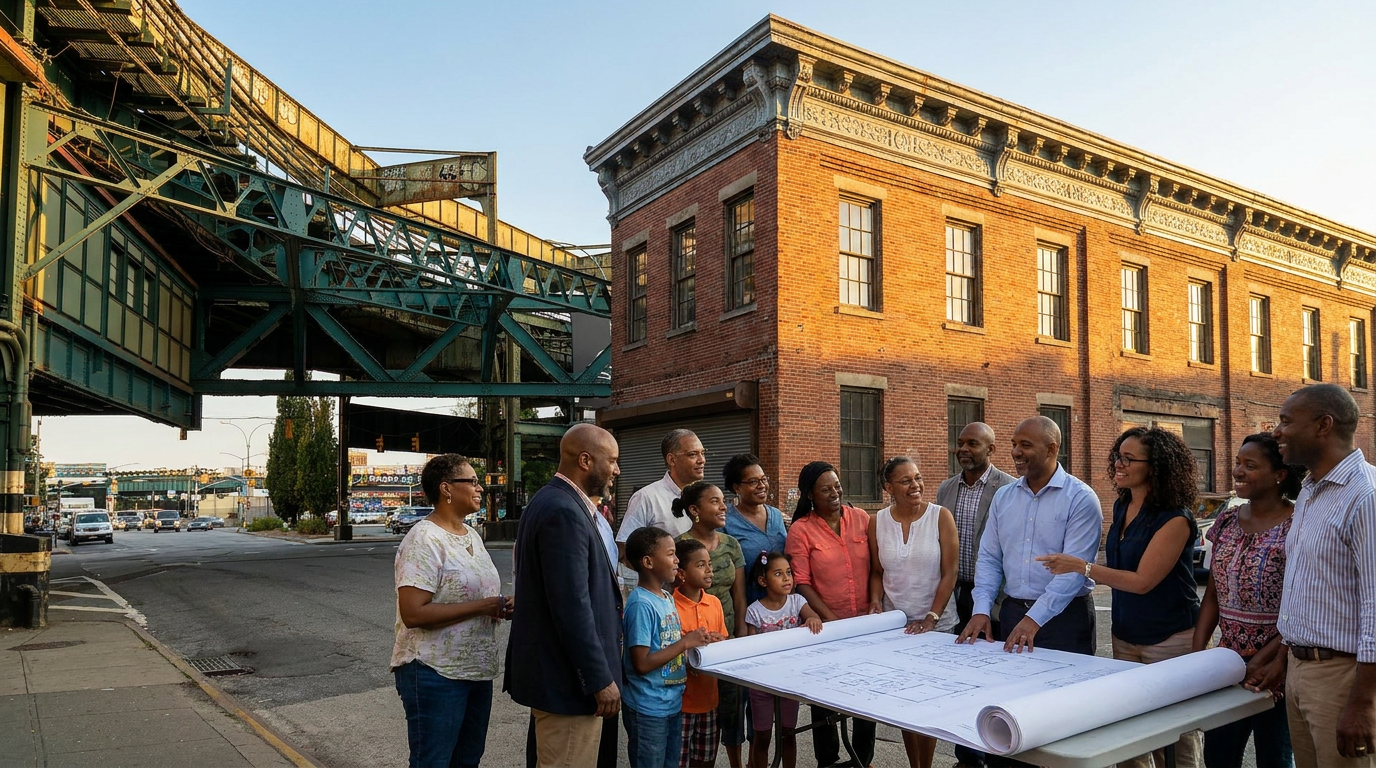
In a historic milestone for New York City's neighborhood preservation efforts, the East New York Community Land Trust (ENYCLT) is set to become the first organization of its kind in city history to purchase a commercial property directly off the private market. The grassroots group is finalizing the acquisition of a vacant, two-story brick warehouse at 161 Jamaica Avenue for $2.3 million. The 9,500-square-foot building will be transformed into the "East Brooklyn Liberation Center," a permanent headquarters for the nonprofit that will also provide deeply affordable office space for local businesses, worker cooperatives, and cultural organizations that might otherwise be priced out of the borough.[1][2][6]
The purchase represents a significant evolution for the community land trust (CLT) model in New York. Traditionally focused on residential housing, CLTs acquire land to remove it from the speculative real estate market, ensuring it remains affordable in perpetuity. By expanding into commercial real estate, ENYCLT aims to protect the economic engines of working-class neighborhoods from the same gentrification pressures that displace long-time residents. "Removing land from the speculative market is building power in the neighborhood," said Boris Santos, president of ENYCLT.[1][3]
East New York and the adjacent neighborhood of Brownsville have faced decades of underinvestment, followed by a recent wave of speculative development spilling over from nearby Bushwick and Bedford-Stuyvesant. A 2016 city rezoning created thousands of affordable housing units, but much of the recent construction has focused heavily on market-rate apartments. Community organizers argue that without protected commercial spaces, local entrepreneurs and essential services are inevitably priced out as neighborhood demographics shift. Securing a commercial foothold ensures that the economic benefits of neighborhood revitalization remain with the people who have lived there for generations.[1][6]

The historic warehouse itself reflects the industrial heritage of the area. Built around 1900, the building has previously housed a wagon painting business, a radio coil manufacturer, and a cabinet maker. Once renovated, the ground floor is expected to feature flexible industrial and office space, while the second floor will host community events, meetings, and homeowner support services. Organizations like Preserving East New York (PENY) and the East Brooklyn Archives have already signaled interest in taking up residence.[2][6]
The historic warehouse itself reflects the industrial heritage of the area.
Financing the $2.3 million acquisition required a coalition of grassroots support and solidarity economics. ENYCLT raised over $722,000 toward an initial $800,000 goal to cover the down payment, closing costs, and immediate repairs. The remainder of the funding comes via no- and low-interest loans from local nonprofit lenders, including the New Economy Loan Fund and Working World, alongside individual community investors. The center is projected to open its doors within the next two years.[2][4][6]
This commercial acquisition builds on ENYCLT's previous successes in the residential sector. In 2024, the nonprofit made headlines by purchasing a 20-unit multifamily apartment building off the private market, which it is currently converting into a shared-equity housing cooperative. Together, these acquisitions place New York City alongside municipalities like Oakland, Denver, and St. Paul, where established CLTs actively steward a diverse mix of residential and commercial properties to anchor community wealth and prevent wholesale displacement. The transition from residential to commercial stewardship marks a maturation of the city's land trust ecosystem, proving that community-led organizations can successfully compete for high-value real estate.[1][3]

The East Brooklyn project arrives as the broader CLT movement gains unprecedented political traction across New York. Citywide, land trusts now steward more than 1,200 units of permanently affordable housing, up from fewer than 400 a decade ago. At the legislative level, city council members are pushing bills that would prioritize nonprofit developers and CLTs for city-owned sites slated for affordable housing, replacing the common practice of awarding them to for-profit firms. This shift reflects a growing consensus among local policymakers that community ownership is a highly effective bulwark against the city's ongoing affordability crisis.[4][5]
Advocates are also fighting for the passage of the Community Opportunity to Purchase Act (COPA), which would give mission-driven nonprofits the right of first refusal when landlords decide to sell distressed multifamily buildings. As the East Brooklyn Liberation Center moves toward its opening, its organizers hope the space will not only serve its immediate neighbors but also act as a proof of concept, inspiring other land trusts to reclaim commercial spaces across the five boroughs.[1][4]
How we got here
2016
New York City rezones East New York, spurring new development but raising concerns about gentrification and displacement.
2020
The East New York Community Land Trust (ENYCLT) is formed by local residents during the COVID-19 pandemic.
Early 2024
ENYCLT becomes the first NYC land trust to buy a multifamily apartment building off the private market.
June 2026
ENYCLT finalizes the $2.3 million purchase of the 161 Jamaica Avenue warehouse to create a commercial community hub.
Viewpoints in depth
Community Organizers & Land Trusts
Advocates view the purchase as a crucial step in building neighborhood power and fighting displacement.
For community organizers, the private real estate market is fundamentally misaligned with the needs of working-class neighborhoods. They argue that speculative buying drives up rents, forcing out the small businesses and cultural institutions that give a neighborhood its identity. By placing commercial property into a land trust, advocates believe they are actively reclaiming their community's economic future. They point to the Liberation Center as a hub for "solidarity economics," where cooperative businesses can thrive without the constant threat of eviction or exorbitant rent hikes.
City Policymakers
Local officials see land trusts as a vital partner in achieving long-term affordable housing and economic goals.
City officials and progressive lawmakers increasingly view CLTs not as radical experiments, but as necessary infrastructure for urban stability. Facing a severe housing crisis and the rapid gentrification of outer-borough neighborhoods, policymakers are advancing legislation to give nonprofits the right of first refusal on property sales and priority access to city-owned land. They argue that supporting CLTs corrects decades of underinvestment and ensures that public subsidies for affordable housing result in permanent, rather than temporary, community benefits.
Traditional Real Estate Sector
Private developers are navigating a shifting landscape as nonprofits gain new legislative advantages.
While traditional real estate developers acknowledge the need for affordable community spaces, some express concern over proposed legislation like the Community Opportunity to Purchase Act (COPA). Industry groups caution that giving nonprofits the right of first refusal could slow down property transactions, complicate private sales, and introduce new bureaucratic hurdles. However, in the case of the East Brooklyn warehouse, the transaction was a willing sale on the private market, demonstrating that CLTs can successfully compete and negotiate within the existing real estate framework when backed by sufficient capital.
What we don't know
- Whether the New York City Council will pass the Community Opportunity to Purchase Act (COPA) to give nonprofits first dibs on future sales.
- Exactly which small businesses and cooperatives will secure the first leases inside the newly renovated Liberation Center.
Key terms
- Community Land Trust (CLT)
- A nonprofit organization that acquires and holds land to ensure it is used for long-term community benefit, typically providing permanently affordable housing or commercial space.
- Speculative Market
- The buying and selling of real estate primarily for future financial gain rather than immediate use, which often drives up property values and rents.
- Shared-Equity Housing
- A model where residents own a share of their housing cooperative, allowing them to build some wealth while keeping the property affordable for future buyers.
- Right of First Refusal
- A legal or legislative right giving a specific party (like a nonprofit or tenant group) the opportunity to match an offer and buy a property before it is sold to an outside buyer.
Frequently asked
What is the East Brooklyn Liberation Center?
It is a planned community hub inside a historic warehouse that will provide deeply affordable office and event space for local nonprofits, worker cooperatives, and small businesses.
How was the $2.3 million building funded?
The purchase was financed through a combination of grassroots fundraising and low-interest loans from nonprofit lenders like the New Economy Loan Fund.
Why is this purchase historic for New York City?
While community land trusts in NYC have previously acquired residential buildings, this marks the first time a CLT has purchased a commercial property directly off the private market.
Sources
Source coverage
6 outlets
3 viewpoints surfaced





[1]Next CityCommunity Organizers & Land Trusts
A Community Land Trust Is Purchasing Commercial Property in NYC for the First Time
Read on Next City →[2]BrownstonerCity Policymakers
Community Land Trust Plans 'Liberation Center' in East New York Warehouse
Read on Brownstoner →[3]Giving CompassCommunity Organizers & Land Trusts
Community Land Trust Purchases First Piece of Property in New York City
Read on Giving Compass →[4]The Real DealTraditional Real Estate Sector
State bill would crack down on private listing
Read on The Real Deal →[5]New Economy ProjectCommunity Organizers & Land Trusts
NYC Community Land Initiative
Read on New Economy Project →[6]East New York Community Land TrustCommunity Organizers & Land Trusts
East Brooklyn Liberation Center
Read on East New York Community Land Trust →
Every angle. Every day.
Get community stories with full source coverage and perspective breakdowns delivered to your inbox.