
How Agrivoltaics is Solving the Bitter War Between Solar Farms and Agriculture
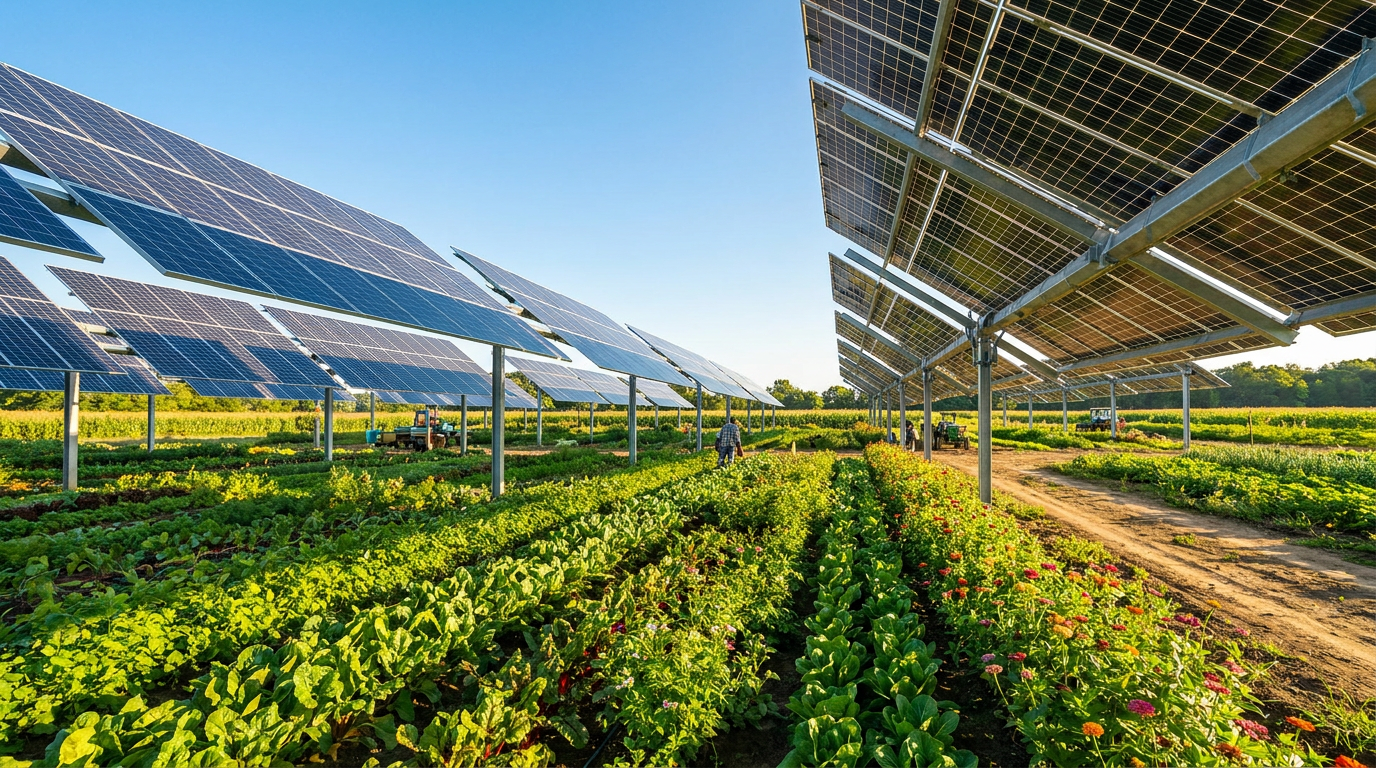
By elevating solar panels above active farmland, agrivoltaics creates a mutually beneficial microclimate that boosts crop yields, saves water, and increases solar efficiency.
By Factlen Editorial Team
- Agricultural Producers
- Farmers view agrivoltaics as a vital tool for climate resilience and financial stability.
- Solar Developers
- Energy companies see dual-use systems as a way to bypass land-use conflicts and accelerate deployment.
- Agronomy Researchers
- Scientists emphasize that agrivoltaics requires precise crop matching and is not a universal solution.
- Rural Communities
- Locals support the technology as a compromise that preserves agricultural heritage while generating tax revenue.
What's not represented
- · Traditional single-use solar operators concerned about the added complexity and CAPEX of elevated racking.
- · Large-scale commodity farmers who cannot utilize the technology due to the high sunlight requirements of corn and wheat.
Why this matters
As the world races to build renewable energy, land-use conflicts threaten to stall progress. Agrivoltaics proves we don't have to choose between clean power and food security, offering a highly profitable blueprint that makes both industries more resilient to climate change.
Key points
- Agrivoltaics combines solar panels and agriculture on the same land, solving the conflict between energy development and food security.
- The shade from solar panels reduces soil evaporation, cutting irrigation water needs by up to 35% in arid regions.
- Plants cool the solar panels through evapotranspiration, actively boosting the electrical efficiency of the arrays.
- Shade-tolerant crops like tomatoes and lettuce see yield increases, while sun-intensive crops like corn suffer yield drops.
- The physical shade provides life-saving heat protection for agricultural workers during summer harvests.
- Elevated solar racking requires a 10% to 20% higher initial capital expenditure than standard ground-mounted systems.
The global transition to renewable energy faces a quiet but escalating real estate crisis that threatens both climate goals and food security. Utility-scale solar farms require vast expanses of flat, sun-drenched land to operate at peak efficiency. Unfortunately, those exact topographical traits perfectly describe the world's most productive agricultural regions. For years, rural communities and energy developers have been locked in a tense, zero-sum battle over land use, forcing municipalities to make a stark choice between harvesting food to feed populations or harvesting electricity to power the grid.[3][5]
A rapidly maturing field known as agrivoltaics is proving that this bitter trade-off is a false dichotomy. Agrivoltaics—the simultaneous co-location of solar photovoltaic panels and active agricultural production on the exact same parcel of land—has evolved from a niche academic concept into a multi-billion-dollar commercial industry. By elevating solar arrays high above the soil or spacing them strategically between crop rows, farmers are now cultivating vegetables, raising livestock, and generating utility-scale clean energy simultaneously without sacrificing the viability of either operation.[4][8]
The United States market alone has seen explosive, unprecedented growth in this sector, expanding from 4.5 gigawatts of dual-use capacity in 2020 to more than 10 gigawatts by the end of 2024. Globally, the agrivoltaics sector was valued at over $5.1 billion in 2025 and is projected by industry analysts to surpass $13.3 billion over the next decade. This immense commercial momentum is driven by a surprising, highly beneficial scientific discovery: solar panels and biological plants actively help each other perform better when paired together.[5][6]
The core mechanism driving the success of agrivoltaics is the creation of a highly regulated, mutually beneficial microclimate. Traditional farming in arid or semi-arid regions exposes vulnerable crops to punishing midday heat and rapid, uncontrolled water evaporation. When elevated solar panels are introduced to the environment, they cast a protective layer of partial shade over the vegetation growing below. This physical shielding drastically reduces the rate of soil evaporation and protects delicate plants from extreme heat stress during the harshest hours of the day.[1][4]

The resulting water savings for agricultural operations are substantial and increasingly vital. Research indicates that the shaded microclimate beneath solar arrays can reduce irrigation requirements by 20% to 35% in dry regions, depending heavily on the specific crop variety and the local climate conditions. In an era defined by worsening seasonal droughts, erratic rainfall, and rapidly depleted underground aquifers, this enhanced moisture retention offers a critical, long-term lifeline for dryland farming operations struggling to survive.[1][5]
Crucially, the environmental benefits of this system flow in both directions, aiding the technology just as much as the biology. Solar panels are notoriously sensitive to extreme heat; as their surface temperatures rise, their photovoltaic efficiency noticeably drops. However, the crops growing beneath the arrays continuously release moisture into the surrounding air through a biological process called evapotranspiration. This steady upward release of water vapor acts as a natural, localized air conditioning system, cooling the underside of the solar panels and actively boosting their electrical output.[4]
As global ambient temperatures continue to rise—a troubling trend that climate models predict could reduce conventional solar panel efficiency by up to 12% by the year 2050—this biological cooling effect becomes incredibly valuable. By harnessing the natural transpiration of plants to regulate hardware temperatures, dual-use agrivoltaic systems prove to be significantly more resilient and efficient over the long term than traditional, single-use solar farms built on barren dirt. This symbiosis ensures that energy grids remain stable even during severe summer heatwaves when electricity demand peaks.[7]
This symbiosis ensures that energy grids remain stable even during severe summer heatwaves when electricity demand peaks.
Despite these remarkable synergies, agronomy experts caution that agrivoltaics is not a universal silver bullet for all types of agriculture. The dual-use system involves inherent, unavoidable trade-offs regarding sunlight distribution, meaning that meticulous crop selection is the single most important variable for a successful installation. Agronomy researchers at institutions across the globe have spent the last five years carefully mapping which specific plants thrive in partial shade environments and which ones ultimately fail when deprived of direct, unfiltered solar radiation.[3][8]

Shade-tolerant crops are the undisputed winners of the agrivoltaic farming model. Leafy greens, tomatoes, broccoli, and various delicate berries often see remarkable yield increases ranging from 8% to 18% when grown under panels, as they are entirely spared the stunting effects of midday heat exhaustion. Conversely, sun-intensive staple crops like corn, wheat, and soybeans require maximum solar radiation to grow properly; planting these essential commodities under solar arrays can result in devastating yield reductions of 25% to 40%, making them entirely unsuitable for the practice.[1]
Beyond raw crop yields and energy metrics, dual-use solar infrastructure is delivering unexpected, life-saving dividends for human health. In states like Arizona, where brutal summer temperatures regularly threaten the lives of agricultural workers, the physical shade provided by agrivoltaic installations is radically transforming daily labor conditions. The U.S. Centers for Disease Control and Prevention notes that crop workers face a drastically higher risk of heat stroke than the general public; working beneath elevated panels directly mitigates this severe danger while keeping drinking water and harvesting equipment cool throughout the day.[2]
The underlying financial architecture of agrivoltaics is equally compelling for rural economies. For agricultural producers, integrating solar energy into their fields provides a lucrative dual-income stream that acts as a powerful financial hedge against volatile commodity markets and climate-related crop failures. Farmers have the flexibility to either lease their vertical airspace to commercial solar developers for steady, guaranteed royalty payments, or they can choose to own the panels outright to completely eliminate their own operational energy costs.[4][6]

For utility-scale solar developers, the primary advantage of agrivoltaics is the acquisition of social license. Large-scale renewable energy projects frequently face fierce, organized local opposition—often termed NIMBYism (Not In My Back Yard)—from rural residents who deeply fear the industrialization of their landscapes and the permanent loss of their agricultural heritage. By keeping the land in active, visible food production, agrivoltaics perfectly aligns developer interests with community priorities, dramatically smoothing the zoning and permitting process.[5][8]
Widespread, ubiquitous adoption of the technology still faces several notable structural and financial hurdles. Designing a solar array that allows heavy agricultural machinery, such as massive tractors and combine harvesters, to operate freely requires elevating the heavy steel racking systems to heights of six to ten feet. This specialized, heavy-duty engineering increases the initial capital expenditure (CAPEX) of the solar installation by 10% to 20% when compared to standard, low-to-the-ground mounted systems used in traditional solar farms.[1][4]

Nevertheless, as specialized engineering costs gradually fall and extreme weather events make traditional, unprotected farming increasingly precarious, the economic calculus is rapidly shifting in favor of dual-use systems. Federal research initiatives, such as the U.S. Department of Energy's InSPIRE project, are actively refining system designs, publishing open-source data, and working directly with farmers to lower these financial barriers to entry. This ongoing public-private collaboration is essential for scaling the technology beyond pilot programs and into mainstream agricultural practice.[3]
Ultimately, agrivoltaics represents a rare, genuinely uplifting paradigm shift in modern climate technology. Rather than forcing rural communities into a bitter compromise between decarbonizing the electrical grid and feeding a growing global population, dual-use solar proves that energy and agriculture can successfully share the exact same soil. By turning a fierce competition for land into a symbiotic, mutually beneficial relationship, agrivoltaics offers a sustainable blueprint for the future of both industries. It stands as a testament to how innovative engineering can solve multiple systemic crises simultaneously, leaving both the land and the people who work it better off.[5][8]
How we got here
2020
U.S. agrivoltaics capacity sits at 4.5 gigawatts across roughly 27,000 acres of farmland.
2024
U.S. capacity more than doubles to 10 gigawatts, covering 62,000 acres as the technology matures.
2025
The global agrivoltaics market valuation surpasses $5.1 billion amid surging adoption in North America and Europe.
2035
Industry projections estimate the global market will reach $13.3 billion as climate pressures accelerate dual-use farming.
Viewpoints in depth
Agricultural Producers
Farmers view agrivoltaics as a vital tool for climate resilience and financial stability.
For the agricultural sector, dual-use solar is primarily a risk-mitigation strategy. By generating a guaranteed secondary income stream from energy production or land leases, farms can insulate themselves against volatile commodity prices and crop failures caused by extreme weather. Furthermore, the water-saving benefits allow dryland farmers to maintain operations in regions facing severe aquifer depletion, ensuring that multi-generational family farms can survive in a warming climate.
Solar Developers
Energy companies see dual-use systems as a way to bypass land-use conflicts and accelerate deployment.
Utility-scale solar requires massive tracts of land, which frequently puts developers at odds with rural communities protective of their agricultural heritage. Developers view agrivoltaics as the ultimate compromise. By keeping the land agriculturally active, they can secure social license, ease local zoning approvals, and reduce NIMBY (Not In My Back Yard) opposition. For these companies, the slightly higher upfront structural costs are a worthwhile trade-off for faster permitting and community goodwill.
Agronomy Researchers
Scientists emphasize that agrivoltaics requires precise crop matching and is not a universal solution.
While the overarching narrative is highly positive, agricultural scientists caution against treating agrivoltaics as a blanket solution for all farming. Researchers stress that the microclimate created by solar panels fundamentally alters photosynthesis dynamics. Their focus is on mapping exactly which shade-tolerant crops benefit from the reduced heat stress, and warning policymakers that sun-intensive staple crops like corn, wheat, and soybeans will suffer significant yield penalties if deployed under standard panel configurations.
What we don't know
- How the long-term degradation of elevated steel racking systems will compare to standard ground-mounted systems over a 25-year lifespan.
- Whether the premium costs of elevated agrivoltaic systems will fall fast enough to be adopted by small-scale farmers without heavy government subsidies.
Key terms
- Agrivoltaics
- The simultaneous use of land for both solar energy generation and agricultural production.
- Evapotranspiration
- The process by which water is transferred from the land to the atmosphere by evaporation from the soil and transpiration from plants.
- Microclimate
- The distinct, localized climate of a small area, such as the shaded, cooler, and more humid environment directly beneath a solar panel.
- CAPEX
- Capital expenditure; the initial upfront cost required to build a physical asset, such as the elevated steel racking needed for dual-use solar.
- Social License
- The ongoing acceptance and approval of an industrial or infrastructure project by the local community and stakeholders.
Frequently asked
Can you grow any type of crop under solar panels?
No. Shade-tolerant crops like lettuce, tomatoes, and berries thrive and can see yield increases. Sun-intensive staple crops like corn and wheat experience significant yield reductions.
How do tractors navigate around the solar panels?
Agrivoltaic systems are specifically designed with elevated racking (often 6 to 10 feet high) or wide inter-row spacing to allow standard agricultural machinery to operate freely beneath them.
Does the farmer own the solar panels or lease the land?
Both business models exist. Some farmers purchase the panels to eliminate their own energy costs, while others lease their airspace to solar developers for a steady royalty income.
Do the plants help the solar panels in any way?
Yes. Plants release moisture into the air through evapotranspiration, which cools the underside of the solar panels and helps them generate electricity more efficiently.
Sources
Source coverage
8 outlets
4 viewpoints surfaced








[1]PV MagazineAgricultural Producers
Agrivoltaics trials show early crop and livestock gains
Read on PV Magazine →[2]BGRAgronomy Researchers
Arizona farmworkers secure funding for agrivoltaics research
Read on BGR →[3]U.S. Department of EnergyAgronomy Researchers
SETO Research in Solar and Agriculture Co-Location
Read on U.S. Department of Energy →[4]USDAAgricultural Producers
Agrivoltaics: Balancing Agriculture and Solar Energy
Read on USDA →[5]IEEFARural Communities
Agrivoltaics increases yields, reduces water usage, and boosts rural participation in the renewable energy transition
Read on IEEFA →[6]Cervicorn ConsultingSolar Developers
Global Agrivoltaics Market Size and Growth 2026 to 2035
Read on Cervicorn Consulting →[7]Seneca Impact EarthSolar Developers
The Environmental and Economic Benefits of Agrivoltaics
Read on Seneca Impact Earth →[8]Factlen Editorial TeamRural Communities
Synthesis by Factlen editorial team
Read on Factlen Editorial Team →
Every angle. Every day.
Get environment stories with full source coverage and perspective breakdowns delivered to your inbox.