
Fact-Checking Ranked-Choice Voting: What the Evidence Actually Shows
As ranked-choice voting spreads across U.S. municipalities and states, advocates promise reduced polarization and higher turnout. A review of recent electoral data and academic models reveals a more complicated reality.
By Factlen Editorial Team
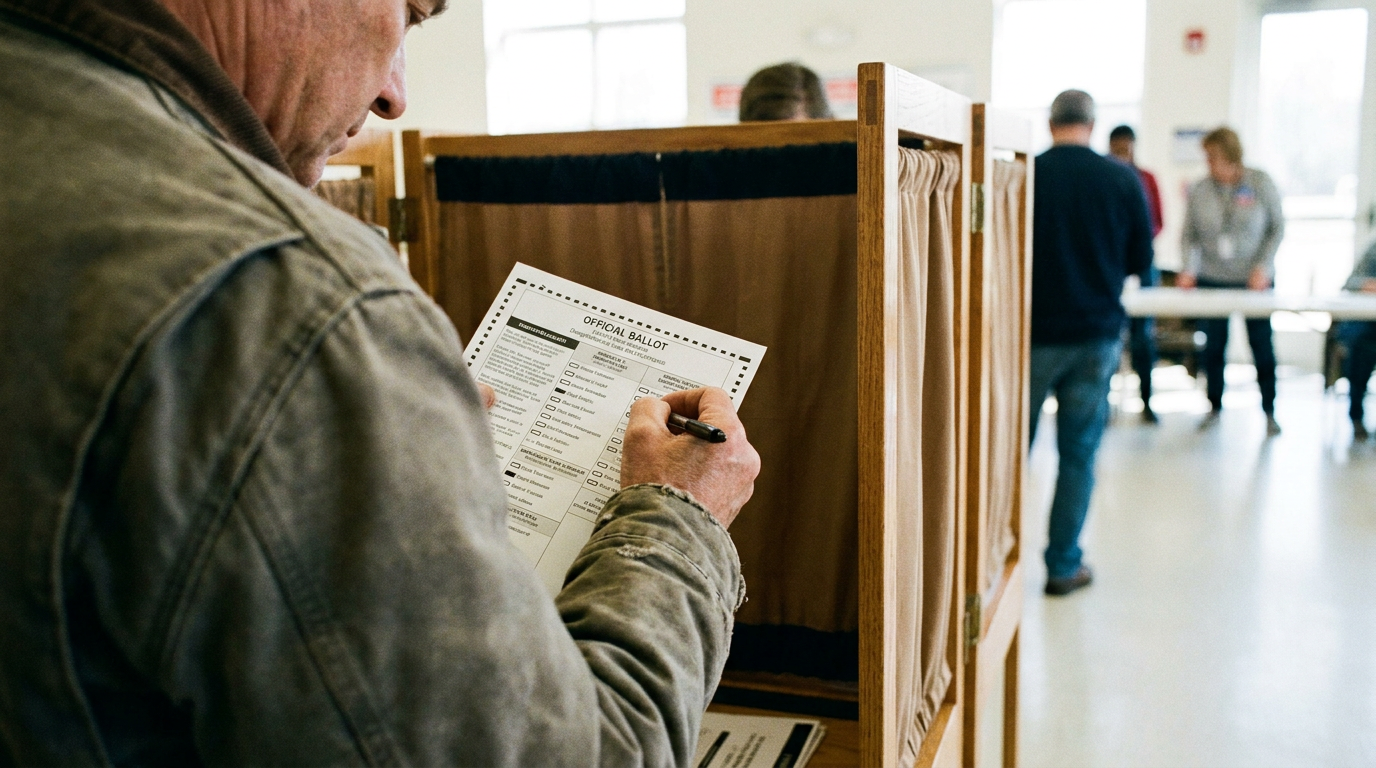
- Reform Advocates
- Argue that RCV eliminates the spoiler effect, encourages civility, and ensures majority support.
- Academic Researchers
- Analyze the data to show that RCV's effects on polarization and turnout are highly dependent on voter distribution and election timing.
- Electoral Administrators
- Focus on the logistical benefits, such as eliminating the cost and administrative burden of secondary runoff elections.
- Independent Fact-Checkers
- Clarify misconceptions about the system, noting that while ballot exhaustion occurs, it represents voter choice rather than disenfranchisement.
What's not represented
- · Voters whose ballots were exhausted in recent elections
- · Third-party candidates who ran under RCV systems
Why this matters
As more cities and states abandon traditional winner-take-all elections, understanding the actual data behind ranked-choice voting helps voters separate political rhetoric from reality and prepare for how their own local ballots might soon change.
Key points
- Ranked-choice voting is now used by nearly 14 million voters across 49 U.S. jurisdictions.
- Evidence shows RCV can encourage civil campaigning, though mathematical models warn of a 'center squeeze' in highly polarized electorates.
- While RCV eliminates the massive voter drop-off seen in delayed runoffs, it may slightly depress initial general election turnout.
- Exit polls consistently show that the vast majority of voters find the ranking process simple to understand.
- Ballots can become 'exhausted' if a voter's choices are eliminated, but fact-checkers note this is a voluntary abstention, not disenfranchisement.
Ranked-choice voting (RCV) is rapidly moving from a niche political science concept to a mainstream American reality. Currently reaching nearly 14 million voters across 49 cities, counties, and states, the system represents one of the most significant shifts in how Americans vote in a century.[1]
The mechanics are straightforward: instead of selecting a single candidate, voters rank their preferences—first, second, third, and so on. If a candidate secures more than 50 percent of the first-choice votes, they win immediately, just as they would in a traditional election.[2][7]
If no candidate reaches that majority threshold, an "instant runoff" is triggered. The candidate with the fewest first-choice votes is eliminated, and their supporters' votes are automatically transferred to their second choices. This process repeats until one candidate crosses the 50 percent mark.[2][7]

As the system spreads, advocates have made bold promises: RCV will reduce toxic polarization, increase voter turnout, and eliminate the "spoiler effect" of third-party candidates. Critics, meanwhile, warn of voter confusion and depressed participation.[7]
To separate political rhetoric from reality, researchers have begun analyzing decades of electoral data. The emerging evidence paints a nuanced picture of a system that delivers on several key promises, but is not a magical cure for all democratic ailments.[2][7]
The most prominent claim surrounding RCV is that it reduces political polarization and encourages civil campaigning. Because candidates often need second- and third-choice votes to win a tight race, the theory suggests they are disincentivized from viciously attacking their opponents.[1][2]
Real-world data provides some support for this theory. A review by the American Bar Association noted that voters in RCV jurisdictions frequently report perceiving a more positive campaign environment and greater civility among candidates.[2]
The 2022 congressional races in Alaska—a state that recently adopted RCV—offered a high-profile example. Republican Senator Lisa Murkowski and Democratic Representative Mary Peltola actively cross-endorsed each other, building broad bipartisan coalitions that ultimately secured both of their victories.[1]
The 2022 congressional races in Alaska—a state that recently adopted RCV—offered a high-profile example.
However, formal mathematical models suggest the polarization benefits have limits. A 2023 study by researchers at New York University found that RCV's ability to elect moderates depends heavily on the specific distribution of voters.[4]
The NYU researchers identified a phenomenon known as the "center squeeze." In a highly polarized electorate, a broadly acceptable moderate candidate might actually be eliminated in the first round because they lack a passionate, extreme base of first-choice voters, leaving only the polarized extremes in the final rounds.[4]
The second major debate centers on voter turnout. Does giving voters more choices bring more people to the ballot box? The data here is decidedly mixed, depending on which elections are being compared.[3][7]
In New York City's 2021 mayoral primary—the largest deployment of RCV in U.S. history—turnout surged. Nearly one million voters participated, representing a 22.6 percent increase compared to the city's previous open primary in 2013.[5]

Yet, a comprehensive difference-in-differences study presented at the Election Science, Reform, and Administration Conference analyzed over 200 cities and found that RCV actually decreased general election turnout by roughly 3 to 5 percentage points.[3]
The vital caveat to that finding is how RCV handles runoffs. Traditional delayed runoff elections notoriously suffer from massive voter drop-off, often seeing participation plummet by 30 percent or more. By consolidating the process into a single day, RCV ensures the final, decisive round of counting is conducted with a vastly larger electorate.[3][7]
Finally, skeptics frequently argue that RCV is simply too confusing for the average voter, leading to errors and "exhausted" ballots that don't count in the final tally.[6]
Exit polling consistently refutes the confusion narrative. In Alaska's 2022 elections, 85 percent of voters reported that the RCV system was "simple," and 73 percent successfully ranked multiple candidates on their ballots.[1]

Ballot exhaustion, however, is a real mathematical feature of the system. In the 2022 Alaska special election, approximately 11,000 ballots were exhausted because those voters chose not to rank a second candidate after their first choice was eliminated.[6]
As independent fact-checkers have noted, ballot exhaustion is not the same as disenfranchisement. Voters have the absolute right to abstain from ranking candidates they do not support. Ultimately, RCV is a structural trade-off: it eliminates costly secondary elections and the fear of "wasted" votes, but requires both voters and candidates to adapt their strategies to a new democratic reality.[6][7]
How we got here
1918
Australia adopts preferential voting (RCV) for federal elections.
2004
San Francisco becomes the first major US city to implement modern RCV.
2018
Maine becomes the first US state to use RCV for federal elections.
2021
New York City uses RCV for its mayoral primary, marking the largest deployment in US history.
2022
Alaska holds its first general elections using a top-four open primary and RCV system.
Viewpoints in depth
Electoral Reform Advocates
Proponents argue that RCV fundamentally improves the democratic process by eliminating the spoiler effect.
Advocacy groups like FairVote emphasize that RCV ensures winning candidates have majority support, rather than just a plurality. They point to data showing that candidates are forced to campaign more positively to secure second-choice votes, which theoretically lowers the temperature of hyper-partisan politics. Furthermore, they argue that allowing voters to rank their true preferences without fear of "wasting" their vote encourages a more diverse field of candidates to run for office.
Political Scientists & Modelers
Researchers caution that RCV's benefits are highly dependent on the specific mathematical distribution of the electorate.
Academic models, such as those developed at New York University, reveal that RCV is not immune to the effects of extreme polarization. In a phenomenon known as the "center squeeze," a moderate candidate who is acceptable to a broad swath of the electorate might be eliminated in the first round simply because they lack a passionate base of first-choice voters. Additionally, researchers studying voter turnout have found that while RCV solves the drop-off problem of delayed runoffs, the added complexity of the ballot may slightly depress overall turnout in the initial general election.
System Skeptics
Critics argue that the system is overly complex and leads to discarded votes.
Skeptics frequently point to the phenomenon of "ballot exhaustion," where a voter's ballot is no longer counted in the final rounds because all of their ranked choices have been eliminated. They argue this effectively silences a portion of the electorate in the deciding round of the election. While fact-checkers note that voters have the right to abstain from ranking candidates they dislike, critics maintain that the traditional "one person, one vote" plurality system is more transparent and easier for the general public to trust.
What we don't know
- Whether the 'center squeeze' effect observed in mathematical models will frequently occur in real-world, high-stakes national elections.
- How long-term voter turnout trends will stabilize once electorates become fully accustomed to ranking candidates over multiple election cycles.
- Whether the adoption of RCV will significantly alter two-party dominance in the United States, or simply change how the two parties campaign.
Key terms
- Ranked-Choice Voting (RCV)
- An electoral system where voters rank candidates by preference rather than choosing just one.
- Instant Runoff
- The process in RCV where the lowest-polling candidate is eliminated and their votes are transferred to those voters' next choices, repeating until someone hits 50 percent.
- Ballot Exhaustion
- When a voter's ballot can no longer be counted in subsequent rounds because all their ranked choices have been eliminated.
- Center Squeeze
- A scenario in RCV where a broadly acceptable moderate candidate is eliminated early because they lack a strong base of first-choice votes.
- Difference-in-Differences
- A statistical technique that compares the changes in outcomes over time between a group that adopted a policy (like RCV) and a similar group that did not.
Frequently asked
Does ranked-choice voting favor Democrats or Republicans?
Evidence suggests RCV does not inherently favor either major party. Instead, it tends to favor candidates who can build broad coalitions and appeal to the center of their specific electorate.
What happens if I only vote for one person on an RCV ballot?
Your vote will count for that person in the first round. If they are eliminated, your ballot becomes "exhausted" and will not factor into subsequent rounds.
Does RCV violate the principle of 'one person, one vote'?
No. Courts have consistently ruled that RCV complies with "one person, one vote" because every voter gets exactly one active vote in each round of counting.
Sources
Source coverage
7 outlets
4 viewpoints surfaced






[1]FairVoteReform Advocates
Ranked choice voting lowers polarization in politics
Read on FairVote →[2]American Bar AssociationAcademic Researchers
Can Ranked Choice Voting Enhance American Democracy?
Read on American Bar Association →[3]Election Science, Reform, and Administration ConferenceAcademic Researchers
Electoral Rules and Voter Turnout in Mayoral Elections: An Analysis of Ranked-Choice Voting
Read on Election Science, Reform, and Administration Conference →[4]New York UniversityAcademic Researchers
Ranked Choice Voting and Political Polarization
Read on New York University →[5]National Conference of State LegislaturesElectoral Administrators
Ranked Choice Voting Overview
Read on National Conference of State Legislatures →[6]PolitiFactIndependent Fact-Checkers
Tom Cotton misinterprets how ranked choice voting works in Alaska
Read on PolitiFact →[7]Factlen Editorial TeamIndependent Fact-Checkers
Synthesis by Factlen editorial team
Read on Factlen Editorial Team →

More in news politics
See all 7 stories →US-Iran Deal
Vance Delays Switzerland Trip for Iran Nuclear Talks Amid Shaky Lebanon Ceasefire
8 sources

Labour Leadership
Andy Burnham Wins Makerfield By-Election, Clearing Path to Challenge UK Prime Minister Keir Starmer
8 sources
U.S.-Iran Deal
U.S. and Iran Sign Preliminary Ceasefire Deal as Rift Widens Between Washington and Israel
8 sources

US-Iran Deal
U.S. and Iran Sign Interim Peace Deal, Lifting Blockade as 60-Day Negotiation Window Opens
12 sources

Every angle. Every day.
Get news politics stories with full source coverage and perspective breakdowns delivered to your inbox.