
Passivhaus Principles: The Science of Ultra-Efficient Homes
Originating in Germany, the Passivhaus standard uses five core building physics principles to reduce home heating and cooling energy by up to 90 percent while radically improving indoor air quality.
By Factlen Editorial Team
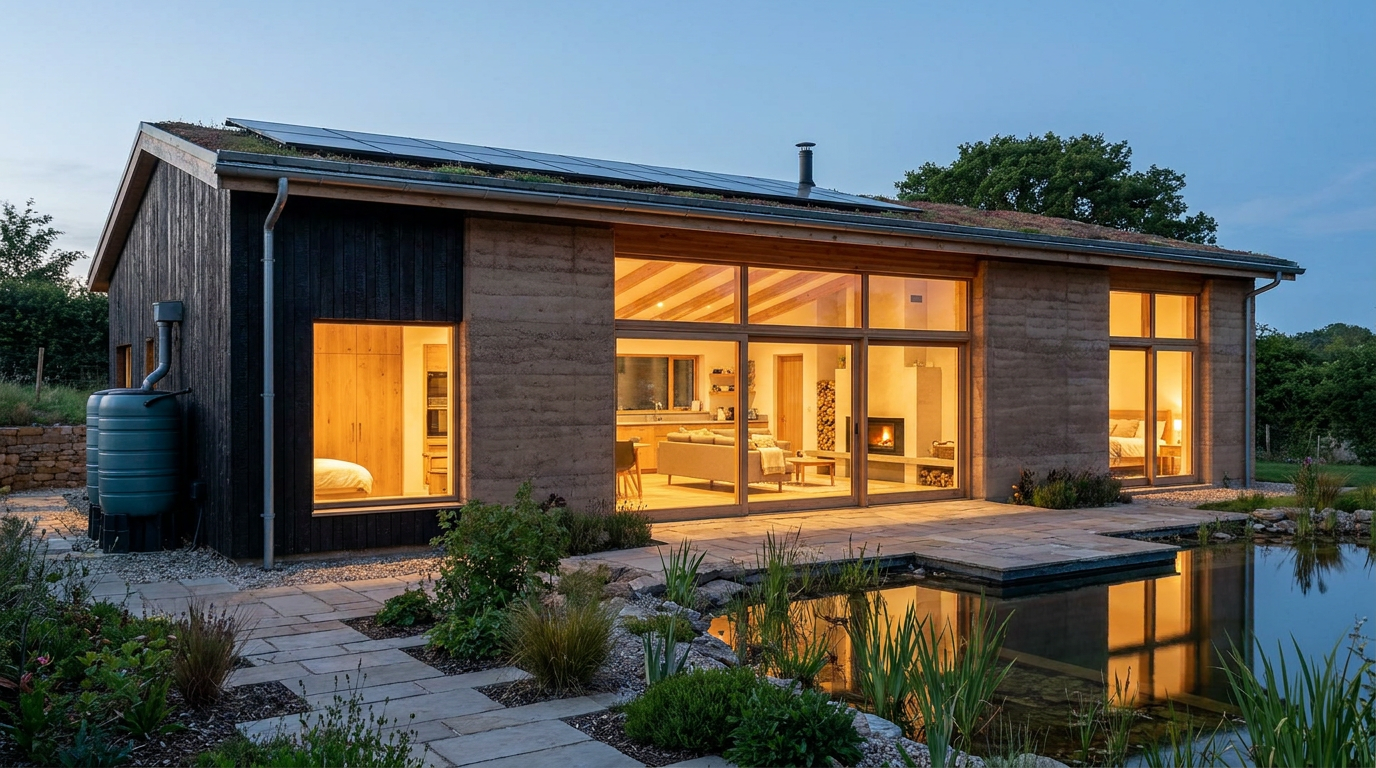
- Sustainable Architects
- View Passivhaus as the necessary baseline for future construction to meet global climate goals.
- Pragmatic Builders
- Highlight the upfront costs, architectural constraints, and embodied carbon of thick insulation.
- Energy-Conscious Homeowners
- Focus on the tangible lifestyle benefits of lower utility bills, superior comfort, and improved indoor air quality.
What's not represented
- · Traditional HVAC Manufacturers
- · Renters in Multi-Family Units
Why this matters
As extreme weather and volatile energy prices become the norm, understanding how homes can naturally regulate their own temperatures offers a blueprint for drastically lowering utility bills and carbon footprints.
Key points
- The Passivhaus standard reduces a building's heating and cooling energy demand by up to 90 percent.
- The system relies on five core principles: super-insulation, airtightness, high-performance windows, thermal-bridge-free design, and mechanical ventilation.
- Mechanical Ventilation with Heat Recovery (MVHR) provides constant filtered fresh air without losing interior heat.
- While upfront construction costs are 3 to 10 percent higher, the investment is typically recouped through drastically lower utility bills.
- Retrofitting older homes to the standard is possible but often prohibitively expensive due to existing structural limitations.
Imagine waking up on a freezing winter morning, looking out at a polar vortex, and realizing you forgot to turn on the heat—yet your home is a comfortable 77 degrees. For residents of a "Passivhaus," or Passive House, this is not a hypothetical scenario but a daily reality. By relying on the physics of the building itself rather than energy-intensive furnaces or air conditioners, these structures maintain a near-constant internal climate regardless of the weather outside.[4]
The concept was born in Germany in the late 1980s, spearheaded by physicist Dr. Wolfgang Feist in response to the energy crises of the preceding decade. The first official Passivhaus was completed in Darmstadt in 1991. Since then, it has evolved from a niche European experiment into the world's most rigorous voluntary energy-based standard for building design.[1][6]
At its core, the Passivhaus standard makes a staggering claim: it can reduce a building's heating and cooling energy consumption by up to 90 percent compared to conventional construction. It achieves this not by adding complex smart-home technology or massive solar arrays, but by stripping away the need for active climate control entirely. The home essentially heats and cools itself using the ambient energy of its occupants, appliances, and the sun.[1][3]

This extreme efficiency is anchored by five interlocking design principles. The first is super-insulation. A Passive House is wrapped in a continuous, thick layer of high-quality insulation, acting like a heavy winter coat. This prevents heat from escaping during the winter and blocks it from entering during the summer.[2]
The second principle is airtight construction. In a traditional home, unintended gaps around doors, windows, and foundations allow massive amounts of conditioned air to leak out. A Passivhaus is meticulously sealed, eliminating drafts and uncontrolled air movement. This not only preserves the internal temperature but also prevents moisture from infiltrating the building envelope, which can cause mold and structural decay.[2][5]
High-performance glazing forms the third pillar. Windows are typically a building's weakest thermal link. Passive homes utilize triple-paned, gas-filled windows with insulated frames. These windows are strategically oriented to capture solar heat gain during the winter months, while architectural shading—like deep eaves or exterior blinds—prevents overheating during the summer.[2][4]
The fourth principle requires a thermal-bridge-free design. Thermal bridges are "heat highways"—points in a building's structure where conductive materials, like steel or concrete, create a direct path for heat to bypass the insulation. By carefully detailing junctions where walls meet roofs or floors, architects eliminate these weak spots, ensuring the thermal envelope remains unbroken.[2][4]

By carefully detailing junctions where walls meet roofs or floors, architects eliminate these weak spots, ensuring the thermal envelope remains unbroken.
Because a Passivhaus is so airtight, it requires a specialized set of "lungs" to keep the interior fresh. This brings us to the fifth and arguably most critical principle: Mechanical Ventilation with Heat Recovery (MVHR). An MVHR system continuously extracts stale, moist air from kitchens and bathrooms and replaces it with fresh, filtered air from outside.[2][4]
The genius of the MVHR lies in the heat exchanger. As the warm indoor air is pushed out, it passes the cold incoming air within the unit, transferring up to 90 percent of its heat without the two air streams ever physically mixing. The result is a constant supply of fresh air that is already pre-heated to room temperature, completely eliminating the cold drafts associated with traditional ventilation.[4][5]
Beyond energy savings, this continuous filtration provides profound health benefits. The MVHR system actively scrubs the incoming air of pollen, dust mites, pollutants, and even wildfire smoke. For individuals with asthma or severe allergies, the indoor air quality of a Passivhaus can be life-changing, offering a pristine microclimate insulated from external environmental hazards.[3][5]
Despite these advantages, the Passivhaus standard faces persistent myths and genuine structural challenges. The most common misconception is that residents are trapped in a hermetically sealed box and cannot open their windows. In reality, occupants are free to open windows whenever the weather is pleasant; the mechanical systems simply ensure that they do not have to rely on open windows for fresh air when conditions outside are extreme.[1][5]

The primary barrier to widespread adoption is financial. Building to Passivhaus standards typically incurs an upfront construction cost premium of 3 to 10 percent due to the specialized materials, thicker insulation, and rigorous energy modeling required. While this premium is often recouped over time through drastically lower utility bills, the initial sticker shock can deter budget-conscious developers and homebuyers.[3][5]
Retrofitting existing homes to meet these standards—a process governed by the slightly relaxed "EnerPHit" certification—is notoriously difficult. Older housing stock often features compromised foundations and structural thermal bridges that are prohibitively expensive to fix. In many cases, achieving true passive performance in a century-old home requires stripping the building down to its studs, leading some critics to argue that the return on investment for retrofits rarely pencils out.[1][5]
Furthermore, the standard has sparked debate regarding embodied carbon. Achieving the required thermal resistance often necessitates massive quantities of petroleum-based foam insulation. Critics point out that the carbon emitted during the manufacturing of these thick synthetic materials can sometimes offset the operational carbon saved during the home's first few decades of use, though the industry is increasingly pivoting toward natural alternatives like wood fiber and cellulose.[4][5]
Ultimately, the Passivhaus standard represents a paradigm shift in how we view shelter. As global building codes slowly tighten in response to climate change, the principles pioneered in Germany three decades ago are moving from the architectural fringe to the mainstream. By proving that homes can be radically efficient, profoundly comfortable, and structurally resilient, the passive movement offers a compelling blueprint for the future of sustainable living.[3][6]
How we got here
1970s
The global energy crisis sparks interest in ultra-low-energy building concepts.
1991
The first official Passivhaus is constructed in Darmstadt, Germany.
1996
Dr. Wolfgang Feist founds the Passive House Institute to formalize the standard.
2010s
The EnerPHit standard is introduced to guide the retrofitting of existing buildings.
Viewpoints in depth
Sustainable Architects
View Passivhaus as the necessary baseline for future construction to meet global climate goals.
For sustainable designers, the Passivhaus standard is the only scientifically rigorous pathway to decarbonizing the residential sector. They argue that relying on 'active' green technologies—like strapping solar panels to a leaky, poorly insulated home—is fundamentally inefficient. By prioritizing the building fabric first, architects can guarantee long-term energy reductions that don't rely on complex machinery that will eventually break down.
Pragmatic Builders
Highlight the upfront costs, architectural constraints, and embodied carbon of thick insulation.
While acknowledging the operational brilliance of the standard, pragmatic contractors point out the steep learning curve and financial hurdles. Achieving perfect airtightness requires meticulous, time-consuming labor that drives up costs. Furthermore, critics note that the massive volumes of petroleum-based foam insulation required to hit thermal targets carry a heavy 'embodied carbon' footprint, which can take decades of energy savings to offset.
Energy-Conscious Homeowners
Focus on the tangible lifestyle benefits of lower utility bills, superior comfort, and improved indoor air quality.
For the people actually living in these homes, the abstract carbon math takes a backseat to daily comfort. Homeowners consistently highlight the elimination of cold drafts, the whisper-quiet acoustics provided by triple-glazed windows, and the pristine indoor air quality. The fact that their heating bills are a fraction of their neighbors' is often viewed as a financial bonus on top of a vastly improved standard of living.
What we don't know
- How quickly the construction industry can train enough certified contractors to meet the growing demand for airtight, thermal-bridge-free building techniques.
- Whether future government building codes will fully adopt Passivhaus standards or settle for less rigorous 'net-zero' compromises.
- The long-term lifecycle carbon math of using thick, petroleum-based foam insulation versus emerging natural alternatives like hempcrete or wood fiber.
Key terms
- MVHR
- Mechanical Ventilation with Heat Recovery; a system that provides fresh air while capturing the heat from outgoing stale air.
- Thermal Bridge
- A highly conductive part of a building envelope that allows heat to easily escape, often called a 'heat highway.'
- Building Envelope
- The physical separator between the conditioned and unconditioned environment of a building, including walls, roof, and foundation.
- EnerPHit
- A slightly relaxed Passivhaus certification standard designed specifically for retrofitting existing buildings.
Frequently asked
Can I open the windows in a Passive House?
Yes. While the mechanical ventilation provides constant fresh air, occupants are free to open windows whenever the weather is pleasant.
Do Passive Houses work in hot climates?
Yes. The same insulation and airtightness that keep heat inside during winter also keep the heat out during summer, aided by architectural shading.
How much more does it cost to build?
Building to Passivhaus standards typically adds a 3 to 10 percent premium to upfront construction costs, which is recouped over time through lower energy bills.
Can I retrofit my current home to this standard?
Yes, through the EnerPHit standard, though retrofitting older homes is often technically challenging and highly expensive compared to new builds.
Sources
Source coverage
6 outlets
3 viewpoints surfaced






[1]Passive House InstituteSustainable Architects
What is a Passive House?
Read on Passive House Institute →[2]Passive House AcceleratorSustainable Architects
What Are the Five Principles of Passive House Design?
Read on Passive House Accelerator →[3]CNETEnergy-Conscious Homeowners
Passive Houses: What They Are and Why They Matter
Read on CNET →[4]SkylightEnergy-Conscious Homeowners
What is the passive house movement?
Read on Skylight →[5]8tfivePragmatic Builders
Passive House Disadvantages: The Real Challenges
Read on 8tfive →[6]Factlen Editorial TeamEnergy-Conscious Homeowners
Synthesis by Factlen editorial team
Read on Factlen Editorial Team →

Every angle. Every day.
Get lifestyle stories with full source coverage and perspective breakdowns delivered to your inbox.