
How Personalized mRNA Cancer Vaccines Are Rewriting the Rules of Oncology
Five-year clinical data reveals that custom-built mRNA vaccines can train the immune system to hunt down cancer cells, cutting recurrence rates in half and offering unprecedented long-term survival.
By Factlen Editorial Team
- Clinical Researchers
- Focus on the durable T-cell response and the biological shift from broad toxicity to targeted immune training.
- Biotech Developers
- Focus on the efficacy data and the unprecedented supply chain challenge of manufacturing bespoke medicines in 30 days.
- Patient Advocates
- Focus on the psychological and physical relief of higher recurrence-free survival rates without the systemic toxicity of traditional chemotherapy.
What's not represented
- · Health Insurance Providers
- · Global Health Equity Advocates
Why this matters
For decades, cancer treatment has relied on broad, toxic therapies that damage healthy tissue alongside tumors. Personalized mRNA vaccines represent a paradigm shift, offering a highly targeted way to prevent cancer from returning after surgery with minimal systemic side effects.
Key points
- Personalized mRNA vaccines train the immune system to recognize up to 34 unique mutations specific to a patient's tumor.
- Five-year data shows the Moderna/Merck vaccine cuts the risk of melanoma recurrence or death by 49%.
- Patients receiving the vaccine combination showed a 92.2% overall survival rate at five years.
- BioNTech's pancreatic cancer vaccine showed 7 of 8 responding patients remained alive up to six years later.
- The bespoke manufacturing process currently takes about 30 days per patient.
- Phase 3 trials are ongoing, with potential FDA approvals expected between 2027 and 2028.
For decades, cancer treatment has relied on blunt instruments: surgery to cut tumors out, radiation to burn them, and chemotherapy to poison them. While effective, these methods often ravage healthy tissue alongside the disease, leaving patients with severe, long-lasting side effects.
But a profound shift is underway in oncology, driven by the same technology that altered the course of the COVID-19 pandemic. Personalized messenger RNA (mRNA) cancer vaccines have moved from theoretical promise to clinical reality, demonstrating an unprecedented ability to train a patient's own immune system to hunt down remaining cancer cells.[6][7]
Unlike preventative vaccines, which are administered to healthy individuals to ward off future viral infections, these mRNA cancer vaccines are strictly therapeutic. They are administered after a patient has already been diagnosed, and typically after the primary tumor has been surgically removed.[2][6]
The goal is to prevent recurrence—the terrifying phenomenon where microscopic, undetected cancer cells multiply and spread to distant organs months or years after a seemingly successful surgery. To achieve this, scientists are turning the patient's unique genetic code into a custom-built weapon.[4][6]

The process begins in the operating room. When a surgeon removes a tumor, a sample is immediately sent to a specialized laboratory for next-generation sequencing. Scientists map the genetic mutations specific to that individual's cancer, looking for "neoantigens"—abnormal proteins that are present on the surface of the cancer cells but absent from healthy tissue.[6][7]
Because a single tumor might harbor hundreds of mutations, artificial intelligence and predictive algorithms are used to identify which specific neoantigens are most likely to trigger a strong immune response. The system selects up to 34 of these highly immunogenic targets to form the basis of the therapy.[1][6]
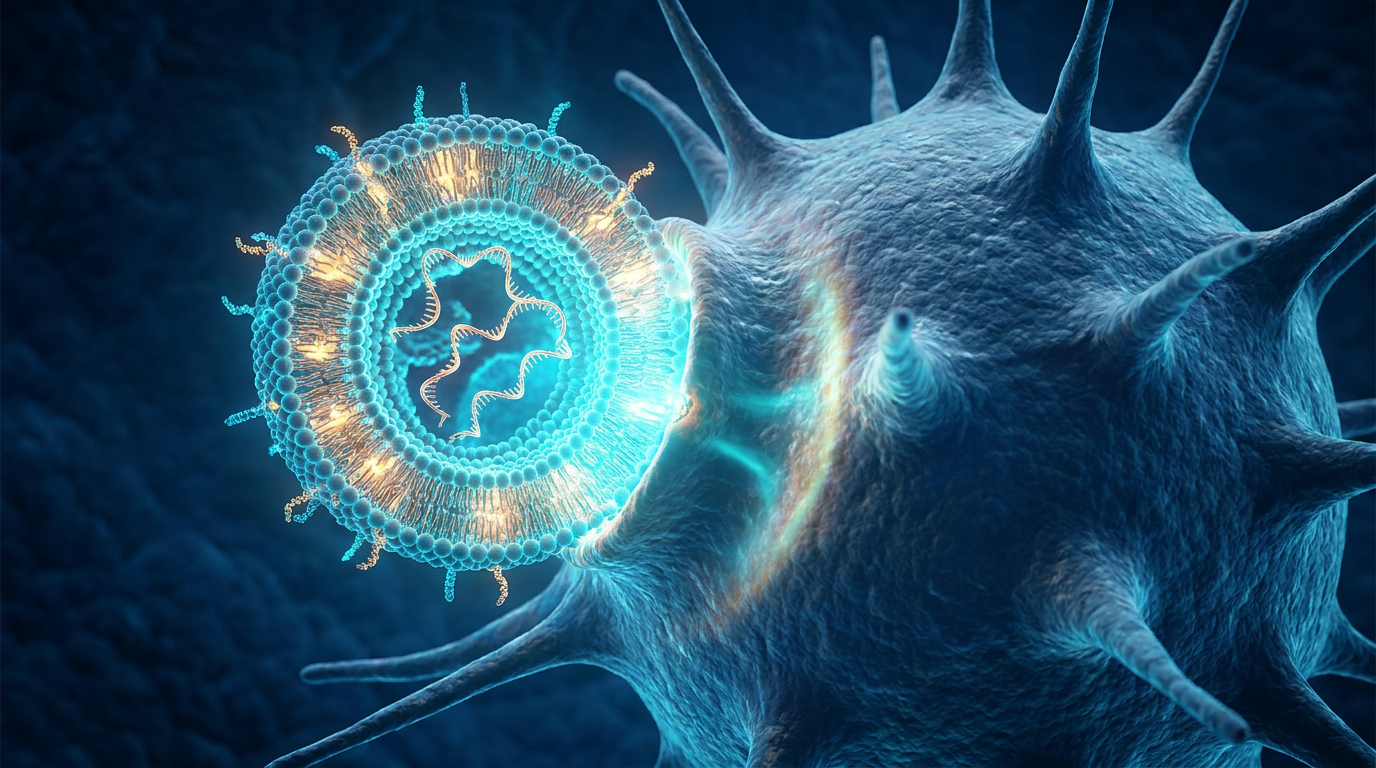
Once the targets are chosen, a custom mRNA sequence is synthesized. This genetic blueprint contains the instructions for building those exact 34 neoantigens. To protect the fragile mRNA from degrading in the bloodstream, it is encapsulated inside a microscopic fat bubble known as a lipid nanoparticle (LNP).[1][7]
The entire manufacturing process—from tumor biopsy to a ready-to-inject personalized vaccine—currently takes about 30 days. "If you and I were diagnosed the same day by the same doctor with skin cancer, Moderna would make a different medicine for your cancer and a different medicine for mine," explained Moderna CEO Stéphane Bancel.[3]
The entire manufacturing process—from tumor biopsy to a ready-to-inject personalized vaccine—currently takes about 30 days.
When the vaccine is injected into the patient's arm, the lipid nanoparticles are absorbed by dendritic cells, which act as the sentinels of the immune system. Inside these cells, the mRNA instructions are translated into the neoantigen proteins.[6][7]
The dendritic cells then display these foreign proteins on their surface and travel to the lymph nodes. There, they act as teachers, presenting the neoantigens to CD8+ "killer" T-cells. This interaction effectively programs the T-cells, giving them a precise biological mugshot of the cancer.[6][7]
The newly educated T-cells multiply and patrol the body, seeking out and destroying any rogue cells bearing those specific neoantigens. To ensure the cancer cannot hide, these vaccines are typically paired with immune checkpoint inhibitors—drugs like pembrolizumab (Keytruda) that strip away the chemical "disguises" tumors use to evade immune detection.[1][6]
The clinical results of this mechanism are proving historic. At the June 2026 American Society of Clinical Oncology (ASCO) Annual Meeting, Moderna and Merck presented five-year follow-up data for their personalized vaccine, intismeran autogene, in patients with high-risk melanoma.[1][2]
The data showed that patients receiving the custom vaccine alongside Keytruda experienced a 49% reduction in the risk of recurrence or death compared to those receiving Keytruda alone. Furthermore, the combination reduced the risk of the cancer spreading to distant organs by 59%.[1][2][4]

Most strikingly, the five-year overall survival rate for patients receiving the personalized mRNA therapy was 92.2%, compared to 71.3% for the control group. In the field of advanced oncology, a durable survival benefit of this magnitude over half a decade is widely considered a breakthrough.[1][2]
The success is not limited to melanoma. In April 2026, BioNTech and Genentech presented long-term data on their own personalized mRNA vaccine, autogene cevumeran, for pancreatic ductal adenocarcinoma—one of the most lethal and treatment-resistant cancers known to medicine.[5]
Up to six years after receiving the BioNTech vaccine, seven of the eight patients whose immune systems responded to the therapy were still alive and showed no signs of cancer recurrence. For context, the standard five-year survival rate for pancreatic cancer hovers around 13%.[5]

The primary challenge moving forward is logistical rather than biological. Scaling a manufacturing pipeline that requires creating a bespoke, clinical-grade pharmaceutical for every single patient in under a month requires massive infrastructure investments and highly synchronized supply chains.[3][4]
However, with Phase 3 trials now fully enrolled and generating data, the pharmaceutical industry is preparing for a paradigm shift. If the pivotal trials confirm these mid-stage results, personalized mRNA cancer vaccines could secure FDA approval by 2027 or 2028, fundamentally rewriting the standard of care for millions of patients worldwide.[3][4]
How we got here
2020–2021
The COVID-19 pandemic validates the safety and efficacy of the mRNA lipid nanoparticle platform on a global scale.
2023
Moderna and Merck publish initial two-year Phase 2b data showing a 44% reduction in melanoma recurrence.
April 2026
BioNTech presents long-term data showing 7 of 8 pancreatic cancer responders remain alive up to six years post-treatment.
June 2026
Moderna and Merck present five-year data at ASCO, demonstrating a 92.2% overall survival rate in high-risk melanoma patients.
2027–2028
Anticipated timeline for potential FDA approval following the completion of ongoing Phase 3 pivotal trials.
Viewpoints in depth
Clinical Researchers
Oncologists view mRNA vaccines as the key to unlocking durable, long-term immune responses against cancer.
For decades, the holy grail of oncology has been finding a way to kill cancer cells without destroying the patient's healthy tissue. Clinical researchers emphasize that personalized mRNA vaccines achieve this by turning the patient's own immune system into a highly specific, targeted weapon. By focusing on neoantigens—proteins that exist only on the tumor—the therapy avoids the systemic toxicity associated with traditional chemotherapy. Furthermore, researchers are highly encouraged by the durable memory of the T-cell response, which appears to provide ongoing surveillance against microscopic recurrence years after the initial treatment.
Biotech Developers
Manufacturers are focused on the unprecedented logistical challenge of scaling bespoke medicines.
While the clinical data is overwhelmingly positive, biotech developers face a manufacturing hurdle unlike anything in pharmaceutical history. Traditional drugs are manufactured in massive batches and stored on pharmacy shelves. Personalized mRNA vaccines require a 'one batch, one patient' supply chain. A tumor sample must be sequenced, the algorithm must select the targets, and the custom mRNA must be synthesized, purified, and shipped back to the clinic—all within a 30-day window. Developers are currently investing billions in automated, AI-driven cleanrooms to ensure this process can scale to serve hundreds of thousands of patients annually.
Patient Advocates
Advocates highlight the psychological relief of recurrence-free survival and the need for equitable access.
For patients diagnosed with high-risk cancers like melanoma or pancreatic ductal adenocarcinoma, the fear of recurrence casts a long shadow over their lives. Patient advocacy groups celebrate the 49% reduction in recurrence risk as a monumental victory that offers genuine peace of mind. However, these groups are also preemptively raising concerns about access and cost. Given the highly personalized nature of the manufacturing process, advocates are urging policymakers and insurance providers to establish frameworks now, ensuring that when these therapies are approved, they are accessible to all patients, not just those with premium healthcare coverage.
What we don't know
- Whether the exceptional survival rates seen in melanoma and pancreatic cancer will translate equally well to other solid tumors.
- The final price tag of these highly personalized therapies once they reach the commercial market.
- How healthcare systems will manage the complex, time-sensitive logistics of a 30-day custom manufacturing pipeline at a global scale.
Key terms
- Neoantigen
- An abnormal protein found exclusively on the surface of cancer cells, created by tumor-specific genetic mutations.
- Lipid Nanoparticle (LNP)
- A microscopic bubble of fat used to protect fragile mRNA molecules and deliver them safely into human cells.
- Dendritic Cell
- A specialized immune cell that acts as a sentinel, capturing foreign proteins and presenting them to T-cells to trigger an immune response.
- CD8+ T-Cell
- A type of white blood cell, often called a "killer" T-cell, that actively hunts and destroys infected or cancerous cells.
- Immune Checkpoint Inhibitor
- A type of drug that blocks proteins cancer cells use to hide from the immune system, allowing T-cells to attack them effectively.
Frequently asked
Are these vaccines used to prevent cancer?
No. Unlike preventative vaccines for viruses, mRNA cancer vaccines are therapeutic. They are given to patients who have already been diagnosed and treated, aiming to prevent the cancer from returning.
How long does it take to make a personalized vaccine?
The current manufacturing process takes approximately 30 days from the time the tumor is surgically removed to the moment the custom vaccine is ready to be injected.
Do these vaccines replace chemotherapy?
They are designed to be used after surgery, often in combination with immunotherapy drugs, to train the immune system. While they may reduce the need for broad chemotherapy in some cases, they are currently part of a combination approach.
When will these vaccines be available to the public?
Several personalized mRNA vaccines are currently in fully enrolled Phase 3 clinical trials. If the data remains positive, the first FDA approvals could occur between 2027 and 2028.
Sources
Source coverage
7 outlets
3 viewpoints surfaced







[1]MerckBiotech Developers
Moderna and Merck Present 5-Year Data for Intismeran Autogene in Combination With KEYTRUDA® in Patients With High-Risk Stage III/IV Melanoma
Read on Merck →[2]Medical News TodayPatient Advocates
Combination therapy sustains 49% melanoma reduction after 5 years
Read on Medical News Today →[3]Fox BusinessBiotech Developers
Moderna, Merck report cancer vaccine breakthrough in melanoma trial
Read on Fox Business →[4]Fierce BiotechBiotech Developers
Merck-Moderna cancer vaccine sustains 49% melanoma risk reduction at 5 years
Read on Fierce Biotech →[5]IFLSciencePatient Advocates
Experimental mRNA Pancreatic Cancer Vaccine Still Effective After 6 Years
Read on IFLScience →[6]National Cancer InstituteClinical Researchers
Can mRNA Vaccines Help Treat Cancer?
Read on National Cancer Institute →[7]The ScientistClinical Researchers
RNA Vaccines: The Basics and Beyond
Read on The Scientist →

Every angle. Every day.
Get guides stories with full source coverage and perspective breakdowns delivered to your inbox.