
How Novel Ingredients and Precision Fermentation Are Forcing an Overhaul of FDA Supplement Regulation
The 1994 law that governs dietary supplements was written for vitamins and herbs. Now, as precision fermentation and synthetic peptides flood the market, the FDA is reassessing what qualifies as a dietary substance.
By Aylin Aksoy


- Supplement Innovators
- Advocates for regulatory flexibility to accommodate new manufacturing technologies.
- Safety and Consumer Advocates
- Emphasizes the need for rigorous pre-market safety data for biologically active compounds.
- Regulatory Authorities
- Focuses on modernizing the interpretation of a dietary substance without creating loopholes.
Summary
- The FDA is reassessing its 1994 dietary supplement regulations to account for modern scientific advancements.
- Novel ingredients like synthetic peptides challenge the traditional definition of a dietary substance.
- Advanced manufacturing methods, such as precision fermentation, are increasingly used to produce highly pure supplement ingredients.
- The agency is exploring whether new production technologies alter an ingredient's identity enough to require new safety data.
- Industry groups advocate for regulatory flexibility, while safety advocates push for stricter oversight of biologically active compounds.
The U.S. Food and Drug Administration is fundamentally reevaluating how it regulates dietary supplements because the science of making them has outgrown the law that governs them. For three decades, the supplement aisle has been governed by a framework designed for vitamins, minerals, and simple plant extracts. Today, that same aisle is filling with lab-engineered proteins, synthetic peptides, and bio-identical compounds that challenge the very definition of a nutritional product.[1][5]
This shift from agricultural extraction to advanced biotechnology has triggered a regulatory reckoning. In 2026, the FDA signaled a willingness to overhaul its interpretation of dietary supplement regulations to address these novel ingredients and production technologies. The agency's ongoing reassessment marks the most significant potential shift in sports nutrition oversight in a generation, forcing manufacturers and consumers alike to navigate a rapidly closing gray area.[5]
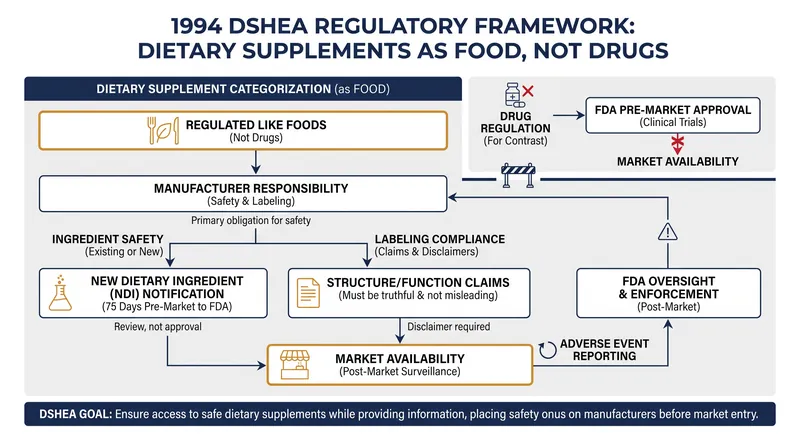
To understand the friction, one must look back to 1994. The Dietary Supplement Health and Education Act (DSHEA) established the rules of the road, categorizing supplements as a subset of food rather than pharmaceutical drugs. Under DSHEA, products do not require pre-market approval from the FDA. Instead, the burden of ensuring safety falls on the manufacturer, and the agency only steps in to remove products proven to be unsafe or misbranded.[2]
The law grandfathered in any dietary ingredient sold before October 1994. For anything introduced after that date, companies must submit a New Dietary Ingredient (NDI) notification, providing evidence that the substance is reasonably expected to be safe. Crucially, DSHEA defined a "dietary substance" as something intended to supplement the diet by increasing total dietary intake—a definition historically interpreted to mean substances already present in the conventional food supply.[2]
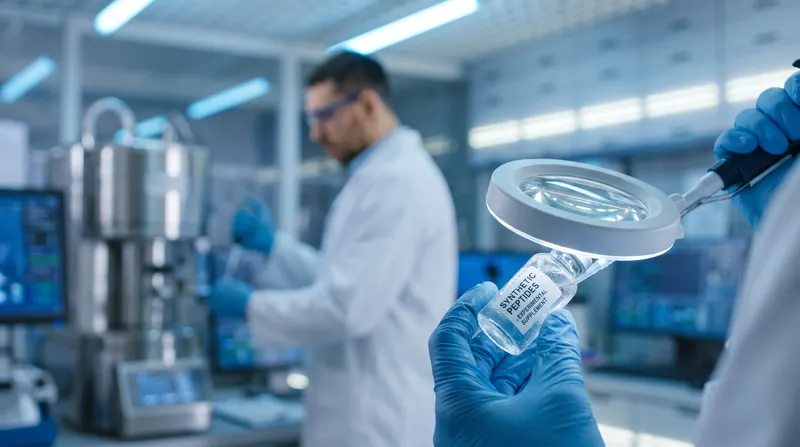
This is where modern sports nutrition collides with the 1994 law. The first major catalyst for the FDA's reassessment is the explosion of peptides—short chains of amino acids that act as signaling molecules in the body. Peptides are highly sought after in fitness circles for their potential to accelerate tissue repair, stimulate muscle growth, and improve metabolic function.[5]
However, many of these compounds are synthesized in laboratories and do not exist in traditional foods. Because they are biologically active and often lack a history of use in the human diet, the FDA frequently views synthetic peptides as unapproved new drugs rather than dietary supplements, creating a massive gray market of products sold online under the guise of "research chemicals" or wellness supplements.[1][5]
However, many of these compounds are synthesized in laboratories and do not exist in traditional foods.
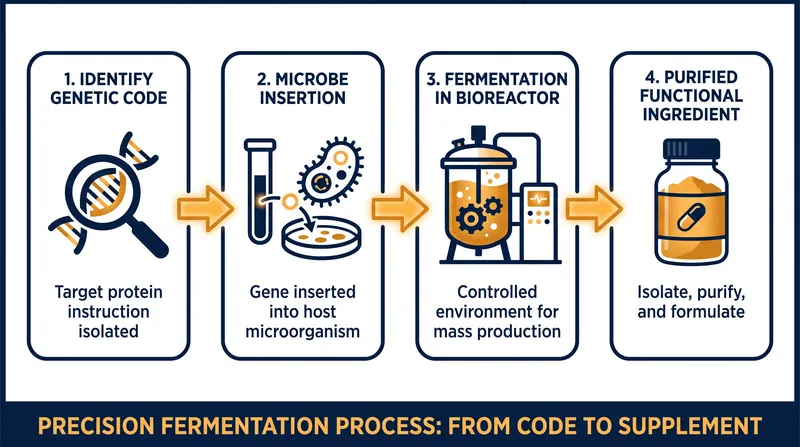
The second catalyst forcing the FDA's hand is a revolution in manufacturing: precision fermentation. Rather than extracting whey protein from cow's milk or vitamin C from citrus, scientists can now program microbes to produce these exact molecules. By inserting specific genetic codes into yeast or bacteria, fermentation tanks act as cellular factories, churning out highly pure, bio-identical proteins, enzymes, and antioxidants with a fraction of the environmental footprint of traditional agriculture.[3][5]
Precision fermentation is already the standard for producing many vitamins and amino acids. But as companies use it to create novel dairy-free whey or specialized collagen peptides, it raises a complex regulatory question: Does changing the manufacturing process alter the regulatory identity of the ingredient? If a protein is identical to one found in nature but was produced by a genetically modified yeast, does it require a new safety dossier?[3][4]
During its 2026 public meetings, the FDA asked stakeholders exactly these questions. The agency is exploring whether the definition of a dietary substance should be expanded to include novel compounds and bio-engineered ingredients that have never been part of the traditional human diet, provided they can be proven safe.[4]
Supplement manufacturers argue that the legislative intent of DSHEA was broad enough to accommodate technological progress. Industry advocates warn that an overly rigid interpretation—one that strictly limits supplements to historical food components—will stifle innovation and keep sustainable, highly effective products out of the hands of consumers.[4]
Conversely, consumer protection groups and regulatory experts caution that advanced biotechnology blurs the line between food and medicine. They argue that highly purified, lab-grown compounds carry different risk profiles—such as novel allergens or unintended byproducts—than their naturally sourced counterparts. These advocates stress that as supplements become more biologically potent, the FDA needs clearer authority to demand rigorous pre-market safety data.[4][5]
The FDA's challenge is to modernize its oversight without dismantling the consumer access that DSHEA was designed to protect. This may involve creating clearer, streamlined pathways for precision-fermented ingredients while simultaneously cracking down on the unregulated sale of synthetic, injectable peptides that bypass safety protocols entirely.[5]
For the consumer, this regulatory overhaul signals a maturation of the sports nutrition industry. The products of the future will increasingly rely on clinical biotechnology rather than simple botanical extraction. As the science of human performance advances, the rules governing it must adapt, marking the beginning of a new era where the definition of a natural supplement is rewritten by the capabilities of the modern laboratory.[5]
Definitions
- Precision Fermentation
- The use of genetically programmed microbes, such as yeast or bacteria, to produce specific functional molecules like proteins or vitamins.
- Peptides
- Short chains of amino acids that act as building blocks for proteins, increasingly used in sports nutrition for recovery and muscle growth.
- DSHEA
- The Dietary Supplement Health and Education Act of 1994, which established the regulatory framework treating supplements as a category of food rather than drugs.
- New Dietary Ingredient (NDI)
- A supplement ingredient that was not marketed in the United States before October 15, 1994, requiring a safety notification to the FDA before sale.
Chronology
October 1994
Congress passes the Dietary Supplement Health and Education Act (DSHEA), establishing the foundational regulatory framework for supplements.
June 2007
The FDA finalizes Good Manufacturing Practices (GMPs) specifically for dietary supplements, imposing higher quality control standards.
March 2026
The FDA holds a public meeting to explore the scope of dietary supplement ingredients, focusing on novel production technologies like precision fermentation.
April 2026
The public comment period closes for the FDA's reassessment, with the agency beginning its review of nearly 1,000 stakeholder submissions.
Analysis by camp
Supplement Industry Innovators
Advocates for regulatory flexibility to accommodate new manufacturing technologies.
Industry groups argue that the original language of the 1994 DSHEA law was intentionally broad to foster innovation. They contend that precision fermentation and synthetic biology offer cleaner, more sustainable, and more effective products than traditional agricultural extraction. From this perspective, an overly rigid FDA interpretation that limits supplements only to historical food components would stifle scientific progress and deny consumers access to next-generation wellness tools.
Safety and Consumer Advocates
Emphasizes the need for rigorous pre-market safety data for biologically active compounds.
Consumer protection organizations warn that modern biotechnology blurs the line between food and medicine. They argue that highly purified, lab-grown compounds—especially synthetic peptides—carry different risk profiles than naturally sourced vitamins, including the potential for novel allergens or unintended byproducts. This camp insists that as supplements become more potent, the FDA must enforce stricter pre-market safety evaluations to prevent untested chemicals from reaching the public.
Regulatory Authorities
Focuses on modernizing the interpretation of a dietary substance without creating loopholes.
The FDA's primary concern is maintaining the structural integrity of the regulatory framework Congress designed. Agency officials recognize that science has outpaced the 1994 definitions, but they are cautious about expanding the definition of a dietary substance so broadly that it renders the word 'dietary' meaningless. Their goal is to clarify when a new manufacturing process fundamentally changes an ingredient's identity, ensuring that novel products are properly vetted without unnecessarily burdening safe, established ingredients.
Questions & answers
What is precision fermentation?
Precision fermentation is a manufacturing process that uses genetically programmed microbes, like yeast or bacteria, to produce highly pure, specific molecules such as proteins, enzymes, or vitamins without relying on traditional agriculture.
Are peptides considered dietary supplements?
It is a regulatory gray area. While many are marketed as supplements, the FDA frequently views synthetic or injectable peptides as unapproved drugs because they are biologically active and lack a history of use in the traditional human diet.
Do dietary supplements need FDA approval before being sold?
No. Unlike pharmaceutical drugs, dietary supplements do not require pre-market approval from the FDA. However, manufacturers must submit a safety notification for any new dietary ingredient introduced after 1994.
Limits of the evidence
- It remains unclear exactly how the FDA will classify bio-identical proteins produced via precision fermentation compared to their naturally extracted counterparts.
- The timeline for any formal regulatory changes or new guidance documents resulting from the FDA's 2026 public meetings has not been finalized.
Significance
As sports nutrition increasingly relies on lab-engineered proteins and synthetic peptides, the FDA's regulatory overhaul will determine which cutting-edge recovery and performance supplements make it to store shelves—and how their safety is verified.
Sources
Source coverage
5 outlets
3 viewpoints surfaced





[1]U.S. Food and Drug AdministrationRegulatory Authorities
Dietary Supplements
Read on U.S. Food and Drug Administration →[2]National Institutes of HealthRegulatory Authorities
Dietary Supplement Health and Education Act of 1994
Read on National Institutes of Health →[3]The Good Food InstituteSupplement Innovators
The Science of Fermentation
Read on The Good Food Institute →[4]Nutritional OutlookSafety and Consumer Advocates
Exploring the Scope of Dietary Supplement Ingredients
Read on Nutritional Outlook →[5]Factlen Editorial TeamRegulatory Authorities
Synthesis by Factlen editorial team
Read on Factlen Editorial Team →
Comments

Every angle. Every day.
Get fitness stories with full source coverage and perspective breakdowns delivered to your inbox.