
The Science of Structured Interviews: Why Standardized Questions Outperform Free-Flowing Conversations
Decades of industrial-organizational psychology research confirm that structured interviews are roughly twice as effective at predicting job performance as traditional unstructured formats.
By Bo Feng


- Industrial-Organizational Psychologists
- Advocate for treating hiring as a rigorous psychometric science to maximize predictive validity.
- Enterprise Talent Acquisition
- Focus on scaling standardized processes to reduce bias and ensure legal compliance.
- Methodology Researchers
- Emphasize strict data collection integrity and fixed sequencing to maintain format reliability.
Why it matters
For job seekers, understanding the mechanics of a structured interview reveals exactly how to prepare: by mapping past experiences to core competencies rather than relying on charm. For hiring managers, adopting this science-backed approach is the single most effective way to eliminate costly mis-hires and systemic bias.
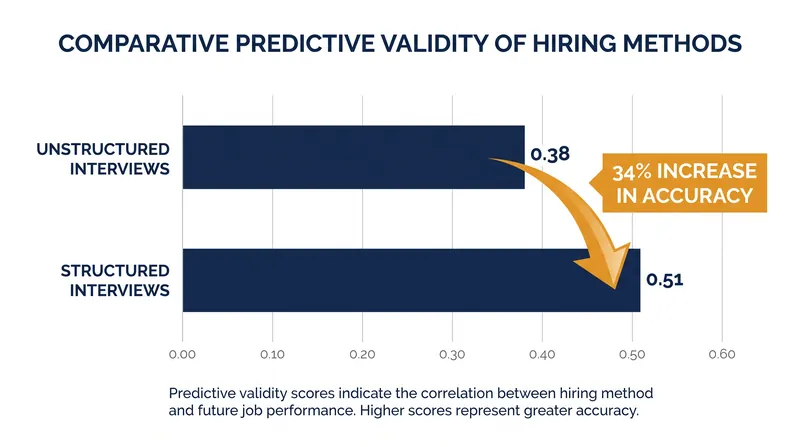
Decades of industrial-organizational psychology research confirm a stark reality about corporate hiring: the traditional, free-flowing job interview is barely more predictive of future performance than a coin flip. When hiring managers "just chat" to assess cultural fit or rely on their gut instincts, the predictive validity of that unstructured conversation hovers around 0.38 on a standard statistical scale. By contrast, structured interviews—where every candidate answers the identical set of job-analyzed questions scored against a standardized rubric—achieve a predictive validity of 0.51, making them roughly 34% more accurate at identifying top performers. This fundamental shift from conversational art to psychometric science is reshaping how modern enterprises build their workforces.[3]
The mechanism behind this massive performance gap lies in the systematic elimination of random variables. In an unstructured interview, the conversation often drifts based on shared hobbies, alma maters, or the interviewer's mood on a given day. This introduces severe "noise" into the evaluation process, allowing unconscious biases—such as the halo effect, where a candidate's confidence masks their incompetence, or similarity bias—to dictate the final outcome. Structured interviews strip away this noise by treating the interview as a highly controlled, standardized psychometric test. Every applicant faces the exact same prompts in the exact same order, ensuring that the resulting data reflects actual competency rather than conversational chemistry or demographic familiarity.[1]
The foundational evidence for this approach stems from Frank Schmidt and John Hunter's landmark 1998 meta-analysis, which synthesized 85 years of personnel selection research to determine what actually works in hiring. They evaluated 19 different selection procedures and found that while general mental ability (cognitive testing) was a strong predictor, structured interviews were equally formidable. More recent updates to this research, including a massive 2022 meta-analysis by Paul Sackett and colleagues, have reinforced and even elevated these historical findings. Sackett's team concluded that structured interviews may actually be the single strongest standalone predictor of job performance, outperforming cognitive tests, work samples, and personality measures when deployed correctly.
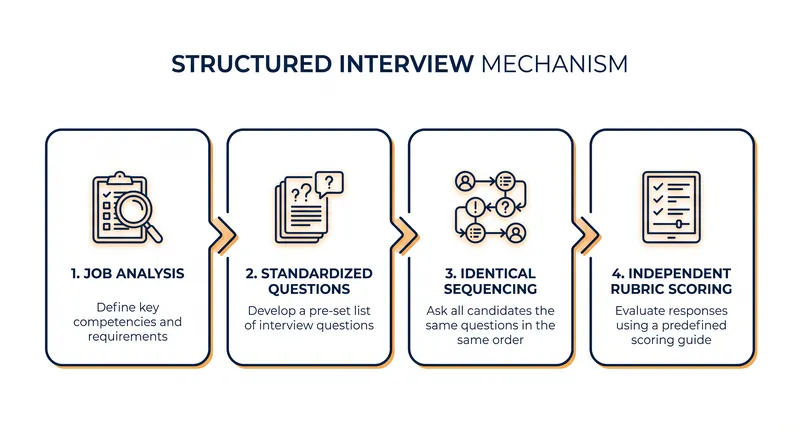
Implementing a structured interview requires significant upfront design, shifting the workload from the interview room to the preparation phase. The process begins with a rigorous job analysis to identify the specific behaviors, technical skills, and core competencies required for success in the role. Hiring teams then draft behavioral questions—asking candidates to describe past actions—and situational questions—posing hypothetical future scenarios—that map directly to those defined competencies. Crucially, interviewers do not improvise follow-up questions based on idle curiosity; they stick strictly to the script to ensure a uniform candidate experience, asking only standardized probing questions to clarify specific details.[1][2][3]
Implementing a structured interview requires significant upfront design, shifting the workload from the interview room to the preparation phase.
The most critical component of the structured method is the scoring rubric, often referred to in the literature as a behaviorally-anchored rating scale (BARS). Instead of relying on a subjective "thumbs up" or "thumbs down" after the candidate leaves the room, interviewers grade each response on a predefined scale—typically ranging from 1 to 5. The rubric explicitly defines what a poor, average, and outstanding answer sounds like for each specific question, providing concrete behavioral examples. Interviewers must submit their scores independently immediately after the interview concludes, preventing groupthink or the influence of a dominant hiring manager during the debriefing phase.[2]
Despite the overwhelming empirical evidence supporting the method, corporate adoption remains incomplete across the broader economy. Organizations like Google, the U.S. Office of Personnel Management, and the Department of Veterans Affairs have mandated structured interviewing across their enterprises, citing internal data that perfectly mirrors the academic consensus. Google's internal research found that structured interviews not only produced demonstrably better hires but also saved interviewers an average of 40 minutes per candidate by eliminating the need to invent questions on the fly. However, many smaller companies resist the transition because developing validated questions and comprehensive rubrics requires substantial time, discipline, and human resources expertise.[1][2]
There is also a persistent myth among traditional hiring managers that structured interviews feel robotic, overly rigid, or alienating to candidates. In reality, candidate feedback data suggests the exact opposite is true. Candidates consistently report higher satisfaction with structured processes because the expectations are clear, the questions are demonstrably relevant to the job, and the evaluation feels fundamentally objective. When applicants understand they are being measured against a transparent, evidence-based standard rather than a hiring manager's arbitrary preferences or hidden criteria, their trust in the organization's fairness and professionalism significantly increases.[2]

While structured interviews represent the absolute gold standard for qualitative assessment, they are not entirely infallible. Self-reported answers can still be rehearsed or exaggerated by savvy candidates, and the highly formalized format struggles to perfectly capture nuanced soft skills like long-term adaptability or deep technical execution under pressure. For this reason, industrial-organizational psychologists strongly recommend combining structured interviews with other validated selection tools, such as cognitive ability tests or practical work samples. Together, this multi-signal approach creates a composite validity that far exceeds what any single method can achieve alone, fundamentally transforming corporate hiring from a guessing game into a rigorous science.[4]
Where opinion splits
Industrial-Organizational Psychologists
Advocates for treating the interview as a rigorous scientific instrument.
This camp views the traditional interview as a fundamentally flawed exercise in human bias. Relying on decades of meta-analyses, they argue that unstructured conversations measure an applicant's charisma and similarity to the interviewer rather than their actual job competence. By enforcing strict standardization—identical questions, fixed sequencing, and behaviorally-anchored rating scales—they aim to convert the interview into a reliable psychometric test. Their primary focus is maximizing predictive validity, ensuring that the scores generated in the interview room accurately forecast long-term performance on the job.
Enterprise Talent Acquisition
Focuses on scaling standardized hiring to reduce bias and legal risk.
For large-scale employers and government agencies, structured interviewing is less about academic purity and more about operational consistency. This perspective values the method's ability to strip unconscious bias from the hiring pipeline, ensuring that diverse candidate pools are evaluated fairly. They also highlight the legal defensibility of structured interviews; because every question is explicitly tied to a formal job analysis, organizations are protected against claims of discriminatory hiring practices. While they acknowledge the heavy upfront cost of developing rubrics, they argue the long-term gains in employee retention and reduced interviewer time justify the investment.
Unanswered questions
- How the rapid integration of AI-driven interview screening will alter the predictive validity of traditional structured formats.
- Whether the rigid standardization of structured interviews inadvertently filters out neurodivergent candidates who may struggle with highly formalized behavioral questions.
Sources
Source coverage
4 outlets
3 viewpoints surfaced




[1]U.S. Office of Personnel ManagementEnterprise Talent Acquisition
Structured Interviews
Read on U.S. Office of Personnel Management →[2]Google re:WorkEnterprise Talent Acquisition
Structured interviewing
Read on Google re:Work →[3]ScribbrMethodology Researchers
Structured Interview | Definition, Guide & Examples
Read on Scribbr →[4]Factlen Editorial TeamMethodology Researchers
Synthesis by Factlen editorial team
Read on Factlen Editorial Team →
Comments
Every angle. Every day.
Get careers work stories with full source coverage and perspective breakdowns delivered to your inbox.