
The New US Labor Reality: A Guide to the Rescission of EO 11246, the End of EEO-1 Reporting, and the Federal Contractor Overhaul
The regulatory landscape for US federal contractors has fundamentally shifted following the rescission of Executive Order 11246 and the proposed elimination of EEO-1 reporting. This guide breaks down the new compliance requirements, what obligations remain, and how organizations are adapting to the merit-based framework.
By Paige Carter


- Deregulation Advocates
- Argue that eliminating affirmative action mandates restores merit-based hiring and reduces administrative burdens.
- Civil Rights Organizations
- Warn that the rollbacks dismantle essential protections and will allow systemic discrimination to go unchecked.
- Legal & Regulatory Consensus
- Focused on navigating the complex transition, maintaining compliance, and mitigating new legal risks.
Summary
- Executive Order 11246, which mandated race- and sex-based affirmative action for federal contractors, was rescinded in early 2025.
- The EEOC has proposed eliminating the EEO-1 demographic reporting requirement, shifting focus to case-by-case investigations.
- Contractors must now certify compliance with new anti-DEI contract clauses, with violations potentially triggering False Claims Act liability.
- Affirmative Action Programs for protected veterans (VEVRAA) and individuals with disabilities (Section 503) remain fully required.
- Civil rights groups are urging Congress to codify the lost protections, arguing the rollbacks harm workplace equality.
The compliance landscape for organizations doing business with the United States federal government has undergone a seismic and rapid shift. For nearly sixty years, Executive Order 11246 served as the foundational cornerstone of federal contractor equal employment opportunity, strictly requiring companies to maintain proactive affirmative action programs based on race, sex, and national origin. That historical framework is now entirely gone. Following the issuance of Executive Order 14173 in early 2025, which officially revoked the longstanding presidential mandate, the Department of Labor has moved aggressively to formally rescind all implementing regulations. This marks the end of an era for federal procurement, fundamentally altering how thousands of companies approach recruitment, hiring, and workforce management.[1][3]
The regulatory overhaul extends significantly beyond the boundaries of affirmative action. In mid-2026, the Equal Employment Opportunity Commission (EEOC) took the unprecedented step of proposing the complete elimination of the EEO-1 demographic reporting requirement. For decades, the EEO-1 report functioned as a mandatory annual data collection mechanism, requiring employers across the country to submit detailed workforce data broken down by race, sex, and ethnicity. The proposed rescission, which is currently undergoing final review by the Office of Information and Regulatory Affairs, aims to shift federal civil rights enforcement away from broad, systemic data collection and toward targeted, case-by-case investigations of disparate treatment. This move has profound implications for how corporate diversity metrics are tracked and scrutinized at the federal level.[1]
For federal contractors, these sweeping changes represent a fundamental pivot from proactive demographic balancing to a strict, neutrality-driven anti-discrimination and merit-based compliance model. The Department of Labor's Office of Federal Contract Compliance Programs (OFCCP) has been explicitly directed to immediately cease holding contractors responsible for taking affirmative action based on race or sex. Instead, the compliance paradigm has flipped: contractors must now affirmatively certify that they do not operate any diversity, equity, and inclusion (DEI) programs that violate federal anti-discrimination laws. This requires a comprehensive internal review of existing corporate initiatives, as practices that were once encouraged or mandated under the old framework may now expose a company to significant legal jeopardy.[3][4]
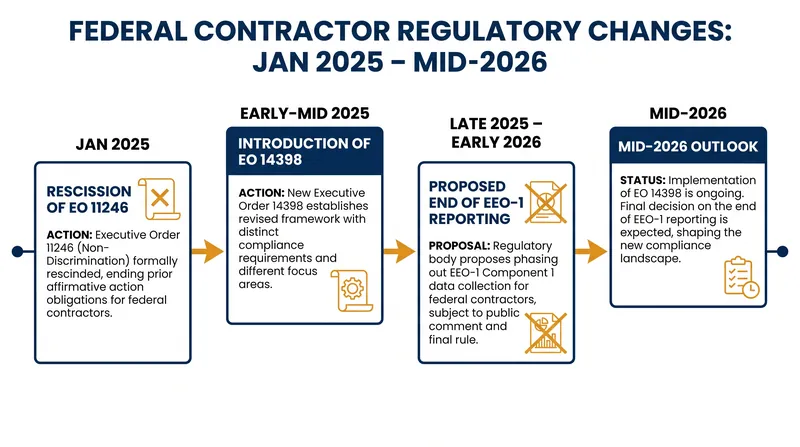
The transition has introduced stringent new contractual obligations that carry severe financial risks. Under Executive Order 14398, signed in March 2026, all federal agencies are required to insert a mandatory anti-DEI clause into government contracts and subcontracts at every tier of the supply chain. This specific clause explicitly prohibits what the administration defines as 'racially discriminatory DEI activities' in recruitment, hiring, promotions, and the allocation of corporate resources. Crucially, compliance with this new clause is tied directly to payment for services rendered. This means that false certifications can trigger catastrophic liability under the False Claims Act, transforming what was once an administrative compliance issue into a major source of corporate fraud litigation.[5]
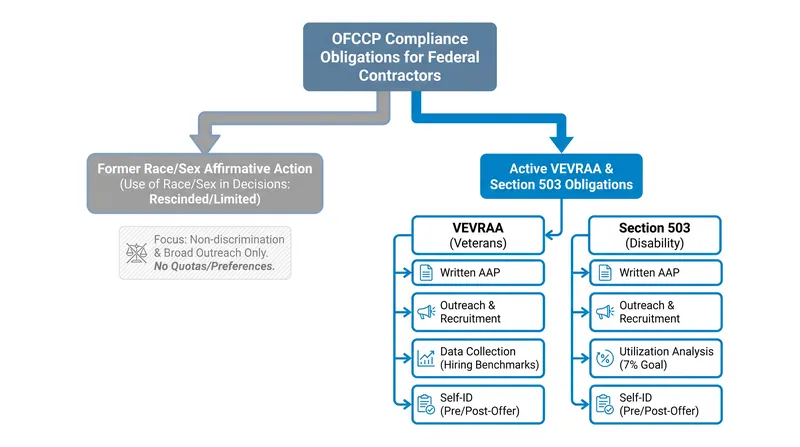
Despite the sweeping nature of these regulatory rollbacks, certain core compliance obligations remain fully intact, creating a complex dual reality for human resources departments. The OFCCP continues to rigorously enforce the Vietnam Era Veterans' Readjustment Assistance Act (VEVRAA) and Section 503 of the Rehabilitation Act. Contractors meeting the applicable financial and employee thresholds must still maintain comprehensive written Affirmative Action Programs specifically for protected veterans and individuals with disabilities. These specialized plans still require the establishment of hiring benchmarks, utilization goals, and detailed data tracking on applicants and hires, ensuring that the infrastructure of federal compliance is not entirely dismantled.[1][7]
The OFCCP continues to rigorously enforce the Vietnam Era Veterans' Readjustment Assistance Act (VEVRAA) and Section 503 of the Rehabilitation Act.
The retention of VEVRAA and Section 503 requirements means that federal contractors cannot simply abandon their compliance tracking systems. While the race- and sex-based components of affirmative action plans are no longer legally required, organizations must continue to invite applicants to self-identify their disability and veteran status at both the pre-offer and post-offer stages. Furthermore, they must conduct annual utilization analyses and meticulously document their targeted outreach efforts to these specific communities. The OFCCP retains full authority to audit these remaining programs, and failure to demonstrate compliance can still result in contract suspension, cancellation, or debarment from future federal opportunities.[4][7]
The rapid pace of this deregulation has sparked intense debate and legal scrutiny across the political and corporate spectrum. Proponents of the overhaul, including various business associations and the current administration, argue that the previous framework had devolved into a system that encouraged unlawful workforce balancing and imposed unnecessary, costly administrative burdens on businesses. By rescinding EO 11246 and moving to eliminate EEO-1 reporting requirements, the administration aims to restore a purely merit-based approach to employment, arguing that true equal opportunity is achieved through strict neutrality rather than proactive demographic engineering.[1][3]
Conversely, civil rights organizations, labor unions, and worker advocacy groups have strongly opposed the rollbacks, warning of long-term damage to workplace equality. Coalitions such as the National Partnership for Women & Families and Equal Rights Advocates argue that EO 11246 was instrumental in breaking down systemic barriers and expanding job opportunities for historically marginalized groups, particularly in high-wage, male-dominated industries like construction and manufacturing. These groups have issued comprehensive legislative recommendations urging Congress to step in and codify the anti-discrimination and data-collection requirements previously mandated by the executive order, arguing that taxpayer dollars should not flow to companies that fail to proactively ensure equal opportunity.[2]
The enforcement landscape is also shifting dramatically, moving from administrative audits to aggressive fraud investigations. The Department of Justice has launched a dedicated Civil Rights Fraud Initiative, signaling its clear intent to use the False Claims Act against contractors that maintain non-compliant DEI programs while certifying adherence to the new federal rules. This unprecedented approach has forced corporate legal departments and compliance officers to meticulously audit internal training modules, mentoring programs, and leadership development initiatives. The goal is to ensure that legacy programs do not run afoul of the broad new definitions of discriminatory practices, which could trigger whistleblower lawsuits and massive financial settlements.[5]

For organizations navigating this new reality, the immediate priority is untangling which obligations have vanished and which remain legally binding. While the 90-day transition period for the initial EO 11246 rescission has long passed, the ongoing rulemaking process around EEO-1 reporting means that some filing obligations technically remain in force until the regulatory process is fully finalized. Legal experts are advising contractors to maintain their current data collection systems and reporting protocols until the EEOC officially publishes the final rescission rule in the Federal Register, warning that premature abandonment of these systems could still invite regulatory penalties.[1][7]
Ultimately, the federal contractor overhaul represents a profound redefinition of what equal employment opportunity means in the context of government procurement. The focus has decisively shifted away from proactive demographic utilization and toward strict neutrality, merit-based advancement, and the elimination of corporate DEI initiatives. As the OFCCP aligns its enforcement strategies and resources with the new executive orders, contractors must rapidly adapt their compliance programs to meet these new standards, preparing for an era of heightened scrutiny where the definition of compliance has been entirely rewritten.[4][6]
Definitions
- Executive Order 11246
- A 1965 directive that required federal contractors to take affirmative action to ensure equal employment opportunity based on race, color, religion, sex, or national origin.
- EEO-1 Report
- A mandatory annual data collection that required employers to submit demographic workforce data, including race and gender, to the federal government.
- OFCCP
- The Office of Federal Contract Compliance Programs, the Department of Labor agency responsible for ensuring that federal contractors comply with non-discrimination laws.
- VEVRAA
- The Vietnam Era Veterans' Readjustment Assistance Act, a law requiring federal contractors to take affirmative action to employ and advance protected veterans.
- Section 503
- A section of the Rehabilitation Act that requires federal contractors to take affirmative action to recruit, hire, and promote individuals with disabilities.
- False Claims Act
- A federal law that imposes liability on persons and companies who defraud governmental programs, now being used to enforce compliance with new anti-DEI contract clauses.
Chronology
Jan 2025
President Trump issues EO 14173, revoking the affirmative action mandates of EO 11246.
Jul 2025
The Department of Labor formally proposes the rescission of all EO 11246 implementing regulations.
Mar 2026
EO 14398 is signed, mandating strict anti-DEI clauses in all federal contracts and subcontracts.
May 2026
The EEOC submits a proposal to the Office of Information and Regulatory Affairs to eliminate EEO-1 reporting.
Jun 2026
Civil rights organizations release comprehensive recommendations urging Congress to restore federal contractor protections.
Analysis by camp
Deregulation Advocates
Supporters of the overhaul argue it removes burdensome quotas and restores merit-based hiring.
Proponents of the regulatory rollbacks, including various business groups and the current administration, argue that the previous framework under EO 11246 had morphed into a system of de facto quotas and unlawful workforce balancing. By eliminating these requirements and the associated EEO-1 demographic reporting, they contend that federal contractors are freed from significant administrative burdens and legal risks. This camp emphasizes that true equal opportunity is best achieved through strict adherence to anti-discrimination laws and merit-based hiring, rather than proactive demographic engineering.
Civil Rights Organizations
Advocacy groups warn that the rollbacks dismantle decades of progress in workplace equality.
Organizations such as the National Partnership for Women & Families and Equal Rights Advocates view the rescission of EO 11246 and the end of EEO-1 reporting as a severe blow to workplace equity. They argue that these tools were essential for identifying systemic barriers, uncovering pay discrimination, and expanding opportunities for women and minorities in industries where they have been historically underrepresented. This camp is actively lobbying Congress to codify the lost protections, warning that without mandatory data collection and proactive affirmative action, discriminatory practices will go undetected and unaddressed.
Legal & Regulatory Consensus
Businesses are focused on navigating the complex transition and mitigating new legal risks.
For the companies actually holding federal contracts, the primary concern is operational compliance and risk management. While some welcome the reduction in reporting burdens, many legal and HR departments are grappling with the uncertainty of the transition. The introduction of mandatory anti-DEI contract clauses tied to False Claims Act liability has created a high-stakes environment. Contractors are currently forced to audit their internal programs meticulously, balancing the need to comply with the new federal mandates against their own corporate diversity goals and the remaining obligations under VEVRAA and Section 503.
Questions & answers
Do federal contractors still need an Affirmative Action Program?
Yes, but it is now narrower. While race- and sex-based plans are no longer required, contractors must still maintain Affirmative Action Programs for protected veterans and individuals with disabilities.
Is the EEO-1 report officially gone?
The EEOC has proposed eliminating the requirement, but the rule is still undergoing final regulatory review as of mid-2026. Existing filing obligations technically remain in force until the rulemaking is complete.
What happens if a contractor violates the new anti-DEI rules?
Contractors who falsely certify compliance with the new anti-DEI contract clauses can face severe penalties, including contract cancellation, debarment, and liability under the False Claims Act.
Can private companies still have DEI programs?
Yes, private employers can maintain voluntary programs, but federal contractors must ensure these initiatives do not violate federal anti-discrimination laws or the specific prohibitions outlined in their government contracts.
Limits of the evidence
- It remains unclear exactly when the EEOC's proposed rescission of the EEO-1 reporting requirement will be finalized and take full effect.
- The full scope of what constitutes 'racially discriminatory DEI activities' under the new contract clauses is still being tested in the courts.
- It is unknown whether Congress will act on recommendations from civil rights groups to codify the protections previously established by EO 11246.
Significance
For the thousands of businesses that contract with the federal government, these regulatory rollbacks fundamentally rewrite the rules of hiring, reporting, and legal liability. Understanding which obligations have vanished and which remain is critical to avoiding contract cancellation and severe financial penalties under the False Claims Act.
Sources
Source coverage
7 outlets
3 viewpoints surfaced







[1]Ogletree DeakinsDeregulation Advocates
Trump Administration Aims to Eliminate a Record Number of Regulations
Read on Ogletree Deakins →[2]National Partnership for Women & FamiliesCivil Rights Organizations
Advocates Release New Report Urging Congress To Restore Federal Contractor Employees' Rights After Trump's Rescission of E.O. 11246
Read on National Partnership for Women & Families →[3]Federal RegisterLegal & Regulatory Consensus
Rescission of E.O. 11246 Implementing Regulations
Read on Federal Register →[4]MondaqDeregulation Advocates
EO 11246 Rescinded: Major Shift For Federal Contractors
Read on Mondaq →[5]Holland & KnightLegal & Regulatory Consensus
Executive Order 14398 and Compliance Timeline
Read on Holland & Knight →[6]Factlen Editorial TeamLegal & Regulatory Consensus
Synthesis by Factlen editorial team
Read on Factlen Editorial Team →[7]CooleyLegal & Regulatory Consensus
Rescission of EO 11246 implementing regulations
Read on Cooley →
Comments
Every angle. Every day.
Get guides stories with full source coverage and perspective breakdowns delivered to your inbox.