
Oracle and Quantinuum Partner to Wire Quantum Computers Directly Into AI Data Centers
Oracle Cloud Infrastructure will host Quantinuum's Helios quantum computer on-site, allowing developers to seamlessly blend classical AI workloads with quantum processing.

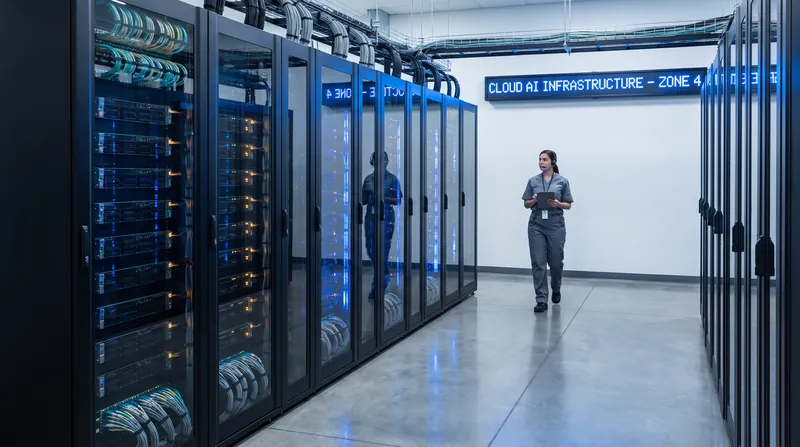
A machine that draws roughly 60 kilowatts of power—less than the HVAC system of a mid-sized office building—is about to be physically wired into one of the world's most power-hungry environments: a U.S.-based Oracle artificial intelligence data center.[4]
The integration is the centerpiece of a multi-year partnership announced Tuesday between cloud giant Oracle and quantum hardware maker Quantinuum.[1][3]
Under the agreement, Oracle Cloud Infrastructure (OCI) will host Quantinuum's third-generation Helios quantum computer on-site.[1][5]
The goal is to allow enterprise developers to seamlessly route computational traffic between Oracle's massive clusters of classical graphics processing units (GPUs) and Quantinuum's quantum processing unit (QPU).[1][2]
While the technology industry has spent the last two years fixated on scaling up classical AI models, the Oracle-Quantinuum pact highlights a parallel race: the push to commercialize hybrid quantum-classical computing.[1]
The premise of hybrid compute is that quantum computers are not designed to replace classical supercomputers or AI accelerators.[2]
Instead, they act as highly specialized co-processors. A classical AI model might handle the vast majority of a workload, such as parsing massive datasets, but hand off a specific, intractable optimization bottleneck to the quantum system.[2][4]
"We believe the next phase of enterprise computing will be shaped by bringing quantum, AI, and high-performance computing together," Quantinuum Chief Executive Officer Rajeeb Hazra said in a statement accompanying the announcement.[1]
To understand the actual capability being deployed, it is necessary to look past the marketing language of "the most accurate commercial quantum computer" and examine the hardware itself.
Helios, which Quantinuum launched commercially in November 2025, is a trapped-ion system featuring 98 physical qubits.[4]
In the quantum realm, physical qubits are notoriously fragile and prone to errors caused by environmental noise or temperature fluctuations.
However, Quantinuum has demonstrated the ability to use those 98 physical qubits to create 48 highly stable "logical" qubits, achieving an average two-qubit gate fidelity of 99.921%.[4]
That fidelity threshold is critical because it allows the machine to run deeper, more complex algorithms before errors overwhelm the calculation.
For enterprise cloud architects, the appeal of the Oracle partnership lies in governance and accessibility. Historically, experimenting with quantum hardware required specialized facilities, bespoke contracts, and entirely separate workflows.[3][4]
By placing Helios directly inside an OCI facility, Oracle allows its customers to access the quantum system using the same identity management, billing, and security frameworks they already use for their classical cloud workloads.[1][4]
Mahesh Thiagarajan, Executive Vice President of Oracle Cloud Infrastructure, noted that the arrangement gives developers "a practical and secure way to explore how quantum computing could complement their existing AI and HPC workloads."[5]
The potential applications span several computationally heavy industries. The companies are targeting pharmaceutical firms looking to simulate molecular interactions for drug discovery, financial institutions running complex risk models, and logistics companies solving large-scale routing optimizations.[2]
There is also a significant energy component to the hybrid equation. As classical AI data centers push the limits of regional power grids—often requiring tens of megawatts to operate—the 60-kilowatt power draw of the Helios system offers a glimpse of a more sustainable computational path for specific tasks.[4]
Where opinion splits
Enterprise Cloud Architects
Focuses on the governance, security, and seamless integration of quantum resources.
For the engineers managing massive corporate data environments, the primary hurdle to quantum adoption hasn't just been the physics—it has been the logistics. Procuring time on a standalone quantum computer typically requires separate vendor agreements, distinct security audits, and moving sensitive data across the open internet. By physically placing the Helios system inside an Oracle facility, architects can route data to the quantum processor using the same virtual private networks, identity access management, and billing structures they already trust for their classical workloads.
Quantum Researchers
Focuses on the fidelity of the hardware and the ability to test hybrid algorithms at scale.
From a scientific perspective, the value of this partnership lies in the specific hardware being deployed. Quantinuum's trapped-ion architecture, which boasts a 99.921% two-qubit gate fidelity, allows researchers to experiment with logical qubits that are highly resistant to environmental noise. By pairing this stable quantum core directly with Oracle's massive GPU clusters, researchers can finally test theoretical hybrid algorithms—where a neural network hands off a specific optimization bottleneck to a quantum circuit—in a low-latency, real-world environment.
Energy-Conscious Infrastructure Planners
Focuses on the stark contrast in power consumption between quantum systems and classical supercomputers.
As the generative AI boom pushes data center power requirements into the hundreds of megawatts, infrastructure planners are increasingly desperate for compute efficiency. A leading classical supercomputer can draw upwards of 30 megawatts of power. In contrast, the Helios quantum system draws approximately 60 kilowatts—roughly the equivalent of a few dozen residential homes. While quantum computers cannot replace GPUs for training large language models, offloading specific, highly complex simulations to a low-power quantum system represents a critical strategy for capping the exponential growth of data center energy consumption.
Key points
- Quantinuum's 98-qubit Helios system will be deployed inside a U.S.-based Oracle AI data center.
- Oracle Cloud Infrastructure (OCI) customers will access the quantum hardware alongside existing GPU and supercomputing services.
- The hybrid approach targets computationally heavy fields like drug discovery, materials science, and financial modeling.
- Helios draws approximately 60 kilowatts of power, a fraction of the megawatts required by traditional supercomputers.
Unanswered questions
- The financial terms of the multi-year partnership between Oracle and Quantinuum.
- The exact date when the Oracle Cloud quantum service will reach general commercial availability.
- The pricing structure for enterprise customers accessing the Helios system via Oracle Cloud Infrastructure.
How we got here
Nov 2025
Quantinuum commercially launches its third-generation Helios quantum computer, featuring 98 physical qubits.
Aug 2026
Oracle and Quantinuum announce a multi-year partnership to deploy Helios inside an Oracle Cloud data center.
Late 2026
Oracle is expected to launch a developer preview of the new hybrid quantum-AI cloud service.
- Enterprise Cloud Providers
- Focuses on integrating quantum capabilities into existing classical workflows to retain and empower enterprise customers.
- Quantum Hardware Developers
- Focuses on proving the real-world utility, stability, and fidelity of trapped-ion systems in commercial environments.
- Financial & Market Analysts
- Focuses on the commercial viability, energy efficiency, and competitive positioning of the partnership in the broader tech sector.
Perspectives this story doesn't cover
- Classical Supercomputer Manufacturers
- Open-Source Quantum Framework Developers
Sources
Source coverage
5 outlets
3 viewpoints surfaced





- [1]ReutersFinancial & Market Analysts
Quantinuum and Oracle on Tuesday announced a multi-year partnership
Read on Reuters → - [2]Constellation ResearchEnterprise Cloud Providers
Quantinuum said it will deploy its Helios quantum computer in US Oracle Cloud
Read on Constellation Research → - [3]Investing.comEnterprise Cloud Providers
Quantinuum and Oracle announced today a multi-year partnership
Read on Investing.com → - [4]StocktwitsQuantum Hardware Developers
Oracle and Quantinuum have partnered to deploy the Helios trapped-ion
Read on Stocktwits → - [5]MorningstarFinancial & Market Analysts
The quantum computing company Quantinuum said it has signed a multi-year
Read on Morningstar →

More in Technology
See all →AI Infrastructure
Enterprises Pivot to 'Multi-Silicon AI' as Power Constraints Cap GPU Growth
3 sources
Cloud Security
The Mechanics of the Cloud Shared Responsibility Model: Who Secures What in IaaS, PaaS, and SaaS?
9 sources

AI Infrastructure
Cisco, Nvidia, and Supermicro Launch Full-Stack AI Infrastructure for Sovereign Clouds
7 sources

Cloud Regulation
EU's DORA Regulation Forces Financial Sector to Confront Cloud Concentration Risk and Operational Resilience Mandates
4 sources

Comments
Every angle. Every day.
Get Technology stories with full source coverage and perspective breakdowns, free every day.