
The Mechanics of the Rent Burden: How 7 Million Low-Rent Units Vanished and What the Data Shows
A comprehensive look at the structural forces driving the U.S. rental affordability crisis, as new data reveals 22.7 million renter households are now cost-burdened.

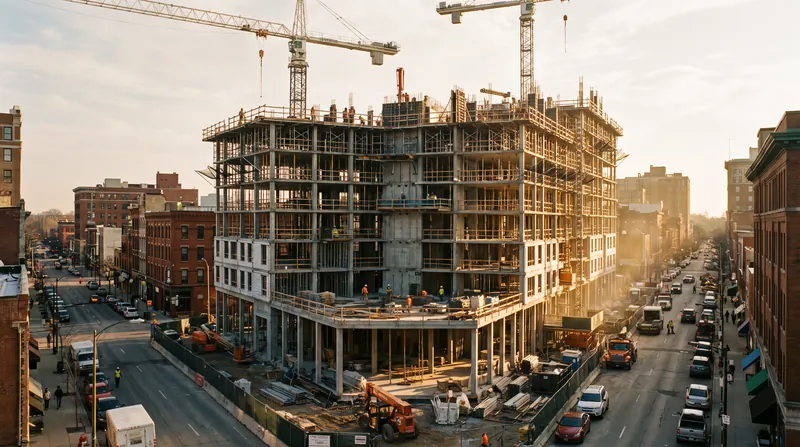
- Supply-Side Reformers
- Focus on zoning deregulation and increasing the overall housing supply to naturally lower costs.
- Public Subsidy Advocates
- Argue that the private market cannot serve low-income renters without robust federal and state financial intervention.
- Tenant Protection Advocates
- Prioritize rent control, anti-eviction laws, and preserving existing affordable units over new market-rate construction.
Fast facts
- A record 22.7 million U.S. renter households are now cost-burdened, spending more than 30 percent of their income on housing.
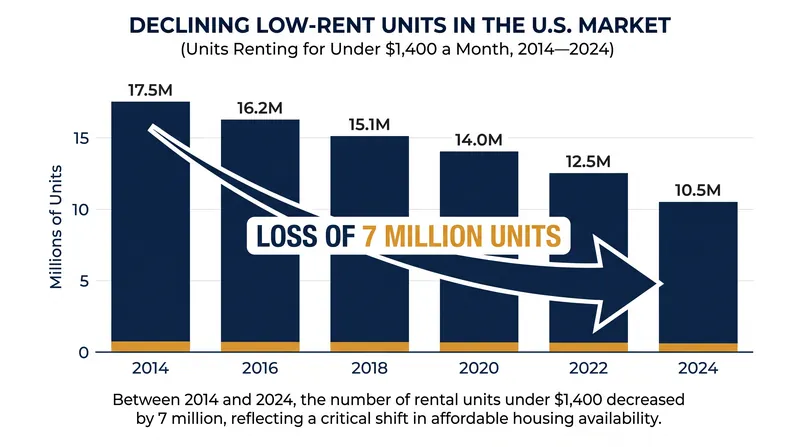
- The supply of low-rent units has sharply declined, with 7 million units renting for under $1,400 a month vanishing over the last decade.
- Rising construction costs, insurance premiums, and zoning restrictions have made it structurally difficult to build affordable housing without subsidies.
- In response, states and cities are innovating with new funding tools, zoning reforms, and mixed-income housing models to fill the gap.
Why this matters
Understanding the mechanics of the housing shortage is essential for renters navigating the market and for communities deciding how to zone and build for the future.
For a family looking for an apartment in a mid-sized American city, the abstract concept of a housing shortage translates into a very concrete reality: the math simply no longer works. The standard measure of housing affordability—the 30 percent rule—dictates that a household should spend no more than 30 percent of its gross income on rent and utilities. Yet, according to the latest comprehensive data from the Joint Center for Housing Studies of Harvard University, a record 22.7 million renter households are now cost-burdened, meaning they exceed that threshold. Of those, over 12 million are severely cost-burdened, spending more than half their income on housing, leaving little financial buffer for food, healthcare, or transportation.[1][2]
This affordability crisis is not merely a symptom of rising demand; it is the result of a structural disappearance of affordable supply. Over the past decade, the U.S. rental market has seen its lowest-cost units systematically vanish. The Harvard report documents that the number of units renting for less than $1,400 a month decreased by over 7 million between 2014 and 2024. Even more critically, 2.5 million units that once rented for less than $600 a month have disappeared entirely from the market. For a renter earning a median wage, this means the entry-level housing that once served as a stepping stone has been effectively erased.[1]
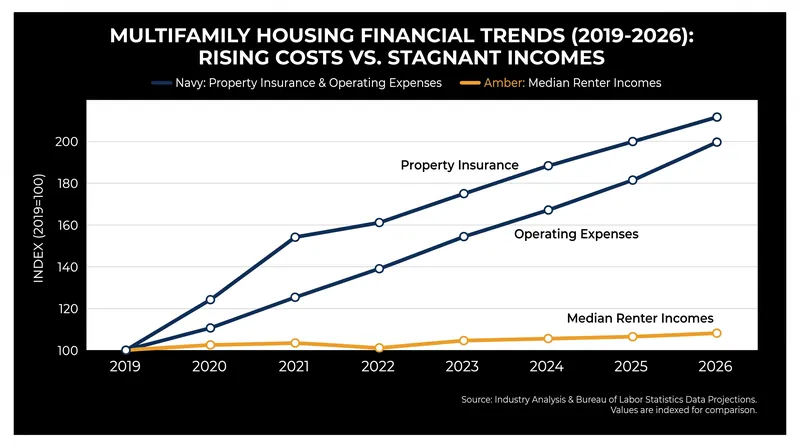
The mechanics behind this disappearance are rooted in the hard costs of maintaining and operating real estate. Property owners are facing a barrage of escalating expenses that make preserving low-rent units economically unfeasible. Multifamily property insurance premiums have doubled since 2019, while routine operating expenses—from maintenance to property taxes—have climbed by 10 to 20 percent. When the baseline cost to simply keep a building open rises, landlords inevitably pass those costs onto tenants, pushing formerly affordable units into higher price tiers or prompting owners to redevelop the properties entirely to target higher-income renters.[1][3]
Building new affordable housing to replace those lost units is equally constrained by structural economics. In the United States, the overwhelming majority of affordable housing is produced by the private sector, which relies on private financing that requires a return on investment. However, there is a fundamental gap between what it costs to acquire land, secure permits, and construct a modern multifamily building, and the rent that a lower-income family can actually afford to pay. Without intervention, developers are financially incentivized to build luxury or market-rate units, as those are the only projects that generate enough revenue to satisfy lenders and cover construction costs.[2][3]
Building new affordable housing to replace those lost units is equally constrained by structural economics.
Local zoning laws and land-use regulations further complicate the equation. In many municipalities, restrictive zoning codes prohibit the construction of dense, multifamily housing, mandating single-family homes on large lots instead. These regulations artificially limit the supply of land available for apartment buildings, driving up land costs and making it nearly impossible to build affordable units by right. For the average renter, this means that even when developers want to build more housing in their neighborhood, local administrative hurdles and community opposition often prevent those projects from breaking ground.[2][3]
Historically, the federal government has attempted to bridge this gap through subsidies like the Low-Income Housing Tax Credit (LIHTC) and Section 8 housing vouchers. The LIHTC program, which provides tax incentives to developers who build affordable units, has been the primary engine for new affordable housing production in the U.S., delivering millions of units since its inception. However, federal assistance falls far short of the actual need. Only about one in four eligible households receives federal rental assistance, leaving the vast majority of low-income renters to navigate the private market unaided.[1][2]
In response to this federal shortfall, states and local municipalities are increasingly taking matters into their own hands, innovating with new funding tools and regulatory reforms. Cities are establishing local housing trust funds, issuing multifamily private activity bonds, and leveraging real estate transfer taxes to subsidize construction directly. More jurisdictions are also tackling the regulatory side of the equation by easing zoning restrictions to spur supply. For example, states like Maine, Montana, and Washington have enacted major zoning reforms, and cities like Cambridge, Massachusetts, now permit four-story multifamily housing by right citywide.[1]
These local innovations represent a crucial shift in how the United States approaches housing affordability. By combining targeted financial subsidies with aggressive zoning reform, communities are attempting to rewrite the underlying economics of the rental market. While the loss of 7 million low-rent units has created a historic burden for American renters, the emerging consensus among housing advocates and local policymakers is that the crisis is solvable. For the renter navigating today's market, these structural changes offer a blueprint for a future where housing supply finally aligns with the reality of working-class incomes.[3]
Viewpoints in depth
Housing Supply Advocates
Argue that restrictive zoning and administrative hurdles are the primary cause of the shortage.
This camp points to the fundamental laws of supply and demand, arguing that local zoning codes—which often mandate single-family homes on large lots—artificially restrict the amount of housing that can be built. By legalizing dense, multifamily housing by right, they argue, cities can lower land costs and incentivize developers to build enough units to stabilize or lower rents across the board.
Affordable Housing Preservationists
Focus on the need to protect existing low-rent units from redevelopment and expand direct subsidies.
Preservationists argue that simply building more market-rate housing will not help the lowest-income renters, as new construction is inherently expensive. Instead, they advocate for stronger tenant protections, rent stabilization, and a massive expansion of federal programs like Section 8 and the Low-Income Housing Tax Credit to ensure that vulnerable populations are not displaced while the market slowly corrects itself.
Sources
Source coverage
3 outlets
3 viewpoints surfaced



[1]Joint Center for Housing Studies of Harvard UniversitySupply-Side Reformers
America's Rental Housing 2026
Read on Joint Center for Housing Studies of Harvard University →[2]WikipediaPublic Subsidy Advocates
Affordable housing in the United States
Read on Wikipedia →[3]Factlen Editorial TeamTenant Protection Advocates
Synthesis by Factlen editorial team
Read on Factlen Editorial Team →
Comments
Every angle. Every day.
Get real estate stories with full source coverage and perspective breakdowns delivered to your inbox.