
How 'Molecular Sponges' Are Pulling Hundreds of Gallons of Drinkable Water From Desert Air
A new generation of atmospheric water harvesters, powered by Nobel-winning chemistry and solar energy, is successfully extracting clean drinking water in environments with less than 20% humidity.
By Factlen Editorial Team
- Materials Scientists
- Focus on optimizing the chemical structure of MOFs and hydrogels to maximize water yield and durability.
- Commercial Innovators
- Prioritize scaling the technology into deployable, cost-effective units for off-grid communities and disaster relief.
- Applied Engineers
- Seek to integrate water-harvesting capabilities into everyday objects, from wearable gear to building infrastructure.
What's not represented
- · Public Water Utilities
- · Arid-Region Farmers
- · Disaster Relief Organizations
Why this matters
With over 2 billion people lacking safely managed drinking water, the ability to pull clean water directly from arid air using only solar power could revolutionize disaster relief and provide a decentralized lifeline to drought-stricken regions.
Key points
- A new generation of atmospheric water harvesters uses Metal-Organic Frameworks (MOFs) to extract drinking water from desert air.
- The technology, pioneered by 2025 Nobel laureate Omar Yaghi, remains effective even when relative humidity drops below 20%.
- Commercial units the size of shipping containers can now produce up to 1,000 liters of clean water per day while running entirely off-grid.
- MIT engineers recently discovered that ultrasonic waves can release trapped water 45 times faster than traditional solar heating.
- Parallel research is integrating water-harvesting hydrogels into wearable textiles and building materials.
The Earth's atmosphere is a hidden, floating ocean. Even in the driest deserts, millions of gallons of water vapor circulate overhead. For decades, engineers have tried to tap into this atmospheric well, but traditional methods like cooling condensation require high humidity and massive amounts of electricity, making them useless in the arid, water-stressed regions that need them most.
Now, a breakthrough in molecular chemistry is rewriting the rules of water scarcity. Powered by materials known as Metal-Organic Frameworks (MOFs), a new generation of atmospheric water harvesters is successfully pulling hundreds of gallons of drinkable water from thin air, even in bone-dry desert environments.[1][2]
The foundation of this technology was laid by Omar M. Yaghi, a chemist at the University of California, Berkeley, who was awarded a share of the 2025 Nobel Prize in Chemistry for his pioneering work. In the 1990s, Yaghi invented MOFs—highly porous, crystalline structures composed of metal nodes connected by organic linkers.[1][7]
To understand a MOF, imagine a microscopic sponge with an almost incomprehensible internal surface area. Just a few grams of the material can contain the surface area of an entire football field. By precisely tuning the chemical structure of these pores, scientists can design MOFs that are highly hydrophilic, meaning they eagerly grab onto water molecules floating in the air while ignoring other gases.[1]

The true magic of MOF-based atmospheric water harvesting lies in its energy efficiency. At night, when temperatures drop and relative humidity slightly rises, the MOF passively absorbs water vapor from the air. During the day, the system is sealed, and ambient sunlight or low-grade thermal energy is used to heat the material.[6]
This gentle heat forces the MOF to release its trapped water—a process called desorption. The released vapor then hits a condenser, which is kept at the temperature of the outside air, turning the vapor into pure, drinkable liquid water. Because the process relies on ambient solar energy rather than mechanical compressors, the devices can operate entirely off-grid.[6]
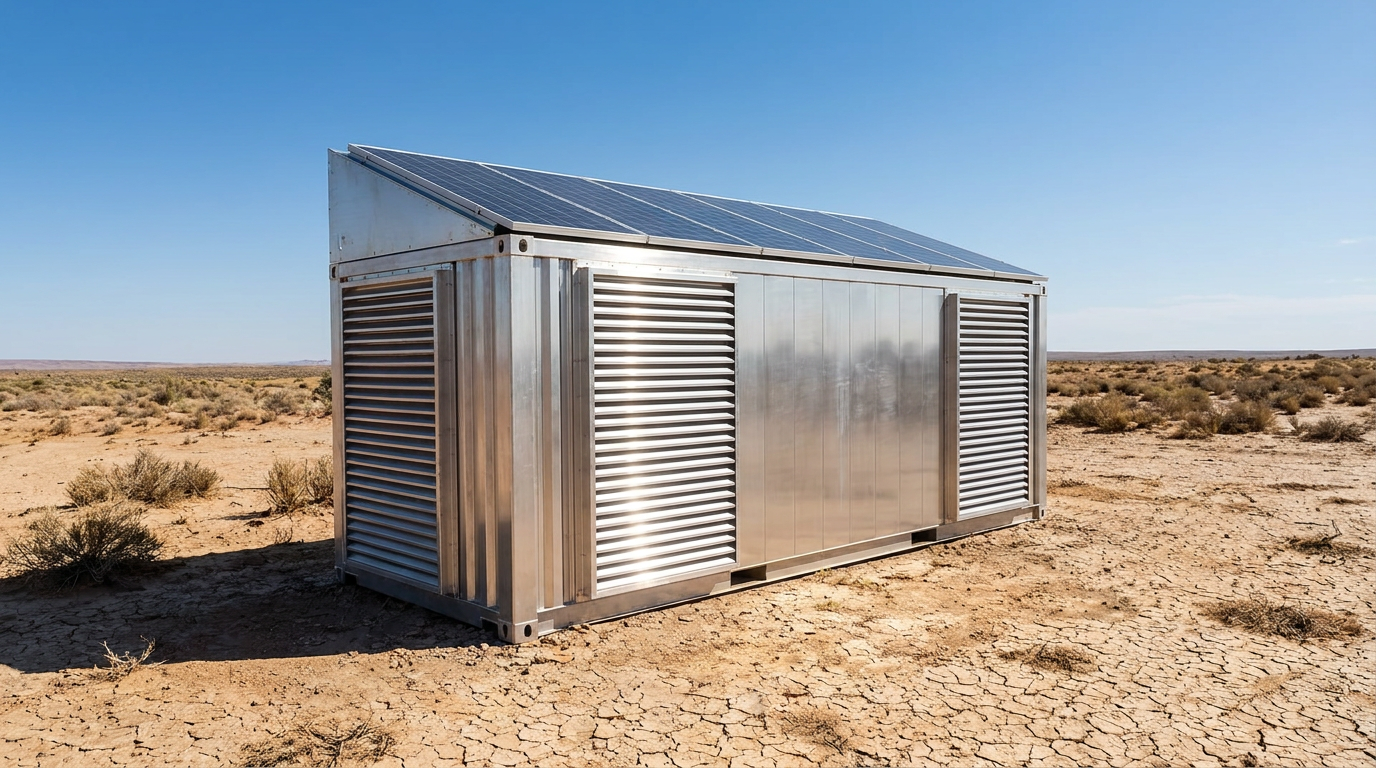
For years, this technology existed primarily in university laboratories, yielding only a few drops of water in proof-of-concept demonstrations. Today, it is rapidly scaling into commercial viability. Atoco, a California-based startup founded by Yaghi, recently unveiled plans for container-sized harvesting units designed for community deployment.[1][2]
According to the company, these rugged, off-grid units can generate up to 1,000 liters—about 264 gallons—of clean water per day. Crucially, they are engineered to function in environments with relative humidity below 20 percent, conditions typical of the Mojave Desert or the arid regions of the Middle East and North Africa.[1][2]

According to the company, these rugged, off-grid units can generate up to 1,000 liters—about 264 gallons—of clean water per day.
The implications for global water security are profound. With an estimated 2.1 billion people worldwide lacking safely managed drinking water, decentralized water stations could provide a lifeline. These systems are particularly valuable for disaster relief, where hurricanes or earthquakes frequently sever centralized water mains and power grids for weeks at a time.[2]
As commercialization accelerates, parallel research is dramatically improving the speed and efficiency of the extraction process. Historically, the slowest step in atmospheric harvesting has been waiting for the sun to heat the sorbent and release the water, a cycle that can take hours.[2]
In late 2025, engineers at the Massachusetts Institute of Technology reported a major breakthrough: using ultrasonic waves to physically shake the water out of the MOF material. This acoustic shortcut completes the desorption process in minutes rather than hours, making the system up to 45 times more efficient than relying on solar heat alone.[2]
The MIT team calculates that by powering a small ultrasonic emitter with a basic solar panel, a harvesting unit could run dozens of rapid collection-and-release cycles throughout a single day, exponentially increasing its total water yield without increasing its physical footprint.[2]

Meanwhile, other researchers are exploring alternative materials inspired by biology. At the University of Nevada, Las Vegas, a team led by mechanical engineering professor H. Jeremy Cho has developed a hydrogel membrane skin that mimics the way tree frogs and air plants absorb ambient moisture.[3]
Commercialized through a startup called WAVR Technologies, this nature-inspired approach captures water vapor directly into a liquid salt solution. Outdoor testing in Las Vegas has proven the system effective down to 10 percent humidity, yielding roughly a gallon of water per day from a three-by-three-foot panel.[3]
The push to harvest atmospheric water is also shrinking in scale, moving from shipping containers to personal apparel. Researchers at the University of Texas at Austin recently published a study detailing a specialized textile that collects moisture from the air and funnels it into detachable harvesting units.[4]

In testing, a jacket made from this fabric produced between 400 and 900 milliliters of drinkable water per day. While still in the prototype phase, the technology points toward a future where hikers, soldiers, and emergency responders wear their water supply, passively hydrating as they move through the environment.[4]
Challenges remain before atmospheric water harvesting becomes ubiquitous. Materials scientists are currently using artificial intelligence to sift through millions of potential MOF configurations, searching for variants that are cheaper to synthesize and capable of surviving thousands of cycles without degrading.[5][8]
Yet, the transition from science fiction to deployable infrastructure is undeniably underway. By turning the sky into a decentralized reservoir, researchers are offering a powerful new tool to communities on the front lines of climate change and chronic drought.
How we got here
1995
Chemist Omar Yaghi successfully crystallizes the first Metal-Organic Frameworks, pioneering the field of reticular chemistry.
2017
Researchers demonstrate the first solar-powered MOF device capable of harvesting water from low-humidity desert air.
2021
Advanced MOF structures are developed that significantly increase water yield and cycle stability.
Late 2025
Omar Yaghi is awarded a share of the Nobel Prize in Chemistry; MIT engineers discover an ultrasonic method to speed up water extraction by 45 times.
Early 2026
Commercial startups unveil container-sized MOF units capable of producing 1,000 liters of water per day off-grid.
Viewpoints in depth
Materials Scientists
Focus on optimizing the chemical structure of MOFs and hydrogels to maximize water yield and durability.
For chemists and materials scientists, the primary frontier is molecular architecture. By tweaking the organic linkers and metal nodes within Metal-Organic Frameworks, researchers aim to create structures that not only hold more water but release it with minimal energy input. Recent breakthroughs in furan-based and aluminum-based MOFs have demonstrated remarkable stability, surviving hundreds of rapid adsorption-desorption cycles without degrading. The integration of artificial intelligence is now accelerating this process, allowing scientists to simulate millions of potential MOF structures to find the perfect balance of hydrophilicity and structural integrity before synthesizing them in the lab.
Commercial Innovators
Prioritize scaling the technology into deployable, cost-effective units for off-grid communities and disaster relief.
Startups and commercial ventures view atmospheric water harvesting as a decentralized infrastructure play. Rather than relying on massive, centralized desalination plants and miles of vulnerable piping, companies like Atoco envision a future of 'personalized water.' Their goal is to manufacture rugged, container-sized units that can be dropped into disaster zones, remote villages, or drought-stricken agricultural areas. For this camp, the engineering challenge is less about theoretical maximums and more about ruggedness, lowering the cost of the raw materials, and ensuring the systems can run entirely on ambient solar or low-grade waste heat without requiring a grid connection.
Applied Engineers
Seek to integrate water-harvesting capabilities into everyday objects, from wearable gear to building infrastructure.
A growing subset of engineers is moving beyond standalone generators to embed water-harvesting technology directly into the built environment and personal gear. Inspired by biological systems like tree frogs and desert beetles, these researchers are developing hydrogel 'skins' and specialized textiles. Their vision includes tents that provide drinking water for refugees, hiking jackets that passively hydrate extreme athletes, and building facades that pull moisture from the morning air to supply a family's daily needs. This perspective emphasizes form factor, weight reduction, and passive operation over sheer volume.
What we don't know
- How quickly the cost of synthesizing complex MOFs at an industrial scale can be reduced to make the technology accessible to low-income nations.
- The long-term durability of hydrogel membranes and MOF powders when exposed to real-world dust, pollution, and extreme weather over multiple years.
- Whether the daily water yields can be scaled up enough to support agriculture, rather than just individual drinking water needs.
Key terms
- Metal-Organic Framework (MOF)
- A class of highly porous, crystalline materials that can be engineered at the molecular level to capture and store specific molecules, such as water vapor.
- Atmospheric Water Harvesting (AWH)
- The process of extracting drinkable liquid water directly from the ambient air, typically using specialized sorbent materials or condensation.
- Sorbent
- A material used to absorb or adsorb liquids or gases. In water harvesting, sorbents pull moisture from the air.
- Desorption
- The process of releasing a captured substance. In this context, it refers to using heat or ultrasonic waves to force the MOF to release its trapped water.
- Hydrogel
- A network of polymer chains that are highly absorbent, used in some water-harvesting systems to capture and hold moisture.
Frequently asked
How much water is actually in the atmosphere?
The Earth's atmosphere holds approximately 12,900 cubic kilometers of water at any given time. Even in arid deserts, millions of gallons of water vapor float overhead.
What is a Metal-Organic Framework (MOF)?
A MOF is a highly porous synthetic material made of metal ions connected by organic molecules. It acts like a molecular sponge, with a massive internal surface area capable of trapping specific gases or water vapor.
Does this technology require a lot of electricity?
No. Unlike traditional dehumidifiers that use energy-intensive cooling compressors, MOF-based harvesters can operate entirely off-grid using ambient sunlight or low-grade thermal energy to release the trapped water.
Can it work in extremely dry climates?
Yes. Recent MOF designs and hydrogel membranes have been proven to successfully extract water in environments with relative humidity as low as 10% to 20%, such as Death Valley or the Atacama Desert.
Sources
Source coverage
8 outlets
3 viewpoints surfaced








[1]Tom's HardwareCommercial Innovators
Device that can extract 1000 liters of clean water a day from desert air revealed by 2025 Nobel Prize winner
Read on Tom's Hardware →[2]OkDiarioCommercial Innovators
A Nobel Prize chemist is turning dry air into 1,000 liters of water a day, and the machine could redraw the fight against drought
Read on OkDiario →[3]SciTechDailyApplied Engineers
Game-Changing Tech Turns Dry Desert Air Into Lifesaving Water
Read on SciTechDaily →[4]EngadgetApplied Engineers
Researchers are developing textiles that can produce drinking water from the air
Read on Engadget →[5]Journal of the American Chemical SocietyMaterials Scientists
Harvesting Water from Air with High-Capacity, Stable Furan-Based Metal–Organic Frameworks
Read on Journal of the American Chemical Society →[6]MaterialsMaterials Scientists
Metal–Organic Framework-Assisted Atmospheric Water Harvesting Enables Cheap Clean Water Available in an Arid Climate
Read on Materials →[7]WikipediaCommercial Innovators
Omar M. Yaghi
Read on Wikipedia →[8]ResearchGateMaterials Scientists
Sustainable Metal-Organic Framework Water Harvesters in the Artificial Intelligence Era
Read on ResearchGate →
Every angle. Every day.
Get environment stories with full source coverage and perspective breakdowns delivered to your inbox.