
How Millions of Abandoned Oil Wells Are Being Transformed Into Geothermal Power Plants
Engineers and startups are retrofitting depleted oil and gas wells to harvest clean, 24/7 geothermal energy, slashing the massive drilling costs that have historically held the renewable sector back.
By Factlen Editorial Team
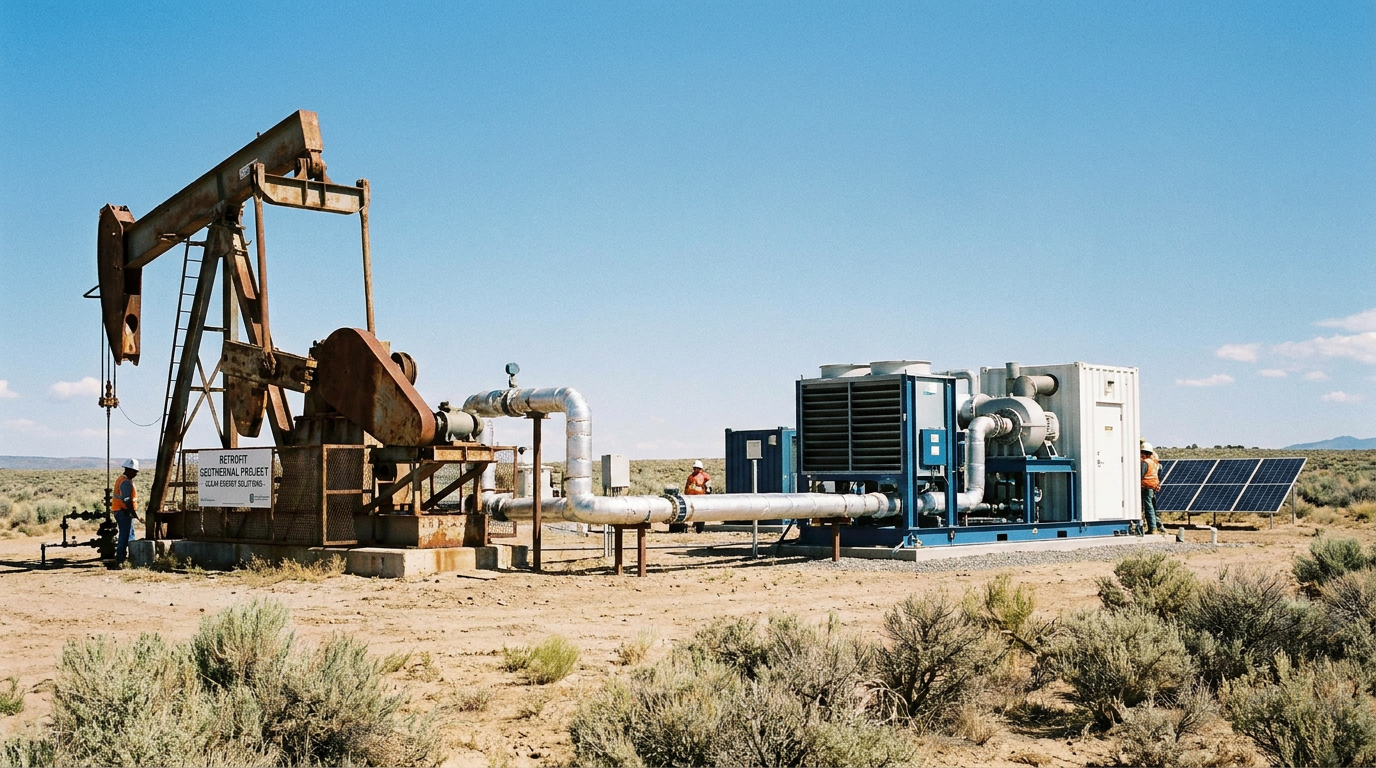
- Geothermal Innovators
- Focuses on scaling baseload clean power by bypassing the prohibitive upfront drilling costs that have historically held the industry back.
- Oil & Gas Industry
- Views well conversion as a pragmatic way to monetize end-of-life assets, reduce plugging liabilities, and transition their existing workforce.
- State Regulators
- Prioritizes mitigating the environmental hazards of leaking orphaned wells while generating local tax revenue and clean energy.
What's not represented
- · Local communities living near abandoned wells
- · Environmental watchdog groups monitoring well integrity
Why this matters
Geothermal energy provides constant, 24/7 clean power but has always been too expensive to scale due to drilling costs. By reusing existing fossil fuel infrastructure, we can rapidly expand zero-carbon energy while simultaneously cleaning up leaking, hazardous oil wells.
Key points
- Millions of abandoned oil and gas wells are being evaluated for conversion into clean geothermal energy sources.
- Reusing existing wellbores eliminates the massive drilling costs that typically account for up to 70% of a geothermal project's budget.
- Closed-loop systems allow heat to be extracted without fluids ever touching the surrounding rock, preventing contamination.
- The U.S. Department of Energy is actively funding pilot projects to accelerate the transition of fossil fuel infrastructure.
- The initiative provides a direct pathway for oil and gas workers to transition their skills into the renewable energy sector.
Across the United States, millions of abandoned oil and gas wells sit idle, scarring landscapes and quietly leaking methane into the atmosphere. For decades, these "orphaned" wells have been viewed strictly as an environmental liability and a massive financial burden for state governments. The traditional remediation method involves mobilizing a rig to pump the wellbore full of cement, permanently sealing the hole. It is a necessary but entirely defensive maneuver, costing taxpayers and companies tens of thousands of dollars per well while generating absolutely zero return on investment.[2][6]
But a paradigm shift is quietly taking hold across the energy sector. Instead of burying these liabilities, engineers and policymakers are realizing that these deep holes in the ground might actually be hidden assets. By retrofitting the existing infrastructure, the fossil fuel industry's discarded wells are being transformed into a source of clean, renewable geothermal energy. It is a rare win-win in the energy transition, offering a way to clean up environmental hazards while simultaneously unlocking a massive new source of zero-carbon power.[1][6]
Geothermal energy has long been considered the holy grail of the renewable sector. Unlike wind and solar, which are intermittent and require massive battery storage to smooth out their delivery, geothermal provides 24/7 baseload power. It harnesses the earth's natural subsurface heat to spin turbines and generate electricity rain or shine. However, despite its immense potential, geothermal energy has historically struggled to scale due to one prohibitive barrier to entry: the staggering cost of drilling.[1][3]
Carving a new hole thousands of feet into the earth's crust is an expensive and risky endeavor. In a standard geothermal project, the drilling phase alone accounts for 40% to 70% of the total capital expenditure. If a developer drills a well and fails to find the right combination of heat and permeability, millions of dollars are instantly lost. This high upfront risk has kept geothermal relegated to a niche role in the global energy mix, primarily clustered around natural hot springs and volcanic regions.[3][6]

This is exactly where abandoned oil and gas wells change the economic calculus. The most expensive part of the geothermal process—the drilling—has already been completed. The holes are already dug, the steel casings are already cemented into the earth, and the geological data regarding subsurface temperatures is already mapped. By repurposing this existing infrastructure, energy developers can bypass the massive upfront capital costs and drastically lower the financial risk of bringing new geothermal power online.[3][5]
Recognizing this massive arbitrage opportunity, the U.S. Department of Energy (DOE) launched the "Wells of Opportunity" (WOO) initiative. Funded by the Geothermal Technologies Office, the program actively partners with existing well owners and operators to tap into the idle infrastructure. By providing millions of dollars in grant funding, the DOE is accelerating pilot projects across the country, proving that the legacy infrastructure of the fossil fuel era can be directly ported over to the clean energy economy.[1][2]
So, how does the conversion process actually work? Engineers generally rely on two primary methods, depending on the state of the well. The first is known as "co-production." In many late-stage oil and gas wells, operators pump up significantly more hot water than actual hydrocarbons. Historically, this co-produced water was treated as a costly waste byproduct. Now, companies are routing that boiling fluid through binary cycle power plants to generate commercial electricity before safely reinjecting the water back into the earth.[1][3]
Engineers generally rely on two primary methods, depending on the state of the well.
The second, more revolutionary method is designed for fully depleted or abandoned wells. Known as a "closed-loop" system or a Wellbore Heat Exchanger (WBHE), this approach does not require extracting any fluids from the actual reservoir. Instead, engineers insert a U-shaped or coaxial pipe directly into the existing steel casing of the well. A proprietary working fluid is then circulated down the pipe, where it absorbs the intense ambient heat of the deep earth before returning to the surface to drive a turbine.[3][6]

The closed-loop approach is particularly attractive because it is environmentally pristine. Because the working fluid remains entirely contained within the inserted pipes, it never makes physical contact with the surrounding rock or the residual hydrocarbons left in the reservoir. This isolation completely eliminates the risks of subsurface contamination, while also protecting the power generation equipment on the surface from the scaling and corrosion that often plague traditional open-loop geothermal systems.[3]
The momentum behind these retrofits is accelerating rapidly at the state level. In June 2026, Colorado commissioned a comprehensive statewide engineering study to evaluate its entire orphaned well program for geothermal conversion. Rather than simply spending federal infrastructure funds to plug the holes, the Colorado Energy and Carbon Management Commission is actively screening sites for bottom-hole temperatures and water flow, looking to identify prime candidates for electricity generation.[5]
The scale of the opportunity uncovered by these early assessments is staggering. Gradient Geothermal, a Denver-based startup involved in the Colorado feasibility study, estimates that up to 500,000 abandoned wells across the United States possess the right thermal conditions for conversion. If fully realized, this repurposed infrastructure could represent up to 13 gigawatts of clean, reliable power—enough to fundamentally alter the grid dynamics in regions with long histories of oil and gas extraction.[5]

Beyond traditional electricity generation, innovators are finding entirely new ways to utilize these deep wells. In California, a startup backed by a $6 million DOE grant is currently demonstrating a "Geologic Thermal Energy Storage" (GeoTES) system. The project uses parabolic solar collectors to gather the sun's heat during the day, injecting that thermal energy into a depleted oil reservoir underground. The sandstone reservoir acts as a massive geological battery, capable of storing the heat for over 1,000 hours before discharging it to the grid.[4]
Even when an abandoned well's subsurface temperature is not quite hot enough to efficiently generate commercial electricity, it can still be highly valuable to the surrounding community. Lower-temperature wells are increasingly being retrofitted for "direct-use" applications. Instead of using the heat to spin a power-generating turbine, the extracted thermal energy is piped directly into local infrastructure. This direct heat transfer can provide essential climate control for industrial manufacturing processes, warm massive agricultural greenhouses during the winter months, or completely offset the heavy heating utility costs of nearby elementary and high schools.[1][3]
Despite the immense promise, the transition from oil well to geothermal asset is not without technical hurdles. Decades-old cement and steel casings degrade over time, particularly in harsh, highly pressurized subsurface environments. Before any retrofit can begin, engineers must conduct rigorous well-integrity assessments to ensure the casing can withstand the thermal stresses of continuous geothermal circulation. Upgrades to seals, valves, and monitoring systems are almost always required.[3][6]
Furthermore, not every abandoned well is a viable candidate. Success depends heavily on the specific geological setting, the depth of the wellbore, and the natural geothermal gradient of the region. A shallow well in a cold geological zone will never produce enough heat to justify the cost of the surface equipment. Careful, data-driven screening is essential to separate the highly profitable conversion candidates from the duds that simply need to be permanently plugged.[3][5]
Yet, the overarching economic and social logic of the geothermal transition remains undeniably compelling for both state governments and private developers. By merging the legacy infrastructure of the 20th century with the advanced clean energy technologies of the 21st, the industry is charting a highly pragmatic path forward. This approach significantly reduces the net cost of environmental remediation, creates sustainable local employment in rural communities, and delivers firm, zero-carbon power to the electrical grid without the need for massive new land disturbances or controversial zoning battles.[5][6]

Perhaps most importantly, the geothermal pivot offers a direct lifeline to the existing oil and gas workforce. The skills required to drill, case, and manage a geothermal well are nearly identical to those used in hydrocarbon extraction. By transforming idle oil patches into bustling geothermal fields, the initiative ensures that the roughnecks, petroleum engineers, and rig operators who built the modern energy system will have a secure, highly valued place in its sustainable future.[1][2]
How we got here
2020
The U.S. Department of Energy launches the Wells of Opportunity (WOO) initiative to explore repurposing oil wells.
Jan 2022
The DOE awards $8.4 million to four pilot projects testing the geothermal potential of abandoned wells.
Aug 2024
A $6 million federal grant is awarded for a 1,000-hour thermal energy storage demonstration in depleted California oil wells.
Jun 2026
Colorado commissions a statewide engineering study to evaluate its orphaned well program for geothermal conversion.
Viewpoints in depth
Geothermal Innovators' view
Bypassing the drilling barrier to scale baseload power.
For researchers and clean-energy startups, the primary appeal of repurposing oil wells is purely economic. Geothermal energy is widely recognized as the ideal renewable resource because it provides constant, 24/7 baseload power, unlike intermittent wind and solar. However, the staggering cost of drilling new wells—often accounting for up to 70% of a project's capital—has kept the technology marginalized. By utilizing existing wellbores, innovators argue they can instantly slash capital expenditures, making geothermal power financially competitive with natural gas and solar on a much broader scale.
The Oil & Gas Industry's view
Transforming environmental liabilities into revenue-generating assets.
Fossil fuel operators are increasingly viewing geothermal conversion as a strategic off-ramp for aging infrastructure. When a well stops producing profitable volumes of oil, companies are legally obligated to plug and abandon it—a process that costs tens of thousands of dollars per well and yields zero financial return. By retrofitting these sites for geothermal energy or thermal storage, operators can eliminate their plugging liabilities, generate new revenue streams, and provide a seamless transition for their highly skilled subsurface workforce into the clean energy economy.
State Regulators' view
Solving the orphaned well crisis while boosting local energy resilience.
State governments and environmental agencies are primarily focused on the remediation aspect of the technology. Millions of orphaned wells across the country are currently leaking methane—a potent greenhouse gas—and threatening local groundwater supplies. Regulators view geothermal conversion as a way to stretch federal cleanup funds further. Instead of simply pouring cement into the ground at the taxpayers' expense, states like Colorado and Oklahoma are creating legislative frameworks to turn these environmental hazards into localized power plants that support the regional grid.
What we don't know
- How many of the estimated 500,000 viable wells will pass rigorous structural integrity tests after decades of degradation.
- Whether the regulatory permitting process for geothermal conversion can be streamlined enough to attract large-scale private equity investment.
Key terms
- Orphaned Well
- An abandoned oil or gas well for which no legally responsible owner can be found, often leaving the state to cover the expensive plugging costs.
- Baseload Power
- The minimum amount of electric power needed to be supplied to the electrical grid at any given time, a role geothermal energy can reliably fill 24/7.
- Co-production
- The simultaneous extraction of geothermal heat from the hot water that is naturally brought to the surface alongside oil and gas.
- Closed-loop System
- A geothermal setup where a working fluid circulates through pipes inside the wellbore to absorb heat without ever touching the surrounding rock.
- Wellbore Heat Exchanger (WBHE)
- The technical term for the pipe assembly inserted into an existing well to extract thermal energy in a closed-loop geothermal system.
Frequently asked
Can any abandoned oil well be used for geothermal energy?
No. Wells must be carefully evaluated for sufficient depth, bottom-hole temperature, and structural integrity before they can be successfully converted into power-generating assets.
Does this conversion process involve fracking?
No. Converting an existing well into a closed-loop geothermal system simply involves circulating fluid through pipes that are inserted into the existing steel wellbore.
How much money does reusing an old well actually save?
Drilling a new well typically accounts for 40% to 70% of a geothermal project's total capital cost. Reusing an existing well eliminates this massive upfront expense entirely.
What happens to the fluid pumped into the well?
In a closed-loop system, the working fluid remains entirely contained within the pipes, absorbing ambient heat from the earth and returning to the surface without ever interacting with groundwater or reservoir fluids.
Sources
Source coverage
6 outlets
3 viewpoints surfaced






[1]U.S. Department of EnergyGeothermal Innovators
Wells of Opportunity (WOO) Initiative
Read on U.S. Department of Energy →[2]Journal of Petroleum TechnologyOil & Gas Industry
DOE Program Seeks To Reuse Abandoned Oil Wells for Geothermal Production
Read on Journal of Petroleum Technology →[3]Applied EnergyOil & Gas Industry
Repurposing abandoned oil and gas wells for geothermal energy extraction: A review of concepts, challenges, and opportunities
Read on Applied Energy →[4]SolarPACESGeothermal Innovators
1000-hour thermal energy storage in abandoned oil wells
Read on SolarPACES →[5]Orphan & Idle WellsState Regulators
Colorado evaluating abandoned oil wells for geothermal conversion
Read on Orphan & Idle Wells →[6]Factlen Editorial TeamState Regulators
Synthesis by Factlen editorial team
Read on Factlen Editorial Team →

Every angle. Every day.
Get energy stories with full source coverage and perspective breakdowns delivered to your inbox.