
How Biophilic Design is Transforming Interiors from Aesthetic Trends to Health Necessities
Rooted in evolutionary biology, biophilic design integrates natural elements into the built environment to actively lower stress and improve cognitive function. In 2026, the movement has evolved past simple houseplants into immersive, science-backed indoor ecosystems.
By Factlen Editorial Team
- Clinical & Psychological Researchers
- Focuses on the measurable physiological and cognitive health outcomes of nature exposure.
- Architectural & Design Practitioners
- Prioritizes the aesthetic integration of organic materials, tactile surfaces, and spatial flow in modern homes.
- Healthcare Facility Planners
- Emphasizes how natural environments can regulate emotions and improve safety in clinical and behavioral health settings.
What's not represented
- · Commercial Real Estate Developers
- · HVAC & Lighting Engineers
Why this matters
Residents of industrialized nations spend roughly 90% of their time indoors, often in sterile environments that subtly elevate stress hormones. By understanding and applying biophilic principles, readers can transform their homes and workspaces into restorative environments that actively lower blood pressure, boost creativity, and improve daily mental health.
Key points
- Biophilic design integrates natural light, organic materials, and living ecosystems into the built environment to support human health.
- The framework is built on 14 specific patterns, ranging from direct nature exposure to psychological spatial configurations.
- Clinical evidence shows biophilic environments lower stress hormones, reduce blood pressure, and accelerate hospital recovery times.
- In 2026, the trend has evolved from simple houseplants to immersive indoor ecosystems and tactile, earth-toned materials.
- Maintaining indoor living walls and water features requires precise lighting and humidity control, presenting an ongoing maintenance challenge.
In the early 2020s, interior design was heavily dominated by stark minimalism and cool gray palettes. But as urbanization accelerated and digital fatigue set in, a profound shift began to take hold. By 2026, the concept of "biophilic design" has evolved from a niche architectural buzzword into a fundamental framework for how we build and furnish our spaces. This approach is not merely about decorating with houseplants; it is an evidence-based philosophy that integrates natural light, organic materials, and living ecosystems directly into the built environment to actively support human health.[5][6]
The foundation of this movement rests on the "biophilia hypothesis," a term popularized by American biologist Edward O. Wilson in the 1980s. Wilson argued that humans possess an innate, genetically driven tendency to seek connections with nature and other forms of life. For the vast majority of human history, our species evolved outdoors, intimately attuned to the rhythms of the sun, the textures of the earth, and the sounds of water.[1][3]
Today, however, residents of industrialized nations spend roughly 90% of their time indoors. Environmental psychologists argue that this chronic disconnection from nature places a subtle but constant strain on the human nervous system. Biophilic design attempts to bridge this gap, erasing the rigid barrier between the natural world and the concrete jungle to create spaces that feel fundamentally alive and restorative.[6]
To move biophilic design from an abstract concept to a measurable architectural standard, researchers at the environmental consulting firm Terrapin Bright Green developed a comprehensive framework known as the "14 Patterns of Biophilic Design." This framework categorizes natural integration into three distinct pillars, providing a concrete blueprint for architects, interior designers, and urban planners to follow.[1]

The first pillar, "Nature in the Space," refers to the direct, physical presence of nature. This includes visual connections, such as large windows overlooking a garden, as well as non-visual stimuli like the sound of flowing water, the subtle shift of airflow, and dynamic, diffuse daylight that changes throughout the afternoon to keep occupants tethered to the natural progression of the day.[1]
The second pillar, "Natural Analogues," focuses on indirect evocations of nature. Because it is not always feasible to maintain living ecosystems indoors, designers use biomorphic forms—shapes and patterns that mimic leaves, shells, or branches—alongside natural materials like visibly grained wood and honed stone. The human brain processes these textures similarly to actual nature, triggering a mild relaxation response even in entirely constructed environments.[1][5]
The final pillar, "Nature of the Space," deals with spatial configurations and human psychology. It draws heavily on evolutionary concepts like "prospect" (having an unimpeded view over a distance) and "refuge" (having a safe, enclosed place to retreat). Spaces that balance open sightlines with cozy, protected alcoves naturally lower anxiety by satisfying our primal, evolutionary need for security.[1][4]
The surge in biophilic design's popularity is heavily driven by a growing body of clinical evidence linking these environments to measurable physiological benefits. When humans are exposed to natural elements, the parasympathetic nervous system engages, lowering heart rates and reducing the production of cortisol, a primary stress hormone that wreaks havoc on the body when chronically elevated.[3][4]
The surge in biophilic design's popularity is heavily driven by a growing body of clinical evidence linking these environments to measurable physiological benefits.
A 2024 systematic review published in Frontiers of the Built Environment analyzed the impact of biophilic design in hospital settings. The researchers found that integrating natural light, organic textures, and views of greenery significantly reduced hospitalization times, lowered patient mortality rates, and decreased the amount of pain medication requested by patients.[2]
The National Institutes of Health has also highlighted the therapeutic potential of biophilic interiors for managing chronic conditions. Recent analyses suggest that combining biophilic interventions—such as circadian light therapy, indoor water features, and natural wood finishes—can alleviate depressive symptoms and reduce the frequency of migraine headaches by providing a restorative sensory environment.[3]

Beyond healthcare, the cognitive benefits of biophilic design are reshaping the modern workplace and home office. Environmental psychologists have found that introducing natural elements into a previously sterile environment can boost creativity by up to 45% and increase overall productivity by nearly 40%. The subtle, non-rhythmic sensory stimuli of nature—like leaves gently moving in a breeze—provide "soft fascination," which allows the brain's directed attention to rest and recover.[6]
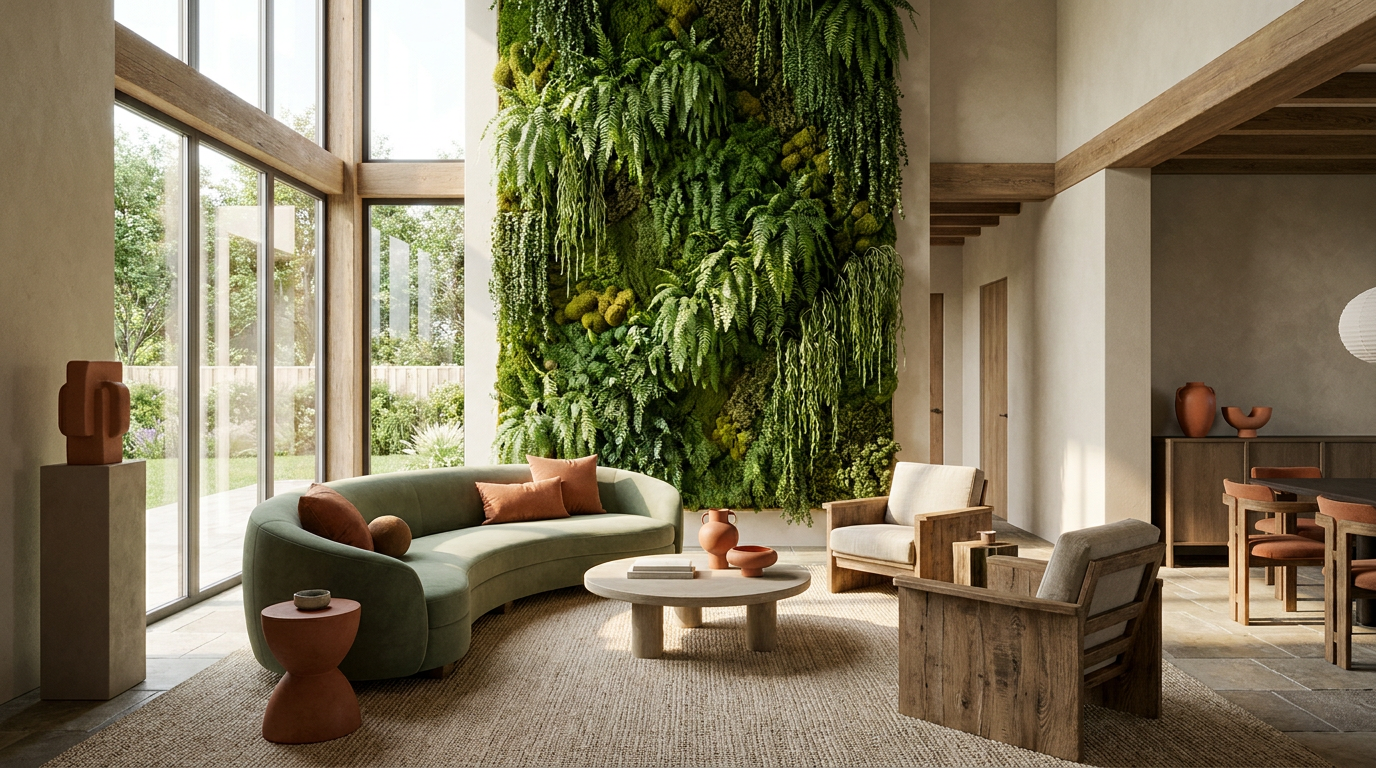
In residential design, 2026 has marked a definitive departure from the "potted plant" era. Designers are no longer satisfied with simply placing a fern in the corner of a room; they are constructing immersive indoor ecosystems. Floor-to-ceiling living walls, integrated water features, and air-purifying moss panels are becoming standard features in high-end renovations, blurring the line between indoor and outdoor living.[5]
This shift is accompanied by the rise of the "post-gray" color palette. Sterile whites and cool grays have been replaced by warm, earth-rooted tones: deep walnuts, terracottas, muddy greens, and soft clays. These colors are paired with tactile, matte finishes like limewash and tadelakt plaster, which invite touch and reflect light in soft, diffuse ways that mimic the natural world.[5]

The behavioral health sector has been particularly aggressive in adopting these principles. Facilities treating patients with heightened emotional or sensory sensitivities are prioritizing biophilic design to foster emotional regulation. By utilizing natural patterns and prospect-refuge spatial layouts, these facilities help patients maintain physical equilibrium, which reduces the likelihood of emotional outbursts and self-harm.[4]
However, the widespread adoption of biophilic design is not without its challenges and uncertainties. The most pressing issue is the maintenance burden of living ecosystems. Indoor vertical gardens and water features require precise humidity control, irrigation, and specialized biological lighting to survive, which can be energy-intensive and costly to maintain over the long term.[6]

If the mechanical systems supporting these features fail, the biophilic intent collapses, leaving behind dead foliage and stagnant water—which can actually increase occupant stress. Furthermore, traditional grow lights often emit harsh, clinical spectrums that clash with the warm, restorative aesthetics designers are trying to achieve, forcing a delicate balancing act between biological function and visual harmony.[5][6]
There is also the persistent risk of "greenwashing" in the design industry. Simply slapping a botanical print wallpaper on a wall or adding a single potted plant does not constitute biophilic design. True biophilia requires a structural, multi-sensory commitment to natural patterns, circadian lighting, and authentic organic materials.[1][6]
Despite these hurdles, the trajectory of interior design is clear. As our lives become increasingly digital and urbanized, the human longing for the natural world will only intensify. Biophilic design offers a scientifically grounded pathway to bring the outdoors in, transforming our homes and hospitals from mere shelters into active participants in our physical and mental well-being.[3][5]
How we got here
1984
Biologist Edward O. Wilson publishes 'Biophilia', hypothesizing humanity's innate biological connection to nature.
2014
Terrapin Bright Green publishes the '14 Patterns of Biophilic Design', creating a standardized framework for architects.
2020–2022
Pandemic lockdowns force millions indoors, sparking a massive surge in houseplant ownership and a reevaluation of residential spaces.
2026
Biophilic design matures into 'immersive ecosystems', moving beyond potted plants to integrated living walls and circadian lighting.
Viewpoints in depth
Clinical Researchers
Viewing biophilic design as a medical intervention that alters human biology.
For environmental psychologists and medical researchers, biophilic design is not an aesthetic choice but a biological necessity. They point to hard data showing that exposure to natural elements actively lowers cortisol levels, reduces blood pressure, and engages the parasympathetic nervous system. In clinical settings, this translates to faster recovery times and reduced reliance on pain medication, proving that the built environment directly manipulates human physiology.
Architectural Designers
Focusing on the sensory and tactile experience of living spaces.
Interior designers approach biophilia through the lens of daily human experience and sensory engagement. Moving away from the stark, sterile minimalism of the early 2020s, they advocate for 'Natural Analogues'—using visibly grained wood, honed stone, and limewash plaster to create environments that feel grounded and authentic. For this camp, the goal is to craft spaces that subconsciously soothe the occupants through texture, warm earth-toned palettes, and seamless indoor-outdoor flow.
Healthcare Planners
Utilizing nature to manage high-stress and behavioral health environments.
Facility planners in the behavioral health sector view biophilic design as a tool for emotional regulation and safety. By incorporating evolutionary spatial concepts like 'prospect and refuge,' they design communal areas where patients feel secure yet connected. The integration of natural light and organic patterns helps patients maintain physical equilibrium, which significantly reduces the likelihood of emotional outbursts and creates a safer environment for both patients and staff.
What we don't know
- The long-term energy costs and maintenance burdens of sustaining complex indoor living ecosystems at scale.
- How to perfectly standardize artificial biological lighting so it supports plant life without clashing with interior aesthetics.
- The exact threshold of nature exposure required to trigger measurable physiological benefits in different demographic groups.
Key terms
- Biophilia Hypothesis
- The scientific theory that humans possess an innate, genetically driven tendency to seek connections with nature and other forms of life.
- Natural Analogues
- Design elements that indirectly evoke nature, such as biomorphic shapes, visibly grained wood, or textures that mimic the natural world.
- Prospect and Refuge
- An evolutionary spatial concept where environments provide both an unimpeded view of the surroundings (prospect) and a safe, enclosed place to retreat (refuge).
- Circadian Lighting
- Artificial lighting systems designed to mimic the natural progression of sunlight throughout the day, helping to regulate the human sleep-wake cycle.
- Limewash
- A traditional, mineral-based paint finish that creates a matte, mottled, and highly tactile surface, often used in biophilic interiors to evoke natural earth.
Frequently asked
Is biophilic design just about adding more houseplants?
No. While plants are a component, true biophilic design is a structural approach that includes maximizing natural light, using organic materials like wood and stone, and designing spatial layouts that mimic natural environments.
Can biophilic design actually improve my health?
Yes. Clinical studies show that environments incorporating natural elements can lower cortisol levels, reduce blood pressure, and engage the parasympathetic nervous system, leading to reduced stress and faster recovery from illness.
How does biophilic design affect productivity?
Research indicates that introducing natural elements into workspaces can boost creativity by up to 45% and increase overall productivity by providing 'soft fascination,' which allows the brain to rest and recover from focused tasks.
What are the best colors for a biophilic room?
Biophilic palettes favor warm, earth-rooted tones over sterile whites or cool grays. Popular choices in 2026 include terracottas, sage greens, deep walnuts, and soft clays.
Sources
Source coverage
6 outlets
3 viewpoints surfaced





[1]Terrapin Bright GreenClinical & Psychological Researchers
14 Patterns of Biophilic Design
Read on Terrapin Bright Green →[2]Frontiers of the Built EnvironmentClinical & Psychological Researchers
Biophilic Design Positively Impacts the Physical and Mental Wellbeing of Patients
Read on Frontiers of the Built Environment →[3]National Institutes of HealthClinical & Psychological Researchers
Therapeutic Interior Environments: Combining Biophilic Design and Lifestyle Medicine
Read on National Institutes of Health →[4]Healthcare Design MagazineHealthcare Facility Planners
Prioritizing Biophilic Design in Behavioral Health Environments
Read on Healthcare Design Magazine →[5]Style SourcebookArchitectural & Design Practitioners
What Is Biophilic Design in 2026?
Read on Style Sourcebook →[6]Factlen Editorial TeamArchitectural & Design Practitioners
Synthesis by Factlen editorial team
Read on Factlen Editorial Team →
Every angle. Every day.
Get home stories with full source coverage and perspective breakdowns delivered to your inbox.