
How Artificial Intelligence is Unlocking the Lost Library of Herculaneum
A global competition using 3D X-ray scanning and machine learning has successfully deciphered ancient Roman scrolls carbonized by the eruption of Mount Vesuvius, recovering lost philosophical texts without ever unrolling them.
By Factlen Editorial Team
- Papyrologists & Historians
- Focused on the unprecedented access to lost philosophical and literary works that could rewrite classical history.
- Computer Vision Researchers
- Focused on the technical triumph of using machine learning to detect 3D topological variations that human eyes cannot see.
- Archaeologists & Preservationists
- Focused on the implications for future excavations, arguing that the ability to read the scrolls justifies digging up the rest of the villa.
What's not represented
- · Modern residents of Ercolano affected by ongoing excavations
Why this matters
Only a tiny fraction of ancient Greek and Roman literature survived to the modern era. The ability to non-invasively read these carbonized scrolls could unlock thousands of lost texts, fundamentally rewriting our understanding of classical history and philosophy.
Key points
- Over 800 ancient scrolls were carbonized by the eruption of Mount Vesuvius in 79 AD.
- Traditional X-rays could not read the scrolls because carbon ink and carbonized papyrus have the same density.
- Machine learning models were trained to detect a microscopic 3D 'crackle pattern' left by the dried ink.
- The Vesuvius Challenge has successfully deciphered thousands of characters of lost Epicurean philosophy.
In 79 AD, the catastrophic eruption of Mount Vesuvius buried the Roman towns of Pompeii and Herculaneum under millions of tons of volcanic ash and pumice. The disaster froze the cities in time, preserving a haunting snapshot of daily life in the Roman Empire.[1][2]
Deep beneath the mud in Herculaneum, a sprawling luxury villa—believed by historians to have belonged to Julius Caesar's father-in-law—harbored a massive private library. When farmworkers stumbled upon the ruins while digging a well in the 1750s, they discovered a cache of over 800 papyrus scrolls, representing the only intact library to survive from antiquity.[1][6]
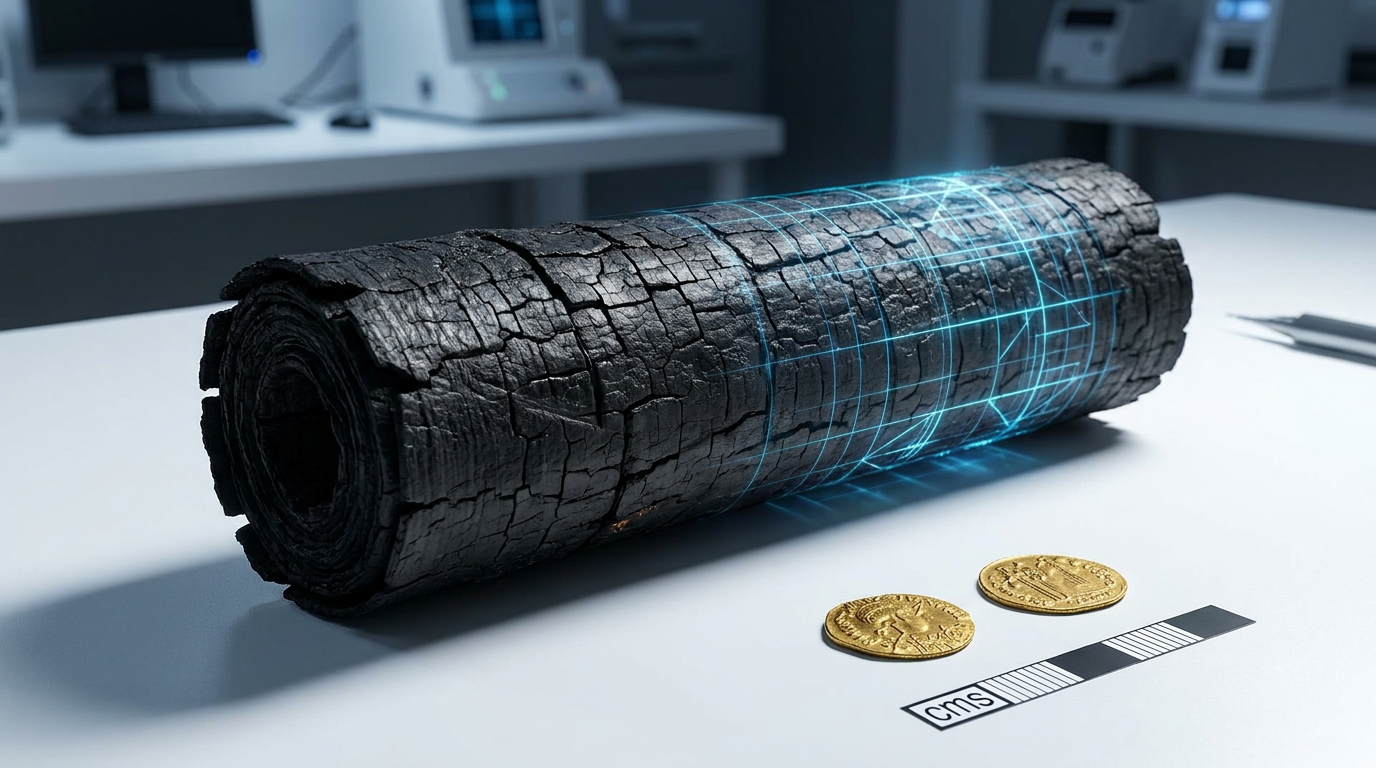
However, the intense heat of the volcanic eruption had carbonized the scrolls, effectively turning them into brittle lumps of charcoal. For centuries, attempts to physically unroll the artifacts proved disastrous, causing the delicate papyrus to crumble into dust and destroying the ancient texts forever.[3][5]
The scrolls remained an unreadable, tantalizing mystery until the advent of modern computer vision. Brent Seales, a computer scientist at the University of Kentucky, spent years developing a non-invasive technique called "virtual unwrapping" to peer inside fragile historical documents.[6][7]

Seales's method relies on high-resolution X-ray computed tomography (CT) scans, often performed at powerful particle accelerators like the United Kingdom's Diamond Light Source. These scans create a meticulous three-dimensional map of a scroll's interior without ever touching the physical object.[2][3]
But the Herculaneum scrolls presented a unique and seemingly insurmountable hurdle. Unlike the metallic inks used in other ancient manuscripts, the Romans wrote with a carbon-based ink. Under an X-ray, the carbon ink and the carbonized papyrus possess the exact same density, rendering the text completely invisible to traditional imaging.[4]
To solve this bottleneck, Seales teamed up with Silicon Valley tech entrepreneurs Nat Friedman and Daniel Gross to launch the Vesuvius Challenge in March 2023. They released terabytes of 3D CT scan data to the public and offered over $1 million in crowdsourced prizes to anyone who could decipher the hidden text.[4][7]
The digital pipeline required to read a scroll begins with a painstaking process known as "segmentation." Researchers must meticulously trace the crinkled, warped, and compressed layers of papyrus within the 3D scan, effectively unrolling the geometry of the scroll in a digital environment.[4][6]
The breakthrough in reading the invisible ink came when a contestant noticed a faint "crackle pattern" on the surface of the segmented digital papyrus. Though invisible to X-rays, the carbon ink subtly altered the physical texture of the papyrus as it dried and burned two millennia ago, leaving a microscopic 3D topological footprint.[4]
The breakthrough in reading the invisible ink came when a contestant noticed a faint "crackle pattern" on the surface of the segmented digital papyrus.
Luke Farritor, a college student and former SpaceX intern, realized this microscopic texture could be detected by artificial intelligence. He trained a machine learning model to recognize the crackle pattern, teaching the algorithm to highlight areas where ink was present and making the invisible visible.[4][5]

In late 2023, Farritor's model successfully revealed the first legible word from an unopened Herculaneum scroll: "porphyras," the ancient Greek word for purple. This milestone proved that the invisible ink could finally be read, sending shockwaves through the fields of computer science and classical history.[1][5]
The competition rapidly accelerated following the initial discovery. Farritor teamed up with two other students, Youssef Nader and Julian Schilliger, to refine the AI and segmentation tools. By early 2024, the trio had deciphered 15 columns of text—over 2,000 characters—claiming the $700,000 grand prize.[1][5]
Papyrologists translated the newly revealed text, attributing it to the Epicurean philosopher Philodemus. The author discusses the nature of pleasure, debating whether the scarcity or abundance of goods, such as food and music, affects the enjoyment derived from them.[2][7]
The technology has only improved since the grand prize was awarded. In early 2025, researchers applied the refined AI pipeline to a different scroll, known as PHerc. 172, which is currently housed at Oxford's Bodleian Libraries.[2][3]
This scan yielded more recoverable text than any previously analyzed Herculaneum papyrus. Scholars identified multiple columns of clean text, including the Greek word "diatrope," meaning disgust, which appeared several times across the cleanly separated layers.[2][3]
Despite these monumental successes, uncertainties remain. The AI models are highly effective on well-preserved sections, but heavily compressed or torn interior layers still pose a significant challenge. If the algorithms are not strictly constrained by the underlying 3D papyrus fibers, they risk hallucinating letter shapes.[4][6]

The stakes for historical preservation are immense. Historians estimate that only 3 to 5 percent of ancient Greek texts have survived to the modern era. Because the Herculaneum library is the only intact library known from the classical world, experts believe thousands more scrolls may still be buried in unexcavated portions of the villa.[1][7]
How we got here
79 AD
Mount Vesuvius erupts, burying Herculaneum and carbonizing the library.
1750s
Farmworkers discover the buried Villa of the Papyri and its cache of over 800 scrolls.
2015
Dr. Brent Seales pioneers virtual unwrapping on the En-Gedi scroll from Israel.
March 2023
The Vesuvius Challenge launches with $1 million in prizes to read the scrolls.
October 2023
Luke Farritor uses AI to decipher the first word, 'porphyras' (purple).
February 2024
A three-student team wins the $700,000 Grand Prize for reading 15 columns of text.
February 2025
Breakthrough on scroll PHerc. 172 reveals unprecedented volumes of text, including the word 'disgust'.
Viewpoints in depth
Papyrologists & Historians
The humanities perspective on recovering lost knowledge.
For classicists, the Herculaneum library represents the holy grail of antiquity. Because the texts were buried in 79 AD, they offer an unedited snapshot of Roman and Greek thought, free from the centuries of monastic copying and translation errors that alter most surviving ancient literature. Scholars argue that reading these scrolls could fundamentally shift our understanding of Epicurean philosophy, early Roman politics, and classical literature, potentially recovering lost plays by Sophocles or missing histories of the Roman Republic.
Computer Vision Researchers
The technical perspective on solving an impossible imaging problem.
From a computer science standpoint, the Vesuvius Challenge is a landmark achievement in pattern recognition. The core problem—that carbon ink on carbonized papyrus offers zero density contrast for traditional X-rays—seemed insurmountable. By shifting the focus from density to 3D surface topology, and training machine learning models to detect microscopic 'crackle' patterns left by dried ink, researchers created an entirely new application for AI. This pipeline of segmentation and texture recognition is now being adapted for other fields, including medical imaging and materials science.
Archaeologists & Preservationists
The debate over future excavations at Herculaneum.
The success of the AI pipeline has reignited debates over whether to resume excavations at the Villa of the Papyri. For decades, archaeologists hesitated to dig further, knowing that any newly discovered scrolls would be unreadable and highly vulnerable to degradation once exposed to the air. Now that a non-invasive reading method exists, preservationists argue there is a compelling scientific mandate to carefully excavate the remaining sections of the villa, which could house thousands of additional texts in its main library.
What we don't know
- Whether the unexcavated portions of the Villa of the Papyri contain the main library, which could hold thousands of additional scrolls.
- If the AI models can be perfected to read the highly compressed and torn innermost layers of the scrolls without hallucinating text.
- Whether any lost masterpieces of classical literature, such as missing plays or histories, are hidden within the currently scanned scrolls.
Key terms
- Herculaneum Papyri
- A collection of over 800 scrolls carbonized by Mount Vesuvius, representing the only surviving library from antiquity.
- Virtual Unwrapping
- A non-invasive digital technique that uses 3D scans to computationally flatten and read rolled or folded manuscripts.
- X-ray Computed Tomography (CT)
- An imaging method that uses X-rays to create detailed 3D cross-sectional models of an object's interior.
- Segmentation
- The digital process of tracing and separating the individual, warped layers of papyrus within a 3D scan.
- Epicureanism
- An ancient Greek system of philosophy founded by Epicurus, which taught that the highest good is pleasure, achieved through modest living and knowledge.
Frequently asked
Why couldn't researchers just unroll the scrolls by hand?
The intense heat of the volcanic eruption turned the papyrus into brittle lumps of charcoal, causing them to crumble into dust when physically manipulated.
How does the AI detect ink if it's invisible to X-rays?
The machine learning models are trained to recognize a microscopic 'crackle pattern' in the 3D texture of the papyrus, caused by the carbon ink drying on the surface.
What do the deciphered texts actually say?
The first major passages translated discuss Epicurean philosophy, specifically the nature of pleasure and whether the scarcity or abundance of food affects enjoyment.
Who funded the Vesuvius Challenge?
The competition was backed by tech entrepreneurs Nat Friedman and Daniel Gross, who helped raise over $1 million in prize money.
Sources
Source coverage
7 outlets
3 viewpoints surfaced







[1]Smithsonian MagazinePapyrologists & Historians
Using A.I., Researchers Peer Inside a 2,000-Year-Old Scroll Charred by Mount Vesuvius' Eruption
Read on Smithsonian Magazine →[2]The GuardianPapyrologists & Historians
AI helps researchers read ancient scroll burned to a crisp in Vesuvius eruption
Read on The Guardian →[3]ForbesArchaeologists & Preservationists
AI Peers Inside Burned 2,000-Year-Old Vesuvius Scroll, Finds 'Disgust'
Read on Forbes →[4]Business InsiderComputer Vision Researchers
AI Deciphered Part of an Ancient Scroll Buried by Vesuvius Eruption
Read on Business Insider →[5]HyperallergicArchaeologists & Preservationists
Students Win $700K for Using AI to Decipher Ancient Roman Scroll
Read on Hyperallergic →[6]Vesuvius ChallengeComputer Vision Researchers
Vesuvius Challenge: Resurrect an ancient library from the ashes of a volcano
Read on Vesuvius Challenge →[7]Silicon RepublicComputer Vision Researchers
Ancient scrolls destroyed by volcano can now be read thanks to AI
Read on Silicon Republic →

Every angle. Every day.
Get culture stories with full source coverage and perspective breakdowns delivered to your inbox.