
How AI Tutors Are Finally Solving Education's 40-Year 'Two Sigma' Problem
For decades, researchers knew that one-on-one tutoring dramatically improved student performance, but scaling it was financially impossible. Now, a new generation of generative AI tutors is delivering comparable learning gains for less than $50 a year.
By Factlen Editorial Team
- EdTech Optimists
- Advocate for rapid deployment of AI to democratize one-on-one tutoring.
- Pedagogical Skeptics
- Emphasize the irreplaceable nature of human emotional connection in teaching.
- Academic Researchers
- Focus on measuring empirical learning gains and cost-effectiveness.
What's not represented
- · Students using the platforms
- · Parents managing screen time
Why this matters
Personalized one-on-one tutoring has historically been a privilege reserved for wealthy families, leaving the majority of students to rely solely on one-size-fits-all classroom instruction. By dropping the cost of a personal tutor to roughly $24 a year, AI platforms are democratizing access to mastery-based learning and fundamentally leveling the educational playing field.
Key points
- Educational psychologist Benjamin Bloom found in 1984 that one-on-one tutoring improves student performance by two standard deviations.
- Scaling human tutoring to every student has historically been financially impossible.
- Generative AI platforms are now mimicking the Socratic method to provide personalized tutoring at scale.
- Recent studies show AI tutors can double learning gains compared to traditional classroom instruction.
- The annual cost of providing an AI tutor is estimated at just $24 to $48 per student.
- Educators emphasize that AI should supplement, not replace, human teachers who provide essential emotional support.
In 1984, educational psychologist Benjamin Bloom published a paper that would haunt the education sector for decades. He discovered that if you give a student one-on-one tutoring and require them to master a concept before moving on, their performance improves by two standard deviations compared to traditional classroom instruction.[3]
To put that "two sigma" metric into perspective, an average tutored student outperforms 98% of students taught in a standard group setting. It was a holy grail of pedagogy, proving that almost any student could achieve elite academic results under the right conditions.[7]
The catch, however, was always the cost. Scaling human tutors to every student on earth was financially and logistically impossible. For forty years, educators tried smaller class sizes, new curricula, and early digital learning tools, but nothing came close to the two-sigma benchmark.[1]

In 2026, the landscape is shifting rapidly. Generative AI has evolved from a novelty that writes essays into specialized, interactive tutoring systems that mimic the Socratic method, finally offering a scalable solution to Bloom's decades-old problem.[6]
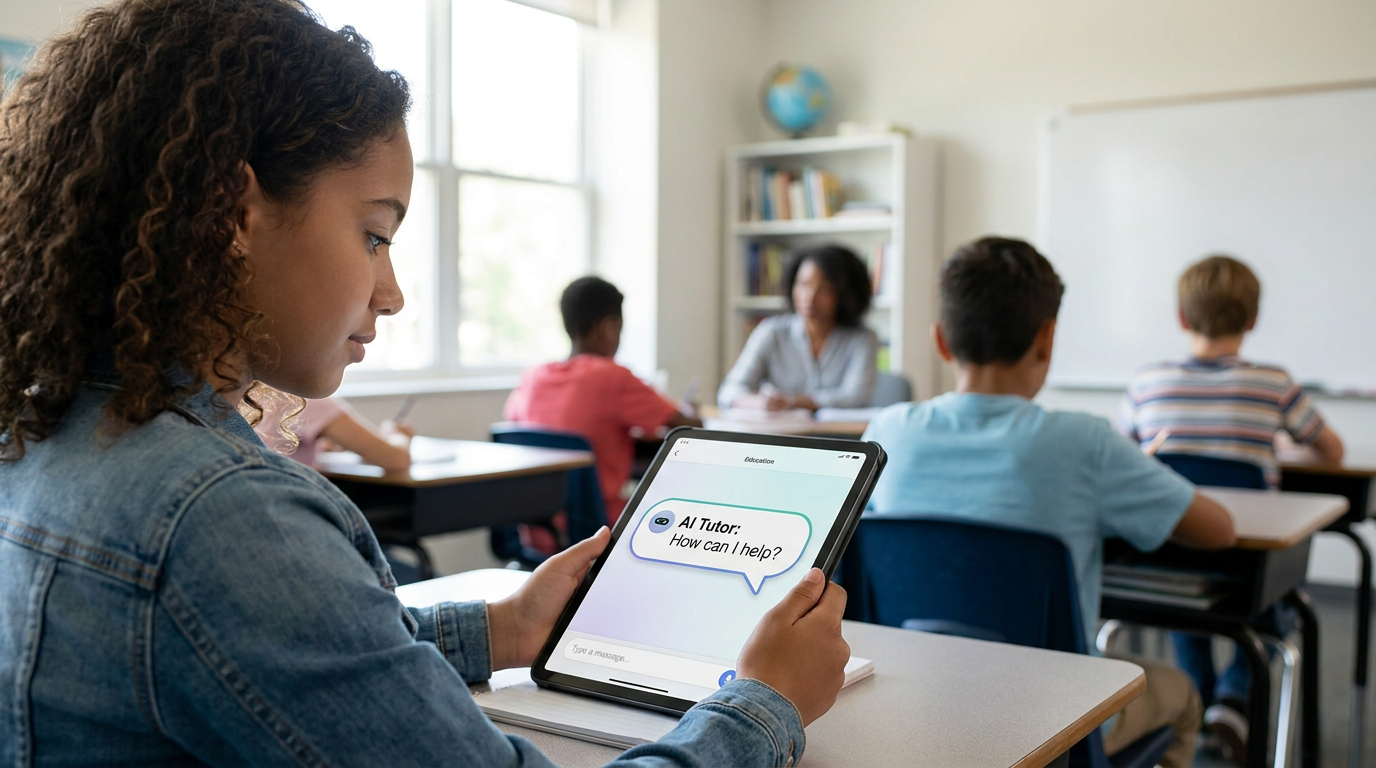
Unlike early chatbots that simply handed out answers, modern AI tutors are explicitly trained to withhold the solution. Instead, they ask probing questions: "What have you tried so far?" or "What operation do you think we might need to solve this?"[4]
This friction is entirely by design. By forcing the student to engage in active problem-solving and articulate their reasoning, the AI replicates the pedagogical strategies of an expert human teacher.[2]
The results are beginning to mirror Bloom's early promises. A recent randomized controlled trial published in Scientific Reports found that an AI tutor, designed around pedagogical best practices, significantly outperformed traditional in-class active learning.[3]
Students using the AI system learned substantially more in less time, achieving median learning gains that were over double those of the in-class group, while reporting higher levels of motivation.[3]
The Brookings Institution recently analyzed these systems, noting that cost-effectiveness is where the technology truly shines. Delivering these massive learning gains costs approximately $24 to $48 per pupil annually, a fraction of the cost of a human tutor.[1]
The Brookings Institution recently analyzed these systems, noting that cost-effectiveness is where the technology truly shines.
This low marginal cost has allowed platforms to scale at an unprecedented rate. Khan Academy's AI assistant, Khanmigo, saw its user base in partner school districts explode from 40,000 to over 700,000 between the 2023-24 and 2024-25 school years.[4]

In pilot districts using Khanmigo, students demonstrated an average improvement of 1.4 grade levels in math, validating the platform's conversational approach to individualized instruction.[4]
The technology is also transforming language acquisition. Duolingo introduced "Duolingo Max," which uses AI to power a feature called "Explain My Answer," addressing one of the most common complaints about digital language learning.[5]
Instead of simply marking a translation wrong with a red 'X', the system provides context on tricky grammar rules and allows users to engage in dynamic, unscripted roleplay scenarios to practice conversational fluency in a safe environment.[5]
Behind the scenes, developers are constantly refining these models to keep students engaged. Khan Academy recently reported that switching to faster AI models and tightening response times by just fractions of a second meaningfully improved student focus and next-item correctness.[2]
To combat the notorious problem of AI "hallucinations"—where a model confidently invents false information—educational platforms are utilizing Retrieval-Augmented Generation (RAG).[3]

This technique restricts the AI to a curated database of verified curriculum materials, ensuring that the tutor's explanations remain factually accurate and pedagogically sound, rather than pulling unverified data from the open internet.[3]
Despite the impressive metrics, researchers caution that AI cannot entirely replace the human element of teaching. While an algorithm possesses infinite patience, it lacks the emotional intelligence to recognize when a student is dealing with outside trauma or needs a human mentor's encouragement.[1]
The consensus among educators is that AI tutors are best utilized as a powerful supplement to, rather than a replacement for, classroom teachers. By offloading routine practice and personalized remediation to the AI, teachers can dedicate more time to complex group discussions and emotional support.[4]
As these systems continue to evolve, the focus is shifting from simply generating content faster to co-creating deep, adaptive learning pathways that respond to a student's unique strengths and weaknesses.[7]
For the first time in modern educational history, the financial barrier to personalized instruction has been broken, bringing Bloom's elusive two-sigma benchmark within reach for millions of students worldwide.[6]
How we got here
1984
Benjamin Bloom publishes his landmark paper identifying the 'Two Sigma' problem in education.
March 2023
Khan Academy launches Khanmigo, an early generative AI tutor designed to use the Socratic method.
2024–2025
AI tutoring platforms see massive adoption, with Khanmigo scaling to 700,000 district users.
2026
Rigorous RCTs confirm that properly designed AI tutors can double learning gains compared to traditional classrooms.
Viewpoints in depth
EdTech Optimists
Believe AI tutors will fundamentally democratize education by providing elite-level instruction to every student.
This camp points to the undeniable math: hiring a human tutor costs upwards of $50 an hour, while an AI tutor costs less than $50 a year. By providing infinite patience, instant feedback, and adaptive pacing, they argue that AI can close the achievement gap between high- and low-income districts. They view the technology not as a teacher replacement, but as a force multiplier that allows every child to experience mastery-based learning.
Pedagogical Skeptics
Warn that over-reliance on AI could isolate students and bypass the necessary struggle of learning.
Educators in this camp worry that students will use AI as a crutch rather than a guide. Even with safeguards in place, clever students often find ways to prompt the AI into giving away the answer. Furthermore, they emphasize that learning is inherently social and emotional; a machine cannot replicate the motivational power of a teacher who genuinely cares about a student's success. They advocate for strict limits on screen time and keeping human educators at the center of the classroom.
Curriculum Developers
Focus on the technical challenge of keeping AI accurate and aligned with educational standards.
For the engineers and curriculum designers building these tools, the primary concern is safety and accuracy. Large Language Models are prone to 'hallucinations,' which is disastrous in an educational setting where a student might learn a fabricated math rule. This group advocates for 'walled garden' approaches like Retrieval-Augmented Generation (RAG), ensuring the AI only pulls from vetted, state-approved textbooks rather than the open internet.
What we don't know
- Long-term data on whether AI-assisted learning gains persist over multiple academic years.
- How the widespread use of AI tutors will impact students' social and emotional development.
- Whether students will eventually find consistent ways to bypass the AI's guardrails to get direct answers.
Key terms
- Two Sigma Problem
- The educational challenge of finding a scalable teaching method that matches the two-standard-deviation improvement seen in one-on-one tutoring.
- Mastery Learning
- An instructional approach where a student must fully understand a concept before moving on to more advanced material.
- Socratic Method
- A form of teaching that relies on asking probing questions to lead the student to the answer, rather than simply providing it.
- Retrieval-Augmented Generation (RAG)
- An AI technique that restricts the model to pulling information from a specific, trusted database to prevent it from making up facts.
Frequently asked
Will AI tutors replace human teachers?
No. Experts agree that AI tutors are designed to supplement teachers by handling routine practice and personalized remediation, freeing up human educators to focus on complex discussions and emotional support.
How much does an AI tutor cost?
Recent analyses estimate the marginal cost of providing an AI tutor to a student is between $24 and $48 per year, making it vastly more affordable than human tutoring.
Do AI tutors just give students the answers?
Well-designed educational AI, like Khanmigo, is explicitly programmed to withhold direct answers. Instead, it uses the Socratic method to ask guiding questions and help the student solve the problem themselves.
Can AI tutors make mistakes?
Yes, generative AI can sometimes hallucinate incorrect information. However, educational platforms are increasingly using techniques like RAG to restrict the AI to verified curriculum data, significantly reducing errors.
Sources
Source coverage
7 outlets
3 viewpoints surfaced







[1]Brookings InstitutionAcademic Researchers
Generative AI as tutor: The evidence for effectiveness
Read on Brookings Institution →[2]Khan AcademyEdTech Optimists
How We Are Improving Khanmigo's Effectiveness
Read on Khan Academy →[3]ResearchGateAcademic Researchers
Generative AI as a Solution to the 2-Sigma Problem
Read on ResearchGate →[4]Education WeekPedagogical Skeptics
Can an AI-Powered Tutor Produce Meaningful Results?
Read on Education Week →[5]DuolingoEdTech Optimists
Duolingo Max: AI-powered features for language learning
Read on Duolingo →[6]Factlen Editorial TeamEdTech Optimists
Synthesis by Factlen editorial team
Read on Factlen Editorial Team →[7]OEB InsightsAcademic Researchers
Beyond Educators' Personal Productivity: Co-Creating AI-Powered Learning Experiences
Read on OEB Insights →

Every angle. Every day.
Get education stories with full source coverage and perspective breakdowns delivered to your inbox.