
How Adaptive Tech and Modular Design Are Leveling the Esports Playing Field
Driven by breakthroughs in modular hardware and eye-tracking technology, competitive gaming is dismantling physical barriers for disabled players. In 2026, adaptive esports is moving from segregated events to mainstream, integrated competition.
By Factlen Editorial Team
- Accessibility Advocates
- Argue that inclusive design must be a core expectation built into every game engine and hardware ecosystem from day one.
- Hardware Innovators
- Focus on the engineering challenges of creating affordable, modular, and durable adaptive controllers that bridge the gap between intent and execution.
- Esports Institutions
- View accessibility as a crucial pathway to expanding the talent pool, audience, and social impact of competitive gaming.
What's not represented
- · Game Engine Developers
- · Sponsors of Adaptive Teams
Why this matters
With an estimated 46 million gamers navigating some form of disability in the U.S. alone, the standardization of accessible hardware transforms esports into the world's most inclusive competitive arena. This shift not only empowers a massive demographic but redefines the baseline requirements for digital competition.
Key points
- Adaptive hardware has moved from a niche market to a core design expectation in the 2026 esports industry.
- Modular controllers allow players to map complex in-game actions to alternative physical movements like eye-tracking or sip-and-puff systems.
- Major events like the Los Angeles 2026 Global Esports Games are prioritizing universally accessible competition.
- Despite hardware advances, the high cost of custom rigs and inconsistent software accessibility remain barriers to entry.
The roar of the crowd at a major esports arena has traditionally belonged to a specific archetype of player: one with the precise fine motor control to execute hundreds of actions per minute on a standard keyboard or gamepad. For decades, competitive gaming inadvertently built an invisible wall, locking out millions of potential competitors whose physical realities didn't match the rigid design of conventional controllers. But in 2026, the architecture of digital competition is undergoing a profound structural renovation. Accessibility is no longer treated as a charitable afterthought or a post-launch patch; it has become a core design expectation driving the fastest-growing sector of the sports world.[1]
This shift is vividly apparent as the industry prepares for the Los Angeles 2026 Global Esports Games. Organizers are framing the event not just as a clash of digital titans, but as a showcase of technological empowerment. The mandate is clear: the future of esports must be universally accessible. This ethos is rippling through the entire ecosystem, from grassroots community tournaments to the highest echelons of professional play, fundamentally redefining what a competitive athlete looks like and how they interact with their digital environment.[5]
The stakes are massive. In the United States alone, an estimated 46 million gamers navigate some form of disability. Historically, these players faced a gauntlet of barriers, from visual overload and screen-reader gaps to hardware that assumed a narrow range of grip strength and joint mobility. The tragedy of these barriers was that virtual worlds inherently possess the potential to erase the physical limitations of the offline world. Now, a convergence of clinical research, hardware engineering, and institutional support is finally unlocking that potential, turning esports into the most inclusive competitive arena on the planet.[2]
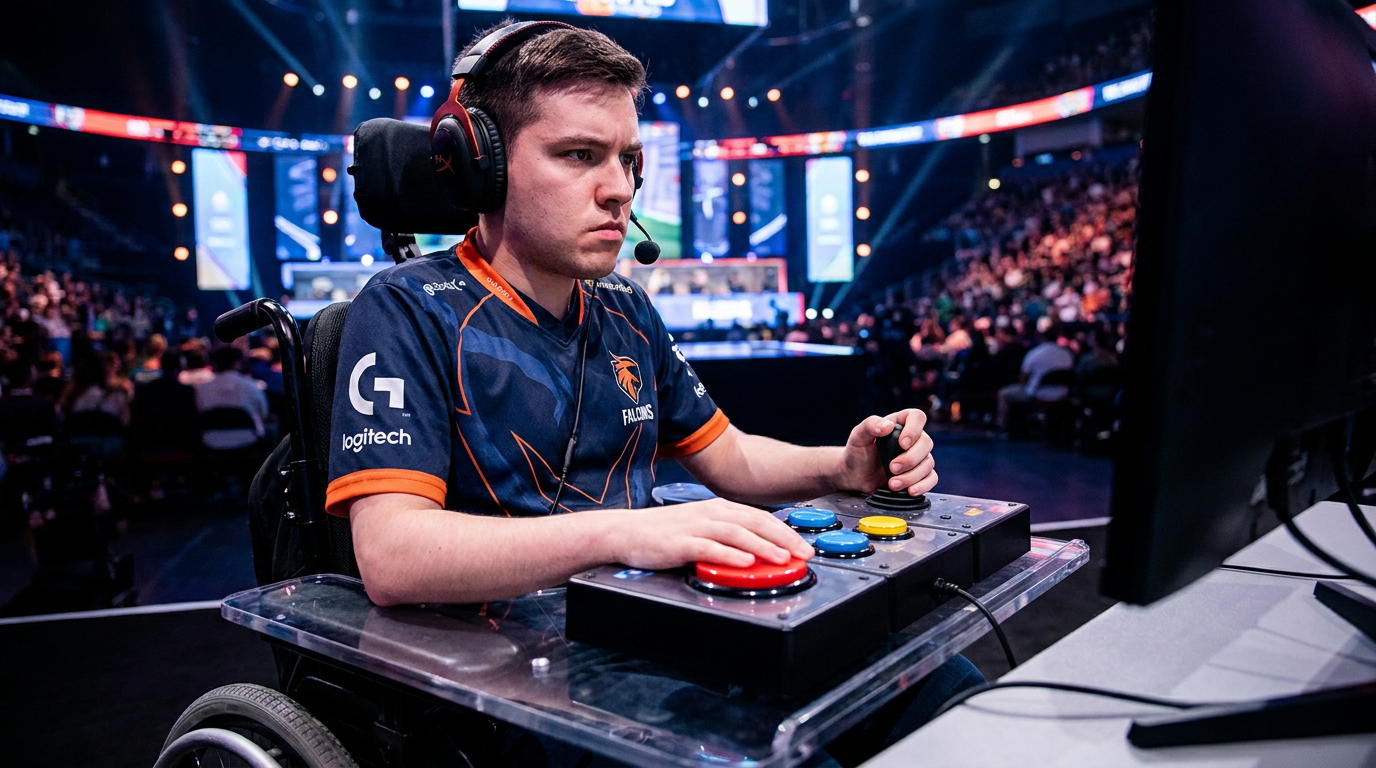
The mechanism driving this revolution is the rapid evolution of adaptive hardware. The standard two-stick, multi-button controller is a marvel of ergonomic design for a specific body type, but it is a complex puzzle for anyone with limited hand mobility. To solve this, engineers have deconstructed the controller into modular components. Instead of a single rigid plastic shell, players can now build bespoke command centers using an array of standardized 3.5mm jacks and USB ports, mapping every necessary in-game action to a physical movement they can comfortably perform.[1][6]

This modularity allows for astonishing creativity in interface design. A player who cannot use their thumbs might use a large, high-sensitivity button triggered by an elbow to shoot, a foot pedal to accelerate, and a sip-and-puff tube to navigate menus. Advanced setups integrate electromyography (EMG) sensors, which detect the faint electrical signals of muscle twitches, translating a flex of the jaw or a shrug of the shoulder into a crucial in-game command. For players with severe motor limitations, these technologies bridge the gap between intent and execution with zero latency.[3]
Eye-tracking technology has also transitioned from a niche novelty to a competitive staple. Systems like the Tobii Eye Tracker 5 allow players to aim down sights or pan across a strategy map simply by looking at their target. When combined with voice-activated commands and AI-assisted targeting algorithms that smooth out involuntary tremors without automating the gameplay, the playing field levels dramatically. The goal is never to play the game for the user, but to ensure that the interface accurately reflects their strategic mind and reaction time.[2]
Major hardware manufacturers are aggressively expanding this ecosystem. In mid-2026, Xbox expanded its pioneering accessibility lineup with a new Adaptive Joystick and released complimentary 3D-printable files for custom thumbstick toppers. By partnering with third-party developers like ByoWave and 8BitDo, the industry is moving away from proprietary silos, ensuring that adaptive equipment works seamlessly across different consoles and PC platforms. This interoperability is crucial for competitive integrity, allowing players to bring their customized rigs to any tournament stage.[6]
Major hardware manufacturers are aggressively expanding this ecosystem.
The push for better hardware is also moving into the academic sphere, treating accessible design as a premier engineering challenge. In March 2026, the Georgia Tech Esports Club partnered with the Center for Inclusive Design and Innovation to host a landmark hackathon. Over 60 engineering and computer science students dedicated three days entirely to adaptive gaming. They tackled the persistent limitations of traditional controllers, prototyping alternative input methods, novel wheelchair mounting solutions, and, crucially, affordable designs that could be manufactured at scale.[3]

Beyond the hardware, institutional support is providing the necessary infrastructure for disabled athletes to compete. South Korea’s Kakao Games recently received government commendations for its 'Play Buddy Together' program. Over three years, the initiative has matched nearly a hundred disabled players with over 600 highly customized assistive devices. By partnering with rehabilitation centers, the program ensures that players receive clinical guidance in setting up their rigs, preventing repetitive strain injuries and optimizing their competitive setups.[2]
This infrastructure is enabling new formats of competition. The Special Olympics has fully embraced this digital frontier with its 'Gaming for Inclusion' initiative. The 2026 virtual esports tournament, running alongside the traditional USA Games in Minnesota, connects athletes of all abilities. It demonstrates that the competitive spirit, the drive to improve, and the thrill of a clutch victory are universal human experiences, entirely independent of physical capability.[4]
Crucially, the end goal of adaptive esports is not segregated competition, but total integration. Grassroots events are proving that this is possible by providing on-site adaptive kits and dedicated accessibility staff. These tournaments allow players using specialized interfaces to race side-by-side with those using standard controllers in the same high school and community brackets. When the hardware barrier is removed, the competition becomes a pure test of game sense, strategy, and mental endurance.[1]
Despite these massive strides, significant uncertainties and challenges remain. The most pressing is the cost barrier. While standard controllers cost around seventy dollars, a fully customized adaptive rig with specialized switches, mounts, and eye-tracking cameras can easily run into the thousands. For many disabled gamers, particularly those facing systemic economic disadvantages, the price of entry into competitive esports remains prohibitively high.[1][3]

Software accessibility also lags behind hardware innovation. A perfectly customized controller is useless if a game’s user interface cannot be scaled for visually impaired players, or if crucial audio cues lack visual indicators for deaf competitors. A 2026 industry review highlighted the steep dropout rate among disabled players when starting unfamiliar titles, pointing to a desperate need for standardized, modular game interfaces, pop-up tutorials, and customizable input layouts built directly into the game engines.[2]
Tournament organizers are also grappling with the complex logistics of standardizing adaptive equipment for professional play. Ensuring competitive integrity requires strict rules against macros—automated sequences of commands triggered by a single button press. Referees must be trained to inspect highly bespoke, one-of-a-kind controller setups to verify that they map one physical input to exactly one in-game action, ensuring that the hardware levels the playing field without providing an unfair automated advantage.[1]

Yet, the trajectory is undeniably positive. The esports industry has realized that inclusivity is not just a moral imperative, but a massive engine for growth. By tearing down the physical barriers to entry, competitive gaming is tapping into a vast, previously sidelined reservoir of talent and passion. As adaptive technology becomes more sophisticated, affordable, and seamlessly integrated into the fabric of the sport, the defining image of an esports champion in 2026 is no longer bound by physical limitations, but defined entirely by the limits of their imagination and skill.[5][7]
How we got here
2018
Microsoft releases the original Xbox Adaptive Controller, establishing a baseline for modular accessible hardware.
March 2023
Kakao Games launches 'Play Buddy Together,' South Korea's first assistive-device support program for game accessibility.
January 2026
CES 2026 features the 'Gaming for All' panel, highlighting AI assistance and inclusive esports infrastructure.
March 2026
Georgia Tech hosts the Tech[HACK] Valley hackathon, dedicating a hardware track entirely to adaptive controller design.
June 2026
The Special Olympics USA Games integrates the 'Gaming for Inclusion' virtual esports tournament.
December 2026
The Global Esports Games in Los Angeles emphasizes inclusive economic participation and accessible competition.
Viewpoints in depth
Hardware Innovators
Engineers are focused on the technical challenge of mapping complex game inputs to alternative physical movements.
For hardware developers and academic engineers, the standard gamepad is viewed as a rigid constraint that fails millions of users. Their focus is on deconstructing the controller into a modular ecosystem. By utilizing 3D printing, open-source designs, and emerging tech like EMG sensors, they aim to lower the prohibitively high costs of custom rigs while ensuring zero-latency performance required for competitive play.
Inclusive Tournament Organizers
Organizers are working to standardize rules for adaptive equipment to ensure fairness without restricting access.
Esports institutions face the logistical hurdle of integrating highly bespoke hardware into standardized competitive brackets. Their primary concern is maintaining competitive integrity—ensuring that adaptive controllers map one physical input to exactly one in-game action. By training referees to inspect custom setups and banning automated macros, organizers aim to create a seamless environment where adaptive and standard players can compete side-by-side.
Disabled Competitors
Players advocate for universal design and the removal of software barriers that limit their competitive potential.
For the athletes themselves, the goal is pure integration rather than segregated 'special' leagues. While they celebrate the hardware breakthroughs, they frequently point out that a perfect controller cannot overcome inaccessible game software. They are pushing developers to mandate scalable UIs, visual audio cues, and customizable input layouts at the engine level, ensuring that skill—not interface friction—determines the victor.
What we don't know
- How quickly major game developers will standardize software accessibility features like scalable UI across all competitive titles.
- Whether the cost of highly customized adaptive rigs will drop enough to remove economic barriers for lower-income disabled gamers.
- How professional esports leagues will formally codify the inspection and approval process for bespoke EMG and eye-tracking setups.
Key terms
- Adaptive Controller
- A customizable gaming interface designed to meet the needs of players with limited mobility, often featuring modular buttons and joystick inputs.
- Sip-and-Puff System
- An assistive technology that allows users to send input commands to a device using their breath, inhaling or exhaling into a straw-like tube.
- EMG Sensor
- Electromyography sensors that detect electrical activity produced by skeletal muscles, translating small muscle twitches into digital game inputs.
- Eye Tracking
- Technology that monitors where a user is looking on a screen, allowing them to aim, navigate menus, or trigger actions using only their gaze.
- Macro
- An automated sequence of commands triggered by a single button press, which is generally banned in competitive esports to maintain fairness.
Frequently asked
Can players using adaptive controllers compete against able-bodied players?
Yes. Many modern tournaments feature integrated brackets where players using adaptive tech compete directly alongside those using standard controllers, ensuring a level playing field based on skill rather than physical interface.
Are adaptive controllers allowed in professional esports?
Generally, yes, provided the controller maps one physical input to one in-game action. Tournament organizers review custom setups to ensure they don't use macros to provide an unfair automated advantage.
What is the biggest barrier remaining for disabled gamers?
While hardware has improved dramatically, the high cost of custom rigs and inconsistent software accessibility—such as a lack of scalable UI or visual audio cues in major titles—remain significant hurdles.
Sources
Source coverage
7 outlets
3 viewpoints surfaced







[1]Factlen Editorial TeamEsports Institutions
Synthesis by Factlen editorial team
Read on Factlen Editorial Team →[2]CTA FoundationAccessibility Advocates
Adaptive Gaming Interfaces Multiply as Industry Pushes Accessibility to Core Designs
Read on CTA Foundation →[3]Georgia Tech CIDIHardware Innovators
Leveling the Playing Field: GT Esports and Tools for Life Hack Accessibility
Read on Georgia Tech CIDI →[4]Special OlympicsAccessibility Advocates
Gaming for Inclusion: Virtual Esports Tournament
Read on Special Olympics →[5]Global Esports FederationEsports Institutions
Beyond Competition: Social Impact and Economic Opportunity
Read on Global Esports Federation →[6]Xbox WireHardware Innovators
Xbox Celebrates Accessibility in Gaming with New Adaptive Joystick
Read on Xbox Wire →[7]Esports InsiderEsports Institutions
Emerging Trends in Esports 2026: Diversity and Inclusion Initiatives
Read on Esports Insider →

More in sports
See all 6 stories →Ski Tech
The End of Forever Chemicals on the Slopes: How Skiing is Replacing Toxic Wax
7 sources

Women's Sports
NWSL Shatters Attendance Records as 2026 Expansion Fuels Historic Growth
8 sources

Grassroots Football
UK Government Unveils £85 Million Investment to Transform Grassroots Football Facilities
6 sources

NBA Finals
New York Knicks Win First NBA Championship in 53 Years, Defeating San Antonio Spurs
7 sources

Every angle. Every day.
Get sports stories with full source coverage and perspective breakdowns delivered to your inbox.