
Evidence Pack: How AI and Drones Are Accelerating Landmine Clearance
New field data shows that drone-mounted sensors paired with artificial intelligence can increase landmine detection speeds by 20-fold while cutting costs and casualties, though buried plastic explosives remain a persistent challenge.
By Factlen Editorial Team
- Demining NGOs
- Focus on the humanitarian impact, prioritizing speed, safety, and the rapid return of agricultural land to civilians.
- Defense Tech Developers
- Emphasize the software capabilities, sensor fusion, and the measurable cost-efficiency of deploying AI models at scale.
- Academic Researchers
- Highlight the physical limitations of the technology, particularly the high false-positive rates and the difficulty of detecting buried plastic.
What's not represented
- · Local farmers awaiting land clearance
- · Traditional manual deminers
Why this matters
More than 57 nations are contaminated by landmines, which kill or maim thousands of civilians annually and render vast tracts of agricultural land unusable. Proving that AI can safely and cheaply clear these areas means displaced populations can return home years earlier than previously projected.
Key points
- AI-equipped drones can survey suspected minefields 20 times faster than manual human teams.
- The technology has reduced the cost of landmine detection by 80%, dropping from $5 to $1 per square meter.
- By mapping threats remotely, automated systems have decreased deminer accident rates by 90%.
- Drones use a combination of RGB cameras, thermal sensors, and magnetometers to spot anomalies.
- Buried plastic landmines remain a significant challenge, as drone-mounted radar is still limited by flight height.
- High-shrapnel areas produce false positives, requiring human analysts to verify AI findings.
The global landmine crisis has long been defined by a grim mathematical reality: laying a mine takes seconds and costs a few dollars, but finding and removing it takes hours and costs exponentially more. Across the 57 nations currently dealing with live anti-personnel mines, traditional clearance has relied on human deminers walking inch-by-inch with handheld metal detectors and probing sticks. It is a process that is agonizingly slow, highly dangerous, and increasingly overwhelmed by the sheer scale of modern conflicts.[2][6][7]
However, a comprehensive review of field data from 2024 through mid-2026 reveals a structural shift in humanitarian demining. The integration of commercial drones, multi-modal sensors, and artificial intelligence is fundamentally altering the speed and economics of land release. By shifting the initial detection phase from the ground to the air, demining non-governmental organizations (NGOs) and military units are clearing land at rates previously thought impossible.[1][7]
The most significant claim supported by recent field deployments is a massive increase in survey speed. Traditional manual demining teams can typically survey about 500 square meters of land per day. In contrast, automated drone systems equipped with AI processing can survey up to 10,000 square meters in the same timeframe—a 20-fold increase in operational velocity. This speed is primarily achieved not just by finding mines, but by confidently proving where mines are absent.[5][7]

In Ukraine, which became the most heavily mined country on Earth following the 2022 Russian invasion, this "area cancellation" has been transformative. Initial estimates suggested that 174,000 square kilometers of Ukrainian territory—roughly the size of Florida—were contaminated. By marrying satellite imagery, drone mapping, and AI to forensically rule out uncontaminated zones, organizations like the HALO Trust have helped reduce the suspected hazardous area to roughly the size of Massachusetts.[1]
The evidence also points to substantial improvements in detection accuracy and cost efficiency. Industry case studies indicate that fine-tuned AI drone systems achieve an average detection accuracy of 92%, compared to the 70% baseline of traditional manual visual and metal-detector surveys. Because the aerial systems require fewer human hours per hectare, the cost of mine detection has plummeted from approximately $5 per square meter to just $1 per square meter.[5]
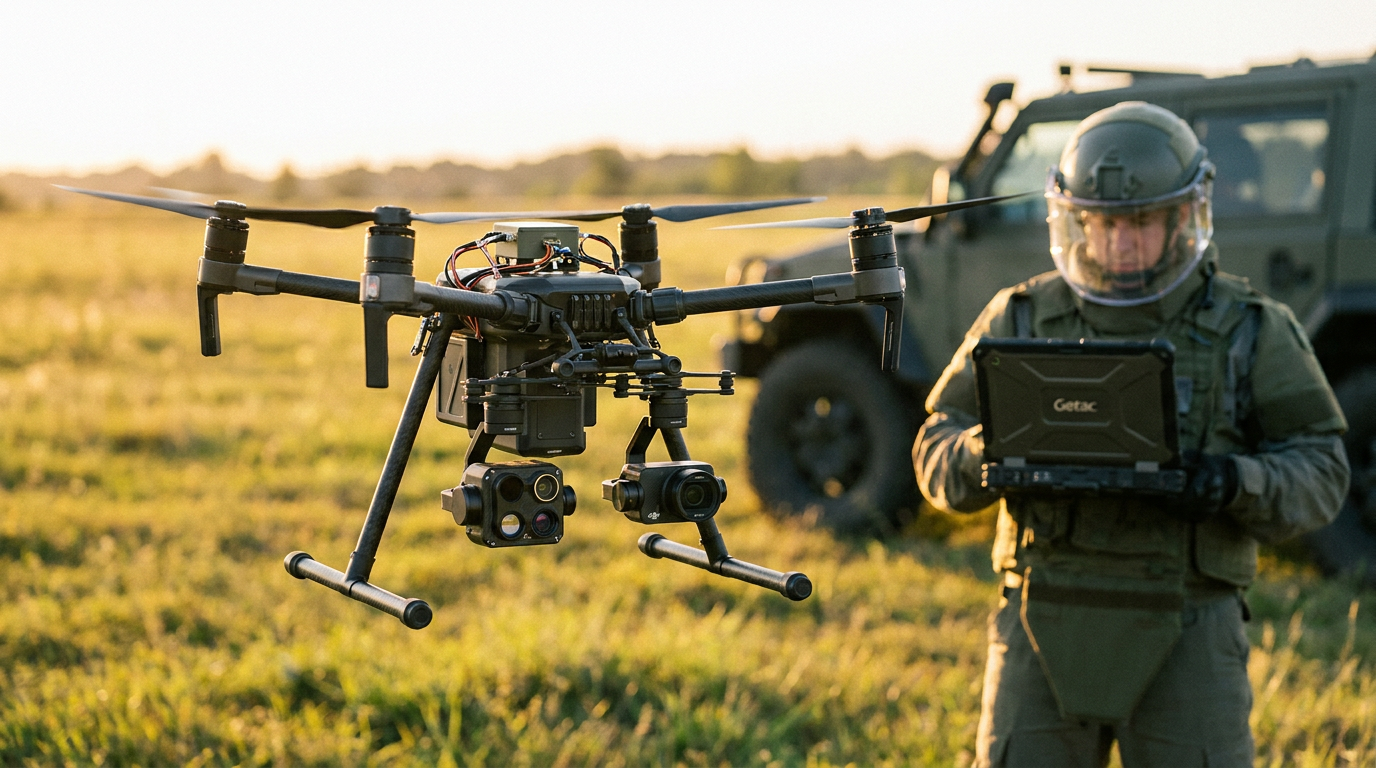
The mechanism driving these gains relies on "sensor fusion." Drones fly at low altitudes—often between 0.5 and 2 meters above the ground—carrying a payload of RGB cameras, thermal infrared sensors, and specialized magnetometers. The magnetometers detect anomalies in the Earth's magnetic field caused by metallic casings, while thermal sensors look for temperature differentials between the soil and buried objects. The Ministry of Defence of Ukraine has actively integrated these specialized magnetometers into their sapper training programs to detect concealed metal objects from the air.[3][4]
Once the drone collects the raw data, deep learning models, such as Faster Regional-Convolutional Neural Networks (Faster R-CNN), process the imagery. These AI models are trained on vast proprietary datasets of explosive remnants of war. They can rapidly identify the visual signatures of over 150 types of munitions, spotting the distinct shapes of surface-laid mines, the thermal footprint of buried explosives, or the subtle craters left by previous detonations.[4][7]
Once the drone collects the raw data, deep learning models, such as Faster Regional-Convolutional Neural Networks (Faster R-CNN), process the imagery.
Crucially, removing humans from the initial survey grid has resulted in a measurable drop in casualties. Data from automated demining deployments shows a 90% decrease in operational incidents, dropping the accident rate from 5 per 1,000 operations down to 0.5. By the time human sappers or armored mechanical flails enter a field, they already possess a high-fidelity map of the exact threat locations, eliminating the deadly uncertainty of a blind sweep.[5][7]

Despite these breakthroughs, the evidence highlights distinct limitations in current AI capabilities, particularly regarding buried, low-metal explosives. Many modern landmines, such as the aerially deployed PFM-1 "Butterfly" mine, are constructed almost entirely of plastic or polyethylene. While thermal cameras can sometimes spot them if they are on the surface, they become nearly invisible to both magnetometers and thermal sensors once buried or covered by dense vegetation.[4][6]
Ground-penetrating radar (GPR) is currently the only modality capable of reliably detecting buried plastic targets. However, academic analyses show that while cart-based GPR pushed by humans has a detection rate of around 55%, UAV-mounted GPR remains severely limited, achieving only an 18.2% detection rate at current operational flight heights. The physics of radar payload weight and drone battery life continue to bottleneck this specific application.[4][7]

Furthermore, AI systems struggle with high false-positive rates in "high metal areas." In active or former battle zones, artillery fire scatters thousands of pieces of harmless shrapnel across the landscape. Magnetometers and AI models can find it challenging to distinguish between a live explosive and a jagged piece of scrap metal, requiring human analysts to manually verify the AI's flags before clearance begins.[2][4]
The tactical evolution of the weapons themselves is also forcing deminers to adapt. In recent conflicts, combatants have begun deploying "high-tech" mines equipped with seismic or magnetic influence sensors. These devices are designed to detonate when they detect the magnetic field of a traditional metal detector or the vibrations of an approaching vehicle. The UN Mine Action Service notes that remote drone surveys are becoming not just a matter of efficiency, but a strict prerequisite for surviving these advanced traps.[2]
Ultimately, drones and AI do not replace the need for physical clearance; they optimize it. The "kill chain" of demining still requires an armored unmanned ground vehicle (UGV) or a trained human specialist to physically neutralize the ordnance. But by shrinking the search grid from the size of a football pitch to the size of a penalty box, AI is ensuring that limited demining resources are spent disarming threats rather than searching empty fields.[1][2][7]
How we got here
Early 2010s
The concept of using consumer drones for humanitarian demining begins to gain traction among NGOs.
Feb 2022
The invasion of Ukraine creates the largest suspected minefield in the modern world, accelerating funding for clearance tech.
2024
Demining organizations log tens of thousands of drone flight minutes, proving the viability of AI mapping at scale.
May 2026
Ukraine's Ministry of Defence formally integrates drone magnetometry into its standard sapper training programs.
Viewpoints in depth
Demining NGOs
Focus on the humanitarian impact, prioritizing speed, safety, and the rapid return of agricultural land to civilians.
For humanitarian organizations like the HALO Trust and the UN Mine Action Service, the primary metric of success is not just finding mines, but safely returning land to communities. These groups emphasize that AI's greatest immediate value is 'area cancellation'—using forensic aerial data to definitively prove that a suspected field is actually safe. By ruling out massive tracts of land without ever putting a human in harm's way, NGOs can focus their limited physical clearance resources on confirmed hazard zones, allowing displaced farmers and families to return home years ahead of schedule.
Defense Tech Developers
Emphasize the software capabilities, sensor fusion, and the measurable cost-efficiency of deploying AI models at scale.
Commercial technology firms and defense contractors view the landmine problem as a data processing challenge. Their focus is on refining the algorithms—like Faster R-CNN—to process hundreds of thousands of multispectral images in near real-time. Developers argue that as proprietary datasets of explosive remnants grow, the AI will become increasingly adept at filtering out false positives caused by battlefield shrapnel. For this camp, the ultimate goal is full automation of the "observe and orient" phases of the kill chain, driving the cost of detection down to pennies per square meter.
Academic Researchers
Highlight the physical limitations of the technology, particularly the high false-positive rates and the difficulty of detecting buried plastic.
Scientists and imaging researchers caution against viewing AI as a silver bullet, pointing to strict limitations in the physics of remote sensing. Academics note that while surface-laid metallic mines are easily spotted, the proliferation of low-metal and plastic explosives creates a dangerous blind spot. Because drone-mounted ground-penetrating radar currently lacks the power and proximity to reliably see beneath the soil, researchers warn that over-reliance on aerial AI could lead to a false sense of security in areas where plastic mines have been buried by time or vegetation.
What we don't know
- When drone-mounted ground-penetrating radar will become light and powerful enough to reliably detect buried plastic mines.
- How quickly fully autonomous unmanned ground vehicles (UGVs) can be integrated to handle the physical disarmament phase without human intervention.
- The exact timeline for clearing Ukraine's remaining contaminated territory, given the ongoing nature of the conflict.
Key terms
- Unexploded Ordnance (UXO)
- Explosive weapons, such as bombs, shells, or grenades, that did not explode when they were deployed and still pose a risk of detonation.
- Multispectral Imaging
- Camera technology that captures image data within specific wavelength ranges across the electromagnetic spectrum, revealing details invisible to the human eye.
- Magnetometer
- A scientific instrument used to measure the strength and direction of magnetic fields, highly effective at detecting buried ferrous metals.
- Ground-Penetrating Radar (GPR)
- A geophysical method that uses radar pulses to image the subsurface, capable of detecting non-metallic buried objects like plastic landmines.
- False Positive
- When a detection system incorrectly flags a harmless object, such as a piece of scrap metal or shrapnel, as a dangerous explosive.
Frequently asked
Can drones actually disarm the landmines?
No. Drones and AI are used exclusively for mapping and detection. Disarming or detonating the mines still requires armored mechanical flails, unmanned ground robots, or human sappers.
Why are plastic landmines harder to find?
Plastic mines contain very little metal, making them invisible to traditional magnetic sensors. Finding them requires thermal imaging or ground-penetrating radar, which struggle when the mine is buried deep or covered by vegetation.
How much of Ukraine is currently mined?
Initial estimates placed the suspected contaminated area at 174,000 square kilometers. However, by using AI and satellite data to prove certain areas are clear, organizations have reduced that suspected zone to roughly the size of Massachusetts.
Sources
Source coverage
7 outlets
3 viewpoints surfaced







[1]National Defense MagazineDemining NGOs
Ukraine War Spurs Demining Tech Advancements
Read on National Defense Magazine →[2]UN NewsDemining NGOs
Deminers race to keep up with military technology
Read on UN News →[3]Ministry of Defence of UkraineDefense Tech Developers
Drones and magnetometers in demining operations: Ministry of Defence deploys advanced technologies for land clearance
Read on Ministry of Defence of Ukraine →[4]Preprints.orgAcademic Researchers
UAV-Based Detection of Explosive Ordnance: A Comparative Analysis of Sensor Modalities
Read on Preprints.org →[5]Blackthorn.aiDefense Tech Developers
Landmine Detection using Deep Learning and Drones
Read on Blackthorn.ai →[6]ZME ScienceAcademic Researchers
Multiple sensors from above: How drones are changing landmine detection
Read on ZME Science →[7]Factlen Editorial TeamAcademic Researchers
Synthesis by Factlen editorial team
Read on Factlen Editorial Team →
Every angle. Every day.
Get defense security stories with full source coverage and perspective breakdowns delivered to your inbox.