
Do Sleep Trackers Actually Work? An Evidence-Based Review of Oura, Apple Watch, and Whoop
Clinical studies reveal that while modern wearables are highly accurate at detecting sleep duration and recovery metrics, they still struggle to map deep sleep architectures.
By Factlen Editorial Team
- Clinical Sleep Specialists
- Prioritize diagnostic accuracy and warn that consumer wearables cannot replace polysomnography for detecting sleep disorders.
- Quantified Self Advocates
- Value continuous, longitudinal data, arguing that long-term baseline trends are more actionable than a single night in a sleep lab.
- Consumer Tech Reviewers
- Focus on usability, ecosystem integration, and the balance between daytime smartwatch features and nighttime tracking comfort.
What's not represented
- · Individuals with chronic insomnia whose sleep is mischaracterized by actigraphy.
- · Primary care physicians who must interpret an influx of consumer sleep data from concerned patients.
Why this matters
Millions of people alter their daily routines, training schedules, and bedtimes based on wearable sleep data. Understanding where these devices are clinically accurate—and where they are merely guessing—prevents unnecessary anxiety and helps users make genuinely evidence-based health decisions.
Key points
- Modern wearables detect sleep versus wakefulness with over 95% accuracy.
- The Oura Ring consistently outperforms wrist-based devices in identifying specific sleep stages.
- Smartwatches like the Apple Watch frequently underestimate deep sleep compared to clinical sensors.
- High-end trackers measure heart rate variability (HRV) with near-medical precision.
- Fixating on imperfect sleep data can cause 'orthosomnia,' a form of sleep anxiety that degrades rest.
Millions of people now begin their mornings by checking a screen to find out how they slept. The consumer sleep tracking industry, led by devices like the Apple Watch, Oura Ring, and Whoop, has transformed sleep from a subjective feeling into a quantified score. But as these devices become ubiquitous, a critical question remains: are the algorithms powering these trackers actually accurate, or are they just providing sophisticated guesswork?
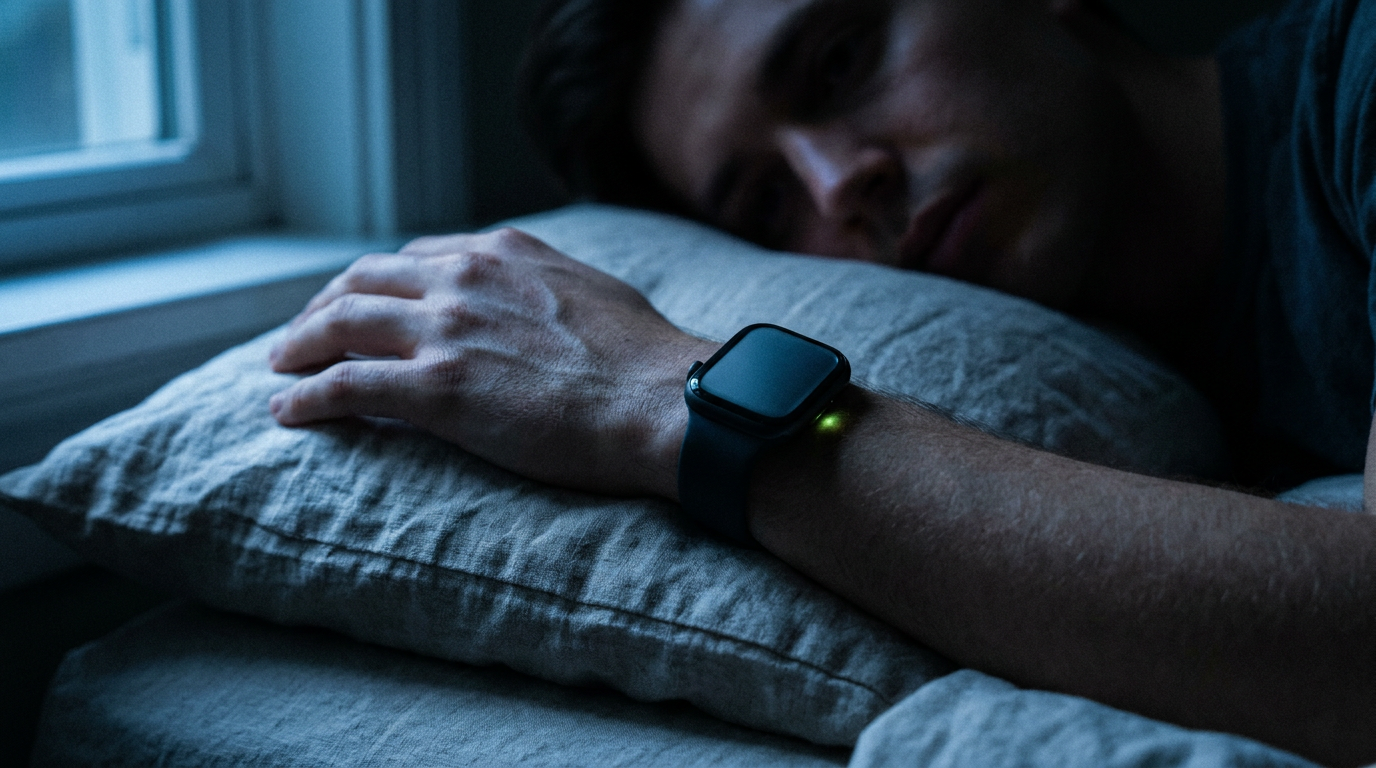
To answer this, scientists evaluate consumer wearables against polysomnography, widely known as PSG. PSG is the clinical gold standard for sleep analysis, requiring an overnight stay in a lab where technicians attach electrodes to the scalp and face to directly measure brain waves, eye movements, and muscle tension. Wearables, by contrast, rely on actigraphy—movement tracking—and optical heart rate monitoring to estimate what the brain is doing based on what the wrist or finger is doing.[4]
When evaluating whether wearables can accurately detect the basic binary of sleep versus wakefulness, the clinical evidence is exceptionally strong. A 2024 study published in MDPI evaluated the Oura Ring Gen3, Apple Watch Series 8, and Fitbit Sense 2 against in-lab PSG. The researchers found that all three devices demonstrated over 95 percent sensitivity in distinguishing sleep from wakefulness. For the average user wanting to know their total time in bed and total time asleep, today's sensors are highly reliable.[1][5]

However, researchers note a significant clinical blind spot regarding insomnia. Because wearables rely primarily on a lack of movement to determine sleep, they struggle to differentiate between quiet, motionless wakefulness and actual sleep. If a user lies perfectly still in the dark while stressed, their watch will likely credit them with a full night of rest, leading to artificially inflated sleep scores.[3]
The scientific consensus shifts from strong to moderate when devices attempt to map specific sleep architectures, such as light, deep, and REM sleep. Differentiating between REM sleep and light sleep is notoriously difficult without an electroencephalogram to measure brain waves. Both stages can present with similar heart rate variability and movement profiles, forcing consumer algorithms to make educated guesses based on population averages.[4]
In the 2024 MDPI study, sensitivity for sleep stage discrimination ranged widely from 50 percent to 86 percent. The Oura Ring performed the best among the tested devices, achieving up to 79.5 percent accuracy across light, deep, and REM stages, showing no statistically significant difference from the PSG baseline.[1]
Conversely, the Apple Watch Series 8 struggled specifically with deep sleep architecture. The study found that the Apple Watch underestimated deep sleep by an average of 43 minutes per night, while simultaneously overestimating light sleep by 45 minutes. Fitbit devices showed a similar, though less severe, tendency to underestimate deep sleep by roughly 15 minutes.[1]

Conversely, the Apple Watch Series 8 struggled specifically with deep sleep architecture.
A separate, comprehensive 2022 study by Central Queensland University tested six devices simultaneously on the same participants. It confirmed that while total sleep time is generally accurate, four-stage classification drops to around 50 to 60 percent accuracy for most wrist-based devices, highlighting the inherent limitations of current optical sensors.[2]
While sleep staging remains imperfect, the evidence supporting wearables as cardiovascular recovery trackers is incredibly strong. The Central Queensland University study found that both the Oura Ring and Whoop achieved a 0.99 intraclass correlation with medical-grade electrocardiography for measuring heart rate variability. This means that for tracking physiological strain and nervous system recovery, high-end wearables are virtually indistinguishable from hospital equipment.[2]
The form factor of the device also plays a crucial role in data accuracy. Devices worn on the finger, like the Oura Ring, benefit from measuring blood flow closer to the surface of the skin with fewer motion artifacts compared to the wrist. This physiological advantage partly explains why ring-based trackers often outperform smartwatches in resting heart rate and HRV precision, even if the underlying algorithms are similarly sophisticated.[6]
Furthermore, the continuous evolution of proprietary algorithms means that a device's accuracy can change overnight via a software update. Companies frequently refine their machine learning models based on millions of nights of user data. While this allows devices to improve over time, it also frustrates independent researchers, as a validation study published in 2024 may evaluate an algorithm that the manufacturer has already replaced by 2025.[5]

Despite the hardware improvements, the psychological impact of daily sleep tracking remains a highly contested variable in the medical community. Researchers at the University of Oxford highlight that fixating on wearable data can induce sleep anxiety, a phenomenon clinically termed orthosomnia.[3]
Ironically, the pressure to achieve a high sleep score can trigger the sympathetic nervous system, degrading the very sleep quality the user is trying to improve. In one revealing Oxford study, participants whose sleep scores were artificially manipulated to look poor reported worse daytime mood, increased fatigue, and lower cognitive function—regardless of how well they actually slept according to the objective data.[3]

For tracking long-term behavioral trends, resting heart rate, and overall sleep duration, modern wearables are highly capable, evidence-backed tools. They excel at establishing a personal baseline and highlighting how lifestyle choices, such as late-night meals or alcohol consumption, impact overnight recovery.[4][6]
Ultimately, consumers should treat daily sleep stage breakdowns—particularly deep sleep metrics on wrist-based wearables—as educated estimates rather than clinical facts. If a user suspects they have a genuine sleep disorder like sleep apnea, no consumer device can replace the diagnostic clarity of a night in a polysomnography lab.[6]
How we got here
1990s
Actigraphy (movement tracking) becomes a standard, albeit limited, tool in clinical sleep research.
2015
The first Apple Watch launches, sparking mainstream interest in wrist-based health tracking.
2018
Oura releases its Gen2 ring, shifting advanced sleep and HRV tracking to a less intrusive form factor.
2022
Central Queensland University publishes a landmark study revealing that most wearables struggle with four-stage sleep classification.
2024
Clinical reviews confirm modern sensors achieve near-perfect accuracy for basic sleep/wake detection, though deep sleep tracking remains inconsistent.
Viewpoints in depth
Clinical Sleep Specialists
Prioritize diagnostic accuracy and warn against over-reliance on consumer data.
Medical professionals emphasize that while wearables are excellent for general wellness, they fundamentally measure the wrong metrics for clinical diagnosis. Because devices like the Apple Watch and Fitbit rely on actigraphy (movement) and photoplethysmography (blood flow), they cannot detect the brainwave patterns (EEG) necessary to definitively diagnose conditions like sleep apnea or narcolepsy. Furthermore, clinicians increasingly report cases of 'orthosomnia'—patients whose fixation on achieving a perfect sleep score induces the very anxiety that keeps them awake.
Quantified Self Advocates
Argue that longitudinal trends matter more than absolute nightly precision.
Data-driven consumers and athletic performance coaches view the 'inaccuracy' of wearables as a moot point. Their argument centers on consistency: even if a device consistently underestimates deep sleep by 20 minutes, the baseline is established. By tracking deviations from that personal baseline, users can accurately gauge how late-night meals, alcohol, or intense training affect their recovery. For this camp, the value lies in continuous, frictionless data collection over months, which a single night in a $2,000 sleep lab cannot provide.
Consumer Tech Reviewers
Evaluate devices based on holistic lifestyle integration and form factor.
Technology analysts evaluate sleep trackers through the lens of daily friction. While the Oura Ring might offer superior sleep staging, reviewers often point out that an Apple Watch provides daytime utility—notifications, cellular connectivity, and workout tracking—that a screenless ring cannot match. This perspective treats sleep tracking as one feature within a broader ecosystem, weighing the discomfort of sleeping with a bulky smartwatch against the financial cost of maintaining multiple specialized devices.
What we don't know
- How proprietary, closed-source algorithms from companies like Apple and Whoop weigh different physiological signals.
- Whether the long-term psychological stress of tracking sleep outweighs the behavioral benefits for the average consumer.
- How accurately these devices perform on individuals with diagnosed sleep disorders, as most validation studies use healthy participants.
Key terms
- Polysomnography (PSG)
- A comprehensive clinical sleep study that measures brain waves, oxygen levels, heart rate, and breathing to diagnose sleep disorders.
- Actigraphy
- The continuous measurement of movement, typically via a wrist-worn accelerometer, used by wearables to estimate sleep and wakefulness.
- Heart Rate Variability (HRV)
- The fluctuation in the time intervals between adjacent heartbeats, used as a key indicator of physical recovery and nervous system readiness.
- Orthosomnia
- A medical term for the anxiety and insomnia caused by an unhealthy fixation on wearable sleep tracking data.
- Epoch
- A short, fixed period of time (usually 30 seconds) used by researchers to break down and classify sleep stages during a study.
Frequently asked
What is the most accurate sleep tracker?
According to recent clinical validations, the Oura Ring consistently ranks highest for sleep stage accuracy and HRV tracking, closely followed by Whoop for recovery metrics.
Why does my Apple Watch say I get no deep sleep?
Studies show the Apple Watch frequently underestimates deep sleep—sometimes by over 40 minutes a night—due to how its algorithm interprets movement and heart rate data.
Can a smartwatch diagnose sleep apnea?
No. While some devices can detect breathing disturbances or blood oxygen drops, a definitive diagnosis requires polysomnography (a clinical sleep study) to monitor brainwaves and respiratory effort.
What is orthosomnia?
Orthosomnia is an unhealthy obsession with achieving perfect sleep data. Ironically, the anxiety caused by checking wearable sleep scores can lead to worse sleep quality.
Sources
Source coverage
6 outlets
3 viewpoints surfaced





[1]MDPIConsumer Tech Reviewers
Accuracy of Commercial Wearable Sleep Trackers Compared to Polysomnography
Read on MDPI →Validation of Six Wearable Devices for Estimating Sleep, Heart Rate and Heart Rate Variability
Read on Sensors →[3]University of OxfordClinical Sleep Specialists
Sleep trackers can cause sleep anxiety
Read on University of Oxford →[4]Sleep FoundationClinical Sleep Specialists
Are Sleep Trackers Accurate?
Read on Sleep Foundation →[5]JMIR mHealth and uHealthQuantified Self Advocates
Validation of Consumer Sleep Trackers: Multicenter Study
Read on JMIR mHealth and uHealth →[6]Factlen Editorial TeamConsumer Tech Reviewers
Synthesis by Factlen editorial team
Read on Factlen Editorial Team →

Every angle. Every day.
Get shopping stories with full source coverage and perspective breakdowns delivered to your inbox.