
Comparing the Meta Quest 3 and Apple Vision Pro for Gaming, Productivity, and Enterprise
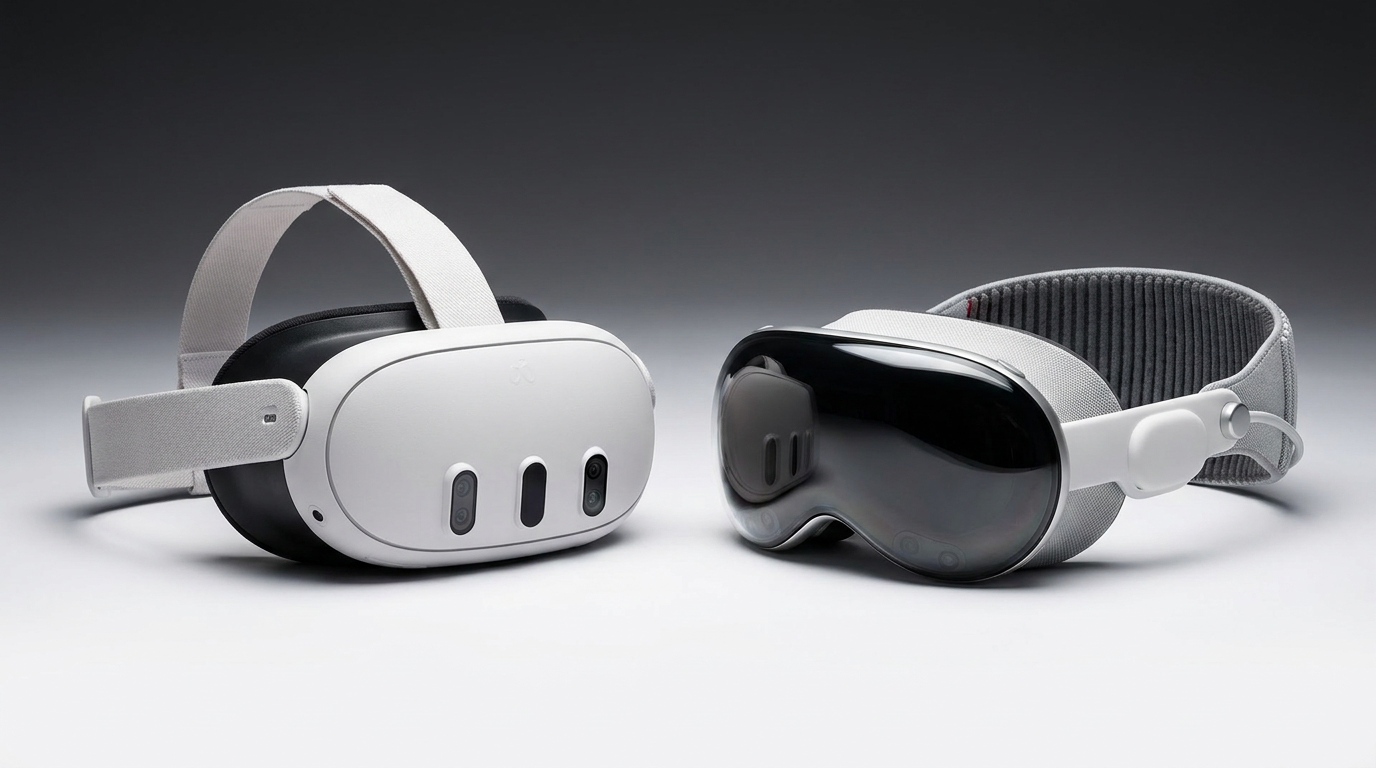
The Meta Quest 3 and Apple Vision Pro represent two fundamentally different approaches to mixed reality, separated by a $3,000 price gap. While Meta dominates gaming and accessible entertainment, Apple's premium headset offers unmatched visual fidelity for professional spatial computing.
By Factlen Editorial Team
- VR Gamers and Enthusiasts
- Users prioritizing immersive gaming, fitness, and tactile feedback.
- Spatial Computing Professionals
- Advocates for the Vision Pro as a premium productivity and media replacement.
- Enterprise Evaluators
- Corporate buyers focused on deployment scale, cost, and specific use cases.
What's not represented
- · Independent software developers struggling to justify the cost of building for the smaller Vision Pro user base.
- · Educators looking for affordable mixed-reality solutions for public school classrooms.
Why this matters
Choosing between these headsets dictates whether you are buying a high-end entertainment console or investing in a fundamentally new way to work and compute. Understanding their distinct trade-offs ensures you don't spend $3,499 on a device that cannot play your favorite games, or $499 on a headset that strains your eyes during a workday.
Key points
- The Meta Quest 3 and Apple Vision Pro target entirely different use cases, despite both offering mixed reality passthrough.
- Apple's Vision Pro excels in productivity and media consumption, utilizing a 23-million-pixel micro-OLED display and seamless macOS integration.
- The Meta Quest 3 dominates the gaming and fitness sectors, relying on physical controllers for tactile feedback and a massive standalone library.
- Enterprise testing reveals the Quest 3 is preferred for large-scale, shared training, while the Vision Pro is reserved for precision tasks.
- At $3,499, the Vision Pro remains a premium device for power users, whereas the $499 Quest 3 offers the best overall value for mainstream consumers.
The defining consumer hardware debate of 2026 centers on two devices that look similar but operate in entirely different stratospheres: the Meta Quest 3 and the Apple Vision Pro. With the recent release of the M5-powered Vision Pro, the conversation has reignited across the tech industry. On one side sits Meta’s $499 headset, widely regarded as the gold standard for mainstream virtual reality. On the other is Apple’s $3,499 spatial computer, a premium device boasting laptop-class silicon and unparalleled visual fidelity. Comparing a device that costs seven times more than its rival might seem absurd, but consumers and enterprise buyers are actively weighing these two ecosystems. The choice is rarely about raw specifications; rather, it hinges on fundamentally different philosophies about what face-worn technology should actually do.[1][4]
To understand the trade-offs, one must look at the core design intent of each headset. The Meta Quest 3 is built as a highly accessible, wireless gaming and mixed-reality console. It relies on a Snapdragon XR2 Gen 2 chip and includes physical controllers designed for tactile interaction. Conversely, the Apple Vision Pro is engineered as a spatial computer meant to augment or replace traditional monitors and laptops. It ditches controllers entirely in favor of an incredibly precise eye-and-hand tracking interface, powered by the same M5 chip found in modern MacBooks. These distinct approaches dictate where each device excels and where each stumbles.[1][5]
The case for the Apple Vision Pro begins with its display technology, which remains unmatched in the consumer market. The headset utilizes dual micro-OLED panels packing a staggering 23 million pixels, resulting in a visual experience that effectively eliminates the screen door effect common in older VR headsets. The evidence for this superiority is most apparent in text readability and passthrough video quality. When wearing the Vision Pro, users can read fine print on a physical smartphone or work in complex spreadsheets without eye strain. The passthrough cameras deliver a near-flawless view of the real world, allowing for genuine mixed-reality integration that feels natural rather than digitized.[4][5]

The case against the Apple Vision Pro centers heavily on its ergonomics and its astronomical price tag. At roughly 650 grams, the headset is composed of premium aluminum and glass, making it noticeably front-heavy. Even with the newly introduced Dual Knit Band designed to distribute weight more evenly, users frequently report neck fatigue during extended sessions. Furthermore, the device requires a tethered external battery pack that lasts roughly two hours, tethering the user to a cord in a way that feels distinctly un-Apple. Finally, the $3,499 entry price restricts the Vision Pro to early adopters, wealthy enthusiasts, and specific enterprise sectors, rather than the general public.[4][5][6]
The evidence for the Vision Pro’s productivity prowess, however, is undeniable for those embedded in the Apple ecosystem. The device seamlessly integrates with macOS; simply looking at a compatible Mac allows the user to project a massive, crisp virtual display into their physical space. Users can surround themselves with floating Safari windows, Messages, and native visionOS applications, all controlled by subtle finger pinches and eye movements. For creative professionals, designers, and remote workers who need infinite screen real estate without the physical footprint of multiple monitors, the Vision Pro delivers a genuinely transformative workflow that the Quest 3 cannot replicate.[3][4]

The evidence for the Vision Pro’s productivity prowess, however, is undeniable for those embedded in the Apple ecosystem.
The case for the Meta Quest 3 is built on its extraordinary value and its dominance in the gaming sector. At $499, it offers a highly capable mixed-reality experience for a fraction of Apple's price. The headset features a lighter, 515-gram all-plastic build with an internal battery, completely freeing the user from external wires. While its LCD panels cannot match Apple's micro-OLED contrast, the Quest 3 still delivers a sharp 2064 by 2208 pixels per eye and supports a fluid 120Hz refresh rate. For the vast majority of consumers, this level of visual fidelity is more than sufficient for immersive entertainment and casual mixed reality.[1][2]
The case against the Meta Quest 3 highlights its limitations as a serious computing device. The LCD displays, while excellent for the price, struggle with fine text rendering at a distance, making long-term spreadsheet or document work fatiguing. Its color passthrough, while a massive upgrade over previous generations, exhibits noticeable grain and warping around moving objects. The evidence shows that while virtual desktop applications exist for the Quest 3, the resolution and software ecosystem are not robust enough to replace a physical laptop for daily professional use. It remains a device you use alongside your computer, not instead of it.[1][3]
The evidence for the Quest 3’s gaming supremacy is overwhelming. Meta has spent years cultivating a massive library of standalone VR titles, from high-intensity fitness apps to sprawling role-playing games. Crucially, the Quest 3 includes the Touch Plus controllers, which provide essential haptic feedback and precise spatial tracking. When playing a virtual sport or swinging a digital sword, the physical sensation of holding a controller is vital for immersion. The Vision Pro’s lack of controllers makes traditional VR gaming nearly impossible, relegating Apple's headset to slower, gaze-based puzzle games or traditional iPad games played on a flat virtual screen.[2][3]
In the enterprise sector, the trade-offs between the two headsets become a matter of scale versus precision. Recent testing by immersive technology firms reveals that the Quest 3 is the preferred choice for large-scale training deployments. Its lower cost allows companies to purchase fleets of headsets, and its design is highly conducive to being shared among multiple users in a rotating training center. The Vision Pro, by contrast, is highly personalized to the individual user’s eye spacing and optical prescription, making it difficult to share. However, for specialized scenarios like medical imaging or precision engineering where pixel-perfect clarity is non-negotiable, the Vision Pro easily justifies its premium.[6]

The interaction paradigms of both devices also represent a significant trade-off. Apple’s gaze-and-pinch system feels like magic when navigating menus or selecting media; it is intuitive, silent, and requires almost no physical exertion. However, it lacks the tactile confirmation that physical buttons provide. Meta’s approach offers the best of both worlds for its price bracket: it supports surprisingly capable hand-tracking for casual menu navigation, but relies on its excellent controllers for complex tasks. This flexibility makes the Quest 3 a more versatile tool for interactive 3D environments, even if its hand-tracking isn't quite as flawless as Apple's.[4][5]
Ultimately, the Apple Vision Pro fits well when you are a creative professional seeking infinite, high-resolution monitor space, a frequent traveler who wants a private IMAX-quality cinema on airplanes, or an enterprise user requiring absolute visual precision for 3D modeling. It is the ultimate luxury consumption and spatial productivity device. However, the Vision Pro does not fit when you want to play active, controller-based VR games, when you intend to share the headset frequently with family members or colleagues, or when you are sensitive to heavy headwear during long sessions.[3][4][6]

Conversely, the Meta Quest 3 fits well when you want the best overall value in the mixed-reality market, when your primary goals are gaming, virtual fitness, and social VR, or when you need to deploy headsets at scale for corporate training. It is the undisputed champion of accessible, active virtual reality. The Quest 3 does not fit when your primary goal is to replace your physical work monitors for eight hours a day, when you require the absolute highest fidelity for reading fine text, or when you want a seamless, native extension of the macOS and iOS ecosystem.[1][2][6]
How we got here
June 2023
Apple officially unveils the Vision Pro, introducing the concept of spatial computing to the public.
October 2023
Meta releases the Quest 3, bringing high-quality color passthrough and improved processing to the mainstream market.
February 2024
The original M2-powered Apple Vision Pro launches in the United States.
Late 2025
Apple releases the M5-powered refresh of the Vision Pro, improving performance and updating the head strap design for better comfort.
Viewpoints in depth
Spatial Computing Professionals
Advocates for the Apple Vision Pro who view it as the ultimate productivity and media consumption device.
For developers, designers, and Apple ecosystem power users, the Vision Pro is not a gaming console—it is the next iteration of the Mac. This camp argues that the $3,499 price tag is justified when viewed as a replacement for a high-end multi-monitor workstation and a home theater system. They emphasize that the micro-OLED displays and seamless macOS integration provide a frictionless workflow that fundamentally changes how digital work is performed, rendering the Quest 3's lower-resolution LCDs inadequate for serious eight-hour workdays.
VR Gamers and Enthusiasts
Users who prioritize immersive gaming, fitness, and tactile interaction in virtual reality.
This perspective champions the Meta Quest 3 as the undisputed king of consumer VR. Gamers argue that virtual reality requires physical movement and tactile feedback, making Meta's Touch Plus controllers essential for immersion. They point to the Quest's massive library of standalone games, SteamVR compatibility, and lightweight, untethered design as proof that Meta understands what actually makes VR fun. From this viewpoint, the Vision Pro's lack of controllers and heavy, tethered battery make it a beautiful but fundamentally limited device for interactive entertainment.
Enterprise Training Managers
Corporate buyers evaluating headsets for large-scale employee training and deployment.
Enterprise evaluators look past the marketing to focus on unit economics, deployment logistics, and shared usability. This camp heavily favors the Meta Quest 3 for broad training initiatives, noting that its $499 price point allows for fleet purchases and its design easily accommodates multiple users sharing a single device. However, they acknowledge that for highly specialized fields—such as surgical preparation or complex 3D engineering—the Vision Pro's pixel-perfect passthrough and eye-tracking precision justify the massive premium, leading to a bifurcated enterprise market.
What we don't know
- Whether Apple will eventually release a cheaper, non-Pro version of the Vision headset to compete directly with Meta's pricing.
- How quickly third-party developers will build native, complex productivity applications for visionOS beyond the current iPad ports.
- If Meta will introduce a high-end 'Quest Pro 2' that bridges the gap between the Quest 3's gaming focus and the Vision Pro's productivity dominance.
Key terms
- Micro-OLED
- An advanced display technology used in the Vision Pro that packs millions of pixels into a tiny area, providing extreme sharpness and true black levels.
- Passthrough
- A feature that uses exterior cameras to show you the real world inside the headset, allowing for mixed reality experiences.
- Spatial Computing
- Apple's preferred term for technology that blends digital content with the physical world, emphasizing productivity and seamless integration over traditional virtual reality gaming.
- Haptic Feedback
- Physical vibrations or resistance provided by controllers—like those on the Quest 3—to simulate the feeling of touching or holding virtual objects.
Frequently asked
Can the Meta Quest 3 replace my work laptop?
While the Quest 3 supports virtual desktop applications, its LCD resolution makes reading fine text fatiguing over long periods. It is best used alongside a computer rather than as a total replacement.
Does the Apple Vision Pro have VR games?
The Vision Pro supports some immersive experiences and traditional iPad games played on a virtual screen, but it lacks the physical controllers required for most popular, active VR games.
Which headset is better for watching movies?
The Apple Vision Pro is significantly better for media consumption. Its 23-million-pixel micro-OLED displays and spatial audio provide an unmatched, theater-like experience.
Can multiple people share an Apple Vision Pro?
It is difficult. The Vision Pro is highly customized to the owner's face shape, light seal size, and optical prescription, making it cumbersome to pass back and forth compared to the easily adjustable Quest 3.
Sources
Source coverage
7 outlets
3 viewpoints surfaced







[1]PCMagVR Gamers and Enthusiasts
Meta Quest 3 Review: The Gold Standard for Standalone VR
Read on PCMag →[2]ForbesVR Gamers and Enthusiasts
Meta Quest 3 Review: A Standalone VR Marvel
Read on Forbes →[3]Reality AtlasEnterprise Evaluators
Meta Quest 3 and Apple Vision Pro Compared: Gaming vs Spatial Computing
Read on Reality Atlas →[4]MacRumorsSpatial Computing Professionals
Apple Vision Pro: Specs, Price, and Features
Read on MacRumors →[5]MashableSpatial Computing Professionals
Apple Vision Pro M5 Review: Visionary Hardware, Steep Price
Read on Mashable →[6]AgileSoftLabsEnterprise Evaluators
Enterprise VR Testing: Is Vision Pro Worth 7x the Price of Quest 3?
Read on AgileSoftLabs →[7]VR EddieVR Gamers and Enthusiasts
Apple Vision Pro (M5) vs Meta Quest 3: Full Specification Comparison
Read on VR Eddie →
Every angle. Every day.
Get meta stories with full source coverage and perspective breakdowns delivered to your inbox.