
Beyond Arabica: How 'Forgotten' Coffee Species Could Save the Global Industry
As climate change threatens the world's Arabica supply, researchers and farmers are reviving heat-tolerant, disease-resistant coffee species like Stenophylla and Liberica to future-proof the morning brew.
By Factlen Editorial Team
- Agricultural Scientists
- Advocating for crop diversification and the revival of wild species to future-proof farming.
- Specialty Coffee Industry
- Focused on maintaining high flavor standards while adapting to climate realities.
- Food-Tech Startups
- Developing lab-grown and fermented alternatives to bypass agricultural vulnerabilities.
- Industry Analysts
- Evaluating the macroeconomic and supply chain impacts of coffee diversification.
What's not represented
- · Smallholder Arabica Farmers
- · Mass-Market Coffee Conglomerates
Why this matters
With rising temperatures projected to wipe out half of the world's suitable coffee-growing land by 2050, the global supply of high-quality coffee is at severe risk. Cultivating alternative, climate-resilient species ensures that millions of farmers retain their livelihoods and consumers don't face exorbitant prices for their daily cup.
Key points
- Rising global temperatures threaten to eliminate up to 50% of the land suitable for growing Arabica coffee by 2050.
- Coffea stenophylla, a rediscovered West African species, tolerates temperatures over 6°C higher than Arabica while maintaining a premium flavor profile.
- Liberica and Excelsa, historically dismissed for their unconventional flavors, are being refined by specialty roasters to thrive in hot, lowland climates.
- Food-tech startups are developing 'beanless' coffee using precision fermentation and upcycled ingredients to reduce the industry's environmental footprint.
The morning ritual of coffee is quietly under threat. Every day, humanity consumes over two billion cups of coffee, the vast majority brewed from just two species: Arabica and Robusta. But the delicate Arabica plant, prized for its complex flavors and smooth acidity, is highly sensitive to temperature shifts. As global temperatures rise and weather patterns become increasingly erratic, the "coffee belt"—the equatorial band where these plants thrive—is shrinking. Without intervention, the future of the world's favorite beverage faces unprecedented volatility.[7]
The stakes for the global supply chain are monumental. A report from the Inter-American Development Bank estimates that rising temperatures will reduce the area suitable for growing Arabica by up to 50% by 2050. Farmers in traditional strongholds from Colombia to Ethiopia are already facing prolonged droughts, snap frosts, and the aggressive spread of coffee leaf rust, a devastating fungal disease. As suitable land disappears, farmers are often forced to move to higher altitudes, inadvertently driving deforestation in vulnerable mountain ecosystems.[2]
For decades, the industry's primary fallback has been Robusta. As its name suggests, Robusta is hardier, more disease-resistant, and capable of growing at lower altitudes where Arabica would wither. However, it carries a distinctively bitter, woody flavor profile and a significantly higher caffeine content, making it less desirable for the booming specialty coffee market. The industry has been trapped in a seemingly impossible compromise: sacrifice cup quality for agricultural resilience, or watch crop yields plummet.[7]

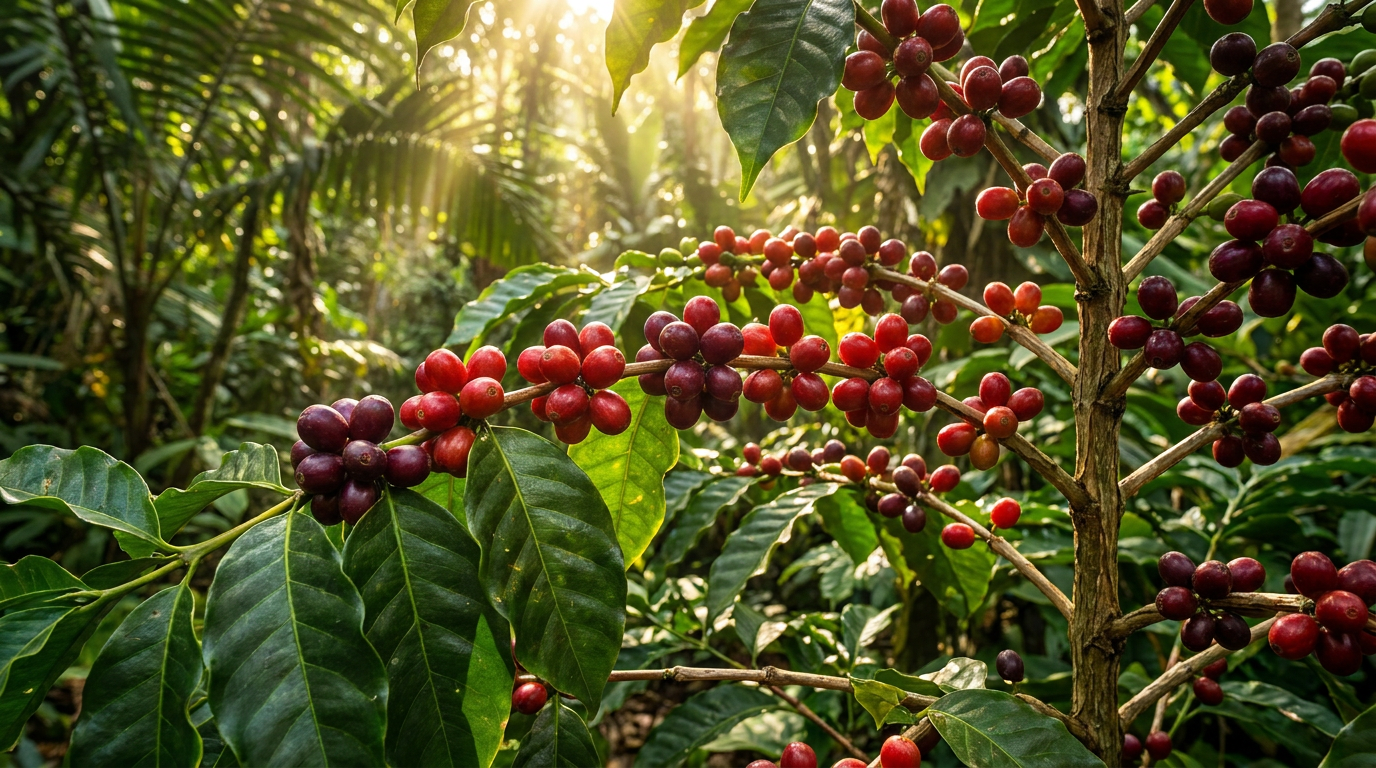
But deep in the highland forests of West Africa, a forgotten botanical solution has been quietly growing. Coffea stenophylla, a wild, narrow-leaved coffee species endemic to Guinea, Sierra Leone, and Ivory Coast, was widely farmed in the late 19th century before being displaced by the higher-yielding Robusta. For decades, it was assumed to be virtually extinct in the wild, relegated to historical footnotes and aging herbarium specimens. Its absence left a critical gap in the genetic library of commercial coffee, right when the industry needed it most.[1][3]
That narrative changed dramatically when researchers, including botanists from the Royal Botanic Gardens, Kew, and local agronomists, rediscovered wild populations of Stenophylla in Sierra Leone. The rediscovery sent ripples through the agricultural science community, not just because a "lost" species had been found, but because of what the plant could endure. It represented a potential paradigm shift for an industry desperate for climate-resilient genetics. Finding a surviving population meant that researchers could finally study its living traits rather than relying on century-old agricultural records, opening the door to modern cultivation trials.[1][3]
Agronomic evaluations quickly revealed that Stenophylla thrives at a mean annual temperature of 24.9°C. That is roughly 6.2 to 6.8°C higher than what Arabica can tolerate, and nearly 2°C warmer than Robusta's ideal conditions. Furthermore, it demonstrated a remarkable ability to withstand prolonged dry seasons, a crucial trait as climate change disrupts historical rainfall patterns across the tropics. This uniquely broad climate envelope makes it an ideal candidate for future-proofing lowland farms. By surviving in conditions that would easily decimate traditional commercial crops, Stenophylla offers a blueprint for how agriculture can adapt to a rapidly warming planet without abandoning established farming regions.[1]

The true breakthrough, however, occurred at the cupping table. When experienced tasters and sensory analysts evaluated Stenophylla, they found something unprecedented for a wild, heat-tolerant species: it tasted remarkably like high-quality Arabica. The flavor profile was described as complex, nuanced, and clean, featuring the natural sweetness and refined acidity that specialty roasters demand. This shattered the long-held assumption that heat tolerance inherently required a sacrifice in flavor quality. For the first time, the industry had a viable path to maintaining the premium sensory experience of specialty coffee while cultivating a plant tough enough to survive the harsh realities of climate change.[1]
The true breakthrough, however, occurred at the cupping table.
Commercial trials are already underway to test the viability of this "sleeping treasure." In eastern Sierra Leone, agricultural teams have propagated thousands of Stenophylla seedlings in community nurseries before transferring them to trial plots. During an intense heatwave in early 2024, where temperatures soared to 40°C for nearly two months, an impressive 80% of the Stenophylla seedlings survived, proving their extraordinary field resilience. These early results are providing crucial data for scaling up production. Agronomists are closely monitoring the plants' growth rates, root development, and eventual cherry yields to determine exactly how this wild species can be integrated into standard commercial farming practices.[3]
Stenophylla is not the only forgotten species experiencing a renaissance. Coffea liberica, and its variant Excelsa, are also drawing renewed attention from researchers and specialty roasters alike. Indigenous to West and Central Africa, Liberica actually saved the Asian coffee industry in the 1870s when a massive leaf rust epidemic decimated Arabica crops across Sri Lanka and Southeast Asia. Despite its historical importance, it eventually fell out of favor due to inconsistent processing and lower market demand. Today, as the threat of climate change mirrors the urgency of the 19th-century rust epidemic, Liberica is once again being viewed as a critical safety net for the global supply chain.[2][4]
Liberica grows into massive trees, yields large cherries, and thrives in hot, humid, low-altitude environments where Arabica would quickly perish. While historically dismissed for having a polarizing, sometimes woody or "jackfruit-like" flavor, modern processing techniques are unlocking its true potential. Specialty roasters in Vietnam and Malaysia are now fermenting and roasting Liberica and Excelsa to produce highly rated, complex cups that rival traditional specialty beans, proving that technique can elevate alternative species. By applying the same rigorous post-harvest standards used for premium Arabica, these pioneers are reshaping consumer perceptions and creating a lucrative new market category.[4]

The revival of these species offers a vital lifeline to millions of smallholder farmers. Rather than abandoning their land or migrating to higher altitudes—which often drives deforestation—farmers could transition to cultivating Stenophylla, Liberica, or Excelsa. This adaptation strategy preserves local economies, maintains the ecological balance of existing agricultural land, and ensures that farming communities are not left behind as the climate shifts. Diversifying the crop portfolio at the farm level also protects growers from the catastrophic financial losses associated with single-crop failures, building a more resilient agricultural foundation.[7]
Parallel to this botanical revival, a completely different approach is brewing in the food-tech sector: "beanless" coffee. Startups across the globe are utilizing precision fermentation and upcycled agricultural byproducts to recreate the molecular profile of coffee without utilizing the coffee plant itself. This technological leap aims to bypass the vulnerabilities of traditional agriculture entirely, offering a radical solution to the industry's impending supply shortages. By analyzing the exact chemical compounds that give coffee its signature aroma and taste, scientists are reverse-engineering the beverage from the ground up.[5][6]
Companies like Seattle's Atomo Coffee and Singapore's Prefer are transforming ingredients such as date seeds, chicory, pea protein, and upcycled bread into espresso alternatives. By roasting and fermenting these abundant botanicals, they can mimic the aroma and acidity of traditional coffee while using up to 94% less water and emitting significantly fewer greenhouse gases. This circular-economy approach turns food waste into a premium beverage, drastically reducing the environmental footprint of the morning cup. Investors have poured millions into these ventures, betting that environmentally conscious consumers will embrace a lab-crafted alternative if the flavor profile matches their daily expectations.[5][6]

While beanless coffee offers a highly sustainable, deforestation-free alternative for cold brews and ready-to-drink products, it is unlikely to entirely replace the ritual and terroir of farm-grown coffee. Instead, industry experts view it as a complementary solution that can relieve pressure on the commercial supply chain, particularly for mass-market blends and instant coffees. By absorbing some of the global demand, beanless alternatives can leave the remaining suitable land dedicated to high-quality, sustainably farmed beans. This dual approach—blending agricultural heritage with cutting-edge food science—creates a buffer against market volatility and ensures that coffee remains accessible to the masses.[5][7]
The road ahead for Stenophylla and Liberica requires patience. Coffee plants take several years to mature and bear fruit, meaning commercial-scale availability is still on the horizon. Researchers are also exploring hybridization—crossing the heat tolerance of Stenophylla or Liberica with the established yield profiles of Arabica to create "super-plants" for the next generation of farmers. These breeding programs are essential for developing cultivars that check every box: climate resilience, high yield, and exceptional flavor. While the science is accelerating, it will likely be another decade before these hybrid varieties are widely distributed to farmers and begin appearing on supermarket shelves.[1][4]
What is clear is that the era of relying exclusively on Arabica is drawing to a close. Through a combination of botanical rediscovery, advanced agricultural practices, and food-tech innovation, the coffee industry is actively building a more diverse, resilient ecosystem. The future of the morning cup may look—and taste—slightly different, but thanks to these forgotten species and scientific breakthroughs, it is far from empty. By embracing biodiversity and technological ingenuity, the global coffee community is proving that even in the face of profound climate challenges, adaptation and survival are entirely within reach.[7]
How we got here
1870s
A massive leaf rust epidemic devastates Arabica crops in Asia, prompting a temporary surge in Liberica cultivation.
2018
Botanists rediscover wild populations of Coffea stenophylla in Sierra Leone, decades after it was thought to be commercially extinct.
2021
Research published in Nature Plants confirms Stenophylla's high heat tolerance and Arabica-like flavor profile.
2024
Commercial trial plots of Stenophylla in Sierra Leone successfully survive a two-month heatwave of 40°C.
2025
Investment accelerates in 'beanless' coffee startups utilizing precision fermentation to create sustainable alternatives.
Viewpoints in depth
Botanists & Agronomists
Focusing on genetic diversity and climate resilience to save the coffee supply chain.
Agricultural scientists argue that the coffee industry's historical over-reliance on just two species has created a dangerous genetic bottleneck. By studying and cultivating wild species like Stenophylla and Excelsa, they aim to broaden the genetic base of commercial coffee. Their primary goal is to develop resilient crop portfolios—either by farming these species directly or using their genetics to breed robust new Arabica hybrids that can withstand the climate realities of the 21st century.
Specialty Coffee Roasters
Prioritizing flavor complexity and cup quality alongside sustainability.
For the specialty coffee market, survival isn't just about yield; it's about taste. Roasters and sensory analysts are cautiously optimistic about Stenophylla because it genuinely mimics the nuanced, sweet acidity of Arabica. Meanwhile, pioneers working with Liberica are proving that meticulous post-harvest processing—such as controlled fermentation—can transform a historically dismissed bean into a premium product, opening new revenue streams for farmers.
Food-Tech Innovators
Bypassing agriculture entirely to create molecularly identical coffee alternatives.
Startups in the 'beanless' coffee space argue that agricultural adaptation alone won't be fast enough to meet the surging global demand for coffee. By utilizing upcycled ingredients and precision fermentation, they aim to decouple coffee production from deforestation and water scarcity entirely. They don't intend to replace the high-end specialty market, but rather to provide a sustainable, scalable alternative for the massive cold brew and ready-to-drink sectors.
What we don't know
- How quickly Stenophylla can be scaled from commercial trial plots to global export volumes.
- Whether mass-market consumers will embrace the distinct flavor profiles of Liberica and Excelsa on a large scale.
- If 'beanless' coffee alternatives can achieve price parity with traditional commodity coffee in supermarkets.
Key terms
- Coffea stenophylla
- A wild coffee species native to West Africa, known for its high heat tolerance and flavor profile similar to high-quality Arabica.
- Coffea liberica
- A resilient, large-fruited coffee species that grows well in hot, lowland environments and is currently seeing a revival in specialty markets.
- Coffee Leaf Rust
- A devastating fungal disease that attacks the leaves of coffee plants, severely reducing yields and killing vulnerable Arabica crops.
- Precision Fermentation
- A technology that uses microorganisms to produce specific complex molecules, used by startups to recreate the flavor and aroma compounds of coffee.
- Cupping
- The standardized sensory evaluation method used by coffee professionals to assess the aroma, flavor, and quality of brewed coffee.
Frequently asked
Why is Arabica coffee threatened by climate change?
Arabica plants require cool, stable temperatures and consistent rainfall to thrive. Rising global temperatures and erratic weather are shrinking the land suitable for its cultivation by an estimated 50% by 2050.
What makes Coffea stenophylla special?
Stenophylla can grow at temperatures over 6°C hotter than Arabica and withstands long dry seasons, yet it produces a complex, high-quality flavor profile that rivals specialty Arabica.
Can I buy Stenophylla or Liberica coffee now?
Liberica and its variant Excelsa are currently available through select specialty roasters, particularly from Southeast Asia. Stenophylla is still in the commercial trial phase and is not yet widely available.
What is beanless coffee?
It is a coffee alternative made by roasting and fermenting upcycled plant ingredients—like date seeds and chicory—to recreate the molecular flavor and caffeine profile of traditional coffee without using coffee beans.
Sources
Source coverage
7 outlets
4 viewpoints surfaced







[1]Nature PlantsAgricultural Scientists
Arabica-like flavour in a heat-tolerant wild coffee species
Read on Nature Plants →[2]Fresh Cup MagazineSpecialty Coffee Industry
Can Liberica Change The Way We Grow Coffee?
Read on Fresh Cup Magazine →[3]SucafinaAgricultural Scientists
Unlocking the Potential of Stenophylla Coffee
Read on Sucafina →[4]25 MagazineSpecialty Coffee Industry
Beyond Arabica and Robusta: Research to Redefine Liberica and Excelsa Coffee
Read on 25 Magazine →[5]Perfect Daily GrindFood-Tech Startups
Interest in 'beanless' coffee is rising, but it poses no threat
Read on Perfect Daily Grind →[6]Green QueenFood-Tech Startups
7 Startups Making Beanless, Cell-Based & Molecular Coffee
Read on Green Queen →[7]Factlen Editorial TeamIndustry Analysts
Synthesis by Factlen editorial team
Read on Factlen Editorial Team →
Every angle. Every day.
Get food drink stories with full source coverage and perspective breakdowns delivered to your inbox.