
AWS Enters the 'Context Layer' Race With a Self-Learning Knowledge Graph for AI Agents
Amazon Web Services has unveiled AWS Context, a new service that automatically maps enterprise data into a self-updating knowledge graph to prevent AI agents from hallucinating.
By Factlen Editorial Team
- Enterprise Cloud Providers
- Argues that a centralized, automated context layer is the missing piece for scaling AI.
- Data Engineers & Architects
- Values the reduction of bespoke engineering work and zero-friction integration.
- AI Security & Governance Advocates
- Prioritizes the risks of shadow orchestration and unauthorized data access.
What's not represented
- · Open-source AI developers
- · Enterprise compliance officers
Why this matters
As businesses deploy autonomous AI agents to handle real workflows, the biggest bottleneck is giving those agents accurate context about proprietary data. Automating the creation of knowledge graphs eliminates the need for brittle, hand-coded retrieval pipelines, accelerating the adoption of reliable enterprise AI.
Key points
- AWS Context is a new service that automatically builds a knowledge graph from an enterprise's existing data stores.
- The graph learns from AI agent usage, automatically updating optimal data join paths without human re-curation.
- New features like S3 Annotations and Glue Data Catalog skill assets allow teams to attach business rules directly to data.
- The service makes all queries identity-aware, ensuring agents only access authorized information.
- AWS is competing with Snowflake, Microsoft, and independent vendors to dominate the emerging 'context layer' market.
The generative AI boom has produced a fleet of highly capable reasoning engines, but deploying them inside a large enterprise often reveals a glaring limitation: they have no idea what a company's data actually means. An AI agent might know how to write flawless SQL, but it does not inherently know that the "revenue_Q3" column in a legacy database excludes European sales, or that a specific storage bucket contains deprecated customer records.
Until now, solving this "context gap" required data engineering teams to manually build bespoke Retrieval-Augmented Generation (RAG) pipelines. Engineers had to hand-curate metadata, define business relationships, and constantly update the system as database schemas changed. It is a brittle, labor-intensive process that scales poorly as organizations attempt to deploy hundreds of specialized AI agents across different departments.[1]
Amazon Web Services (AWS) is making a direct play to eliminate that manual labor. At the AWS Summit in New York City on Wednesday, the cloud computing giant unveiled a suite of tools designed to automate how AI agents understand enterprise data, centered around a new service called AWS Context.[1][5]
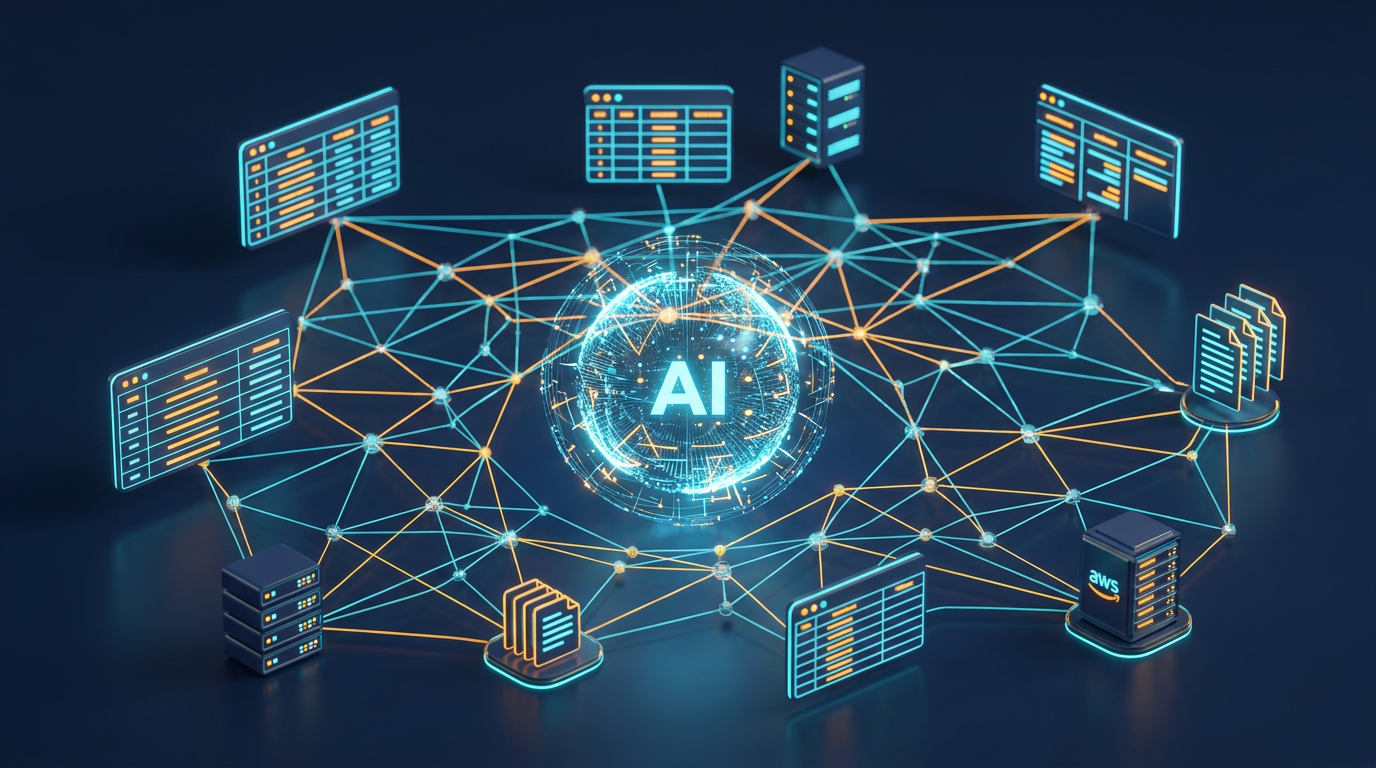
AWS Context functions as a dynamic, self-learning knowledge graph. Rather than forcing human engineers to map every relationship, the service automatically scans an organization's existing data stores—across data lakes, warehouses, and databases—and infers how different tables, columns, and business rules relate to one another.[1][4]

"You want to trust the decisions made by your AI agents, but that can't happen until agents have context," Mai-Lan Tomsen Bukovec, AWS vice president of technology for data analytics, wrote in a blog post detailing the launch. The goal is to provide a governed, centralized layer that gives agents the situational awareness required to act autonomously without hallucinating.[2][3]
The most significant architectural shift in AWS Context is its self-learning mechanism. The knowledge graph does not just map data statically; it observes how AI agents interact with it in real-time, effectively crowdsourcing intelligence from the AI models themselves.[1][3]
When an agent queries the graph to solve a problem, AWS Context monitors which data sources produce correct results, which join paths the agent relies on, and which curated business rules are successfully applied. It then ranks those sources by actual usage, continuously refining the enterprise ontology.[3][4]
It then ranks those sources by actual usage, continuously refining the enterprise ontology.
"Your agents now get smarter without you having to rebuild anything from scratch," Swami Sivasubramanian, vice president of Agentic AI at AWS, explained during his keynote address. If one customer support agent discovers the correct path to resolve a schema ambiguity while pulling a user's purchase history, the graph updates automatically. The next agent to face a similar query will instantly know the optimal route, bypassing the need for human re-curation.[1][4]

To feed this centralized graph, AWS introduced two supporting features that push context closer to where the data actually lives. The first, Amazon S3 Annotations, is now generally available. It allows organizations to attach rich, queryable business context directly to individual objects stored in Amazon's ubiquitous S3 storage service.[1][3]
The second feature, currently in preview, introduces skill assets to the AWS Glue Data Catalog. This allows data producers to attach domain-specific knowledge—such as team runbooks, query patterns, and usage rules—directly at the catalog layer. AWS Context then synthesizes the S3 annotations and the Glue metadata into a single, cohesive map that agents can query at runtime.[1][3]
Industry analysts note that this approach addresses a critical bottleneck in enterprise AI adoption. Jake Dolezal, lead data engineer at McKnight Consulting Group, highlighted that AWS Context represents a "meaningful shift from each team building its own pipeline to one governed context layer the whole organization draws from."[2]
By extending an existing identity model, AWS is also addressing the security nightmares associated with autonomous agents. AWS Context makes all queries identity-aware. An AI agent can only see, search, and operationalize information that it is explicitly authorized to access, preventing a rogue agent from surfacing sensitive HR or financial data to an unauthorized user.[2][4]

The launch places AWS squarely in the middle of a fiercely contested architectural battle. The "context layer" has rapidly become the most valuable new real estate in the enterprise software stack. Snowflake recently announced its Horizon Context and Cortex Sense services, while Microsoft offers a semantic ontology through its Fabric IQ platform.[1]
Independent vendors are also racing to solve the same problem. Vector database provider Pinecone offers a Nexus context service that compiles enterprise data into task-specific artifacts, and Redis has developed its own retrieval-optimized context platform.[1]
AWS's structural argument to enterprises is one of zero-integration friction. For companies already running their data lakes on Amazon S3, AWS Glue, and Lake Formation, AWS Context requires no data movement. The metadata is simply published into the open Apache Iceberg format, allowing customers to query their context with tools like Amazon Athena or Apache Spark.[1][3]
As the industry transitions from chat-based copilots to proactive, autonomous workflow agents, the underlying infrastructure must evolve. The era of siloed data and manual RAG pipelines is giving way to automated, self-healing knowledge graphs—ensuring that the AI agents of tomorrow actually understand the businesses they are trying to help.
How we got here
October 2023
AWS launches Amazon Q, introducing a personal knowledge graph for individual enterprise users.
Early 2026
Competitors like Snowflake and Microsoft introduce their own centralized context and semantic ontology services.
June 17, 2026
AWS announces AWS Context at the New York Summit, extending its knowledge graph technology into an automated, organization-wide layer.
Viewpoints in depth
Enterprise Cloud Providers
Argues that a centralized, automated context layer is the missing piece for scaling AI.
Major cloud vendors view the current state of AI deployment as fundamentally bottlenecked by data engineering. They argue that manually building and maintaining Retrieval-Augmented Generation (RAG) pipelines is unsustainable for large enterprises. By automating the creation of knowledge graphs, providers believe they can unlock the true potential of autonomous agents, allowing them to reason over vast lakes of proprietary data without hallucinating.
Data Engineers & Architects
Values the reduction of bespoke engineering work and zero-friction integration.
For the practitioners tasked with actually deploying AI, the appeal of automated context layers lies in escaping the maintenance nightmare of custom pipelines. This camp prioritizes solutions that integrate seamlessly with existing data stores—like S3 and Lake Formation—without requiring massive data migrations. They are particularly supportive of approaches that publish metadata into open standards like Apache Iceberg, which prevents vendor lock-in while still solving the context problem.
AI Security & Governance Advocates
Prioritizes the risks of shadow orchestration and unauthorized data access.
As AI transitions from reactive chatbots to proactive agents, security professionals warn about the risks of "shadow orchestration." If an agent has autonomous access to a company's entire knowledge graph, it could inadvertently surface restricted financial data, HR records, or proprietary source code to unauthorized users. This camp insists that any context layer must be built on strict, identity-aware access controls and maintain transparent audit trails for every query an agent makes.
What we don't know
- How seamlessly AWS Context will integrate with third-party data catalogs outside of the Amazon ecosystem.
- The exact pricing structure for AWS Context when it reaches general availability.
- How effectively the self-learning graph will handle conflicting business rules or contradictory data sources.
Key terms
- Knowledge Graph
- A structured representation of data that maps the relationships between different entities, concepts, and business rules.
- Retrieval-Augmented Generation (RAG)
- An AI framework that improves the quality of language model responses by grounding the model on external sources of knowledge.
- Agentic AI
- Artificial intelligence systems designed to act autonomously, making decisions and executing complex workflows rather than just answering chat prompts.
- Apache Iceberg
- An open-source table format for huge analytic datasets, allowing different computing engines to safely work with the same underlying data.
- Semantic Search
- A search technique that looks for the contextual meaning and intent behind a query, rather than just matching exact keywords.
Frequently asked
What is a 'context layer' in AI?
A context layer is a centralized system that connects AI agents to an organization's proprietary data, business rules, and metadata, giving the AI the situational awareness needed to provide accurate answers.
How does AWS Context differ from traditional RAG pipelines?
Traditional Retrieval-Augmented Generation (RAG) pipelines require manual engineering to map data relationships. AWS Context automatically builds and updates a knowledge graph that learns from how agents use it.
Does AWS Context require moving data into a new database?
No. It operates on existing data stores like Amazon S3 and AWS Glue, publishing its metadata into the open Apache Iceberg format without requiring data migration.
How does AWS Context handle security and permissions?
The service makes all queries identity-aware, meaning an AI agent can only access and retrieve information that the specific user or application is explicitly authorized to see.
Sources
Source coverage
5 outlets
3 viewpoints surfaced





[1]VentureBeatData Engineers & Architects
AWS enters the context layer race with a graph that learns from agents, not manual curation
Read on VentureBeat →[2]TechTargetData Engineers & Architects
AWS Context aims to feed AI agents situational awareness
Read on TechTarget →[3]Amazon Web ServicesEnterprise Cloud Providers
Context intelligence for your data and AI agents at scale
Read on Amazon Web Services →[4]AboutAmazonEnterprise Cloud Providers
AWS Summit New York 2026: AI agents and new innovations
Read on AboutAmazon →[5]GeekWireAI Security & Governance Advocates
AWS announces new AI agents for security, coding, and more at New York Summit
Read on GeekWire →



Every angle. Every day.
Get technology stories with full source coverage and perspective breakdowns delivered to your inbox.