
Apple Unveils Gemini-Powered Siri AI and Spatial Reframing at WWDC 2026
Apple has completely rebuilt Siri with Google's Gemini models, transforming the voice assistant into a context-aware, cross-app powerhouse across iOS 27 and macOS Golden Gate.
By Factlen Editorial Team
- Everyday Apple Users
- Focused on seamless, private, and practical AI integration in daily tasks.
- Enterprise & Industry Analysts
- Analyzing the strategic shift of the Google Gemini partnership and its business impact.
- Software Developers
- Focused on the technical requirements and opportunities of the new App Intents framework.
What's not represented
- · Android Ecosystem Users
- · Privacy Advocacy Groups
Why this matters
After years of lagging behind in the generative AI race, Apple's massive Siri overhaul fundamentally changes how over a billion people will interact with their devices. By integrating Google's Gemini models directly into the operating system with strict privacy guardrails, complex AI capabilities are moving from standalone chatbot apps into the everyday tools users already rely on.
Key points
- Apple unveiled Siri AI, a rebuilt voice assistant powered by Google's Gemini foundation models.
- Siri AI features cross-app task execution, on-screen awareness, and a dedicated standalone application.
- A new 'Spatial Reframing' tool allows users to change the angle and perspective of existing photos.
- Apple introduced 'Private Cloud Compute' to process complex AI requests without storing user data.
- The keynote marked Tim Cook's final WWDC as CEO before John Ternus takes over in September.
- Developer betas for iOS 27 and macOS Golden Gate are available now, with a public release this fall.
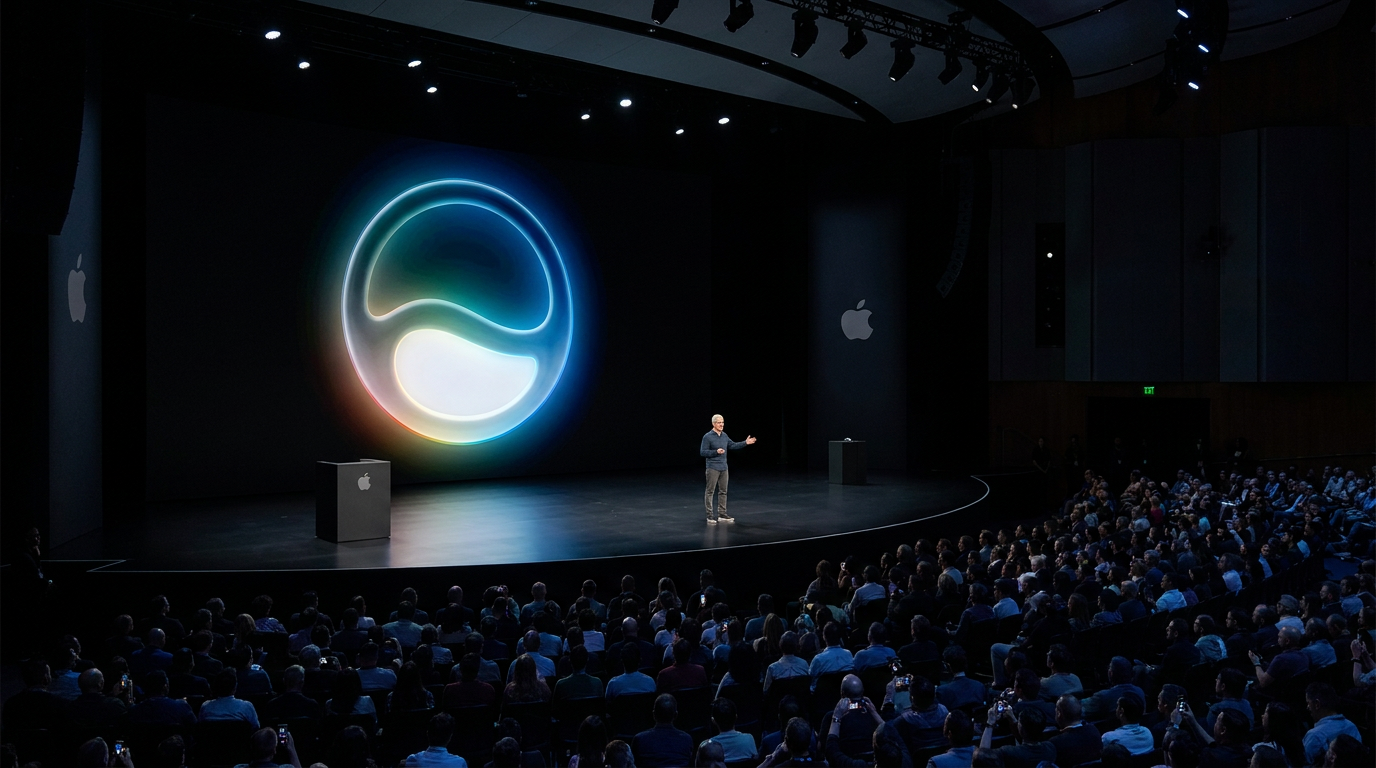
Apple has finally answered the industry's artificial intelligence arms race with a sweeping overhaul of its ecosystem. At the 2026 Worldwide Developers Conference (WWDC), the company unveiled "Siri AI," a completely rebuilt, context-aware assistant that transforms Siri from a limited voice-command tool into a deeply integrated, conversational powerhouse across iOS 27 and macOS Golden Gate.[1][2]
The most significant shift is under the hood: Apple confirmed that the new Siri experience is powered by Google's Gemini foundation models. This partnership turns a long-rumored licensing deal into a live product feature, marking the first time a third-party frontier model has been embedded at the operating system level of Apple's flagship devices.[4][6]
Unlike the rigid, single-turn queries of the past, Siri AI is designed for free-flowing, organic conversations. The assistant can now handle complex, multi-step requests and maintain context over long interactions. It also gains a dedicated standalone app, complete with a grid of past conversations and iMessage-style chat bubbles, allowing users to search their history or type requests silently.[2][8]

The integration extends to cross-device continuity, a hallmark of Apple's ecosystem. Users can initiate a complex research query or file analysis with Siri AI on their Mac, and seamlessly pick up the exact same conversation on their iPhone without waiting for cloud uploads.[2][3]
Visually, Siri's presence has been modernized. On iPhones equipped with the Dynamic Island, triggering the assistant now summons a glowing "Search or Ask" prompt at the top of the screen. Alternatively, users can swipe down from the middle of the display to bring up a Siri AI interface card, keeping the assistant accessible without obstructing the active application.[1][8]

On iPhones equipped with the Dynamic Island, triggering the assistant now summons a glowing "Search or Ask" prompt at the top of the screen.
The true breakthrough, however, lies in Siri's new cross-app capabilities. Utilizing a developer framework called App Intents, Siri AI possesses on-screen awareness, allowing it to understand what the user is currently looking at and execute tasks across multiple applications. For example, a user can ask Siri to find specific photos from a recent trip and automatically drop them into a shared family album or an ongoing email draft.[1][2]
Beyond the voice assistant, Apple introduced a suite of generative tools under the "Apple Intelligence" banner, with "Spatial Reframing" emerging as the standout feature. Leveraging technology originally developed for the Vision Pro headset, this photography tool uses on-device spatial models to let users change the angle, perspective, or zoom of a standard two-dimensional photo after it has been taken.[3][5]
By simply dragging a finger across the screen, users can pivot the perspective of an image, with the AI seamlessly filling in the gaps while keeping the original subject intact. Apple is also adding system-wide proofreading, generative writing tools, and an "Image Playground" for creating custom graphics, all of which will carry a "SynthID" watermark to identify AI-generated content.[1][3]

Anticipating enterprise and consumer concerns, Apple heavily emphasized a privacy-first architecture. While many features run entirely on-device, more complex requests are routed through "Private Cloud Compute." Apple guarantees that data sent to these servers is never stored, cannot be accessed by the company, and is subject to continuous verification by independent third-party security researchers.[2][4]
The software updates also bring aesthetic refinements to Apple's platforms. Following last year's introduction of the "Liquid Glass" design language, macOS Golden Gate and iOS 27 introduce new customization sliders, allowing users to adjust the opacity and tint of interface elements, alongside standardized corner radii and multi-layer app icons that refract light dynamically.[5][7]
The keynote carried an underlying emotional weight, serving as CEO Tim Cook's final WWDC presentation. Cook, who has steered the company through a decade of massive growth, will step down on September 1, handing the reins to current Senior Vice President of Hardware Engineering John Ternus just ahead of the critical fall product launches.[4][6]
Developer betas for iOS 27, macOS Golden Gate, and the rest of Apple's operating systems are available immediately. While the public release is slated for the fall, the WWDC announcements signal a definitive shift: Apple is no longer sitting out the generative AI revolution, but rather weaving it directly into the daily lives of over a billion users.[1][4]

How we got here
June 2024
Apple first previews early generative AI concepts.
October 2025
Apple releases the M5 iPad Pro, laying the hardware groundwork for on-device AI.
June 8, 2026
WWDC 2026 keynote officially introduces Siri AI and iOS 27.
September 1, 2026
John Ternus succeeds Tim Cook as Apple CEO.
Fall 2026
Public release of iOS 27, macOS Golden Gate, and Apple Intelligence.
Viewpoints in depth
Everyday Apple Users
Focused on seamless, private, and practical AI integration in daily tasks.
For the average iPhone or Mac user, the technical details of foundation models matter far less than the practical utility. This camp celebrates the end of Siri's rigid voice-command era, welcoming a conversational assistant that can actually understand context and execute multi-step tasks. The strict privacy guarantees of Private Cloud Compute are a major selling point, reassuring users who have been hesitant to embrace cloud-based AI tools from other tech giants.
Enterprise & Industry Analysts
Analyzing the strategic shift of the Google Gemini partnership and its business impact.
Market watchers view WWDC 2026 as a pragmatic concession by Apple. By licensing Google's Gemini models rather than relying solely on in-house technology, Apple acknowledged its AI deficit while instantly closing the gap. Analysts note that deploying a highly capable, context-aware assistant across 1.4 billion devices instantly raises the baseline expectation for voice interfaces, forcing businesses to upgrade their own customer service and internal tools to match the new standard.
Software Developers
Focused on the technical requirements and opportunities of the new App Intents framework.
While consumers get immediate benefits, the developer community faces a significant integration challenge. To participate in Siri AI's impressive cross-app task execution, development teams must implement the App Intents framework. While this opens up powerful new ways for users to interact with third-party apps via voice, it requires a non-trivial rewrite of how apps expose their functions to the operating system, creating a race among developers to be fully compatible by the fall release.
What we don't know
- It remains unclear exactly which third-party apps will have full App Intents integration ready by the fall launch.
- Apple has not detailed the exact financial terms or duration of its licensing agreement with Google for the Gemini models.
- The full impact of John Ternus taking over as CEO on Apple's future hardware and software roadmap is yet to be seen.
Key terms
- Apple Intelligence
- Apple's branded suite of generative AI tools integrated across its operating systems.
- App Intents
- A developer framework that allows Siri to execute specific actions and retrieve context from inside third-party applications.
- Private Cloud Compute
- Apple's secure server infrastructure designed to process complex AI requests without storing user data.
- Spatial Reframing
- An AI photography feature that uses spatial models to alter the perspective of 2D photos.
- Liquid Glass
- Apple's overarching design language for its operating systems, characterized by translucent layers, depth, and dynamic light refraction.
Frequently asked
Will Siri AI work on my current iPhone?
Siri AI requires significant processing power and will be available on the iPhone 15 Pro, iPhone 15 Pro Max, and the upcoming iPhone 16 lineup, as well as iPads and Macs with M1 chips or newer.
What is Spatial Reframing?
Spatial Reframing is a new photography tool in iOS 27 that uses on-device spatial models to let users change the angle, perspective, or zoom of a standard photo after it has been taken.
Is Apple storing my data to train its AI?
No. Apple emphasized a privacy-first approach, utilizing on-device processing and "Private Cloud Compute" to ensure user data is never stored, accessed by Apple, or used to train foundation models.
Sources
Source coverage
8 outlets
3 viewpoints surfaced








[1]EngadgetSoftware Developers
Everything Announced At Apple's WWDC 2026 Keynote
Read on Engadget →[2]PCMagEnterprise & Industry Analysts
WWDC 2026: Apple's 7 Biggest AI Upgrades, Ranked
Read on PCMag →[3]MashableEveryday Apple Users
Apple's new, smarter Siri AI is finally here
Read on Mashable →[4]Enterprise DNAEnterprise & Industry Analysts
Apple Finally Delivers AI: What WWDC 2026 Actually Means for Business
Read on Enterprise DNA →[5]42GearsSoftware Developers
WWDC 2026: Apple Intelligence & macOS Golden Gate
Read on 42Gears →[6]T3Everyday Apple Users
Apple WWDC 2026 recap: Siri AI, iOS 27, EU exclusions and Cook's farewell
Read on T3 →[7]AppleInsider
WWDC 2026 was somehow even more one note than I expected
Read on AppleInsider →[8]MacRumors
WWDC 2026: Everything to Expect
Read on MacRumors →

More in technology
See all 76 stories →AI Security
Evidence Pack: How Defensive AI is Outpacing the Automation of Cybercrime
8 sources

Web Trust
How Portable Social Graphs Are Finally Letting Users Own Their Online Networks
6 sources

Green Cloud
The Zero-Carbon Cloud: How Geothermal Energy and AI Are Decarbonizing Data Centers
9 sources

AI Architecture
Why Enterprises Are Abandoning Massive AI for Small Language Models
9 sources

Every angle. Every day.
Get technology stories with full source coverage and perspective breakdowns delivered to your inbox.