
U.K. Defense Secretary John Healey Resigns Over Military Funding Dispute, Deepening Crisis for Starmer
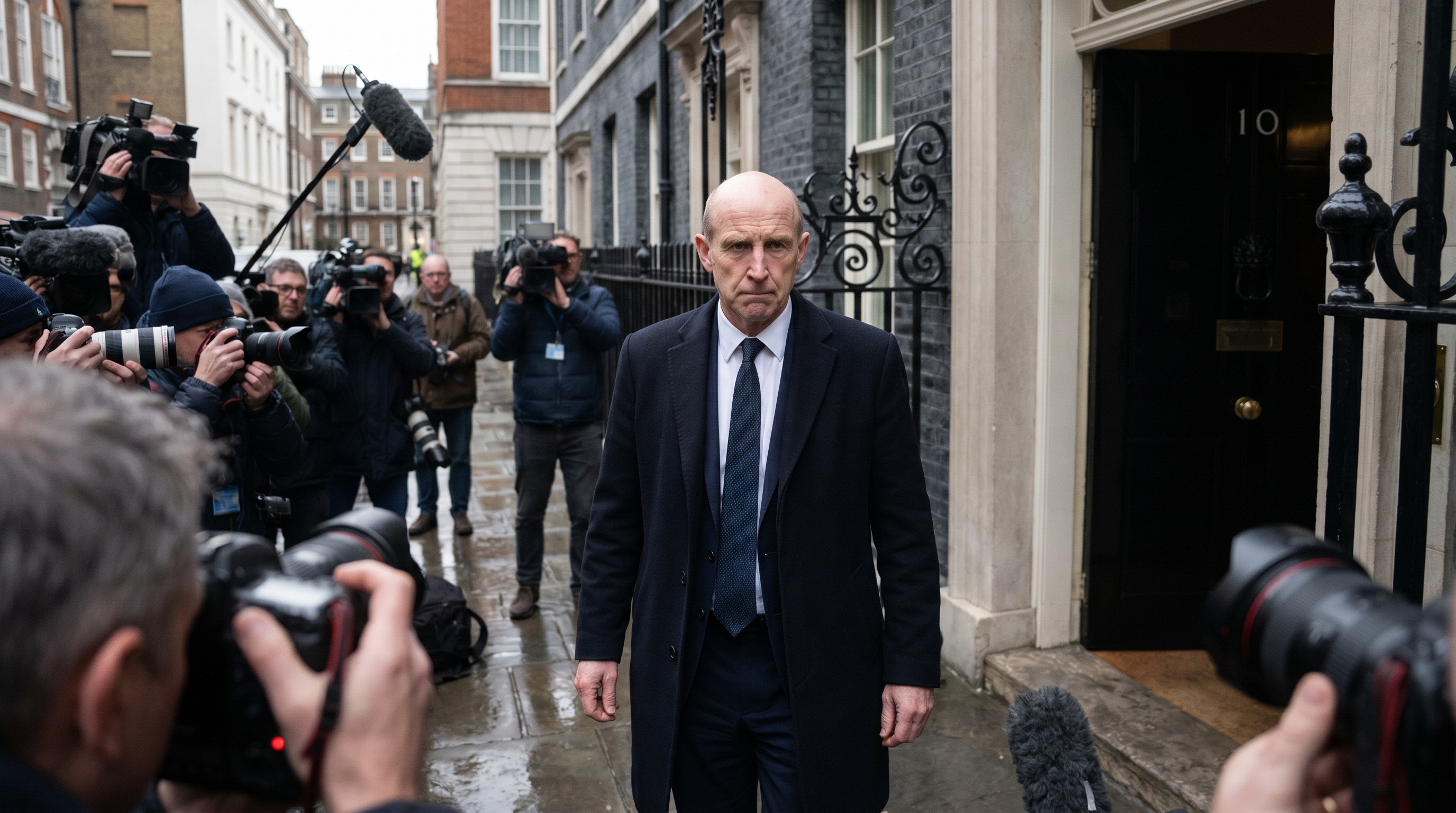
U.K. Defense Secretary John Healey abruptly resigned Thursday over the government's refusal to adequately fund the military, warning the shortfall leaves the country vulnerable to rising global threats.
By Factlen Editorial Team
- Military & Defense Establishment
- Argues the U.K. is actively going backwards on national security by failing to fund its strategic defense review.
- Political Observers & Critics
- Views the defense crisis as a symptom of Starmer's failing leadership and inability to govern.
- Fiscal Conservatives
- Prioritizes domestic economic stability over massive military budget hikes.
What's not represented
- · Rank-and-file military personnel facing equipment shortages
- · NATO allies relying on U.K. defense commitments
Why this matters
Healey's exit exposes a severe fracture in the U.K.'s ability to meet its military commitments amid escalating global conflicts. For British citizens and NATO allies, the resignation signals that domestic fiscal constraints are actively overriding national security priorities at a time when the alliance is demanding greater European defense spending.
Key points
- U.K. Defense Secretary John Healey resigned after the Treasury refused his £18 billion military funding request, offering only £12 billion.
- Healey warned the current Defence Investment Plan leaves the U.K. vulnerable and projects defense spending to reach just 2.68% of GDP by 2030.
- Armed Forces Minister Al Carns and two ministerial aides also quit, deepening the crisis at the Ministry of Defence.
- The resignation is a massive political blow to Prime Minister Keir Starmer, who has seen six ministers resign in the past month.
- Security Minister Dan Jarvis, a former Parachute Regiment officer, was immediately appointed as the new Defense Secretary.
U.K. Defense Secretary John Healey abruptly resigned on Thursday, delivering a scathing rebuke of Prime Minister Keir Starmer's government for failing to commit the resources necessary to protect the nation. In a stark resignation letter, Healey warned that the forthcoming Defence Investment Plan falls "well short" of what is required, forcing decisions that would reduce military readiness and increase risks to personnel. The departure of the defense chief lays bare a profound fracture at the highest levels of the British government over how to navigate a deteriorating global security environment.[2][4]
The resignation was quickly followed by the departure of Armed Forces Minister Al Carns and two ministerial aides, transforming a cabinet dispute into a full-blown crisis at the Ministry of Defence. The exodus comes just weeks before Starmer is scheduled to meet with NATO counterparts, including U.S. President Donald Trump, at a critical summit in Ankara. The timing could not be worse for London, as Washington continues to heavily pressure European allies to shoulder more of the collective defense burden.[1][3]
At the heart of the rupture is a bitter, months-long battle between the Ministry of Defence and the Treasury over the U.K.'s long-term military budget. Healey had sought an £18 billion ($24 billion) financial settlement to modernize the armed forces, replenish depleted stockpiles, and meet expanding international commitments. However, Chancellor Rachel Reeves firmly refused to approve anything beyond a £12 billion ceiling. Treasury officials reportedly argued that authorizing higher defense spending would necessitate unacceptable cuts to domestic programs, including schools and hospitals, which are already facing severe financial strain.[3][5]

Healey revealed that the financial settlement presented to him on Monday projected defense spending to reach just 2.68 percent of gross domestic product by 2030. He argued that a firm 3 percent target by the end of the decade was absolutely essential, invoking Starmer's own recent warnings that Russia could launch a direct attack on NATO territory by 2030. Healey noted that the Prime Minister had powerfully made the case for increased military spending at the Munich Security Conference in February, making the Treasury's current stance a glaring contradiction.[2][7]
“You have been unable, and the Treasury has been unwilling, to commit the resources that the nation needs to defend the country at this time of rising threats,” Healey wrote in his resignation letter to the Prime Minister. He added that accepting the Treasury's terms would force him to make decisions that would actively make the country “less safe.” The outgoing secretary emphasized that the demands on defense are growing exponentially, and the government's current financial trajectory fails to match the seriousness of the geopolitical moment.[4][7]
The U.K. military is currently stretched across multiple complex theaters, leading a multinational maritime mission in the Strait of Hormuz amid the ongoing U.S.-Iran conflict, heading NATO's Arctic Sentry mission in the High North, and supporting Ukraine against relentless Russian aggression. Defense analysts warn that the severe funding shortfall directly undermines these critical operations, leaving British forces overextended and underequipped as they attempt to project power and deter adversaries on multiple fronts simultaneously. Without adequate resources, the Ministry of Defence cannot sustain its current tempo of operations while simultaneously modernizing its aging equipment.[2]

Without adequate resources, the Ministry of Defence cannot sustain its current tempo of operations while simultaneously modernizing its aging equipment.
General Sir Richard Barrons, a former British military commander who helped lead the strategic review underpinning the investment plan, offered a scathing assessment of the government's fiscal choices. He stated that the administration is “actively going backwards” by refusing to fund the very defense review it commissioned and endorsed. Barrons warned that the failure to adequately resource the military diminishes the U.K.'s standing within NATO, weakens its credibility with key allies, and significantly increases the nation's vulnerability to the harsh realities of twenty-first-century conflict. He noted that the military needs to be in a much stronger position within the next three to five years, not a decade from now.[6]
Politically, Healey's departure is a devastating blow to Starmer, whose authority has rapidly eroded since his landslide election victory in July 2024. Healey is the sixth minister to resign from the government in the past month alone, following the high-profile exit of Health Secretary Wes Streeting, who publicly stated he had lost confidence in the Prime Minister's leadership. The cascading resignations paint a picture of a government in freefall, unable to maintain cabinet discipline or execute its core policy objectives.[2][7]
The internal Labour Party rebellion has reached a boiling point, with at least 95 Labour MPs officially calling for Starmer to resign or outline a clear departure timetable. Observers note that Healey's resignation opens a dangerous new frontier of criticism for the embattled Prime Minister. While previous controversies centered on domestic scandals and political missteps, the defense funding crisis strikes directly at Starmer's core competency in national security and foreign affairs, an area where he had previously enjoyed a relatively assured track record.[2][3]
Conservative opposition leaders immediately seized on the resignation to attack the government's strategic priorities. Shadow Defense Minister James Cartlidge praised Healey's integrity, stating that the outgoing secretary had no choice given the “tiny amount of money” offered to the armed forces by the Treasury. The opposition argues that the Labour government is fundamentally unserious about national security, choosing to prioritize domestic political considerations over the urgent need to recapitalize a military facing the most dangerous threat environment since the Cold War.[5]
In a desperate bid to stabilize the situation, Starmer quickly appointed Security Minister Dan Jarvis—a former Parachute Regiment officer who served combat tours in Iraq and Afghanistan—as the new Defense Secretary. Jarvis inherits a deeply fractured department, a demoralized officer corps, and the immediate, unenviable challenge of finalizing the controversial Defence Investment Plan. He will have to navigate the exact same fiscal constraints that drove his predecessor to resign, with little indication that the Treasury is willing to offer any meaningful concessions.[3]

The fallout from the crisis is already rippling well beyond Europe's borders. Australian Defense Minister Richard Marles was reportedly left adrift on Thursday, as a scheduled joint visit to a naval base in Portsmouth with Healey was abruptly canceled just hours before it was due to take place. The sudden disruption raises serious questions about the momentum and stability of the AUKUS submarine pact, a generational security agreement that relies heavily on seamless integration and consistent leadership between the U.K., U.S., and Australian defense establishments.[8]
Defense industry leaders have also expressed profound alarm over the sudden leadership vacuum at the Ministry of Defence. Kevin Craven, CEO of the U.K. aerospace and defense trade body ADS Group, called the resignation “a damning reflection on the current state of affairs.” Industry executives warn that the ongoing political uncertainty over the Defence Investment Plan will rattle fragile supply chains, delay critical procurement contracts, and undermine the long-term planning required to rebuild the nation's defense industrial base. Without a clear, fully funded roadmap, defense contractors cannot make the necessary investments in workforce and manufacturing capacity.[5]
Ultimately, the clash represents a fundamental ideological divide within the governing party: balancing the urgent demands of a rapidly deteriorating global security environment against strict domestic fiscal rules. As Jarvis takes the helm, the Ministry of Defence remains caught in an impossible position. It must prepare the armed forces for an era of great power competition while answering to a Treasury that remains unwilling to open its checkbook, leaving the U.K.'s military posture dangerously misaligned with the threats it faces.[3][6]
How we got here
February 2026
PM Keir Starmer warns at the Munich Security Conference that the U.K. must spend more on defense.
May 2026
Health Secretary Wes Streeting and several other ministers resign, citing a lack of confidence in Starmer's leadership.
June 8, 2026
Healey is presented with the Treasury's final Defence Investment Plan, which caps spending increases.
June 11, 2026
Healey officially resigns as Defense Secretary, followed hours later by Armed Forces Minister Al Carns.
Viewpoints in depth
Military and Defense Establishment
Argues the U.K. is actively going backwards on national security.
Former commanders and defense industry leaders view the Treasury's funding cap as a dereliction of duty. They argue that failing to fund the strategic defense review diminishes the U.K.'s standing in NATO, weakens the AUKUS partnership, and leaves the armed forces dangerously underequipped to handle simultaneous threats from Russia and the Middle East.
Treasury and Fiscal Conservatives
Prioritizes domestic economic stability over massive military budget hikes.
Chancellor Rachel Reeves and Treasury officials maintain that the U.K. simply cannot afford an £18 billion defense settlement without inflicting severe damage on the domestic economy. They argue that authorizing such a massive increase would necessitate deeply unpopular cuts to essential public services, including schools and hospitals, at a time when the government is already struggling with stagnant economic growth.
Internal Labour Critics
Views the defense crisis as a symptom of Starmer's failing leadership.
For the growing faction of Labour rebels, Healey's resignation is less about military procurement and more about Prime Minister Keir Starmer's inability to govern effectively. With 95 MPs already calling for his departure and six ministers resigning in a single month, this camp sees the defense funding failure as the final proof that Starmer lacks the authority to bridge cabinet divides and execute a coherent national strategy.
What we don't know
- Whether the new Defense Secretary, Dan Jarvis, will be able to secure any additional funding concessions from the Treasury.
- How the U.K.'s funding shortfall will impact its specific commitments to the AUKUS submarine pact and NATO's Arctic Sentry mission.
- If the escalating cabinet rebellion will force Prime Minister Keir Starmer to resign before the end of the year.
Key terms
- Defence Investment Plan (DIP)
- A multi-year blueprint outlining the U.K. government's long-term funding and procurement strategy for the armed forces.
- Chancellor of the Exchequer
- The U.K. government minister responsible for economic and financial policy, equivalent to a finance minister or treasury secretary.
- AUKUS
- A trilateral security partnership between Australia, the U.K., and the U.S., primarily focused on equipping Australia with nuclear-powered submarines.
- Ministry of Defence (MoD)
- The British government department responsible for implementing national defense policy and managing the armed forces.
Frequently asked
Why did John Healey resign as U.K. Defense Secretary?
Healey resigned because the Treasury refused to approve his requested £18 billion funding settlement for the military, offering only £12 billion instead. He argued this shortfall would leave the U.K. vulnerable to rising global threats.
Who is replacing John Healey?
Prime Minister Keir Starmer appointed Security Minister Dan Jarvis, a former Parachute Regiment officer with combat experience in Iraq and Afghanistan, as the new Defense Secretary.
How does this affect NATO?
The resignation raises concerns about the U.K.'s ability to meet its military commitments and reach a 3% GDP defense spending target, potentially isolating London at the upcoming NATO summit in Ankara.
What is the political impact on Prime Minister Keir Starmer?
The resignation is a massive blow to Starmer, who is already facing a rebellion from 95 Labour MPs calling for his resignation. Healey is the sixth minister to quit in the past month.
Sources
Source coverage
8 outlets
3 viewpoints surfaced








[1]Fox NewsPolitical Observers & Critics
Starmer in 'seismic' crisis, UK defense chief quits before high-stakes Trump NATO summit
Read on Fox News →[2]Al JazeeraPolitical Observers & Critics
Britain's defence secretary Healey quits over defence spending
Read on Al Jazeera →[3]Financial TimesFiscal Conservatives
UK defence ministers resign as row over military spending escalates
Read on Financial Times →[4]CBS NewsMilitary & Defense Establishment
U.K. defense chief John Healey resigns, says government's military funding plan 'falls well short'
Read on CBS News →[5]Breaking DefenseMilitary & Defense Establishment
British defense secretary John Healey resigns over defense funding
Read on Breaking Defense →[6]Chatham HouseMilitary & Defense Establishment
John Healey's resignation highlights profound strategic failure in the UK government's approach to defence
Read on Chatham House →[7]EuractivFiscal Conservatives
UK defense secretary John Healey resigns over military spending
Read on Euractiv →[8]The GuardianPolitical Observers & Critics
Australia news live: Richard Marles left adrift as UK counterpart quits hours before scheduled visit to naval yard
Read on The Guardian →

More in news politics
See all 53 stories →Energy Economics
Fact Check: Is Renewable Energy Now Cheaper Than Fossil Fuels?
7 sources

Iran War
Trump Halts Planned Strikes on Iran, Claims Peace Deal is Imminent Despite Tehran's Caution
7 sources

Emissions Standards
Historic Legal Battle Escalates Over EPA's Repeal of the Greenhouse Gas Endangerment Finding
8 sources
Crowdsourced Moderation
Fact Check: Can Crowdsourced 'Community Notes' Actually Stop Political Misinformation?
8 sources

Every angle. Every day.
Get news politics stories with full source coverage and perspective breakdowns delivered to your inbox.