
The Science of Psyllium Husk: How a Simple Fiber Revolutionized Gluten-Free Baking
By mimicking the long-chain elasticity of wheat proteins, psyllium husk has transformed gluten-free baking from crumbly batters into workable, artisan doughs.

In short
- Psyllium husk acts as a powerful hydrocolloid, mimicking the long-chain elasticity of traditional wheat gluten.
- Unlike xanthan gum, psyllium allows gluten-free bread batter to become a pliable, kneadable dough.
- Clinical studies show psyllium reduces bread staling and crumb firming by up to 75% over three days.
For decades, the pursuit of high-quality gluten-free bread has been an exercise in managing disappointment. Home bakers and commercial kitchens alike have struggled to produce loaves that do not resemble dense, crumbly bricks or overly moist cakes. The fundamental issue has never been the alternative flours themselves, but rather the absence of the crucial biological scaffolding that gives traditional bread its defining characteristics.
In conventional baking, gluten—a composite of two proteins found in wheat, barley, and rye—acts as a natural, microscopic glue. When hydrated and kneaded, these proteins form an intricate, stretchy web that traps the carbon dioxide gas produced by yeast during fermentation. This viscoelastic network is what allows a dough to expand, hold its shape, and eventually bake into a loaf with a chewy crust and an airy, open crumb. Rebuilding that exact architecture without wheat has been the central challenge of modern food science.[3]
For years, the standard industry answer to the gluten gap was xanthan gum. A polysaccharide produced through bacterial fermentation, xanthan gum is highly effective at thickening liquids and stabilizing batters. When introduced to a gluten-free flour blend, it creates a viscous, gel-like network that successfully mimics some of gluten's structural properties, preventing cakes and cookies from crumbling into dust.
However, while xanthan gum excels in pastry applications, it fundamentally fails to replicate the mechanics of bread dough. Xanthan provides what food scientists call "short" binding—it holds ingredients together but snaps when stretched. It lacks the necessary elasticity to support the long, slow fermentation required for artisan bread, often resulting in a sticky batter that must be poured into a loaf pan rather than a pliable dough that can be shaped by hand.
The paradigm shift in gluten-free baking has arrived in the form of psyllium husk. Derived from the seeds of the Plantago ovata plant—an annual herb native to parts of Asia, the Mediterranean, and North America—psyllium has long been utilized primarily as a dietary fiber supplement. Today, it is recognized as the "magic" ingredient that allows gluten-free bakers to achieve results virtually indistinguishable from traditional wheat loaves.[2]
The secret to psyllium's efficacy lies in its behavior as a powerful hydrocolloid. When exposed to water, the husks absorb liquid rapidly and swell, forming a dense, sticky, and highly stable gel. Unlike the rigid structure created by xanthan gum, the psyllium gel exhibits remarkable long-chain elasticity, mimicking the specific stretch and resilience of hydrated wheat proteins.[2]
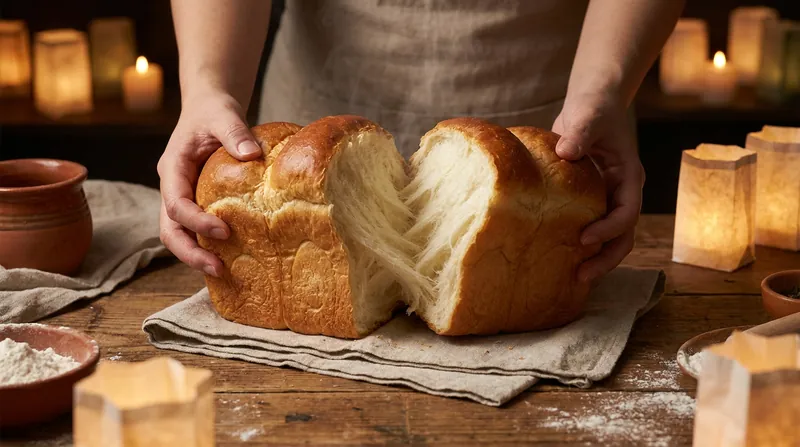
This long-chain elasticity fundamentally transforms the physical nature of gluten-free baking. Instead of mixing a runny, cake-like batter, bakers using psyllium husk can create an actual dough. The resulting mixture is pliable, workable, and structurally sound enough to be kneaded, stretched, and folded. It allows bakers to hand-shape boules, braid challah, and roll out flexible flatbreads like rotis that bend without shattering.
Beyond workability, psyllium husk solves the secondary curse of gluten-free bread: rapid staling. Traditional gluten-free baked goods are notorious for drying out and becoming unpalatably hard within hours of leaving the oven. This process, known as retrogradation, occurs when starch molecules realign and crystallize as moisture escapes.[3]
Because psyllium is exceptionally efficient at absorbing and holding onto water, it physically traps moisture within the bread's crumb structure, drastically slowing the staling process. Clinical research published in food science journals has quantified this effect, demonstrating that gluten-free breads formulated with psyllium exhibit significantly less crumb firming over a 72-hour period compared to those made with standard binders.[1]
In rigorous laboratory testing, researchers found that adding psyllium husk to gluten-free bread formulations reduced crumb firmness by an astonishing 65 to 75 percent over three days of storage. The studies concluded that specific hydration thresholds—often around 17 percent psyllium by flour weight—yielded the longest delay in staling, producing a texture and shelf life that closely mirrored conventional wheat bread.[1][3]
The transition from artificial gums to psyllium also carries significant metabolic and gastrointestinal benefits. While xanthan gum can occasionally cause bloating or digestive distress in sensitive individuals, psyllium is a prebiotic soluble fiber. Nutritionists note that its gel-forming properties slow carbohydrate absorption in the digestive tract, helping to flatten post-meal blood sugar spikes and providing more stable, sustained energy.[2]
Despite its transformative properties, working with psyllium does present unique quirks. One of the most common surprises for novice bakers is the "purple bread" phenomenon. Psyllium husks contain natural antioxidants called anthocyanins, which can react with certain mineral-rich flours or water pH levels, turning the baked dough a distinct shade of purple.[3]
While the color change is entirely harmless and does not affect the flavor, it can be visually off-putting. Expert bakers mitigate this by adding a small amount of acid—such as a splash of lemon juice or lactic acid—to the dough, which neutralizes the reaction. Alternatively, many find that using whole psyllium husks rather than finely ground powder entirely prevents the discoloration.
The application of psyllium in the kitchen also requires specific techniques. While some recipes instruct bakers to whisk the psyllium with water to create a pre-formed gel before incorporating it into the dough, many professionals advise against this. Mixing the dry psyllium directly into the gluten-free flour blend ensures a more even distribution, allowing all the ingredients to hydrate simultaneously and preventing dense, gummy pockets in the final loaf.
Precision is critical when converting recipes. Because psyllium husk powder has a significantly larger surface area than whole husks, it absorbs water much faster. Bakers substituting powder for whole husks must reduce the volume by roughly 10 to 15 percent to prevent the dough from becoming overly stiff and dry. A standard baseline for bread development is utilizing approximately one tablespoon of whole psyllium husk per cup of gluten-free flour.[3]
The elevation of psyllium husk from a simple fiber supplement to a cornerstone of culinary science represents a major victory for dietary accessibility. By providing the mechanical strength to trap gas, the elasticity to be shaped by hand, and the moisture retention to survive on the counter, psyllium has finally closed the gap between gluten-free compromises and objectively excellent artisan bread.[3]
Jargon, explained
- Hydrocolloid
- A substance that forms a gel when mixed with water, used to thicken, bind, and stabilize foods.
- Viscoelasticity
- The property of a substance that exhibits both fluid-like flow and solid-like elasticity, crucial for allowing bread dough to stretch without breaking.
- Crumb Structure
- The pattern, size, and distribution of the air holes inside a baked loaf of bread.
- Anthocyanins
- Natural, water-soluble pigments found in plants (including psyllium husks) that can cause baked goods to turn purple under certain pH conditions.
- Staling (Retrogradation)
- The chemical process where starch molecules in baked bread realign and crystallize over time, causing the bread to become hard and dry.
Common questions
Why did my gluten-free bread turn purple?
Psyllium husks contain natural antioxidants called anthocyanins that can react with certain flours and turn baked goods purple. Using whole husks instead of powder, or adding a small amount of acid like lemon juice, prevents this reaction.
Can I just use xanthan gum instead of psyllium?
For cakes and cookies, yes. But for yeast-leavened bread, xanthan gum lacks the long-chain elasticity needed to trap gas and allow the dough to be kneaded and shaped.
Should I mix psyllium with water before adding it to dough?
While some recipes call for creating a pre-mixed gel, many expert bakers recommend whisking the dry psyllium directly into the gluten-free flours to ensure even hydration and prevent clumping.
Is psyllium husk powder the same as whole husks?
No. Powder has a much larger surface area and absorbs liquid faster. If a recipe calls for whole husks and you only have powder, you should reduce the amount by about 10 to 15 percent.
Competing readings
Artisan Gluten-Free Bakers
Focuses on achieving the holy grail of gluten-free baking: a workable dough and an open crumb.
For professional and home artisan bakers, psyllium husk is the difference between a batter and a dough. They emphasize that traditional gluten-free baking relies on pouring wet batters into loaf pans, resulting in dense, cake-like squares. Psyllium introduces the mechanical ability to knead, shape boules, braid challah, and score crusts, fundamentally restoring the tactile art of breadmaking to those who cannot consume wheat.
Food Scientists & Researchers
Focuses on the measurable rheological properties and shelf-life extensions provided by hydrocolloids.
Materials scientists and food researchers view psyllium through the lens of rheology—the study of how matter flows and deforms. They point to clinical data showing that psyllium's specific water-binding capacity drastically alters the retrogradation of starches. By trapping moisture within its gel matrix, psyllium physically blocks the starches from crystallizing as quickly, effectively solving the notorious 24-hour staling problem that plagues commercial gluten-free breads.
Digestive Health Advocates
Focuses on the metabolic and gastrointestinal benefits of replacing artificial gums with natural soluble fiber.
Nutritionists and gut-health advocates highlight that the shift toward psyllium is a nutritional upgrade, not just a culinary one. While xanthan gum is a fermented polysaccharide that can cause bloating or digestive distress in sensitive individuals, psyllium is a prebiotic soluble fiber. They emphasize its proven ability to increase fecal bulk, slow carbohydrate absorption, and flatten post-meal blood sugar spikes, turning a simple slice of bread into a functional food.
- Artisan Gluten-Free Bakers
- Focuses on achieving the holy grail of gluten-free baking: a workable dough and an open crumb.
- Food Scientists & Researchers
- Focuses on the measurable rheological properties and shelf-life extensions provided by hydrocolloids.
- Digestive Health Advocates
- Focuses on the metabolic and gastrointestinal benefits of replacing artificial gums with natural soluble fiber.
Perspectives this story doesn't cover
- Commercial Wheat Farmers
- Industrial Bakery Manufacturers
Sources
Source coverage
3 outlets
3 viewpoints surfaced



- [1]National Institutes of HealthFood Scientists & Researchers
Novel approaches in gluten-free breadmaking: Interface between food science, nutrition, and health
Read on National Institutes of Health → - [2]HealthlineDigestive Health Advocates
9 Substitutes for Xanthan Gum
Read on Healthline → - [3]Factlen Editorial TeamFood Scientists & Researchers
Synthesis by Factlen editorial team
Read on Factlen Editorial Team →
More in Food & Drink
See all →Commodities Watch
USDA Slashes Global Sugar Surplus by 57%: How Energy Markets and Weather Are Rewiring the Baking Supply Chain
4 sources
Wheat Supply Chain
U.S. Wheat Crop Hits 54-Year Low Amid Drought, Forcing Global Bakers to Adapt
5 sources
Culinary Physics
The Science of Laminated Dough: How Physics and Thermodynamics Build the Perfect Croissant
3 sources
Baking Science
The Science of Tangzhong: How a Simple Flour Paste Creates the World's Softest Bread
7 sources
Comments
Every angle. Every day.
Get Food & Drink stories with full source coverage and perspective breakdowns, free every day.