
The Science of Pilates: How Low-Impact Core Training Reshapes Biomechanics and Aids Longevity
Sports scientists and biomechanists are using electromyography and ultrasound to map exactly how Pilates alters deep core musculature, validating its role in athletic longevity.
By Factlen Editorial Team
- Clinical Biomechanists
- Focus on measurable data like electromyography and ultrasound to validate how Pilates alters deep muscle hypertrophy and joint stability.
- Strength & Conditioning Coaches
- View Pilates as a highly effective supplementary tool for core stability, but emphasize that it cannot replace heavy lifting for bone density and absolute strength.
- Pilates Practitioners
- Emphasize the method's unique ability to foster a mind-body connection, improve postural alignment, and promote lifelong athletic longevity.
What's not represented
- · Yoga Practitioners
- · Physical Therapists specializing in other modalities
Why this matters
As the fitness industry shifts away from high-impact burnout toward sustainable longevity, understanding the exact biomechanics of Pilates helps you make evidence-based decisions about injury prevention, core stability, and long-term joint health.
Key points
- Pilates specifically targets deep stabilizing muscles like the transversus abdominis and multifidus, rather than superficial global muscles.
- Ultrasound imaging confirms that regular Pilates practice physically increases the thickness of the abdominal wall's inner corset.
- Electromyography data shows that Pilates makes core muscles more efficient, offloading strain from the lower back during athletic performance.
- While excellent for stability and injury prevention, Pilates does not provide the progressive overload needed for maximum bone mineral density.
- Exercise physiologists recommend combining Pilates with heavy resistance training and cardiovascular work for optimal athletic longevity.
As we move deeper into the 2020s, the fitness industry is undergoing a profound philosophical shift. The era of high-impact burnout and relentless, joint-punishing workouts is gradually giving way to a prioritized focus on sustainable longevity. In this evolving landscape, Pilates is experiencing a massive resurgence. Originally developed in the 1920s by Joseph Pilates as a rehabilitation method called "Contrology," the practice has transcended its niche origins to become a cornerstone of both elite athletic training and mainstream wellness routines.[7]
But beyond the aesthetic promises of a "toned" physique and the ubiquitous celebrity endorsements, what is actually happening beneath the skin during a session? Biomechanists, physical therapists, and sports scientists have spent the last decade quantifying the exact physiological adaptations triggered by Pilates. By utilizing advanced imaging and electrical monitoring, researchers are moving past anecdotal praise to map the precise neuromuscular benefits of the method. They are revealing exactly why it has become the strategic choice for individuals looking to maintain peak physical competence for decades, rather than just a few athletic seasons.[7]
The core mechanism of Pilates lies in its targeted activation of deep stabilizing muscles, rather than the superficial global mobilizers that traditional weightlifting often prioritizes. When most people think of core strength, they envision the rectus abdominis—the visible "six-pack" muscle responsible for flexing the spine. Pilates, however, demands the rigorous engagement of the transversus abdominis (TrA) and the lumbar multifidus. The TrA acts as the body's natural corset, wrapping horizontally around the spine and pelvis to provide foundational stability before any limb movement even occurs.[7]

Recent advancements in rehabilitative ultrasound imaging (RUSI) have allowed researchers to visualize this deep muscle activation in real-time. A 2025 clinical study published by the National Institutes of Health demonstrated that Pilates-based core stabilization exercises effectively increase the physical thickness of these deep muscles over time. The researchers observed that the method promotes the independent contraction of the transversus abdominis and internal obliques, fundamentally altering the structural resilience of the abdominal wall. This localized hypertrophy enhances overall spinal stability, which is a critical factor in mitigating chronic lower back pain.[1]
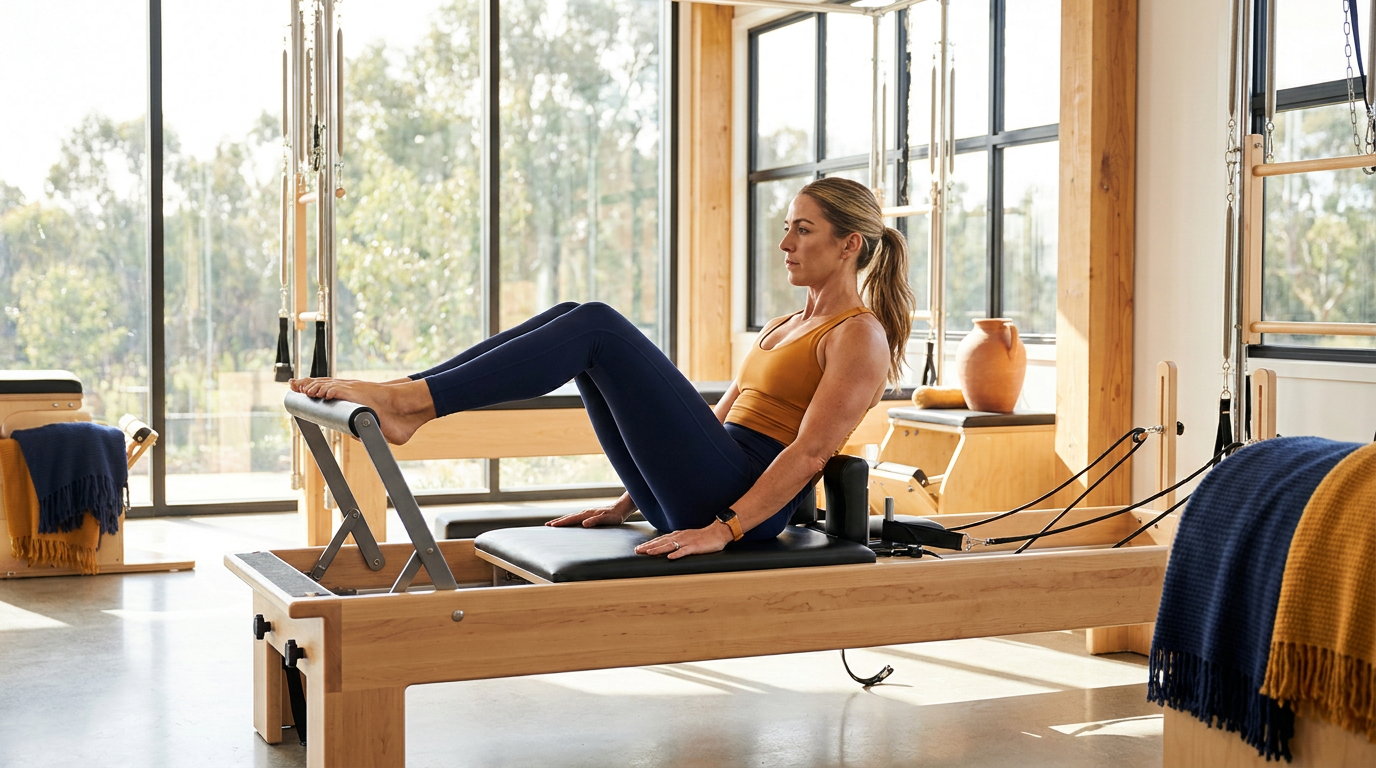
The same clinical study found that exercises performed on unstable surfaces—such as the spring-loaded carriage of a Pilates reformer machine—force the central nervous system to constantly adjust to shifting resistance. This dynamic, unpredictable environment significantly enhances proprioception and improves the contraction timing of the core musculature. By continuously challenging the body's equilibrium, the reformer ensures that the deep stabilizing muscles fire instantly to protect the spine during sudden movements. This rapid neuromuscular response is a vital adaptation that translates directly to fall prevention in older adults and heightened agility in competitive athletes.[1]
Electromyography (EMG) data further corroborates this highly targeted muscle activation. Research published in the Archives of Physical Medicine and Rehabilitation examined the specific muscle firing patterns during quadruped Pilates exercises. The researchers placed surface electrodes on participants to measure the root mean square values of various trunk and hip muscles, seeking to understand how subtle shifts in posture affect muscular load. They discovered that the method's notorious emphasis on precise physical alignment is scientifically validated, rather than just being strict pedagogical cueing from instructors.[2]
Specifically, the researchers found that variations in pelvic tilt dramatically changed which muscles were doing the work. A retroverted pelvis with a flexed trunk position led to significantly increased activation of the external obliques and gluteus maximus. Conversely, an anteverted pelvis with trunk extension shifted the load to the multifidus muscles along the spine. This proves that the micro-adjustments demanded in a Pilates class effectively isolate and strengthen specific stabilizers that are easily bypassed during traditional, momentum-heavy gym workouts.[2]
Specifically, the researchers found that variations in pelvic tilt dramatically changed which muscles were doing the work.
This biomechanical efficiency translates directly into measurable athletic performance and injury prevention. For professional athletes, the line between peak performance and a season-ending injury is often dictated by core stability and neuromuscular control. A 2024 study published in the Journal of Bodywork and Movement Therapies investigated the impact of an eight-week Mat Pilates protocol on young competitive volleyball players. The researchers aimed to bridge the gap between traditional strength training and the nuanced control offered by the Pilates method.[3][6]
Following the eight-week protocol, the volleyball athletes showed a significant increase in their sport-specific endurance plank test (SEPT) scores. But the most revealing finding came from the accompanying EMG data. The readings revealed a notable decrease in the activation of superficial muscles, like the erector spinae, during the endurance tests. This indicates that their deep core muscles had become vastly more efficient at stabilizing the torso, successfully offloading the strain from the superficial back muscles—a primary mechanism for preventing overuse injuries in high-impact sports.[3]

Despite these heavily documented benefits, sports scientists and exercise physiologists are careful to delineate exactly what Pilates can and cannot achieve. A common misconception in the wellness space is that Pilates can entirely replace traditional heavy resistance training for overall strength and bone health. While the method utilizes body weight and spring tension to create resistance, it generally lacks the heavy progressive overload required to maximize absolute strength or trigger massive muscle hypertrophy in the global mobilizers. It excels at endurance and stability, but it will not build the raw power generated by a heavy barbell deadlift.[5]
A comprehensive 2026 meta-analysis evaluated by the PEDro scale compared Pilates to other exercise modalities for dynamic and isometric strength gains. After reviewing numerous randomized controlled trials, the researchers concluded there was low evidence of any significant difference in pure strength gains between Pilates and standard exercise routines. The data suggests that while Pilates is highly effective for beginners or those in rehabilitation, it does not provide a superior stimulus for maximal force production compared to dedicated strength and conditioning programs.[4]
Furthermore, the impact of Pilates on bone mineral density (BMD) is relatively limited. Heavy strength training applies significant axial stress to the skeletal system, which stimulates bone remodeling and increases density—a crucial physiological adaptation for preventing osteopenia and osteoporosis as we age. Because Pilates is inherently low-impact and does not load the spine with heavy external weights, it does not apply the same level of mechanical stress to the bones, making it less effective as a standalone intervention for bone health.[5]

Cardiovascular adaptations are similarly constrained by the nature of the movements. While a vigorous, advanced flow class on the reformer can certainly elevate the heart rate and induce a sweat, Pilates does not provide the sustained physiological stress necessary to significantly improve long-term cardiovascular markers. Studies indicate that its impact on lowering resting blood pressure, improving cholesterol profiles, or increasing VO2 max is minimal when compared to dedicated aerobic training, running, or high-intensity interval training (HIIT). It is a muscular endurance practice, not a primary cardiovascular one.[5]
Therefore, the consensus among modern exercise physiologists is not to view Pilates as a standalone panacea that replaces all other forms of exercise. Instead, it is best understood as a highly specialized, evidence-based tool for neuromuscular re-education, joint mobility, and deep core hypertrophy. When integrated intelligently with traditional heavy strength training and cardiovascular exercise, Pilates addresses the precise biomechanical imbalances—such as tight hip flexors, weak glutes, and poor spinal articulation—that heavy lifting and endurance sports often exacerbate. This synergistic approach creates a vastly more resilient athlete.[5][6][7]

As the fitness industry continues to mature, the scientific validation of Pilates secures its permanent place in the modern training paradigm. By shifting the focus from how the body looks to how efficiently the nervous system controls the musculoskeletal structure, the method offers a sustainable pathway to lifelong movement. Whether utilized by a professional volleyball player seeking injury prevention or an older adult aiming to maintain balance, Pilates ensures that the body's structural foundation remains robust, adaptable, and pain-free for decades to come.[7]
How we got here
1920s
Joseph Pilates develops 'Contrology' in New York City, primarily rehabilitating injured dancers and athletes.
2000s
Pilates enters the mainstream fitness market, moving beyond niche rehabilitation clinics into commercial studios.
2010s
Sports science begins rigorously quantifying the method's biomechanical data using electromyography and ultrasound.
2024–2026
Clinical consensus firmly establishes Pilates as a premier supplementary tool for athletic longevity and deep core hypertrophy.
Viewpoints in depth
Clinical Biomechanists
Focus on measurable data like electromyography and ultrasound to validate how Pilates alters deep muscle hypertrophy and joint stability.
For clinical researchers, the value of Pilates lies in its measurable impact on the nervous system and deep musculature. By utilizing rehabilitative ultrasound imaging (RUSI) and electromyography (EMG), biomechanists have proven that the method successfully isolates the transversus abdominis and lumbar multifidus—muscles that are notoriously difficult to activate in traditional gym settings. They view Pilates not as a mystical mind-body practice, but as a highly specific biomechanical intervention that physically thickens the abdominal wall and improves the contraction timing necessary to prevent lower back pain.
Strength & Conditioning Coaches
View Pilates as a highly effective supplementary tool for core stability, but emphasize that it cannot replace heavy lifting for bone density and absolute strength.
In the realm of athletic performance, strength coaches appreciate Pilates for its ability to correct postural imbalances and enhance proprioception, which keeps athletes off the injury reserve list. However, they are quick to point out its physiological limitations. Because Pilates relies on spring tension and body weight, it lacks the heavy progressive overload required to maximize absolute strength or stimulate significant bone remodeling. Therefore, they advocate for a hybrid approach: using heavy barbells to build raw power and bone mineral density, while utilizing Pilates to ensure the joints and core can safely handle those heavy loads.
Pilates Practitioners
Emphasize the method's unique ability to foster a mind-body connection, improve postural alignment, and promote lifelong athletic longevity.
Advocates and instructors of the method focus on the holistic benefits of "Contrology," arguing that the intense concentration required to perform the movements correctly is just as important as the physical exertion. They highlight that Pilates teaches the body how to move with efficiency and grace, correcting the hunched postures and tight hip flexors that modern sedentary lifestyles create. For practitioners, the ultimate goal is not necessarily lifting the heaviest weight, but achieving a state of physical resilience and joint mobility that allows for pain-free movement well into old age.
What we don't know
- The exact long-term cardiovascular benefits of high-intensity reformer Pilates compared to traditional aerobic exercise.
- Whether the deep core hypertrophy achieved through Pilates can permanently reverse severe, chronic spinal degeneration without surgical intervention.
Key terms
- Transversus Abdominis (TrA)
- The deepest layer of abdominal muscle that wraps horizontally around the torso like a corset, providing foundational stability to the spine.
- Lumbar Multifidus
- A series of small, deep muscles attached directly to the spinal column that provide proprioception and postural stability during movement.
- Electromyography (EMG)
- A diagnostic procedure that uses surface electrodes to evaluate the health and electrical activation levels of muscles during specific exercises.
- Progressive Overload
- The gradual increase of stress placed upon the body during exercise training, typically through heavier weights, to stimulate muscle growth and bone density.
- Proprioception
- The central nervous system's ability to sense the body's movement, action, and location in space, which is crucial for balance and agility.
- Isometric Contraction
- A type of muscle contraction where the muscle length does not change and the joint angle remains constant, such as holding a plank position.
Frequently asked
Does Pilates build muscle mass like weightlifting?
No. While clinical ultrasound studies show it increases the physical thickness of deep core muscles, it lacks the heavy progressive overload needed for significant global muscle hypertrophy.
Can Pilates improve bone density?
Its impact on bone mineral density is minimal compared to heavy resistance training, which applies the necessary axial stress to the skeletal system to stimulate bone remodeling.
How often should I do Pilates to see results?
Clinical studies typically observe significant improvements in core endurance, proprioception, and muscle activation with protocols of 2 to 3 sessions per week over an 8-week period.
Is Pilates better than yoga for core strength?
While both improve flexibility and balance, Pilates places a much heavier, specific biomechanical emphasis on activating the transversus abdominis and stabilizing the spine through spring and bodyweight resistance.
Sources
Source coverage
7 outlets
3 viewpoints surfaced






[1]National Institutes of HealthClinical Biomechanists
Effects of Pilates-Based Core Stabilization Training on Deep Stabilizing Muscles
Read on National Institutes of Health →[2]Archives of Physical Medicine and RehabilitationClinical Biomechanists
Muscle activation during four Pilates core stability exercises in quadruped position
Read on Archives of Physical Medicine and Rehabilitation →[3]Journal of Bodywork and Movement TherapiesStrength & Conditioning Coaches
Pilates increases resistance performance in young volleyball players
Read on Journal of Bodywork and Movement Therapies →[4]ResearchGateClinical Biomechanists
Effectiveness of Pilates method compared against other exercise modalities for muscle strength increase
Read on ResearchGate →[5]The Perfect WorkoutStrength & Conditioning Coaches
Pilates vs Strength Training: Which Workout Wins?
Read on The Perfect Workout →[6]IDEA Health & Fitness AssociationPilates Practitioners
Pilates for Athletes: Longevity and Performance
Read on IDEA Health & Fitness Association →[7]Factlen Editorial TeamPilates Practitioners
Synthesis by Factlen editorial team
Read on Factlen Editorial Team →



Every angle. Every day.
Get fitness stories with full source coverage and perspective breakdowns delivered to your inbox.