
How Small Language Models Brought AI to Your Phone Without the Cloud
By shrinking neural networks and leveraging specialized mobile chips, tech giants are moving AI processing from massive data centers directly onto personal devices. This shift to 'Small Language Models' promises faster responses, offline capabilities, and unprecedented privacy.
By Factlen Editorial Team
- Edge & Mobile Ecosystem
- Silicon vendors and edge developers prioritize latency, cost, and offline availability.
- Privacy-First Ecosystem
- Consumer tech companies emphasize on-device AI as a fundamental security guarantee.
- Hybrid AI Pragmatists
- Enterprise AI providers argue that small models are just one piece of a larger, cloud-backed puzzle.
What's not represented
- · Environmental advocates concerned about the e-waste generated by consumers upgrading devices to access NPU hardware.
- · Open-source researchers focused on the democratization of AI access in developing nations.
Why this matters
Running AI locally means your most sensitive data—from private messages to health records—never has to be sent to a corporate server. It also democratizes AI access, allowing advanced tools to function in remote areas without internet connectivity.
Key points
- Tech companies are shifting focus from massive cloud-based AI to Small Language Models (SLMs) that run locally on phones and laptops.
- Techniques like quantization and knowledge distillation allow developers to shrink models without losing their core reasoning capabilities.
- On-device AI offers significant advantages, including zero network latency, offline functionality, and a mathematical guarantee of data privacy.
- While highly efficient at logic and formatting, SLMs struggle with factual recall and require external data to prevent hallucinations.
The artificial intelligence boom of the early 2020s was defined almost entirely by massive scale. The industry's most famous breakthroughs were powered by models containing hundreds of billions—and eventually trillions—of parameters, requiring warehouse-sized data centers and staggering amounts of electricity to function. The prevailing assumption was that creating smarter AI inherently meant building larger networks. But as generative AI transitions from a novel technological showcase into a daily utility integrated into everyday software, a quiet but profound revolution has inverted that trend. The future of AI is no longer just about building the biggest brain possible; it is about making that brain small enough to fit in your pocket.[6]
Today, the frontier of artificial intelligence research is increasingly focused on efficiency and miniaturization. Tech giants, silicon manufacturers, and open-source researchers are aggressively developing Small Language Models (SLMs)—highly optimized neural networks designed specifically to run entirely on consumer hardware. Rather than relying on a continuous connection to a distant server farm, these compact models are engineered to execute directly on the processors inside standard smartphones, tablets, and lightweight laptops. This pivot represents a fundamental rethinking of how AI should be deployed, moving the computational heavy lifting away from centralized corporate infrastructure and directly into the hands of the end user.[4][6]
This architectural shift from the cloud to the "edge" solves some of the most stubborn friction points associated with modern generative AI: privacy vulnerabilities, network latency, and recurring computational costs. When an AI model lives entirely in the cloud, every prompt, question, and uploaded document must be transmitted over the internet, processed on a corporate server, and sent back. This creates inherent security risks for sensitive personal or corporate data. By processing prompts locally on the device itself, Small Language Models ensure that private information never has to leave the user's physical possession, fundamentally altering the privacy calculus of using AI assistants.[1][5]
But fitting a digital brain that previously required a multimillion-dollar supercomputer into a battery-powered device that fits in a pocket requires severe architectural compromises. You cannot simply shrink a massive model without losing the very capabilities that make it useful. To bridge this gap, software engineers and hardware designers have had to collaborate closely, relying on a combination of aggressive algorithmic compression, highly specialized training regimens, and entirely new classes of mobile silicon to make on-device AI a practical reality rather than just a theoretical concept.[6]

The first major breakthrough in this miniaturization effort involved fundamentally rethinking how models are trained in the first place. Microsoft's Phi-3 family of models demonstrated that the quality of training data can often trump raw data volume. Instead of scraping the entire unfiltered internet—which includes vast amounts of low-quality text, repetition, and noise—researchers trained the 3.8-billion-parameter Phi-3-mini on highly curated, "textbook-like" synthetic data. This data was specifically designed to teach the model underlying reasoning patterns and logic, rather than forcing it to memorize vast quantities of rote information.[1]
The result of this targeted training approach is a compact model that punches far above its weight class. By focusing on high-quality, reasoning-dense inputs, developers proved that a model small enough to load into a standard smartphone's memory could match—and sometimes exceed—the logical reasoning capabilities of older models that were ten times its size. It proved that for many everyday tasks, a highly educated small model is vastly more efficient than a poorly focused massive one. This realization sparked an industry-wide race to develop highly capable models in the 3-billion to 8-billion parameter range, which is widely considered the sweet spot for mobile deployment.[1]
For models that have already been trained, engineers employ a sophisticated mathematical compression technique known as "quantization." In a standard, uncompressed neural network, the parameters—the billions of individual weights and biases that dictate how the model processes language—are typically stored as high-precision 32-bit floating-point numbers. While this precision is useful during the initial training phase, it requires massive amounts of memory to store and process. Quantization systematically rounds these precise numbers down to much smaller formats, such as 8-bit or even 4-bit integers, drastically reducing the space each parameter occupies.[3][5]
While this aggressive rounding slightly reduces the model's absolute mathematical precision, it drastically shrinks the overall file size and memory footprint, making local execution possible. Meta's open-source Llama 3 8B model, for instance, can be quantized down to 4-bit weights. This compression allows the model to run efficiently on modern mobile processors, like Qualcomm's Snapdragon series, without overwhelming the device's limited Random Access Memory (RAM) or causing the operating system to crash from resource exhaustion. By shrinking the model's footprint, developers ensure that the AI can run quietly in the background without disrupting the user's ability to keep other apps open simultaneously.[3]
Meta's open-source Llama 3 8B model, for instance, can be quantized down to 4-bit weights.
Another crucial optimization technique driving the Small Language Model revolution is "knowledge distillation." In this process, a massive, highly capable "teacher" model—running on a powerful cloud cluster—is used to train a smaller "student" model. The student model is repeatedly tested and adjusted until it learns to mimic the teacher's high-quality outputs and reasoning patterns. By learning directly from an already-smart model rather than starting from scratch, the student captures the essence of the larger model's capabilities in a fraction of the parameters, resulting in a highly efficient, specialized tool.[5]
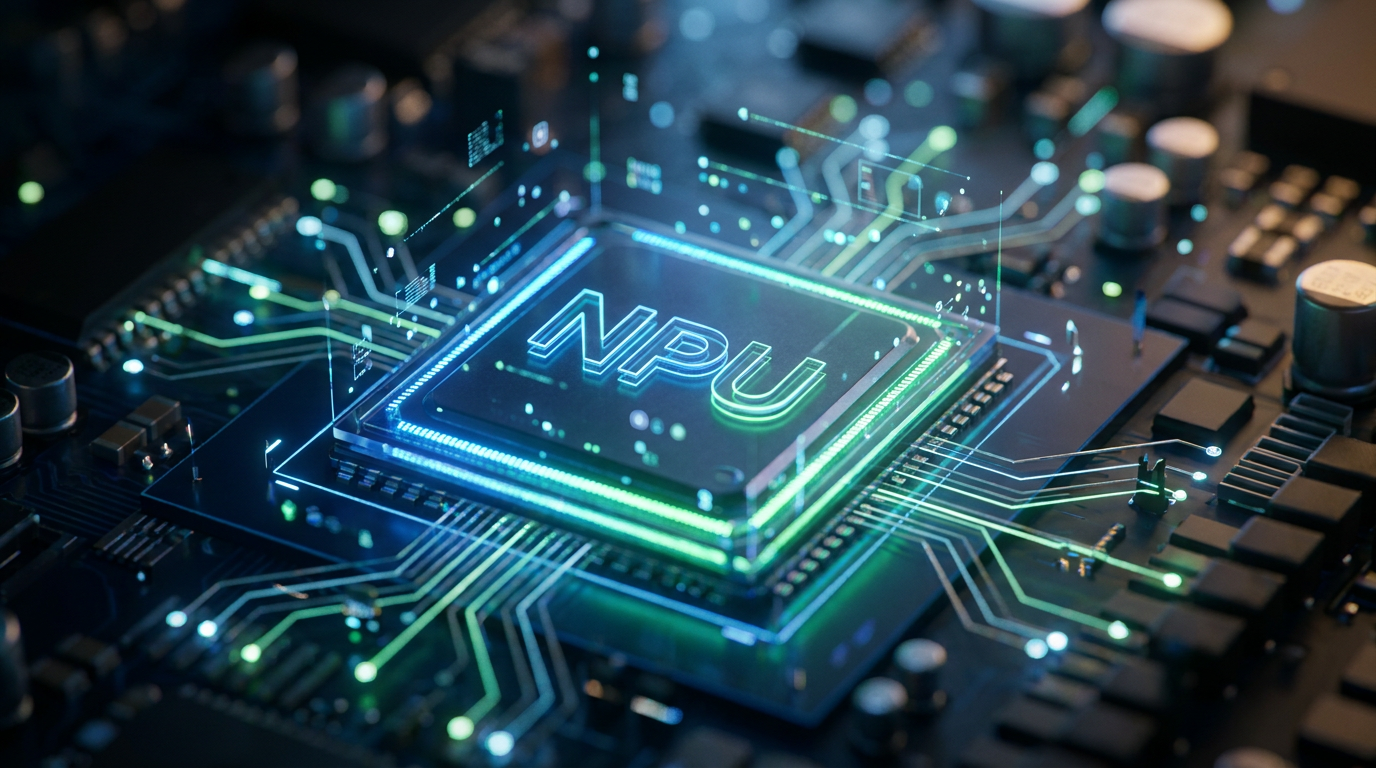
However, software compression and clever training techniques are only half of the equation. The physical hardware inside consumer devices has also had to evolve rapidly to meet the intense computational demands of local machine learning. Modern smartphones, tablets, and laptops now feature Neural Processing Units (NPUs)—specialized silicon pathways designed specifically to accelerate the complex matrix math required by AI. Unlike traditional Central Processing Units (CPUs), which handle general tasks, NPUs are purpose-built to run neural networks with incredible speed and minimal power draw.[1][2]

Apple's approach to its system-wide "Apple Intelligence" suite relies heavily on this tight hardware-software synergy. Rather than relying on generic off-the-shelf models, the company's architecture utilizes a custom 3-billion-parameter dense model, known as AFM 3 Core. This specific model is purpose-built to execute directly on the Neural Engine embedded within Apple's custom A-series and M-series silicon, ensuring that the software and hardware are perfectly aligned to maximize performance while minimizing battery drain during everyday tasks like text summarization and notification sorting.[2]
For more complex on-device tasks that require deeper reasoning, Apple employs a sophisticated sparse architecture in its AFM 3 Core Advanced model. While this advanced model contains roughly 20 billion parameters in total, it does not use all of them at once. Instead, it dynamically activates only 1 to 4 billion parameters at a time, depending on the specific context of the user's request. This "Mixture of Experts" approach carefully balances high-end performance with the strict thermal limits and battery constraints inherent to mobile devices.[2]
The practical benefits of this localized, hardware-accelerated architecture are profound, beginning with sheer speed. Because an on-device model does not need to package data, send it across the internet to a cloud server, and wait for a response to travel back, inference latency drops dramatically. On modern NPUs, small models can achieve sub-80 millisecond response times. This near-instantaneous processing enables truly real-time voice interactions and seamless text generation that feels like a native part of the operating system, rather than a sluggish web query.[1]
Furthermore, local processing enables artificial intelligence to function seamlessly in airplane mode or in geographic areas with poor or non-existent cellular connectivity. This offline capability is not just a convenience; it is crucial for critical applications like real-time translation for international travelers, offline navigation assistance, or diagnostic tools for medical workers operating in remote regions. By severing the tether to the cloud, SLMs transform AI from a web service into a persistent, reliable utility that works wherever the user goes.[4][5]

Most importantly, on-device AI offers a mathematical guarantee of privacy that cloud services simply cannot match. When a Small Language Model summarizes a confidential work email, analyzes a personal health metric, or drafts a private text message, the data processing happens entirely within the device's secure hardware enclave. Because the information never leaves the phone, it simply cannot be intercepted in transit, logged by a third-party cloud provider, or inadvertently used to train future iterations of a public AI model.[2][5]
Despite these massive advantages, the transition to Small Language Models is not without significant compromises. Because they possess vastly fewer parameters than their cloud-based counterparts, small models simply cannot memorize as much factual trivia. A 1-trillion parameter model has the capacity to store vast amounts of obscure knowledge across thousands of domains, effectively acting as a comprehensive encyclopedia. A 3-billion parameter model, by contrast, must dedicate its limited capacity to understanding language structure and logic, leaving little room for rote memorization.[4]
As a result, while an SLM might excel at reasoning, summarizing a provided document, or formatting text into a specific style, it is significantly more likely to hallucinate when asked about obscure historical facts, niche programming libraries, or complex global events. They are highly efficient engines for logic and language manipulation, but they require external data—such as a user providing a document to summarize, or the system fetching a live web search—to ground their knowledge and prevent them from confidently inventing false information.[4][6]
Despite these inherent limitations regarding factual recall, the trajectory of the technology industry is clear. As quantization techniques continue to improve, training datasets become more refined, and mobile silicon grows increasingly powerful, the gap between cloud and edge capabilities is narrowing. The default home for everyday, utility-grade artificial intelligence is shifting away from the distant, power-hungry cloud and directly into the devices we carry with us, promising a future where AI is faster, cheaper, and fundamentally more private.[6]
How we got here
Feb 2023
Meta releases the original LLaMA model, sparking the open-weights movement and early local-run experiments by developers.
Apr 2024
Microsoft introduces the Phi-3 family, proving that small models trained on highly curated data can achieve top-tier reasoning scores.
Jun 2024
Apple announces Apple Intelligence, centering its strategy on 3-billion-parameter on-device models running on its Neural Engine.
2025-2026
Neural Processing Units (NPUs) become standard in consumer smartphones and laptops, accelerating the adoption of local AI.
Viewpoints in depth
The Edge Ecosystem's View
Silicon vendors and edge developers prioritize latency, cost, and offline availability.
For hardware manufacturers and edge computing platforms, the push toward Small Language Models is about unlocking new use cases that the cloud simply cannot support. They argue that relying on distant servers introduces unacceptable latency for real-time applications like live translation or autonomous robotics. By optimizing models to run locally, they eliminate recurring API costs and ensure that AI tools remain functional even in disconnected environments.
The Privacy-First View
Consumer tech companies emphasize on-device AI as a fundamental security guarantee.
Companies building consumer-facing operating systems view local AI as a critical trust mechanism. They argue that users will not adopt deeply integrated AI assistants if every personal text message, photo, and health metric is uploaded to a corporate server. By processing data on-device, they can offer a mathematical guarantee of privacy, ensuring that sensitive context never leaves the user's physical possession.
The Hybrid Pragmatists' View
Enterprise AI providers argue that small models are just one piece of a larger, cloud-backed puzzle.
While acknowledging the speed and privacy benefits of local models, enterprise AI developers caution against viewing them as a complete replacement for massive cloud infrastructure. They point out that SLMs inherently lack the parameter count required to store vast amounts of factual knowledge or perform highly complex, multi-step reasoning. Their vision is a hybrid architecture: local models handle immediate, privacy-sensitive tasks, while seamlessly routing complex queries to more capable cloud models when necessary.
What we don't know
- It remains unclear how quickly developers will be able to solve the factual hallucination problem inherent to smaller parameter counts.
- The long-term impact of continuous on-device AI processing on the physical lifespan and thermal degradation of smartphone batteries is still being studied.
- We do not yet know if open-source SLMs will eventually match the capabilities of proprietary on-device models deeply integrated into operating systems like iOS and Android.
Key terms
- Small Language Model (SLM)
- A compact artificial intelligence model, typically under 10 billion parameters, optimized to run locally on consumer devices rather than in massive data centers.
- Quantization
- A compression technique that shrinks an AI model's file size by rounding its high-precision mathematical weights down to smaller, less precise numbers.
- Neural Processing Unit (NPU)
- A specialized hardware chip inside modern computers and smartphones designed specifically to accelerate the complex math required by machine learning.
- Knowledge Distillation
- A training method where a massive, highly capable AI model is used to teach a smaller model, transferring its reasoning skills into a more compact format.
- Parameters
- The internal variables and connections within a neural network that the model learns during training, dictating how it processes and generates language.
Frequently asked
Can a Small Language Model run without an internet connection?
Yes. Because the model is downloaded and stored directly on your device's memory, it can process prompts and generate text entirely offline, making it ideal for airplane mode or remote areas.
Are small models as smart as massive cloud models like ChatGPT?
They match larger models in basic reasoning and text formatting, but they fall short on factual trivia. Because they have fewer parameters, they cannot memorize as much information and are more likely to hallucinate obscure facts.
Will running AI locally drain my smartphone's battery?
While AI processing is computationally intense, modern devices use dedicated Neural Processing Units (NPUs) designed specifically to run these models efficiently, minimizing battery drain compared to using the main CPU.
Sources
Source coverage
6 outlets
3 viewpoints surfaced






[1]MicrosoftHybrid AI Pragmatists
Small Language Models in the Edge AI Context
Read on Microsoft →[2]ApplePrivacy-First Ecosystem
Apple Foundation Models Architecture
Read on Apple →[3]QualcommEdge & Mobile Ecosystem
Deploying Llama 3 on-device
Read on Qualcomm →[4]IBMHybrid AI Pragmatists
What are small language models (SLMs)?
Read on IBM →[5]RunPodEdge & Mobile Ecosystem
Small Language Models Revolution: Deploying Efficient AI at the Edge
Read on RunPod →[6]Factlen Editorial TeamEdge & Mobile Ecosystem
Synthesis by Factlen editorial team
Read on Factlen Editorial Team →

More in ai
See all 5 stories →Edge AI
The Reasoning Threshold: How Sub-10B Parameter AI Models Are Outperforming Giants in 2026
6 sources
Federal Preemption
The Federal Government Moves to Preempt State AI Laws as Congress Drafts National Framework
8 sources

Local AI
The 2026 Guide to Running AI Locally: How Consumer Hardware Caught Up to the Cloud
8 sources

Every angle. Every day.
Get ai stories with full source coverage and perspective breakdowns delivered to your inbox.