
The Rise of Solarpunk and Cozy Fantasy: How Optimism is Rewiring Speculative Fiction
A new wave of speculative fiction is rejecting dystopian tropes in favor of community, sustainability, and low-stakes comfort, reshaping the publishing industry and reader expectations.
By Factlen Editorial Team
- Solarpunk Advocates
- View optimistic fiction as a necessary political tool to combat climate despair and envision sustainable futures.
- Publishing Industry Analysts
- Focus on the commercial viability of the trend, tracking how reader burnout drives sales of comfort-focused literature.
- Traditional Speculative Fiction Critics
- Argue that removing high stakes and physical conflict fundamentally weakens narrative tension and pacing.
What's not represented
- · Non-Western speculative fiction authors
- · Climate scientists evaluating the real-world feasibility of solarpunk technologies
Why this matters
The stories a culture consumes shape its vision of the future. The shift from apocalyptic dread to actionable optimism in literature provides a psychological blueprint for how society might navigate real-world climate and social crises.
Key points
- Solarpunk and cozy fantasy are rapidly replacing dystopian narratives in speculative fiction.
- These genres focus on community, sustainability, and low-stakes conflict rather than world-ending threats.
- The shift is largely driven by reader exhaustion with real-world crises like climate change and pandemics.
- Critics argue the lack of high stakes can weaken narrative tension, while proponents view optimism as a necessary survival tool.
- The trend has proven highly lucrative for publishers, driven by grassroots communities like BookTok.
For the better part of four decades, the speculative fiction landscape has been dominated by the shadows of dystopia and the neon-lit cynicism of cyberpunk. From the irradiated wastelands of post-apocalyptic survival narratives to the grim, morally gray battlefields of epic fantasy, the prevailing assumption in publishing was that high stakes required high trauma. Readers were conditioned to expect world-ending threats, anti-heroes, and a pervasive sense of doom. But over the last several years, a quiet, radically optimistic revolution has taken root in the publishing industry.[6]
This movement is largely defined by two rapidly growing subgenres: solarpunk and cozy fantasy. Rather than asking how humanity might survive the end of the world, these genres ask a fundamentally different question: what if we actually manage to fix it? Or, in the case of cozy fantasy, what if the characters simply decide to step away from the battlefield and open a coffee shop instead? It is a deliberate pivot away from the adrenaline of survival toward the quiet work of living.[1][2]
The shift represents a massive reallocation of reader attention and publishing resources. Driven by a collective exhaustion with real-world polycrises—from climate anxiety to global pandemics—audiences are increasingly seeking out narratives that offer comfort, community, and sustainable futures. This isn't merely a fleeting trend; it is a structural rewiring of what science fiction and fantasy are expected to deliver to their audiences in the 2020s.[4][6]
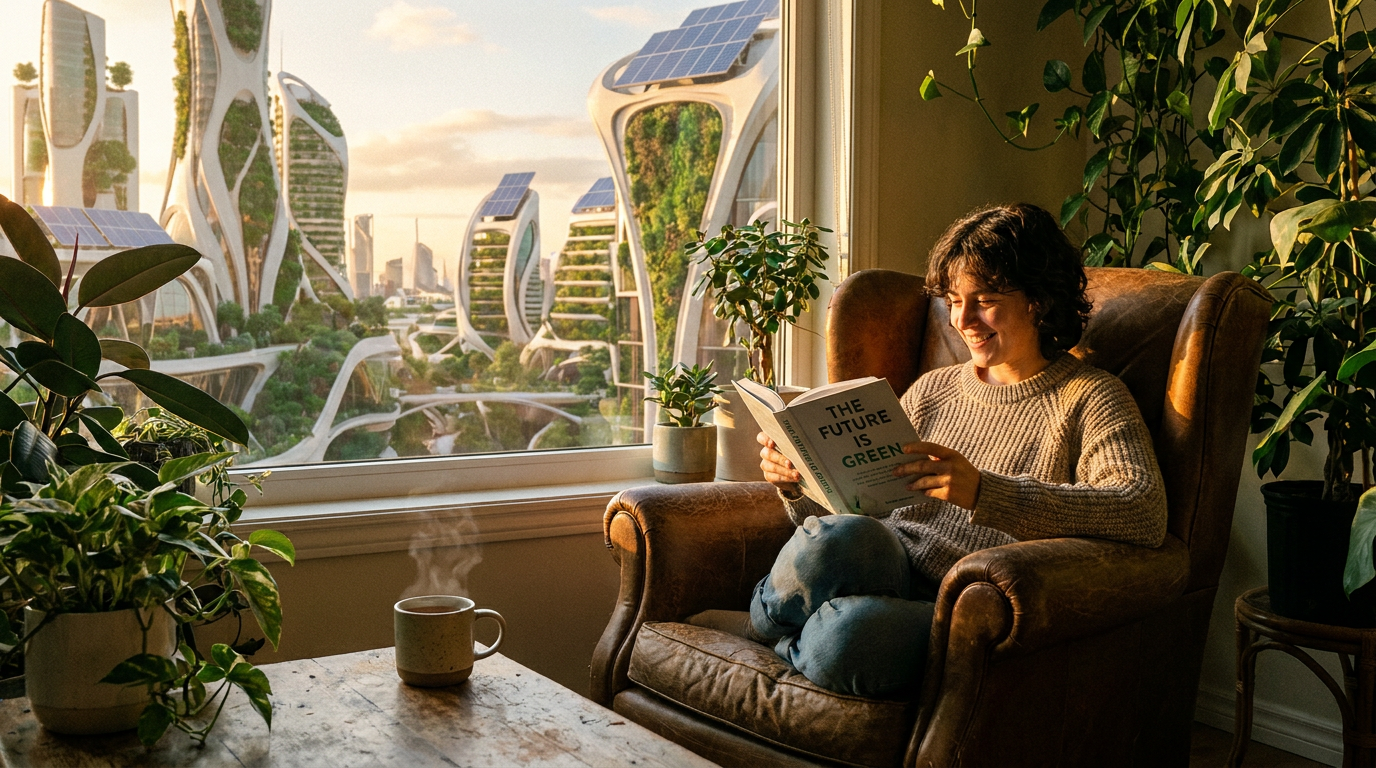
To understand this shift, it is essential to define the mechanics of solarpunk. Originally emerging as an aesthetic movement on platforms like Tumblr in the late 2000s and early 2010s, solarpunk has matured into a robust literary genre. It stands in direct opposition to cyberpunk. Where cyberpunk envisions a high-tech, low-life future dominated by mega-corporations and environmental collapse, solarpunk imagines a future where humanity has successfully integrated advanced technology with ecological sustainability.[3][5]

In a solarpunk narrative, the conflict rarely centers on preventing an apocalypse. The apocalypse has often already been averted, or the characters are actively engaged in the localized, community-driven work of rebuilding. The aesthetic is characterized by art nouveau architecture, ubiquitous renewable energy, urban farming, and a deep reverence for the natural world. It is a genre that treats radical hope not as a naive fantasy, but as a necessary political and survival strategy.[5][6]
Running parallel to solarpunk is the explosion of "cozy fantasy," a subgenre that removes the world-ending stakes of traditional epic fantasy entirely. The defining text of this recent boom is widely considered to be Travis Baldree’s 'Legends & Lattes', a novel about a bloodthirsty orc barbarian who retires from adventuring to open the first coffee shop in a fantasy city. The book's viral success proved that there was a massive, untapped market for low-stakes, character-driven fantasy.[1][4]
Cozy fantasy operates on a specific set of narrative mechanics. The stakes are deeply personal rather than global. A plot might revolve around a protagonist trying to keep a small business afloat, repairing a broken relationship, or learning a new domestic skill. The tension comes from interpersonal dynamics and the challenges of daily life, rather than the threat of a Dark Lord destroying the realm.[1]
Cozy fantasy operates on a specific set of narrative mechanics.
This focus on the mundane and the domestic is a deliberate subversion of the traditional "hero's journey." In cozy fantasy, the ultimate reward is not a throne or a magical artifact, but a sense of belonging and a comfortable home. The "found family" trope is central to these narratives, emphasizing that community and mutual care are the most powerful forces in the universe, far outweighing martial prowess.[1][2]
The commercial impact of this shift has been staggering. Traditional publishers, initially skeptical that stories without life-or-death stakes could sustain reader interest, have been scrambling to acquire titles that fit the "cozy" or "hopepunk" labels. Sales data from the past three years indicates that titles marketed with these keywords have seen exponential growth, often outpacing traditional grimdark fantasy in both pre-orders and sustained backlist sales.[4]

Much of this commercial velocity has been driven by organic word-of-mouth on social media platforms, particularly TikTok's literary community, BookTok. Readers experiencing burnout and anxiety have actively curated recommendation lists focusing on "books that feel like a warm hug." This grassroots demand has forced the traditional publishing apparatus to pivot, proving that reader appetite for comfort is a highly lucrative market force.[4][6]
However, the rise of optimistic literature is not without its critics. Some traditional speculative fiction purists argue that the removal of high stakes fundamentally weakens narrative drive. They contend that conflict is the engine of storytelling, and without significant adversity or physical danger, these novels risk becoming stagnant, overly sentimental, or structurally inert.[6]
Furthermore, there is an ongoing debate within literary circles about the line between "radical hope" and "toxic positivity." Critics of the cozy movement suggest that by retreating into low-stakes, idealized worlds, readers and authors might be engaging in a form of escapism that ignores the pressing, systemic issues of the real world. They ask whether reading about a utopian coffee shop actually equips a reader to deal with modern geopolitical crises.[2][6]

Proponents of solarpunk and hopepunk fiercely reject this characterization. They argue that imagining a better world is the first necessary step to building one. In an era saturated with doomscrolling and apocalyptic news cycles, they view the act of writing and reading about functional, supportive communities as an act of profound rebellion against a culture of despair.[3][5]
Authors like Becky Chambers, whose 'Monk and Robot' series has become a cornerstone of modern cozy sci-fi, frequently emphasize that writing about good people trying their best is not a denial of darkness, but a deliberate choice of focus. Her work demonstrates that exploring how a society cares for its most vulnerable members can be just as narratively compelling as a sprawling space battle.[1][3]

The influence of this literary shift is already bleeding into other mediums. The video game industry has seen a parallel rise in "cozy gaming," while independent filmmakers are increasingly exploring low-stakes, community-focused science fiction. The aesthetic and philosophical principles of solarpunk are even influencing real-world urban design, permaculture movements, and climate activism.[5][6]
Ultimately, the rewiring of speculative fiction reflects a profound change in what we ask of our stories. We no longer just want to be warned about how bad things could get; we want a blueprint for how good things could be. By centering sustainability, community, and radical kindness, solarpunk and cozy fantasy are proving that the most powerful magic in literature might simply be the belief that a better future is possible.[6]
How we got here
1980s-2000s
Cyberpunk and grimdark fantasy dominate the speculative fiction publishing landscape.
2008
The term 'solarpunk' is first coined on a blog, sparking an aesthetic movement focused on green technology and art nouveau.
2017
Author Alexandra Rowland coins the term 'hopepunk' to describe narratives where optimism is a political choice.
2022
Travis Baldree's 'Legends & Lattes' goes viral, proving the massive commercial viability of low-stakes cozy fantasy.
2024-2026
Major traditional publishers aggressively acquire solarpunk and cozy fantasy titles, cementing the genre shift.
Viewpoints in depth
Solarpunk Advocates
Writers and readers who believe optimistic fiction is a necessary tool for social and environmental change.
This camp argues that dystopia has outlived its usefulness. While cautionary tales were necessary in the 20th century, modern audiences are already acutely aware of the world's problems. Solarpunk advocates believe that constantly consuming apocalyptic media leads to climate fatalism and political apathy. By providing concrete, imaginative blueprints for sustainable, community-driven futures, they argue that literature can inspire real-world activism and technological innovation. For them, hope is not passive; it is a radical, active discipline.
Traditional Speculative Fiction Critics
Literary purists who worry that removing high stakes damages the fundamental structure of storytelling.
Critics of the cozy movement often point to the mechanics of narrative theory, arguing that a story requires significant conflict to maintain momentum. They express concern that the demand for 'comfort reads' is pushing the genre toward overly sentimental, structurally flat narratives where characters face no real adversity. Furthermore, some critics warn of 'toxic positivity,' suggesting that retreating into idealized, low-stakes fantasy worlds is a form of privileged escapism that allows readers to ignore the very real, systemic injustices occurring outside their windows.
Publishing Industry Analysts
Market watchers focused on how reader psychology is reshaping the economics of the book industry.
For industry analysts, the philosophical debate is secondary to the sales data. They note that the polycrises of the 2020s—pandemics, inflation, geopolitical instability—have fundamentally altered consumer behavior. Readers are treating books as a form of self-care and psychological regulation. Analysts point out that the viral, word-of-mouth success of cozy fantasy on platforms like TikTok has created a highly lucrative, low-risk market segment for publishers. They project that 'comfort fiction' will remain a dominant commercial force as long as real-world anxiety remains high.
What we don't know
- Whether the cozy fantasy trend will sustain its current explosive growth or eventually saturate the market.
- How effectively solarpunk literature will translate into big-budget film and television adaptations, which traditionally rely on high-stakes conflict.
- The long-term psychological effects of shifting cultural consumption from cautionary dystopias to comfort-focused narratives.
Key terms
- Solarpunk
- A science fiction subgenre and art movement that envisions a sustainable, egalitarian future powered by renewable energy and community cooperation.
- Cozy Fantasy
- A subgenre of fantasy literature characterized by low-stakes plots, a focus on domestic life or small businesses, and themes of found family and comfort.
- Grimdark
- A subgenre of speculative fiction characterized by a tone that is dark, dystopian, violent, and morally ambiguous.
- Hopepunk
- A literary concept where characters actively choose optimism, kindness, and community as a form of resistance against a cynical or oppressive world.
- Cyberpunk
- A sci-fi subgenre featuring advanced technological and scientific achievements juxtaposed with a degree of societal breakdown or dystopian corporate control.
Frequently asked
What is the difference between solarpunk and hopepunk?
Solarpunk is heavily focused on ecology, renewable energy, and sustainable futures. Hopepunk is a broader narrative tone that emphasizes fighting for positive change and community, even in grim circumstances, without necessarily focusing on environmental tech.
Is cozy fantasy just romance?
No. While cozy fantasy often includes romance, its defining feature is low-stakes conflict and domestic focus. A cozy fantasy can center entirely on friendship, running a business, or personal healing without a romantic subplot.
Where did the term solarpunk come from?
The term originated on blogging platforms like Tumblr around 2008 as an aesthetic counter-movement to cyberpunk, eventually evolving into a fully realized literary and artistic genre.
Sources
Source coverage
6 outlets
3 viewpoints surfaced






[1]Reactor MagazinePublishing Industry Analysts
The Anatomy of Cozy Fantasy and Low-Stakes Sci-Fi
Read on Reactor Magazine →[2]The GuardianTraditional Speculative Fiction Critics
Why readers are turning to hopepunk and solarpunk in an age of anxiety
Read on The Guardian →[3]WiredSolarpunk Advocates
Solarpunk Is the Optimistic Sci-Fi We Need Right Now
Read on Wired →[4]Publishers WeeklyPublishing Industry Analysts
Sales Data Shows Massive Growth in Low-Stakes Fantasy Subgenres
Read on Publishers Weekly →[5]Journal of Science FictionSolarpunk Advocates
Ecology and Community in Contemporary Solarpunk Literature
Read on Journal of Science Fiction →[6]Factlen Editorial Team
Synthesis by Factlen editorial team
Read on Factlen Editorial Team →
Every angle. Every day.
Get culture stories with full source coverage and perspective breakdowns delivered to your inbox.