
AI Model Decodes Sperm Whale 'Phonetic Alphabet', Revealing Language-Like Complexity
Using advanced machine learning, scientists at Project CETI have mapped the intricate click patterns of sperm whales, discovering context-dependent "vowels" and "diphthongs" that suggest one of the most complex communication systems in the animal kingdom.
By Factlen Editorial Team
- Marine Linguists & Biologists
- Views the structural complexity of whale clicks as a parallel to human language evolution.
- AI & Bioacoustics Engineers
- Focuses on the computational breakthroughs required to parse non-human audio data and bridge the domain gap.
- Legal & Conservation Advocates
- Seeks to translate scientific discoveries of non-human language into concrete legal rights for cetaceans.
What's not represented
- · Commercial Fishing Industry
- · Maritime Shipping Operators
Why this matters
Decoding the complex language of sperm whales not only bridges a profound interspecies divide, but also provides a powerful scientific foundation for establishing new legal rights and protections for marine life.
Key points
- Project CETI researchers used AI to identify a 'phonetic alphabet' in sperm whale communication.
- The AI model, WhAM, discovered acoustic elements in whale clicks that function similarly to human vowels and diphthongs.
- Whales modify their codas using 'rubato' (timing variations) and 'ornamentation' (added clicks) to convey context.
- The discovery challenges the assumption that complex language is an exclusively human trait.
- Legal scholars are using these findings to advocate for stronger, legally binding protections for cetaceans.
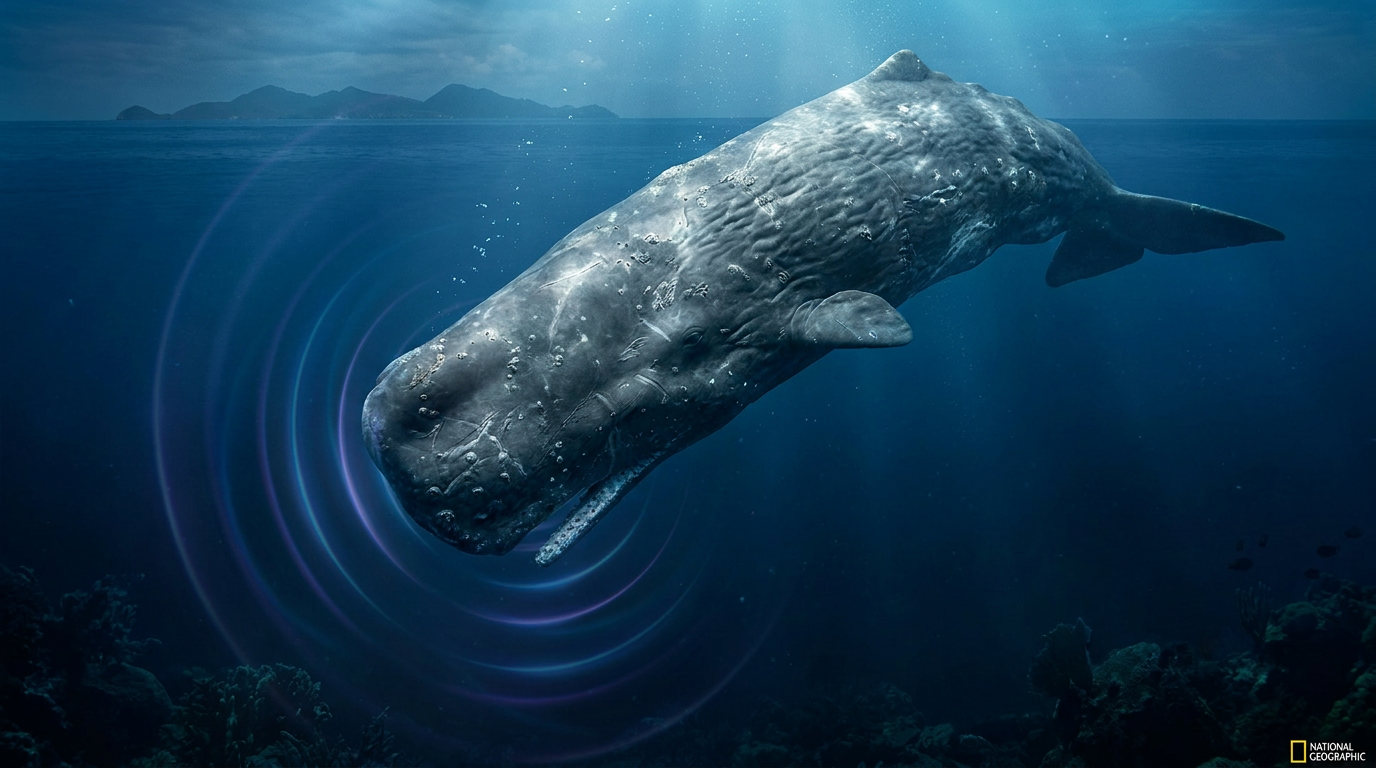
Deep in the waters of the Eastern Caribbean, an artificial intelligence model is listening to the ocean and learning to speak whale. For decades, marine biologists have recorded the rhythmic, Morse code-like clicks of sperm whales, known as codas, treating them primarily as simple identification signals. But a multidisciplinary initiative known as Project CETI (Cetacean Translation Initiative) is fundamentally challenging that assumption. By applying advanced machine learning to massive acoustic datasets, researchers have discovered that sperm whale communication possesses a structural complexity previously thought to be exclusive to human language.[1][3]
The breakthrough centers on the identification of a "phonetic alphabet" within the whales' vocalizations. When researchers sped up the codas and removed the silences, they found distinct acoustic elements that function remarkably like human vowels and diphthongs. Just as the English word "cow" glides seamlessly from an "ah" to an "oo" sound, sperm whale clicks exhibit systemic shifts in length, resonance, and frequency. This suggests that the whales are not merely repeating static signals, but actively combining and modifying phonetic units to convey nuanced, context-dependent information.[1][2][6]

To decode these patterns, Project CETI developed WhAM (Whale Acoustic Model), an AI system originally inspired by music-generation algorithms. The team, which includes researchers from MIT's Computer Science and Artificial Intelligence Laboratory (CSAIL), trained the model on an "ark's worth" of animal audio from open databases before fine-tuning it exclusively on thousands of sperm whale codas. WhAM operates like an acoustic game of Mad Libs, analyzing incomplete sequences of clicks and predicting the missing elements until its outputs sound convincingly whale-like.[2][5]
Through this predictive training, the AI began detecting subtle acoustic features that human ears—and traditional spectrograms—had entirely missed. Dr. Daniela Rus, director of MIT CSAIL, noted that the whales modify their codas through "ornamentation" (the addition of extra clicks) and "rubato" (expressive, slight variations in the timing between clicks). These structural tweaks indicate that the sperm whale communication system is capable of representing a vast space of possible meanings, far exceeding the complexity of most other animal vocalizations.[2][3][5]
Through this predictive training, the AI began detecting subtle acoustic features that human ears—and traditional spectrograms—had entirely missed.
For the linguists involved in the project, the process of deciphering these codas is akin to studying ancient, dead languages like Hittite or Sanskrit. However, instead of being separated by thousands of years of history, the researchers are separated by the profound environmental divide of the deep ocean. This "massive domain gap" is the greatest hurdle in moving from structural recognition to actual translation. Because sperm whales live in an environment utterly alien to humans—navigating the pitch-black abyss via echolocation and hunting giant squid—much of their vocabulary likely references experiences for which no human words exist.[1][2]

Despite this semantic barrier, the structural revelations are already sending shockwaves beyond the scientific community. The discovery that cetaceans may possess a capacity for true language is challenging long-held anthropocentric views in both philosophy and law. If sperm whales are not just signaling, but actively conversing using a phonetic alphabet, it fundamentally alters the ethical calculus of how humans interact with the marine environment.[4]
In response to these findings, legal scholars are exploring how AI-assisted bioacoustics could reshape environmental policy. New York University's More-Than-Human Life (MOTH) Program has partnered with Project CETI to investigate the legal impacts of these discoveries. Their collaborative research argues that proving cetaceans have language could disrupt current legal frameworks, providing a foundation to grant whales stronger, legally binding protections as sentient, communicating beings rather than mere biological resources.[4]

While WhAM cannot yet translate a sperm whale's clicks into English, the model's ability to map the architecture of their communication marks a historic milestone in interspecies relations. By leveraging artificial intelligence to bridge the cognitive divide, researchers are moving closer to a future where conservation is driven not just by human observation, but by a genuine understanding of the voices that inhabit the deep.[1][2][4]
How we got here
1960s
Scientists first document whale clicks, treating them primarily as simple identification signals or Morse code.
2024
Project CETI publishes research identifying a 'phonetic alphabet' in sperm whale communication.
April 2025
NYU's MOTH program and Project CETI publish findings on the legal implications of AI-assisted animal communication.
Early 2026
The WhAM AI model demonstrates the ability to predict and generate complex sperm whale codas, identifying vowel-like structures.
Viewpoints in depth
Marine Linguists & Biologists
This camp views the structural complexity of whale clicks as a parallel to human language evolution.
Researchers like Gašper Beguš approach whale codas similarly to dead human languages. By analyzing the "rubato" (timing variations) and "ornamentation" (added clicks), they argue that whales have independently evolved a vowel-like system. This perspective emphasizes that the whales are not just signaling, but actively combining phonetic units into context-dependent phrases, representing a massive leap in our understanding of animal cognition.
AI & Bioacoustics Engineers
This group focuses on the computational breakthroughs required to parse non-human audio data.
For computer scientists, the challenge is building models like WhAM that can process an "ark's worth" of animal audio without human bias. They highlight the "massive domain gap"—the reality that whale communication likely references deep-ocean experiences humans cannot comprehend. By training AI to predict missing click sequences, engineers are allowing the models to discover acoustic features that human ears and traditional spectrograms would never detect.
Legal & Conservation Advocates
This perspective seeks to translate scientific discoveries into concrete legal rights for cetaceans.
Organizations like NYU's MOTH program argue that law and policy lag dangerously behind science. If AI can definitively prove that sperm whales possess a complex language, it shatters the anthropocentric view that confines language to humans. Advocates believe this evidence can be weaponized in courts to establish stronger, legally binding protections for whale habitats, moving beyond basic conservation to recognizing the rights of a communicating, sentient culture.
What we don't know
- The actual semantic meaning behind the specific codas and vowel structures.
- Whether other cetacean species possess similarly complex phonetic alphabets.
- How quickly international courts might adopt new legal frameworks based on bioacoustic evidence.
Key terms
- Coda
- A patterned series of acoustic clicks used by sperm whales for social communication.
- Rubato
- Slight, expressive variations in the timing between clicks within a coda, which can alter its meaning.
- Ornamentation
- The addition of extra clicks to a standard coda pattern, adding complexity to the vocalization.
- Bioacoustics
- A cross-disciplinary science that combines biology and acoustics to study how animals produce and perceive sound.
Frequently asked
What is a sperm whale coda?
A coda is a short, rhythmic burst of clicks interspersed with silences that sperm whales use to communicate, functioning somewhat similarly to Morse code.
Can the AI actually translate what the whales are saying?
Not yet. While the AI can map the complex phonetic structure and predict click sequences, the specific meanings of the codas remain unknown due to the vast differences between human and whale environments.
Why does this discovery matter for the law?
Proving that whales possess a complex, language-like communication system challenges the legal view that language is exclusive to humans, potentially paving the way for stronger legal rights and protections for cetaceans.
Sources
Source coverage
6 outlets
3 viewpoints surfaced






[1]National GeographicMarine Linguists & Biologists
Sperm whales may have an 'alphabet'—and it's remarkably similar to ours
Read on National Geographic →[2]AtmosAI & Bioacoustics Engineers
Learning an animal's language: How AI is decoding sperm whale clicks
Read on Atmos →[3]Baleines en DirectLegal & Conservation Advocates
Project CETI: Discovering the Phonetic Alphabet of Sperm Whales
Read on Baleines en Direct →[4]NYU MOTH ProgramLegal & Conservation Advocates
What if We Understood what Animals are Saying? The Legal Impact of AI-assisted Studies
Read on NYU MOTH Program →[5]MIT CSAILAI & Bioacoustics Engineers
MIT researchers use machine learning to uncover complex structures in whale communication
Read on MIT CSAIL →[6]Proceedings of the Royal Society BMarine Linguists & Biologists
Contextual and combinatorial structure in sperm whale vocalisations
Read on Proceedings of the Royal Society B →

More in ai
See all 6 stories →AI Provenance
The Global Standardization of AI Watermarking: Evidence from 2026 Policy Implementation
7 sources

Medical AI
AI Medical Assistants Match or Surpass Human Doctors in Diagnostic Accuracy, Landmark Studies Show
6 sources

Oculomics
How AI Retinal Scans Are Predicting Heart Disease and Dementia
7 sources
Edge AI
The Era of Local AI: How Small Language Models Are Putting Power Back on Your Device
7 sources

Every angle. Every day.
Get ai stories with full source coverage and perspective breakdowns delivered to your inbox.