
How 'Coral IVF' and Automation Are Scaling the Great Barrier Reef's Recovery
Marine scientists and engineers are deploying automated seeding machines and heat-tolerant coral breeding to rebuild the Great Barrier Reef at an unprecedented scale.
By Factlen Editorial Team
- Marine Scientists & Technologists
- Focuses on developing and scaling active interventions to rebuild reef ecosystems and buy time against climate change.
- Coastal Communities & Tourism
- Views the reef as a vital economic and cultural lifeline, actively participating in restoration to protect local livelihoods.
- Climate Realists
- Argues that while local restoration is necessary, it is ultimately futile without aggressive global action to reduce carbon emissions.
What's not represented
- · Traditional Owners and First Nations groups whose cultural heritage is tied to the reef
- · Fossil fuel industries whose emissions are the primary driver of ocean warming
Why this matters
The Great Barrier Reef supports tens of thousands of jobs and anchors a $95 billion coastal economy. Scaling these restoration technologies proves that humanity has the tools to actively reverse ecological collapse, offering a blueprint for saving marine ecosystems globally.
Key points
- Scientists are using 'Coral IVF' to capture and rear coral spawn in floating nurseries, increasing survival odds 100-fold.
- Researchers are selectively breeding naturally heat-tolerant corals to create offspring that can survive warmer oceans.
- A new automated system called 'Machine One' allows conservationists to plant up to 1,000,000 corals per year.
- Underwater 'larval seedboxes' are boosting coral settlement rates by 56 times in targeted reef zones.
- The Great Barrier Reef supports tens of thousands of jobs and is valued at $95 billion to the Australian economy.
- Experts warn that while restoration buys time, global carbon emissions must still be reduced to save the ecosystem.
The Great Barrier Reef, a sprawling underwater metropolis visible from space, is in a race against time. Over the past decade, marine heatwaves have triggered successive mass bleaching events, severely testing the resilience of the world's largest coral ecosystem. Yet, beneath the surface, a quiet revolution is taking place.[8]
Rather than accepting the reef's decline as inevitable, a coalition of Australian marine biologists, engineers, and local communities has pivoted from observation to active intervention. They are deploying a suite of breakthrough technologies—from "Coral IVF" and assisted evolution to Formula 1-inspired automation—designed to rebuild the reef at an unprecedented scale.[5]
The foundational challenge of coral restoration is the sheer inefficiency of natural reproduction. Once a year, typically following the November full moon, the reef erupts in a synchronized mass spawning event, releasing trillions of eggs and sperm into the water column.[3]
Sir David Attenborough has described this underwater snowstorm as one of nature's greatest spectacles. However, the odds of survival are brutally low. In the wild, only about one in a million fertilized eggs survives the perilous journey to settle on the reef floor and grow into a mature coral colony, with the vast majority swept out to sea or consumed by predators.[3]

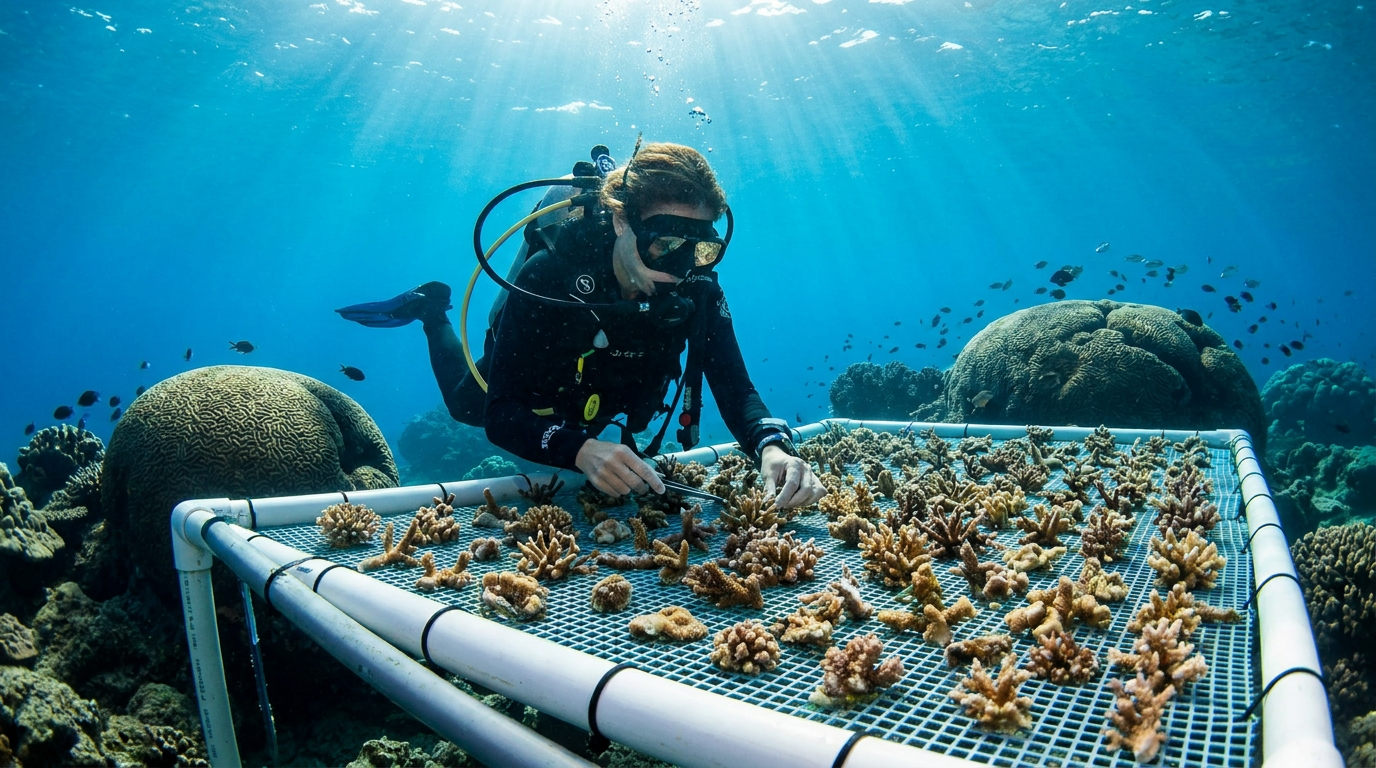
To tilt the odds, scientists pioneered a technique known as Coral IVF, or larval seeding. During the annual spawning, researchers and local tourism operators work through the night to capture the delicate spawn bundles in fine mesh nets.[3]
These bundles are transferred into specially designed floating nursery pools. By facilitating fertilization in a controlled, predator-free environment, the technique increases successful fertilization rates by a factor of 100.[3]
The microscopic coral larvae remain in these protective pools for about a week until they are mature enough to settle. They are then strategically released over degraded sections of the reef. This intervention dramatically improves their survival chances, raising the odds from one in a million to roughly one in ten thousand.[3]
The long-term viability of Coral IVF is already becoming evident. Coral populations conceived during early trials at Heron Island have not only survived recent severe bleaching events but have grown to maturity and begun spawning themselves, completing the reproductive cycle and proving that laboratory-assisted corals can thrive in the wild.[6]
But simply planting more coral is not enough if ocean temperatures continue to rise. To ensure the new reefs can withstand future heatwaves, scientists are turning to "assisted evolution"—a process of identifying and breeding naturally heat-tolerant corals.[7]
But simply planting more coral is not enough if ocean temperatures continue to rise.
Researchers have discovered that certain coral species, such as the tabular coral Acropora spathulata, exhibit remarkable variations in heat tolerance. Even within the same reef, some colonies can retain up to 95 percent of their symbiotic algae—and thus their color and primary food source—when exposed to extreme heat, while neighboring colonies bleach entirely.[4]

By mapping these resilient "super-corals" across the Great Barrier Reef, scientists can selectively cross-breed them. The goal is to accelerate natural evolutionary processes, producing offspring equipped with the genetic traits necessary to survive in a warming ocean.[4][7]
While the biological science has advanced rapidly, the logistical bottleneck has always been deployment. Historically, planting baby corals was a painstakingly slow, manual process requiring scuba divers to attach individual fragments to the reef structure by hand.[5]
To solve this constraint, the Great Barrier Reef Foundation forged an unlikely partnership with McLaren Racing. Applying the high-performance engineering mindset of Formula 1 to marine conservation, the collaboration yielded "Machine One," affectionately known as OSCAR (Operational System for Coral Assembly and Restoration).[1]
Unveiled in early 2026, Machine One is a semi-automated coral-seeding system that revolutionizes the speed of deployment. The machine completes the assembly of coral cradles in just ten seconds—a process that previously took up to 90 seconds.[1]
Early modeling suggests this technology can assemble up to 100,000 coral seeding devices per week. This leap in efficiency means that annual coral planting efforts could scale from 100,000 to one million corals per year, drastically reducing costs and matching the urgency the crisis demands.[1]

Complementing this automation are new "larval seedboxes" developed by Australia's national science agency, CSIRO. Acting as underwater delivery systems, these seedboxes delay the dispersal of larvae, giving them more time to establish themselves in targeted zones.[2]
Large-scale trials of the seedboxes at Lizard Island demonstrated coral settlement rates up to 56 times higher than previous methods. By deploying these boxes across thousands of square meters, researchers can seed new coral growth at unprecedented densities.[2]
The stakes for these interventions extend far beyond ecological preservation. A recent economic valuation commissioned by the Great Barrier Reef Foundation estimates the reef's worth to the Australian economy at $95 billion. It underpins tens of thousands of jobs and sustains the cultural heritage of saltwater First Nations peoples.[1][5]

Despite these monumental leaps in restoration technology, scientists remain clear-eyed about the ultimate solution. Coral IVF, assisted evolution, and automated seeding are vital treatments that buy the reef time, but they cannot replace the urgent need for global reductions in greenhouse gas emissions.[5][7]
"We are supporting natural recovery, but we're just giving Mother Nature a helping hand," noted Theresa Fyffe of the Great Barrier Reef Foundation. If paired with decisive climate action, these breakthroughs offer a genuine lifeline, ensuring that the world's most biodiverse marine ecosystem endures for generations to come.[5]
How we got here
Early 1980s
The concept of coral larval reseeding is first proposed by marine biologists.
2016
The first successful small-scale Coral IVF trial is conducted at Heron Island.
December 2020
Researchers confirm that corals from the 2016 trial survived severe bleaching and reached reproductive maturity.
November 2024
Coral IVF is scaled up significantly, with local tourism operators joining the mass spawning capture effort.
November 2025
CSIRO deploys 'larval seedboxes,' boosting coral settlement rates by 56 times.
March 2026
Machine One, developed with McLaren Racing, is unveiled to automate coral seeding and increase output by 800%.
Viewpoints in depth
Marine Scientists & Technologists
Scaling active interventions to rebuild reef ecosystems.
For decades, marine biology focused on observing and documenting the decline of coral reefs. Today, the field has aggressively pivoted toward active intervention. Scientists argue that the reef can no longer recover on its own due to the frequency of marine heatwaves. By applying industrial scaling techniques—such as automated seeding machines and mass aquaculture—they believe we can sustain the ecosystem's core functions while the world transitions away from fossil fuels.
Coastal Communities & Tourism
Protecting the economic and cultural lifeline of the reef.
For the communities along the Queensland coast, the Great Barrier Reef is not just an ecological wonder; it is the foundation of their livelihood. Tourism operators have transitioned from passive observers to active participants in restoration, volunteering their vessels and labor during mass spawning events. For these stakeholders, scaling Coral IVF is a matter of economic survival, protecting a $95 billion natural asset that supports tens of thousands of regional jobs.
Climate Realists
Restoration is a stopgap, not a cure for ocean warming.
While celebrating the breakthroughs in assisted evolution and automated seeding, climate researchers maintain a stark caveat: technology cannot outpace a boiling ocean. They emphasize that creating heat-tolerant corals only buys the reef a few extra decades. If global greenhouse gas emissions are not drastically reduced to stabilize ocean temperatures, even the most resilient, lab-grown super-corals will eventually succumb to the heat.
What we don't know
- Whether the laboratory-bred heat tolerance of these corals will persist across multiple generations in the wild.
- How the broader marine food web will adapt if only a select few heat-tolerant coral species dominate the restored reef.
Key terms
- Coral IVF
- A restoration technique that captures coral eggs and sperm during mass spawning to fertilize and rear them in protected nursery pools.
- Assisted Evolution
- Human interventions, such as selective breeding, designed to accelerate a species' natural adaptation to environmental stress.
- Mass Spawning
- An annual synchronized event where corals release trillions of eggs and sperm into the water column to reproduce.
- Coral Bleaching
- A stress response where corals expel the symbiotic algae living in their tissues, turning them white and leaving them vulnerable to starvation.
- Larval Seedbox
- An underwater delivery device that acts as a nursery, delaying the dispersal of coral larvae so they can settle more effectively on targeted reefs.
- Symbiotic Algae
- Microscopic plants living inside coral tissues that provide the coral with its color and primary source of food through photosynthesis.
Frequently asked
What is Coral IVF?
Coral IVF is a restoration technique where coral spawn is captured and fertilized in floating nursery pools to dramatically increase survival rates before being released back onto the reef.
How does assisted evolution help corals?
It involves identifying naturally heat-tolerant corals and selectively cross-breeding them to produce offspring that are genetically equipped to survive in warmer ocean temperatures.
What is Machine One?
Machine One is a semi-automated coral-seeding system developed with McLaren Racing that speeds up the assembly of coral cradles, allowing up to one million corals to be planted annually.
Can technology alone save the Great Barrier Reef?
No. While these interventions buy crucial time and rebuild degraded areas, scientists stress that global greenhouse gas emissions must be reduced to stop ocean warming.
Sources
Source coverage
8 outlets
3 viewpoints surfaced







[1]Great Barrier Reef FoundationMarine Scientists & Technologists
McLaren Racing and the Great Barrier Reef Foundation move revolutionary coral restoration technology into the field
Read on Great Barrier Reef Foundation →[2]Oceanographic MagazineMarine Scientists & Technologists
Millions of coral larvae get second chance on Great Barrier Reef
Read on Oceanographic Magazine →[3]The New DailyCoastal Communities & Tourism
Coral IVF gives big boost to Great Barrier Reef
Read on The New Daily →[4]Royal Society PublishingClimate Realists
Environmental drivers of acute heat tolerance of Acropora spathulata on the Great Barrier Reef
Read on Royal Society Publishing →[5]Good Good GoodClimate Realists
A new lifeline for the world's coral reefs
Read on Good Good Good →[6]World Economic ForumClimate Realists
A coral population conceived using 'coral IVF' has just survived their first bleaching events
Read on World Economic Forum →[7]Australian Institute of Marine ScienceMarine Scientists & Technologists
Breeding temperature tolerant corals for reef restoration and adaptation
Read on Australian Institute of Marine Science →[8]Factlen Editorial TeamMarine Scientists & Technologists
Synthesis by Factlen editorial team
Read on Factlen Editorial Team →
Every angle. Every day.
Get world stories with full source coverage and perspective breakdowns delivered to your inbox.