
Smart Ring vs. Smartwatch: Which Wearable Actually Wins for Sleep and Health Tracking?
As smart rings challenge the dominance of the smartwatch, the choice between finger and wrist comes down to passive recovery versus active fitness.
By Factlen Editorial Team
- Sleep & Recovery Optimizers
- Argue that nighttime comfort and passive HRV tracking are the most critical metrics for long-term health.
- Active Fitness Enthusiasts
- Value real-time data, GPS, and workout pacing, arguing that screenless devices fail during actual exercise.
- Digital Minimalists
- Prefer rings because they eliminate screen fatigue, buzzing notifications, and the aesthetic bulk of a smartwatch.
What's not represented
- · Medical professionals evaluating clinical-grade ECG features
- · Budget-conscious consumers priced out of premium wearables
Why this matters
Wearables are a major investment in personal health, often costing upwards of $300. Choosing the wrong form factor means you either stop wearing it because it is uncomfortable at night, or miss out on real-time workout data when you need it most.
Key points
- Smart rings offer superior comfort and sensor accuracy for overnight sleep tracking.
- Smartwatches remain essential for real-time workout metrics, GPS, and pacing.
- Rings boast multi-day battery life, eliminating the daily charging gaps of smartwatches.
- Many premium smart rings require monthly subscriptions, increasing long-term costs.
- Using both devices—a watch by day and a ring by night—is becoming a popular compromise.
The era of the smartwatch monopoly is officially over. For years, consumers looking to track their health metrics had little choice but to strap a miniature smartphone to their wrist, accepting the bulk and the constant barrage of notifications. But in 2026, smart rings like the Oura Ring 4, Samsung Galaxy Ring, and RingConn Gen 2 have moved from niche gadgets to mainstream health tools. By packing advanced biometric sensors into a discreet piece of jewelry, they are directly challenging the long-standing dominance of wrist-worn giants like the Apple Watch and Garmin.[2][6]
The decision between a ring and a watch is no longer just a matter of aesthetics or personal style; it represents a fundamental philosophical divide in how we interact with our personal health data. Smartwatches are designed as active companions that command your attention with real-time alerts, vibrating alarms, and glowing screens. Smart rings, on the other hand, are built to be passive observers. They sit quietly on your finger, collecting biometric data around the clock without ever interrupting your day, sending everything to your smartphone for later review.[7][8]
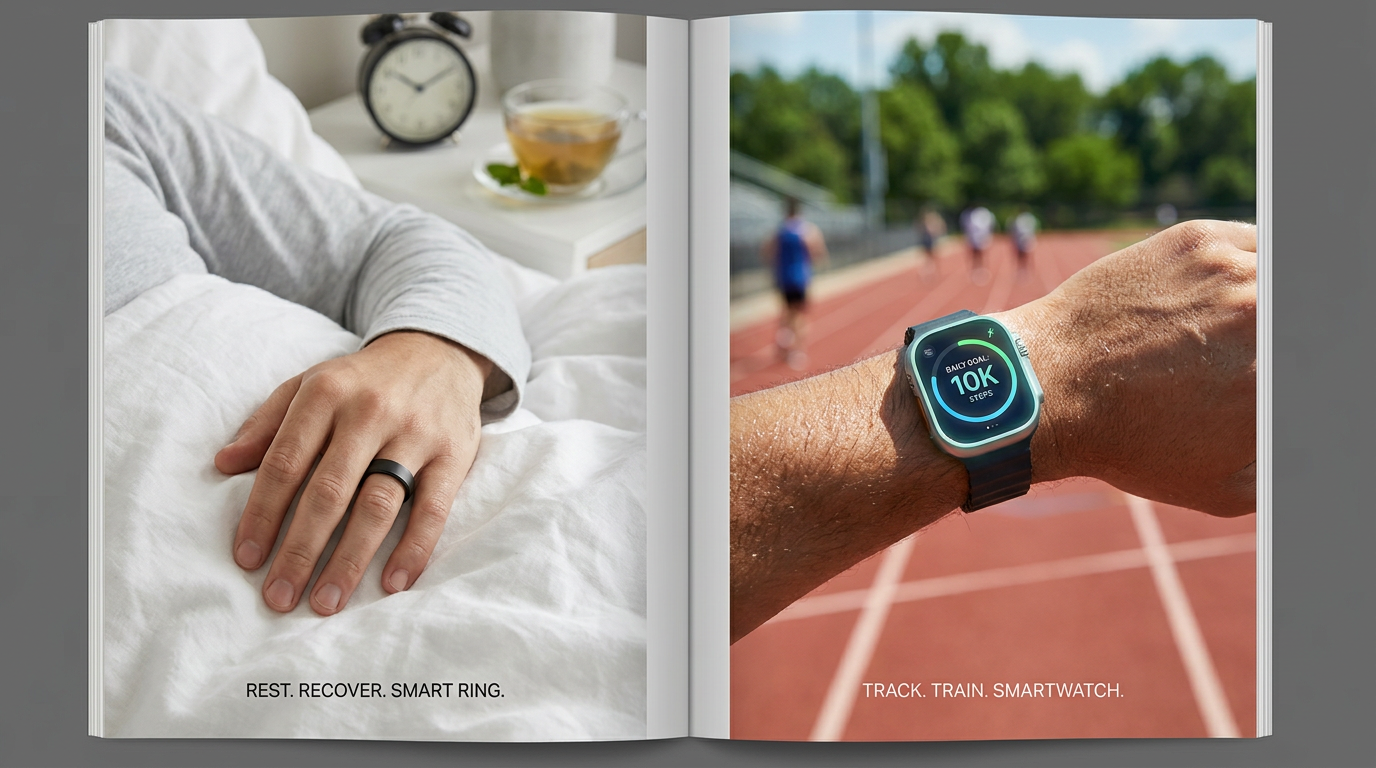
The most significant battleground between the two form factors is sleep tracking, and here, the smart ring has a distinct and undeniable structural advantage. Weighing between four and eight grams, premium rings are virtually unnoticeable at night. This eliminates the physical bulk and the glowing screens that make smartwatches notoriously disruptive to a good night's rest. Consistent nighttime wear is the foundation of accurate sleep tracking, and compliance rates are significantly higher for rings simply because users forget they are even wearing them.[2][7]
Beyond pure comfort, rings actually capture cleaner and more reliable biometric data while you are asleep. The digital arteries located in the finger are closer to the skin's surface and feature a much denser capillary network than the wrist. This anatomical advantage allows the photoplethysmography sensors in devices like the Oura Ring 4 to capture a stronger, clearer pulse signal. Because the finger moves less than the wrist during sleep, the sensors suffer from far less motion artifact, resulting in highly accurate heart rate variability readings.[7][8]

Clinical validations in 2026 have consistently shown that finger-based sensors achieve up to 79 percent accuracy in four-stage sleep classification, frequently outperforming their wrist-worn counterparts. The Samsung Galaxy Ring even leverages its highly sensitive skin temperature sensors to predict impending illnesses and track overall physical recovery. By focusing purely on data collection rather than data display, these rings provide medical-adjacent insights without the user ever needing to interact with a screen or navigate a complex menu system before bed.[6][7]
However, the moment you step out of bed, lace up your sneakers, and head into the gym, the smartwatch aggressively reclaims its crown. For active fitness tracking and intense physical exertion, devices like the Apple Watch Series 11 and the Garmin Forerunner remain entirely untouchable. While rings are excellent at measuring how well you recovered from yesterday's workout, watches are purpose-built to guide you through today's session with precision and immediate feedback. The sheer processing power and physical interface of a watch make it an indispensable tool for anyone serious about athletic performance.[1][5]
Smartwatches provide the real-time feedback—such as live heart rate zones, pacing metrics, and GPS routing—that a screenless ring simply cannot offer by design. If you are running a marathon, cycling through a new neighborhood, or pushing through a grueling interval training session, a quick glance at your wrist is an essential part of the workout experience. You cannot pull out your smartphone to check your heart rate while sprinting, making the watch's glowing display a critical feature for active athletes.[3][5]
Smartwatches provide the real-time feedback—such as live heart rate zones, pacing metrics, and GPS routing—that a screenless ring simply cannot offer by design.
Smart rings also face severe physical limitations during certain types of exercise, particularly in the weight room. Gripping a heavy barbell, dumbbell, or pull-up bar presses the rigid metal ring directly into the soft tissue of the finger. This is not only physically uncomfortable, but it actively disrupts the sensor's contact with the skin, leading to dropped heart rate data and inaccurate calorie counts during strength training. Many fitness enthusiasts find themselves having to remove their smart ring entirely during gym sessions to avoid scratching the titanium finish or bruising their fingers, completely defeating the purpose of a 24/7 fitness tracker.[5][8]

Battery life serves as another major dividing line in the wearable debate, fundamentally altering how users interact with their devices. Feature-rich smartwatches like the Apple Watch consume massive amounts of power to run their bright displays and constant background apps, requiring daily charging. This creates inevitable data gaps in your health profile. Users often have to make a frustrating choice: charge the watch overnight and lose out on sleep tracking, or charge it during the day and miss out on step counts and daytime calorie burn.[1][3]
In stark contrast, premium smart rings boast multi-day endurance that completely eliminates charger anxiety. The Oura Ring 4 and the Samsung Galaxy Ring reliably last between five and eight days on a single charge, while the highly efficient RingConn Gen 2 stretches past ten days. This extended battery life allows for true, uninterrupted 24/7 baseline monitoring. You can wear the ring through a long weekend trip or a busy work week without ever needing to pack a proprietary charging cable.[2][4]
The hidden costs of ownership also diverge sharply between the two wearable categories, catching many first-time buyers off guard. While smartwatches generally require a higher upfront hardware investment—often ranging from $300 to $800—they rarely charge you to access your own data. Smart rings, however, have historically relied on recurring subscription models to subsidize their lower entry prices. Oura, for example, charges $5.99 per month to unlock its deep sleep insights and readiness scores, adding roughly $70 a year to the total cost of ownership.[3][4]

Fortunately for consumers, the market is rapidly shifting away from mandatory subscriptions. Samsung's entry into the space with the Galaxy Ring, alongside aggressive alternatives like the Ultrahuman Ring AIR and RingConn, has introduced powerful subscription-free models in 2026. This forces buyers to carefully weigh their options: pay a higher upfront hardware cost for a subscription-free device, or accept a lower initial price tag tied to a lifetime of monthly software fees. Over a three-year lifespan, a cheaper subscription ring can easily become the most expensive wearable you own.[4][6]
Ultimately, the choice between these two powerful form factors comes down to identifying your primary health goal. The smart ring fits perfectly when your focus is on sleep optimization, long-term recovery trends, and discreet, distraction-free monitoring. It is the ultimate tool for the digital minimalist who wants comprehensive health data without the digital noise of text messages, emails, and vibrating move alerts interrupting their day. If you want to wear traditional mechanical watches while still tracking your health, the ring is the only logical choice.[1][8]
Conversely, the smart ring does not fit well when you need real-time workout metrics, built-in GPS tracking, or the convenience of smartphone notifications on your wrist. For serious athletes, runners, and those who want an interactive digital assistant to help manage their busy lives, the smartwatch remains the undisputed champion. A ring simply cannot tell you your mile pace or let you skip a song on your playlist while your phone is tucked away in a gym bag. The watch is a tool for action, while the ring is a tool for reflection.[3][5]
For a growing number of health enthusiasts in 2026, the answer to the ring versus watch debate is not choosing one or the other, but embracing both. Wearing a feature-rich smartwatch during the day for active fitness tracking and swapping to a sleek, comfortable smart ring at night for sleep analysis provides the most comprehensive, uninterrupted health data possible. As the ecosystems begin to sync more seamlessly, this dual-device approach represents the ultimate, albeit expensive, setup for personal health optimization.[1][7]
How we got here
2015
Oura launches its first-generation smart ring, introducing the concept of finger-based sleep tracking to early adopters.
2020
The Apple Watch Series 6 introduces blood oxygen monitoring, cementing the smartwatch as a comprehensive health tool.
2024
The smart ring market explodes with new entrants like Ultrahuman and RingConn challenging Oura's dominance.
2026
Samsung releases the Galaxy Ring, bringing mainstream tech giant validation to the screenless wearable category.
Viewpoints in depth
Sleep & Recovery Optimizers
Argue that nighttime comfort and passive HRV tracking are the most critical metrics for long-term health.
This camp believes that health tracking is only useful if you actually wear the device consistently. Because smartwatches are bulky and require frequent charging, users often take them off at night, missing out on crucial sleep data. Optimizers argue that the finger provides a superior physiological location for measuring resting heart rate and HRV, making the smart ring the ultimate tool for understanding long-term recovery trends without the distraction of a glowing screen.
Active Fitness Enthusiasts
Value real-time data, GPS, and workout pacing, arguing that screenless devices fail during actual exercise.
For serious athletes, a wearable must be an active participant in their training regimen. This perspective highlights the severe limitations of a screenless device during a run, a cycling session, or a high-intensity interval workout. Without real-time heart rate zones, pacing alerts, or built-in GPS, a smart ring leaves athletes flying blind. Furthermore, they point out that metal rings are actively detrimental in the weight room, making the smartwatch the only viable option for comprehensive fitness tracking.
Digital Minimalists
Prefer rings because they eliminate screen fatigue, buzzing notifications, and the aesthetic bulk of a smartwatch.
This group views the smartwatch not as a health tool, but as an invasive extension of the smartphone. Digital minimalists champion the smart ring because it passively collects vital health data without demanding attention. By removing the screen, the ring eliminates the anxiety of unread emails, text messages, and vibrating stand alerts. It allows users to stay connected to their biology while disconnecting from their digital lives, all while leaving the wrist free for traditional mechanical timepieces.
What we don't know
- Whether future smart rings will successfully integrate reliable GPS without destroying their multi-day battery life.
- How long subscription-based models can survive as tech giants release powerful fee-free alternatives.
Key terms
- Photoplethysmography (PPG)
- An optical sensor technology that uses light to measure changes in blood volume at the skin's surface, commonly used to track heart rate.
- Heart Rate Variability (HRV)
- The measure of the time variation between consecutive heartbeats, used as a key indicator of physical recovery and stress levels.
- Sleep Staging
- The process of categorizing sleep into distinct phases, such as light, deep, and REM sleep, to evaluate overall rest quality.
- Readiness Score
- A proprietary metric used by wearables to quantify how well the body has recovered, based on sleep, HRV, and previous activity levels.
Frequently asked
Can a smart ring track my runs via GPS?
No, smart rings lack built-in GPS and screens, meaning you must carry your smartphone with you if you want to track route and pace data.
Do all smart rings require a monthly subscription?
No. While the market leader Oura requires a $5.99 monthly fee, competitors like the Samsung Galaxy Ring and RingConn are entirely subscription-free.
Are smart rings comfortable to wear while lifting weights?
Generally, no. Gripping heavy barbells or dumbbells presses the rigid metal ring into your finger, which can be uncomfortable and disrupt the sensor's heart rate readings.
Which device is more accurate for heart rate tracking?
Smart rings are highly accurate for resting heart rate and overnight HRV due to finger blood flow, but smartwatches are far superior for tracking active heart rate during intense exercise.
Sources
Source coverage
8 outlets
3 viewpoints surfaced








[1]CNETActive Fitness Enthusiasts
The Apple Watch vs. Oura Ring Debate Comes Down to One Feature
Read on CNET →[2]PCMagDigital Minimalists
The Best Smart Rings for 2026
Read on PCMag →[3]ForbesActive Fitness Enthusiasts
Oura Ring Vs. Apple Watch: Which Wearable Is Right For You?
Read on Forbes →[4]WareableDigital Minimalists
Best smart rings 2026: Top picks for sleep and health tracking
Read on Wareable →[5]Runner's WorldActive Fitness Enthusiasts
I trained for an ultra with the Samsung Galaxy Ring — here's why I'm still reaching for my Garmin
Read on Runner's World →[6]TechRadarDigital Minimalists
Samsung Galaxy Ring review: The best premium smart ring
Read on TechRadar →[7]AskVoraSleep & Recovery Optimizers
Smart Ring vs Smartwatch: The Honest 2026 Comparison
Read on AskVora →[8]Smart Ring HQSleep & Recovery Optimizers
Smart Ring vs Smartwatch: The Honest 2026 Comparison
Read on Smart Ring HQ →



Every angle. Every day.
Get shopping stories with full source coverage and perspective breakdowns delivered to your inbox.