
How Local LLMs Are Turning Everyday Laptops Into Private AI Powerhouses
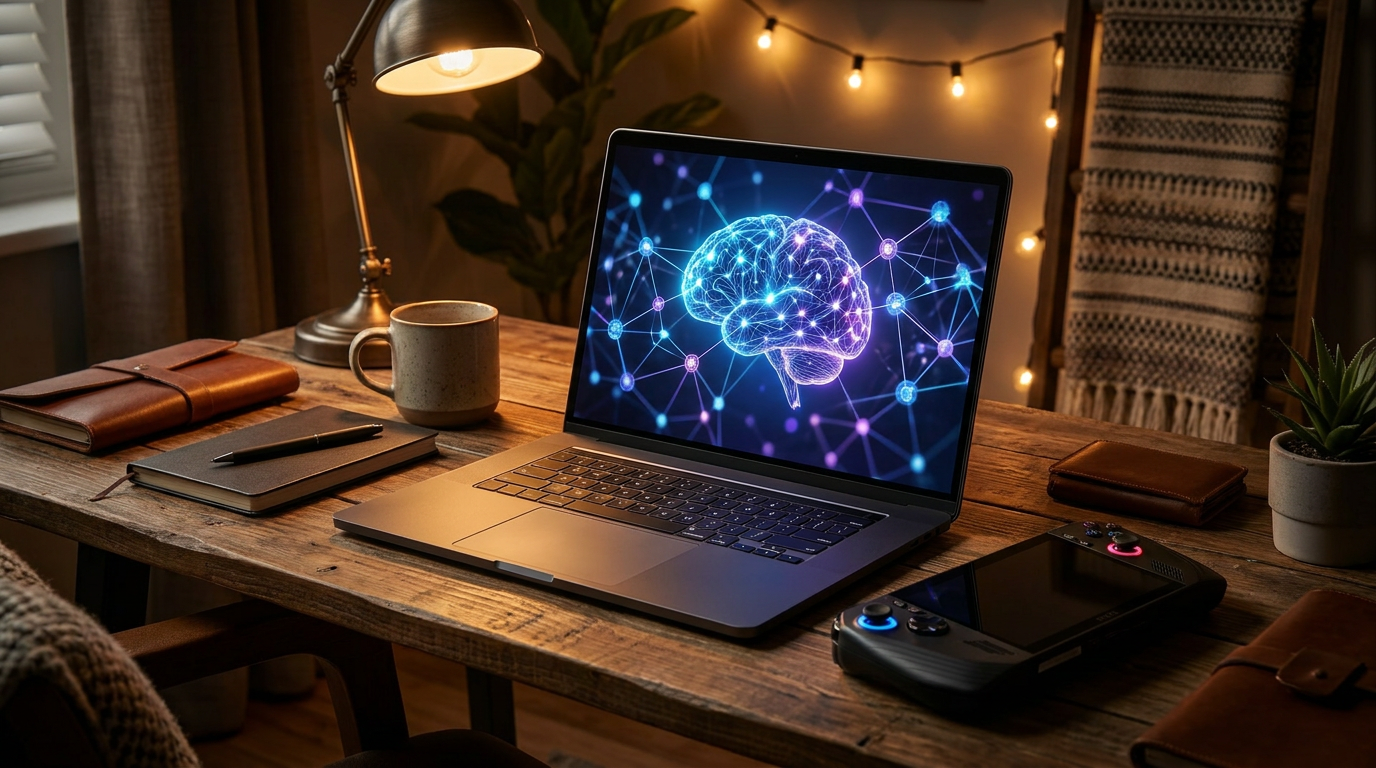
Driven by privacy concerns and subscription fatigue, millions of users are downloading powerful AI models directly to their laptops. Advances in software and specialized hardware have made local, offline AI accessible to everyone.
By Factlen Editorial Team
- Privacy Advocates
- Argue that sending sensitive personal or corporate data to cloud servers is an unacceptable risk, making local AI a necessity.
- Hardware Manufacturers
- Focus on developing specialized chips like NPUs and unified memory architectures to drive a new cycle of PC upgrades.
- Open-Source Developers
- Value the democratization of AI, building tools and compressing models so anyone can tinker without relying on big tech monopolies.
- Everyday Users
- Prioritize ease of use, zero subscription costs, and simple graphical interfaces over technical customization.
What's not represented
- · Cloud Infrastructure Providers
- · Regulatory Bodies
Why this matters
Running AI locally allows users to process sensitive personal or professional data with zero risk of leaks, while eliminating monthly subscription fees. It represents a fundamental shift in computing, moving artificial intelligence from distant data centers directly into the hands of the user.
Key points
- Millions of users are shifting from cloud-based AI subscriptions to running models locally on their own laptops.
- Local AI guarantees complete data privacy and eliminates monthly subscription fees, driving a massive increase in enterprise adoption.
- Software tools like LM Studio and Ollama have made downloading and running AI models as easy as installing a standard app.
- Modern hardware, including Apple Silicon's unified memory and Windows Copilot+ NPUs, enables laptops to run these models efficiently.
The artificial intelligence revolution started in massive, billion-dollar data centers. Now, it is moving to the backpack. For the past several years, accessing a highly capable AI meant paying a monthly fee and sending every prompt, document, and question to a remote server. In 2026, a quiet rebellion is reshaping the industry: millions of users are severing their reliance on cloud-based subscriptions and downloading "local LLMs" directly to their everyday laptops.[7]
The primary driver behind this migration is data sovereignty. When a user types a prompt into a cloud service, that information leaves their machine. For healthcare workers handling patient records, lawyers reviewing contracts, or individuals processing personal finances, this transmission is often a non-starter. Local AI models run entirely on the user's hardware, meaning the data never touches the internet, offering a mathematically guaranteed level of privacy.[4][5]
The secondary driver is subscription fatigue. Cloud AI services typically cost roughly $20 a month, which accumulates quickly for independent professionals and small businesses. Local AI, by contrast, is entirely free once the initial hardware investment is made. Users can query the model thousands of times a day without hitting rate limits or incurring additional API costs.[4][6]
This shift is not limited to hobbyists; the enterprise sector is leading the charge. Industry data reveals that 55% of enterprise AI inference now happens on-premises, representing a massive leap from just 12% in 2023. Companies are realizing that for routine tasks like document summarization and data classification, local models offer the perfect blend of security and cost-efficiency.[4]

A few years ago, running a local model required deep technical knowledge, command-line interfaces, and complex software dependencies. Today, the user experience has been entirely transformed. Software applications like LM Studio act as a "Spotify for AI," allowing users to browse, download, and chat with various models through a simple, intuitive graphical interface.[4][6]
For developers and power users, tools like Ollama have become the industry standard. With a single line of code, programmers can spin up a local AI environment that perfectly mimics cloud APIs. This allows developers to build, test, and deploy AI-integrated applications securely offline, without worrying about cloud latency or unexpected billing spikes.[4][6]
This software revolution is powered by the rapid evolution of Small Language Models (SLMs). Tech giants and open-source communities have realized that bigger is not always better. They have released highly capable, compact models—such as Meta's Llama 3.3, Google's Gemma 4, and Alibaba's Qwen series—that are specifically optimized to run on consumer hardware.[4][6]
This software revolution is powered by the rapid evolution of Small Language Models (SLMs).
To fit these sophisticated models onto a standard laptop, engineers rely on a mathematical compression technique called quantization. This process shrinks the model's neural weights, reducing a massive file that would normally require a server farm into a manageable four to eight gigabytes. Remarkably, this compression preserves the vast majority of the model's intelligence and reasoning capabilities.[4][5]

Hardware manufacturers have aggressively adapted to support this new workload. Apple Silicon, spanning the M1 through M4 chips, accidentally created the perfect local AI machines. Their "unified memory" architecture allows the laptop's graphics processor to access the entire pool of system RAM, easily accommodating these compressed models without the need for expensive, specialized graphics cards.[5][7]
The Windows ecosystem has responded with a new category of hardware known as "Copilot+ PCs." These laptops feature a dedicated Neural Processing Unit (NPU), a specialized chip designed specifically for machine learning workloads. To meet the industry standard, these NPUs must be capable of at least 40 Trillion Operations Per Second (TOPS), ensuring they can run AI tasks efficiently.[2][3]
The inclusion of an NPU is critical for battery life. While a traditional CPU or GPU can run an AI model, doing so consumes massive amounts of power and generates significant heat. An NPU handles the repetitive math of AI inference with extreme thermal efficiency, allowing users to run local models on an airplane or in a coffee shop without immediately draining their battery.[2][3]

Apple is formalizing this local-first philosophy with its "Apple Intelligence" suite. The system is designed to process everyday requests entirely on-device, ensuring maximum privacy. If a user requests a highly complex task that exceeds the laptop's capabilities, the system routes it to "Private Cloud Compute"—a secure, stateless server that immediately deletes the data after processing, bridging the gap between local privacy and cloud power.[1][7]
Despite these massive advancements, local AI is not without its limitations. Running a heavy model on a laptop, even one equipped with an NPU, will eventually spin up the fans and consume more power than standard web browsing or word processing. Users must balance the size of the model they choose with the thermal limits of their specific machine.[5]
Furthermore, while local models excel at drafting emails, summarizing long documents, and assisting with basic coding, they cannot yet match the deep, multi-step reasoning capabilities of massive, cloud-based frontier models. For highly complex logic puzzles or advanced software architecture, the data center still reigns supreme.[4]

The trajectory of the industry, however, is unmistakable. As NPUs become a standard component in every new computer and open-source models grow increasingly efficient, the barrier to entry continues to fall. The default home for everyday artificial intelligence is steadily shifting from the distant cloud directly into the personal computer, permanently altering how society interacts with machine intelligence.[3][7]
How we got here
2023
Cloud AI dominates the landscape; local inference accounts for only 12% of enterprise workloads.
Mid-2024
Apple Silicon's unified memory proves that consumer laptops can efficiently handle small AI models.
2025
Microsoft launches Copilot+ PCs featuring dedicated NPUs, while open-source models shrink in size.
June 2026
Tools like LM Studio and Ollama make one-click local AI accessible to non-programmers.
Viewpoints in depth
Privacy Advocates
Argue that sending sensitive data to the cloud is an unacceptable risk.
For professionals in healthcare, law, and finance, data sovereignty is non-negotiable. Privacy advocates argue that the terms of service for cloud-based AI providers often leave loopholes for data harvesting or accidental exposure. By running models locally, users ensure that their prompts and proprietary documents never leave their physical device, providing a mathematically guaranteed level of security that cloud providers cannot match.
Hardware Manufacturers
Focus on developing specialized chips to drive a new cycle of PC upgrades.
Companies like Apple, Microsoft, and Qualcomm view local AI as the catalyst for the next major hardware supercycle. By integrating Neural Processing Units (NPUs) and unified memory architectures into their devices, they are positioning the modern laptop not just as a portal to the internet, but as a self-contained intelligence engine. Their goal is to make 40+ TOPS NPUs the baseline standard for all future computing.
Open-Source Developers
Value the democratization of AI and the freedom to tinker without reliance on big tech.
The open-source community sees local AI as a bulwark against the monopolization of intelligence by a few massive corporations. Developers are constantly refining quantization techniques to squeeze more performance out of smaller models. Through platforms like Hugging Face and tools like Ollama, they are building an ecosystem where anyone can download, modify, and run uncensored AI models for free, ensuring that the future of AI remains decentralized.
What we don't know
- Whether local hardware advancements can outpace the growing size of next-generation frontier models.
- How cloud providers will adjust their pricing models as more users migrate to free local alternatives.
Key terms
- NPU (Neural Processing Unit)
- A specialized computer chip designed specifically to run AI tasks efficiently without draining the battery.
- Quantization
- A compression technique that shrinks large AI models so they can fit into a standard laptop's memory.
- SLM (Small Language Model)
- A compact version of an AI model optimized for personal devices rather than massive data centers.
- Unified Memory
- An architecture where the CPU and GPU share the same pool of RAM, making it highly efficient for running AI models.
- GGUF
- A popular file format used to store compressed AI models so they can be easily downloaded and run on everyday computers.
Frequently asked
Do I need internet to use a local LLM?
No. Once the model and software are downloaded, the AI runs entirely offline using your device's own hardware.
Will running AI locally drain my laptop battery?
Yes, processing AI models requires significant power. However, newer laptops with dedicated NPUs handle this much more efficiently than older models.
Is local AI as smart as cloud-based ChatGPT?
For everyday tasks like drafting emails or summarizing text, local models are highly capable. For highly complex reasoning, massive cloud models still hold an edge.
Can I run local AI on an older computer?
It is possible, but performance will be slow. A modern machine with at least 8GB of RAM (ideally 16GB) and a dedicated GPU or NPU is recommended for a smooth experience.
Sources
Source coverage
7 outlets
4 viewpoints surfaced







[1]AppleHardware Manufacturers
Apple Intelligence and Privacy on iPhone
Read on Apple →[2]MicrosoftHardware Manufacturers
Copilot+ PCs Developer Guidance
Read on Microsoft →[3]HPHardware Manufacturers
Key Components of the AI PC Ecosystem
Read on HP →[4]TechsyPrivacy Advocates
Run LLMs Locally 2026: The 5-Minute Setup for Any GPU
Read on Techsy →[5]Prompt QuorumPrivacy Advocates
Running a Local LLM on a Laptop in 2026
Read on Prompt Quorum →[6]PinggyOpen-Source Developers
Best Local LLMs and Tools in 2026
Read on Pinggy →[7]Factlen Editorial TeamEveryday Users
Synthesis by Factlen editorial team
Read on Factlen Editorial Team →

More in ai
See all 8 stories →Oculomics
How AI Retinal Scans Are Predicting Heart Disease and Dementia
7 sources
Edge AI
The Era of Local AI: How Small Language Models Are Putting Power Back on Your Device
7 sources
On-Device AI
The Era of Local AI: How Small Language Models Are Putting Private Intelligence on Your Phone
7 sources
Scientific Discovery
Self-Driving Labs: How AI and Robotics are Automating Scientific Discovery
8 sources
Every angle. Every day.
Get ai stories with full source coverage and perspective breakdowns delivered to your inbox.