
Complex Life on Earth Could Survive 500 Million Years Longer Than Previously Expected
Advanced 3D climate models reveal that Earth's biosphere could persist for up to 1.87 billion years, significantly extending the known habitable window for complex life. The findings also expand the theoretical habitable zones for exoplanets across the universe.
By Factlen Editorial Team
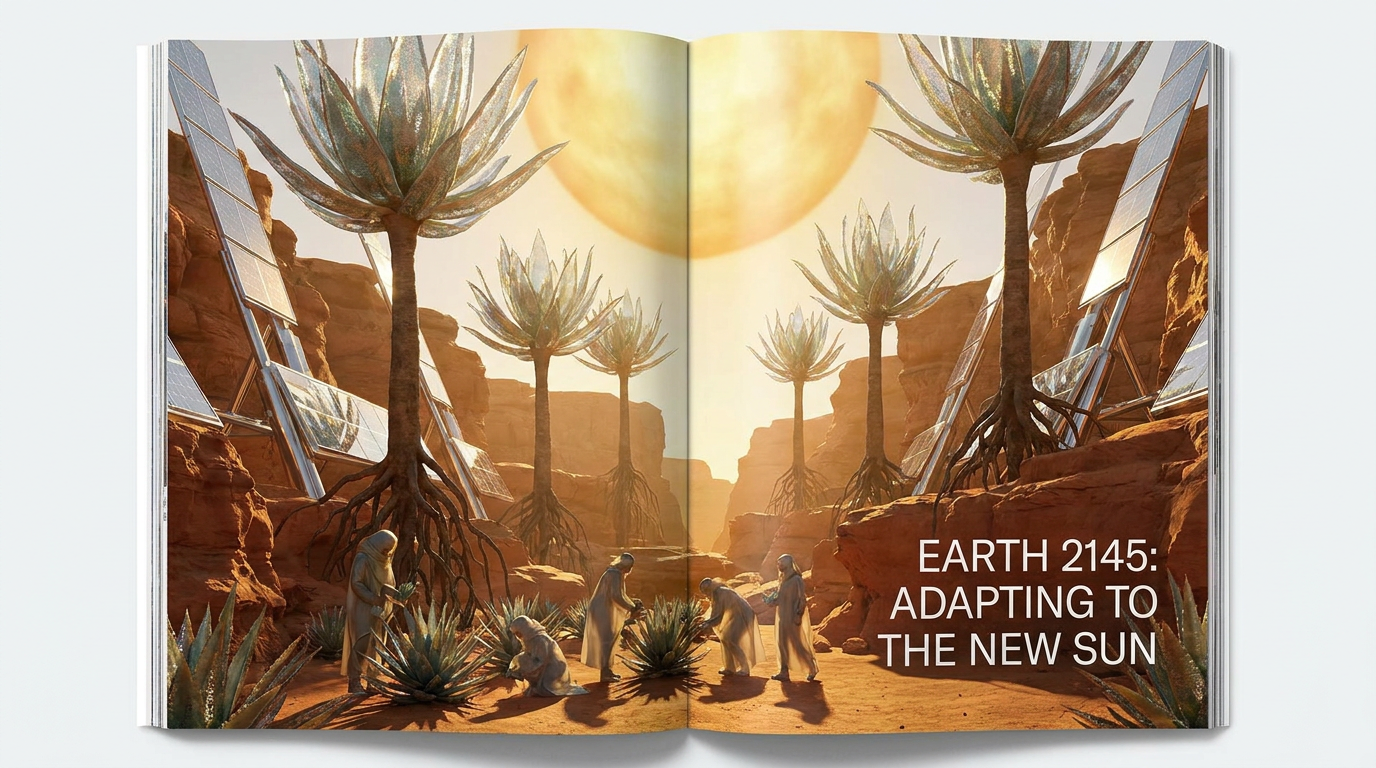
- Planetary Climate Modelers
- Focus on the intricate 3D modeling of Earth's carbon-silicate cycle and the specific thermal and chemical limits of the biosphere.
- Astrobiologists & Exoplanet Hunters
- View the extended timeline as a crucial variable in calculating the probability of complex life existing on other planets.
- Deep-Time Geologists
- Emphasize the historical baseline of Earth's evolution and the inevitable, long-term consequences of stellar aging.
What's not represented
- · Evolutionary Biologists
Why this matters
Understanding the ultimate limits of Earth's habitability doesn't just tell us about our planet's deep future—it fundamentally changes the math for finding complex, intelligent life elsewhere in the universe. A longer habitable window means evolutionary 'hard steps' have more time to occur on Earth-like exoplanets.
Key points
- Advanced 3D climate models suggest Earth's biosphere could survive for 1.35 to 1.87 billion years, up to 800 million years longer than previous estimates.
- The primary threat to future plant life is a drop in carbon dioxide levels caused by increased rock weathering as the Sun brightens.
- Certain highly adaptable plants utilizing Crassulacean Acid Metabolism (CAM) could potentially survive in extreme, low-CO2 environments.
- The extended timeline implies that the evolutionary 'hard steps' to intelligent life have a wider window, boosting the odds of finding complex life on exoplanets.
The ultimate deadline for life on Earth has always been tied to the Sun. As our star ages, it fuses hydrogen into helium, causing its core to shrink and heat up, which in turn increases its overall luminosity by roughly 1 percent every 100 million years.[5][6]
For decades, the scientific consensus held a somewhat pessimistic view of Earth's remaining habitable window. Previous one-dimensional climate models suggested that complex, multicellular life had roughly one billion years left before the steadily brightening Sun rendered the planet unlivable.[5][6]
The presumed cause of death in these older models wasn't just extreme heat, but starvation. As the Sun warms the planet, a geological thermostat called the carbonate-silicate cycle kicks into overdrive to compensate.[3][5]
This weathering process pulls carbon dioxide out of the atmosphere, dissolving it in rainwater and eventually locking it into carbonate rocks on the ocean floor. Eventually, CO2 levels would drop so low that photosynthesis would become impossible, collapsing the global food web from the bottom up.[3][5]

However, a new wave of research utilizing advanced three-dimensional climate models has dramatically rewritten this timeline, revealing a much more resilient planet.[1][3]
According to a recent study published in The Planetary Science Journal and highlighted by New Scientist, the biosphere's expiration date has been pushed back significantly.[1][3]
The new calculations indicate that terrestrial plant life could persist for another 1.35 billion to 1.87 billion years—an extension of nearly half a billion to 800 million years beyond previous estimates.[1][2]

To reach this conclusion, researchers modeled two extreme limiting scenarios to understand how the Earth system will respond to a steadily brightening Sun over deep time.[2][3]
In the "strong weathering" scenario, the planet's surface temperature remains relatively stable because the carbonate-silicate cycle efficiently draws down CO2 to offset the increasing solar radiation.[3]
Even in this severely CO2-starved environment, the researchers found that certain plants might survive much longer than anticipated. While standard C3 and C4 photosynthesis might fail when CO2 drops to 10 parts per million, plants utilizing Crassulacean Acid Metabolism (CAM)—like modern succulents—could potentially persist down to just 1 ppm.[3]

Even in this severely CO2-starved environment, the researchers found that certain plants might survive much longer than anticipated.
In the alternative "weak weathering" scenario, atmospheric CO2 levels remain stable, but the surface temperature steadily climbs as the Sun brightens.[2][3]
Under these conditions, the thermal limits of biology become the primary constraint. The 3D models suggest Earth would become too hot for most land plants, exceeding 122 degrees Fahrenheit (50 degrees Celsius), around 1.68 billion years from now.[3]
By 1.87 billion years, temperatures would surpass the absolute thermal limit for all terrestrial vegetation at roughly 149 degrees Fahrenheit (65 degrees Celsius), leading to a moist greenhouse effect where the oceans begin to boil away into space.[3]
This revised timeline is not just a curiosity about Earth's distant future; it fundamentally alters the math of astrobiology and the search for extraterrestrial intelligence.[1][4]
The "hard steps" model of evolution suggests that the emergence of intelligent life requires a sequence of highly improbable evolutionary leaps, which take vast amounts of time to occur.[3]
If Earth's habitable window is nearly two billion years longer than previously thought, it implies that these evolutionary hard steps might not be as difficult or time-consuming as assumed, since life has a much wider temporal canvas to work with.[1][3]
Furthermore, these findings have direct implications for the study of exoplanets. Models like the Smaller Than Earth Habitability Model (STEHM) rely on understanding atmospheric retention and stellar evolution to identify promising worlds.[4]
If complex life can survive lower CO2 thresholds and higher temperatures than 1D models predicted, the habitable zones around other stars—particularly long-lived red dwarfs—might be wider and more forgiving than currently mapped.[4][7]

Ultimately, while the Sun will eventually expand into a red giant and consume the inner solar system in about 5 billion years, the planet's intricate biological and geological feedback loops are far more resilient than we gave them credit for.[7]
How we got here
4.5 billion years ago
Earth forms, with a faint young Sun and an atmosphere devoid of oxygen.
2.4 billion years ago
The Great Oxidation Event introduces significant oxygen into the atmosphere, paving the way for complex life.
538 million years ago
The Cambrian Explosion marks a rapid diversification of complex, multicellular life forms.
1.35 - 1.87 billion years from now
The projected end of Earth's terrestrial biosphere due to extreme heat and carbon dioxide starvation.
5 billion years from now
The Sun expands into a red giant, likely engulfing the inner solar system.
Viewpoints in depth
Planetary Climate Modelers
Focus on the intricate 3D modeling of Earth's carbon-silicate cycle and the specific thermal and chemical limits of the biosphere.
This camp emphasizes the mechanical superiority of modern three-dimensional climate models over the 1D models used in the past. By accurately simulating the interaction between the atmosphere, ocean, and Earth's surface, they argue that the planet's geological thermostat—the carbonate-silicate cycle—is far more nuanced than previously understood. Their evidence points to specific thresholds, such as the 1 ppm CO2 limit for CAM photosynthesis, demonstrating that life's chemical adaptability can stretch the biosphere's lifespan by hundreds of millions of years.
Astrobiologists & Exoplanet Hunters
View the extended timeline as a crucial variable in calculating the probability of complex life existing on other planets.
For researchers looking outward, Earth's revised timeline is a massive boon for the Drake Equation and the search for extraterrestrial intelligence. They argue that if complex life on Earth can survive up to 1.87 billion years into the future, the 'habitable zones' around other stars are effectively wider and more forgiving. This perspective suggests that the evolutionary 'hard steps' required to produce intelligent life might not be as rare or difficult as assumed, since life on rocky exoplanets likely has a much longer temporal canvas to evolve before stellar aging sterilizes the surface.
Deep-Time Geologists
Emphasize the historical baseline of Earth's evolution and the inevitable, long-term consequences of stellar aging.
While acknowledging the extended timeline, this camp maintains a focus on the inescapable physics of stellar evolution. They point out that a 1% increase in solar luminosity every 100 million years is an unstoppable force that will eventually trigger a runaway greenhouse effect. From their perspective, whether the biosphere collapses in 1 billion or 1.87 billion years is a detail; the broader narrative is that Earth is already in the latter half of its habitable lifespan, and the slow, grinding machinery of the cosmos will ultimately dictate the planet's fate.
What we don't know
- Whether evolutionary biology can outpace the slow geological changes, allowing entirely new forms of photosynthesis to emerge.
- Exactly how the complex interplay of cloud cover and ocean currents will respond to extreme solar luminosity in the deep future.
- If technological interventions by future civilizations could artificially regulate the carbon-silicate cycle to extend the biosphere's life even further.
Key terms
- Biosphere
- The regions of the surface, atmosphere, and hydrosphere of the Earth occupied by living organisms.
- Carbonate-silicate cycle
- A geological process that regulates Earth's climate over millions of years by transferring carbon between the atmosphere, oceans, and rocky crust.
- Runaway greenhouse effect
- A state where a planet's climate warms uncontrollably, eventually causing its oceans to boil away into space, as seen on Venus.
- C4 photosynthesis
- An advanced form of photosynthesis used by grasses and crops like corn that is more efficient at capturing carbon dioxide than the more common C3 pathway.
- Crassulacean Acid Metabolism (CAM)
- A carbon fixation pathway that evolved in some plants as an adaptation to arid conditions, allowing them to absorb carbon dioxide at night.
- Habitable zone
- The orbital region around a star where a planet can possess liquid water on its surface and potentially support life.
Frequently asked
Why is the Sun getting brighter over time?
As the Sun fuses hydrogen into helium, its core gradually shrinks and heats up. This causes its outer layers to expand and its overall luminosity to increase by about 1% every 100 million years.
What is the carbonate-silicate cycle?
It is a geological process where carbon dioxide from the atmosphere dissolves in rainwater to weather rocks, eventually washing into the ocean and becoming locked in the crust, acting as a long-term planetary thermostat.
How does a brighter Sun lead to CO2 starvation for plants?
Higher temperatures increase the rate of rock weathering, which pulls more CO2 out of the atmosphere. Eventually, CO2 levels drop too low for most plants to perform photosynthesis.
What is CAM photosynthesis?
Crassulacean Acid Metabolism (CAM) is a specialized form of photosynthesis used by plants like succulents and cacti. It allows them to be highly efficient with water and carbon dioxide, potentially surviving in extreme future environments.
Sources
Source coverage
7 outlets
3 viewpoints surfaced







[1]New ScientistAstrobiologists & Exoplanet Hunters
Complex life on Earth may last 500 million years longer than expected
Read on New Scientist →[2]ZaminPlanetary Climate Modelers
When Life on Earth Will End: Scientists Recalculate the Biosphere's Deadline
Read on Zamin →[3]The Planetary Science JournalPlanetary Climate Modelers
Substantial Extension of the Lifetime of the Terrestrial Biosphere
Read on The Planetary Science Journal →[4]EarthSkyAstrobiologists & Exoplanet Hunters
New model finds which small exoplanets can keep their atmospheres
Read on EarthSky →[5]ForbesDeep-Time Geologists
Life On Earth To Hit Brick Wall In Another 500 Million Years
Read on Forbes →[6]AstrobiologyAstrobiologists & Exoplanet Hunters
Habitable Lifetime of Planet Earth
Read on Astrobiology →[7]The Times of IndiaDeep-Time Geologists
Earth has just 5 billion years left: The shocking truth about our planet's lifespan
Read on The Times of India →
Every angle. Every day.
Get science stories with full source coverage and perspective breakdowns delivered to your inbox.