
The Science of Bioluminescent Beaches: How the Ocean's 'Living Light' Works
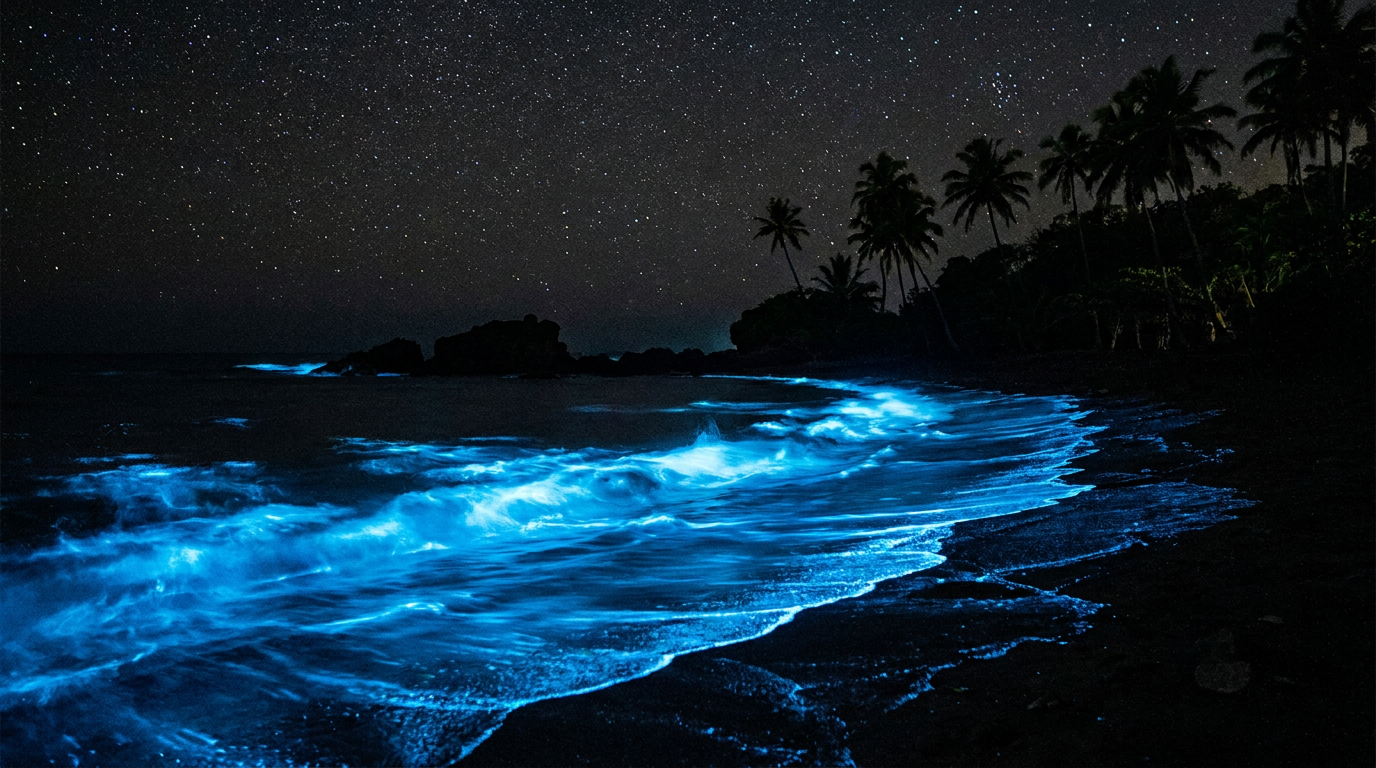
Across the globe, certain coastlines erupt in electric-blue light when the water is disturbed. This natural phenomenon is driven by microscopic marine life using a chemical reaction to survive, creating one of nature's most spectacular displays.
By Factlen Editorial Team
- Marine Biologists
- Focuses on the ecological function of bioluminescence as a survival mechanism and studies the environmental conditions required for these organisms to thrive.
- Eco-Tourism Operators
- Advocates for sustainable, guided access to bioluminescent bays to educate the public while driving local economic benefits.
- Conservationists
- Prioritizes the strict protection of these fragile ecosystems from chemical pollutants, light pollution, and over-tourism.
What's not represented
- · Local residents living near bioluminescent bays
- · Indigenous communities with historical ties to glowing coastal regions
Why this matters
Understanding the mechanics of bioluminescence helps travelers plan the perfect trip to witness this rare phenomenon, while highlighting the fragile balance of coastal ecosystems and the urgent need for eco-conscious tourism.
Key points
- Bioluminescence is a natural chemical reaction used by marine organisms primarily as a 'burglar alarm' defense mechanism.
- The glowing effect on beaches is most commonly caused by single-celled plankton called dinoflagellates, though micro-shrimp and squid also contribute in some regions.
- Mosquito Bay in Puerto Rico holds the world record for the brightest bioluminescent bay, supported by a unique, nutrient-rich mangrove ecosystem.
- Optimal viewing requires absolute darkness, making the New Moon phase the only reliable time to witness the full intensity of the glow.
- The organisms are highly sensitive to human impact; chemicals like DEET and sunscreen can cause massive die-offs in the bays.
Imagine dipping a paddle into a dark lagoon and watching the water erupt in a trail of electric-blue sparks, or walking along a shoreline where every footstep leaves a glowing footprint in the wet sand. This is the magic of bioluminescent beaches—rare coastal environments where microscopic organisms light up the night. While it looks like something out of a fantasy novel, the phenomenon is entirely natural, blending complex marine biology with highly specific environmental conditions.[4][6]
At the heart of this spectacle is a chemical reaction known as chemiluminescence. When certain living organisms undergo this process, scientists call it bioluminescence. The reaction relies on two primary biological components: a light-emitting molecule called luciferin and an enzyme called luciferase. When oxygen is introduced to the mix, the luciferase catalyzes the oxidation of the luciferin. This reaction releases energy almost entirely as visible light, rather than heat, creating what is known as "cold light."[1][6]

While bioluminescence is incredibly common in the deep ocean—where the National Oceanic and Atmospheric Administration (NOAA) estimates that up to 90% of pelagic animals possess the trait—it is much rarer to see it concentrated along coastlines. In shallow waters and bays, the primary drivers of the light show are dinoflagellates, a type of single-celled plankton. Species like Pyrodinium bahamense and Noctiluca scintillans float near the surface and emit flashes of blue or green light whenever they are physically disturbed by waves, fish, or human movement.[1][2]
For these tiny organisms, glowing is not a performance; it is a matter of survival. Marine biologists refer to this behavior as the "burglar alarm" defense mechanism. When a dinoflagellate is agitated by a small predator, such as a copepod, it flashes its light. This sudden burst of illumination startles the immediate attacker and, more importantly, acts as a beacon to attract larger predators that will eat the copepod, allowing the dinoflagellate to escape unharmed.[1][2][6]
While dinoflagellates are the most common source of glowing beaches, they are not the only one. In the Maldives, the famous "Sea of Stars" on Vaadhoo (Mudhdhoo) Island is primarily illuminated by bioluminescent ostracods, a type of micro-shrimp. Unlike dinoflagellates, which flash for only a fraction of a second, these tiny crustaceans can glow for up to a minute when disturbed, creating a longer-lasting, starry effect on the sand. Meanwhile, in Japan's Toyama Bay, the seasonal arrival of bioluminescent firefly squid turns the waters a brilliant cobalt blue.[4][5]
Creating a world-class bioluminescent bay requires a highly specific ecological recipe. The organisms need sheltered waters, such as lagoons with narrow geographic openings, which prevent them from being washed out to the open ocean and allow their populations to concentrate. They also require nutrient-rich environments, often provided by surrounding mangrove forests whose decaying leaves feed the plankton. Finally, the water must be warm, which is why the most spectacular bioluminescent bays are found in tropical and subtropical regions.[3][4]
Creating a world-class bioluminescent bay requires a highly specific ecological recipe.
Nowhere is this recipe perfected quite like Mosquito Bay on the island of Vieques, Puerto Rico. Holding the Guinness World Record for the brightest bioluminescent bay on Earth, Mosquito Bay boasts an astonishing concentration of up to 720,000 dinoflagellates per gallon of water. Its brilliance is supported by a pristine mangrove ecosystem and strict local regulations that ban motorized boats and swimming, ensuring the delicate plankton are not destroyed by chemical pollutants.[3][4]

Puerto Rico is actually home to three of the world's most famous glowing bays. In addition to Mosquito Bay, travelers frequently visit Laguna Grande in Fajardo, which is easily accessible from San Juan, and La Parguera on the southwestern coast. La Parguera is unique because it is currently the only bioluminescent bay in Puerto Rico where visitors are legally permitted to swim, allowing them to immerse themselves entirely in the glowing waters.[3][5]
For travelers hoping to witness the phenomenon, timing is the most critical factor. The brightness of the bioluminescence is entirely dependent on the darkness of the sky. Tour operators universally recommend visiting during a New Moon, or within three days before or after it. During a Full Moon, the natural moonlight overpowers the glow of the plankton, rendering the bioluminescence nearly invisible. In fact, many reputable eco-tours suspend operations entirely during the Full Moon phase.[3][6]

Seasonality also plays a role in the intensity of the display. In the Caribbean, the warm season from July through October often yields the brightest glow, as dinoflagellates thrive in higher water temperatures. However, this period overlaps with hurricane season. Heavy tropical downpours can temporarily dim a bay by stirring up sediment and altering the water's salinity, though the nutrient runoff from normal rainfall eventually helps the plankton populations bloom.[3]
Despite their resilience in nature, bioluminescent bays are incredibly fragile when exposed to human activity. The chemicals found in standard sunscreens, lotions, and insect repellents—particularly those containing DEET—are highly toxic to dinoflagellates. When hundreds of tourists enter the water wearing these products, it can cause massive die-offs of the organisms, permanently dimming the bay. This is why strict eco-tourism guidelines emphasize the use of reef-safe products and physical barriers like long sleeves instead of chemical sprays.[3][5]

Light pollution from coastal development is another existential threat. As shorelines become more populated, artificial lights from hotels, streetlamps, and cars bleed into the bays, washing out the natural glow. Conservationists are actively working to establish "dark sky" zones around these lagoons, ensuring that the surrounding infrastructure uses low-impact, red-spectrum lighting that does not interfere with the visibility of the bioluminescence.[4][6]
Ultimately, the survival of the world's bioluminescent beaches depends on a delicate partnership between nature and responsible tourism. By understanding the science behind the glow and respecting the strict environmental boundaries required to maintain it, visitors can ensure that these "living light" shows continue to dazzle future generations.[5][6]
Viewpoints in depth
Marine Biologists
Focuses on the ecological function of bioluminescence as a survival mechanism and studies the environmental conditions required for these organisms to thrive.
For marine biologists, bioluminescence is far more than a tourist attraction; it is a critical communication and survival tool in the ocean's food web. Researchers study how the 'burglar alarm' effect helps regulate populations of micro-predators like copepods. Furthermore, scientists monitor dinoflagellate populations as indicators of coastal health. Because these organisms require a highly specific balance of salinity, temperature, and nutrients, sudden drops in their population can serve as an early warning sign of broader ecological distress, such as chemical runoff or the impacts of climate change on ocean currents.
Eco-Tourism Operators
Advocates for sustainable, guided access to bioluminescent bays to educate the public while driving local economic benefits.
Tour operators view bioluminescent bays as invaluable assets that can drive local economies if managed correctly. They argue that guided access—such as clear-bottom kayaking tours—fosters a deep appreciation for marine conservation among the general public. By strictly enforcing rules against swimming, motorized boats, and chemical sunscreens, responsible operators believe they can balance the high demand for noctourism with the preservation of the bays, ensuring the phenomenon remains a sustainable source of income for coastal communities.
Conservationists
Prioritizes the strict protection of these fragile ecosystems from chemical pollutants, light pollution, and over-tourism.
Conservation groups often take a more cautious stance, emphasizing the extreme fragility of bioluminescent ecosystems. They point out that even a small amount of DEET or chemical sunscreen introduced into a closed lagoon can decimate the dinoflagellate population. Conservationists advocate for strict carrying capacities—limiting the number of visitors allowed in a bay per night—and heavily lobby local governments to enforce 'dark sky' ordinances. Their primary concern is that unchecked coastal development and light pollution will eventually wash out the natural glow, destroying the very phenomenon tourists come to see.
What we don't know
- Exactly how climate change and rising ocean temperatures will alter the long-term frequency and intensity of bioluminescent blooms globally.
- The full evolutionary history of bioluminescence, as the ability to create light appears to have evolved independently dozens of times across different marine species.
Key terms
- Bioluminescence
- The production and emission of light by a living organism as the result of a chemical reaction.
- Chemiluminescence
- The broader scientific term for the production of visible light by a chemical reaction, which occurs with almost no heat.
- Dinoflagellate
- A type of single-celled microscopic plankton that is the primary source of bioluminescence in coastal waters.
- Luciferin
- The light-emitting organic molecule or substrate involved in the bioluminescent chemical reaction.
- Luciferase
- The enzyme that catalyzes the oxidation of luciferin, speeding up the reaction that produces light.
Frequently asked
Can you swim in bioluminescent bays?
In most protected bays, such as Mosquito Bay in Puerto Rico, swimming is strictly prohibited to protect the fragile organisms from chemicals on human skin. However, a few locations, like La Parguera, still allow swimming.
Why is bioluminescence usually blue?
Blue light travels the farthest and penetrates deepest through seawater. Most marine organisms have evolved to emit and see blue light, making it the most effective color for communication and defense in the ocean.
Are bioluminescent algae dangerous to humans?
The dinoflagellates found in popular bioluminescent bays are generally harmless. However, some glowing algae are associated with 'red tides,' which can produce toxins harmful to marine life and humans, so it is always best to check local advisories.
When is the best time to see a bioluminescent beach?
The best time to visit is during a New Moon, or within three days before or after it, when the night sky is at its darkest. Full moons provide too much ambient light, which washes out the glow.
Sources
Source coverage
6 outlets
3 viewpoints surfaced






[1]NOAA Ocean ExplorationMarine Biologists
What is Bioluminescence?
Read on NOAA Ocean Exploration →[2]Marine Biological LaboratoryMarine Biologists
America's 5 Best Bioluminescent Beaches
Read on Marine Biological Laboratory →[3]Puerto Rico ActivitiesEco-Tourism Operators
The Best Time to Go to Puerto Rico's Bioluminescent Bays (2026 Guide)
Read on Puerto Rico Activities →[4]Beach.comConservationists
The Best Bioluminescent Beaches Around the World
Read on Beach.com →[5]Tier One TravelEco-Tourism Operators
Bioluminescence Beaches Around the World
Read on Tier One Travel →[6]Factlen Editorial TeamConservationists
Synthesis by Factlen editorial team
Read on Factlen Editorial Team →


Every angle. Every day.
Get travel stories with full source coverage and perspective breakdowns delivered to your inbox.