
AI Decodes Sperm Whale 'Phonetic Alphabet,' Revealing Complex Language Parallels
Using advanced machine learning, marine biologists and AI researchers have discovered that sperm whale vocalizations contain a phonetic alphabet with vowel-like structures. The breakthrough reveals striking parallels to human speech and brings scientists closer to translating interspecies communication.
By Factlen Editorial Team
- Marine Biologists & AI Researchers
- Focused on the empirical mapping of the whale phonetic alphabet using machine learning.
- Legal & Rights Advocates
- Focused on leveraging the discovery to establish legal standing and rights for marine life.
- Scientific Skeptics
- Cautioning against anthropomorphizing the data or assuming direct semantic translation is possible.
What's not represented
- · Indigenous communities with historical ties to whaling and ocean conservation
- · Commercial maritime industries affected by potential new ocean noise regulations
Why this matters
Decoding animal communication shatters the long-held assumption that complex language is a uniquely human trait. Beyond the profound philosophical implications, this AI breakthrough could fundamentally reshape environmental law, potentially granting legal rights and protections to marine life based on their proven cognitive and cultural complexity.
Key points
- AI models have discovered that sperm whale vocalizations contain a 'phonetic alphabet' with vowel-like structures.
- The research reveals that whale communication shares structural similarities with human languages like Mandarin and Latin.
- Project CETI used natural language processing to analyze thousands of rapid-fire clicks, known as codas.
- The breakthrough has prompted legal scholars to explore how AI-assisted translation could bolster animal rights.
- Researchers aim to comprehend 20 specific whale expressions within the next five years.
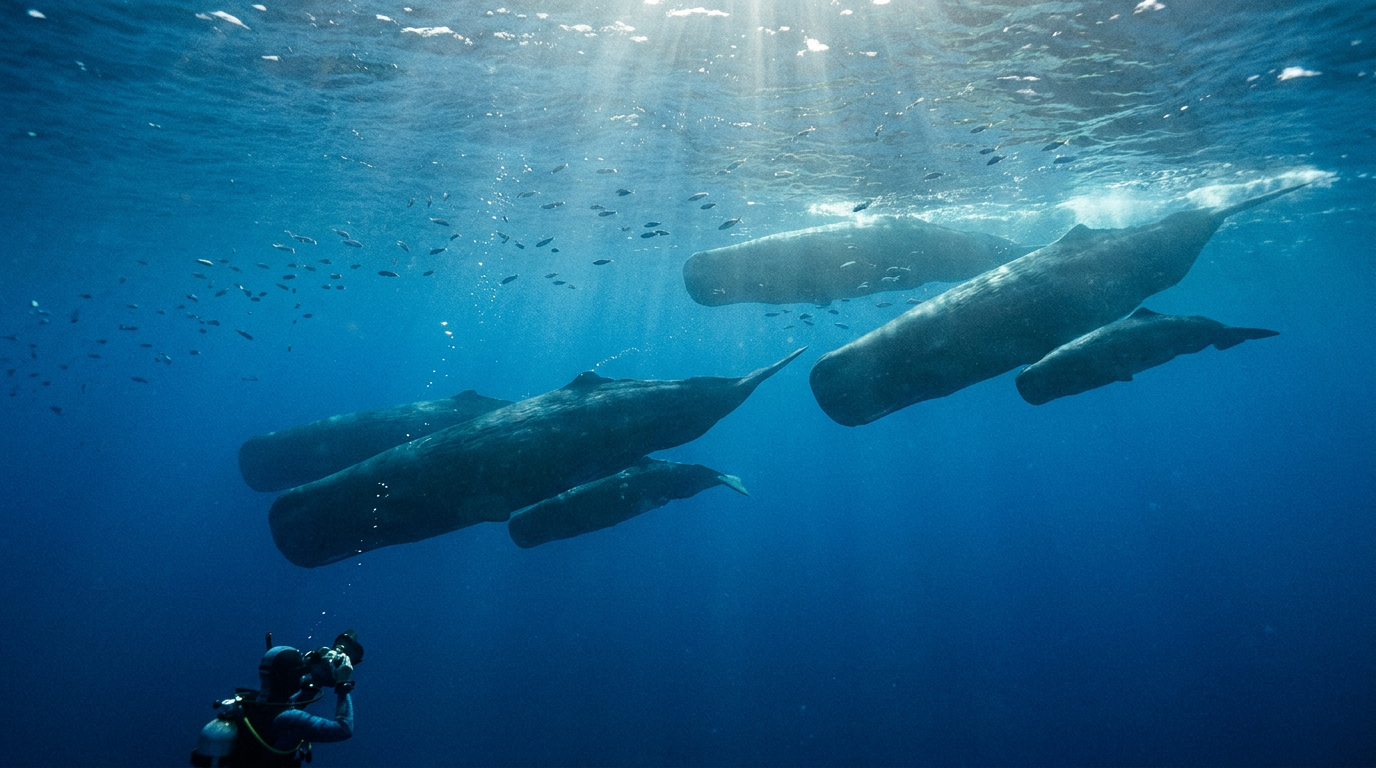
For decades, the rapid-fire clicks echoing through the deep ocean were a mystery to marine biologists—a wall of acoustic data too dense and complex for human researchers to fully parse. Now, artificial intelligence has provided a Rosetta Stone for the sea. A sweeping interdisciplinary study has revealed that sperm whales communicate using a highly structured "phonetic alphabet" that closely parallels the phonetics and phonology of human language. The discovery, driven by advanced machine learning models, marks a watershed moment in the quest to understand interspecies communication, suggesting that complex language may have evolved independently in the ocean millions of years before humans walked the earth.[1][6]
The breakthrough is the culmination of years of work by Project CETI (the Cetacean Translation Initiative), an international coalition of marine biologists, linguists, and AI researchers. Operating primarily off the coast of Dominica, the team deployed a vast array of underwater microphones and gentle robotics to capture the vocalizations of sperm whale pods. Because sperm whales generate sound using specialized organs above their jaws, their communication—known as codas—consists of intricate sequences of clicks. Until recently, scientists struggled to identify the underlying grammar of these codas. By feeding massive acoustic datasets into natural language processing algorithms originally designed for human speech, the CETI team bypassed decades of manual analysis to uncover the hidden architecture of whale song.[4][5][7]
The AI models identified 156 distinct codas, breaking them down into foundational components that function much like phonemes in human language. Crucially, the algorithms detected subtle variations in the timing and frequency of the clicks that human ears had previously missed. The researchers discovered that sperm whales differentiate their vocalizations through short or elongated clicks, as well as through rising and falling tones. This tonal variation behaves remarkably like vowels in human speech, utilizing patterns that linguists note are structurally similar to human languages such as Mandarin, Latin, and Slovenian.[1][6]

"The structure of the whales' communication has close parallels in the phonetics and phonology of human languages, suggesting independent evolution," the researchers detailed in their findings, which were published in the Proceedings of the Royal Society B journal. The study concluded that sperm whale coda vocalizations represent one of the closest parallels to human phonology of any analyzed animal communication system. For the scientists involved, the data confirms what observational biology has long suspected: these marine mammals possess a sophisticated, culturally transmitted language capable of conveying complex information across vast distances.[1][6]
The study concluded that sperm whale coda vocalizations represent one of the closest parallels to human phonology of any analyzed animal communication system.
The behavioral insights unlocked by the AI analysis are already reshaping our understanding of whale society. Beyond mapping the phonetic alphabet, the CETI team recently utilized their acoustic models to document a sperm whale birth. The synchronized audio and video recordings revealed a breathtaking scene of cooperation, involving complex coordination among at least a dozen female whales who gathered to support the mother and calf. "I think it's another humbling moment that we're not the only species with rich, communicative, communal and cultural lives," said David Gruber, founder and president of Project CETI. "These whales could be passing information along generation to generation to generation for over 20 million years."[1][4]
As machine learning pulls back the curtain on animal cognition, the ability to parse and potentially translate interspecies communication is raising profound ethical and legal questions. If science can verifiably prove that animals possess structured language and complex societies, the legal frameworks governing environmental protection and animal welfare may face unprecedented challenges. Recognizing this shift, Project CETI has partnered with legal scholars from New York University School of Law's More Than Human Life (MOTH) Program. The collaboration aims to explore how AI-assisted translation could establish new legal guardrails for marine life, moving beyond traditional conservation toward recognizing the inherent rights of non-human cultures.[2][3]

César Rodríguez-Garavito, founder of the MOTH program, argues that decoding whale communication could fundamentally alter the trajectory of environmental advocacy. In a co-authored paper assessing the legal impact of AI-assisted animal studies, the scholars suggest that empirical evidence of whale language could bolster the "rights of nature" movement. Whales have historically played an outsized role in environmental campaigns, from the "Save the Whales" movement of the 1970s to modern climate litigation. Providing a literal voice to these creatures through AI translation could transform them from passive subjects of conservation into recognized stakeholders in international environmental law.[2][3]
While the prospect of a two-way conversation with a sperm whale remains a distant frontier, the researchers are setting concrete, near-term milestones. Project CETI's immediate goal is to comprehend 20 different vocalized expressions—such as specific codas relating to diving, hunting, or sleeping—within the next five years. Achieving this would represent the first time humans have successfully mapped the semantic meaning of a wild animal's vocabulary using artificial intelligence. "It's totally within our grasp," Gruber noted, reflecting on the rapid pace of the AI models' progress. "We've already got a lot further than I thought we could."[1][4]

The success of Project CETI is also accelerating a broader movement within the artificial intelligence community to apply generative models to the natural world. Researchers are increasingly turning their attention to other highly social species, from elephants to corvids, hoping to replicate the acoustic breakthroughs achieved with sperm whales. By demonstrating that AI can decode the phonetic structure of a non-human language, the CETI initiative has provided a scalable blueprint for interspecies translation. As these models grow more sophisticated, they promise to bridge the cognitive divide between humans and the rest of the animal kingdom, fundamentally redefining our place within the natural world.[3][8]
How we got here
1950s
Scientists first confirm that sperm whales actively vocalize underwater.
2020
Project CETI is founded to apply advanced machine learning to whale communication.
2024
Early AI models begin isolating distinct codas from massive acoustic datasets.
April 2026
Researchers publish findings detailing the sperm whale 'phonetic alphabet' and its parallels to human speech.
Viewpoints in depth
Marine Biologists & AI Researchers
Scientists focused on the technical and biological breakthrough of mapping a non-human language.
For the interdisciplinary teams at Project CETI, the primary focus is on the empirical data. By treating whale codas as a natural language processing problem, they have bypassed the limitations of human hearing and manual acoustic analysis. Their goal is strictly scientific: to build a robust, verifiable model of sperm whale communication, eventually mapping specific codas to behavioral contexts like hunting, diving, or socializing, without anthropomorphizing the animals.
Legal & Environmental Advocates
Scholars arguing that verifiable animal language should fundamentally change legal rights.
Legal scholars, such as those at NYU's MOTH program, view the AI breakthrough as a catalyst for systemic legal reform. They argue that if science can prove whales possess culture, language, and complex societal structures, the legal system can no longer treat them merely as 'resources' or passive subjects of conservation. Instead, they advocate for the 'rights of nature' framework, suggesting that sentient, communicating species should hold recognized legal standing in international environmental law.
Skeptics of Interspecies Translation
Researchers cautioning against projecting human linguistic frameworks onto alien intelligence.
While celebrating the acoustic discoveries, some cognitive scientists and linguists warn against the temptation to map human grammar directly onto whale clicks. They argue that a sperm whale's sensory world—dominated by echolocation in a three-dimensional aquatic environment—is so fundamentally different from human experience that their 'language' may convey concepts we cannot easily translate. These skeptics emphasize that finding structural similarities to human vowels does not necessarily mean the whales are conveying human-like semantic meaning.
What we don't know
- Whether the structural similarities to human language translate to similar semantic meaning.
- How the legal system will practically respond to empirical evidence of non-human language.
- Whether these AI translation models can be successfully adapted to other highly social animal species.
Key terms
- Coda
- A distinct pattern of rapid-fire acoustic clicks used by sperm whales to communicate.
- Phonology
- The branch of linguistics that deals with systems of sounds within a language.
- Natural Language Processing (NLP)
- A branch of artificial intelligence that helps computers understand, interpret, and manipulate human language.
- Rights of Nature
- A legal and jurisprudential theory that describes inherent rights as associated with ecosystems and species, rather than just humans.
Frequently asked
Can we talk to whales now?
Not yet. While AI has identified the structural alphabet of their communication, scientists do not yet know the semantic meaning of most specific sounds.
How does the AI analyze the sounds?
Researchers use natural language processing algorithms—similar to those powering large language models—to detect subtle patterns, timing, and tonal variations in massive datasets of underwater recordings.
Why study sperm whales?
Sperm whales have the largest brains on Earth, live in highly complex, multi-generational matrilineal societies, and rely entirely on acoustic clicks to communicate in the dark ocean depths.
Sources
Source coverage
8 outlets
3 viewpoints surfaced








[1]The GuardianScientific Skeptics
Sperm whales' communication closely parallels human language, study finds
Read on The Guardian →[2]NYU LawLegal & Rights Advocates
AI-enabled decoding of whale communication could bolster animal rights
Read on NYU Law →[3]The Explorers ClubLegal & Rights Advocates
On the Cusp of Communicating with Whales
Read on The Explorers Club →[4]BioneersScientific Skeptics
The Quest to Decode Whale-speak
Read on Bioneers →[5]Project CETIMarine Biologists & AI Researchers
Understanding the communication of sperm whales
Read on Project CETI →[6]Proceedings of the Royal Society BMarine Biologists & AI Researchers
Close parallels in the phonetics and phonology of human languages and sperm whale codas
Read on Proceedings of the Royal Society B →[7]National GeographicMarine Biologists & AI Researchers
Groundbreaking effort launched to decode whale language
Read on National Geographic →[8]Hakai MagazineScientific Skeptics
Are We on the Verge of Chatting with Whales?
Read on Hakai Magazine →

More in ai
See all 5 stories →Federal Preemption
The Federal Government Moves to Preempt State AI Laws as Congress Drafts National Framework
8 sources
Local AI
The 2026 Guide to Running AI Locally: How Consumer Hardware Caught Up to the Cloud
8 sources

On-Device AI
How Small Language Models Brought AI to Your Phone Without the Cloud
6 sources

Every angle. Every day.
Get ai stories with full source coverage and perspective breakdowns delivered to your inbox.