
The Postbiotic Promise: How Urolithin A Recycles Aging Cells
A gut-derived compound called Urolithin A is showing unprecedented ability to clear out damaged cellular power plants, offering a new frontier in the science of healthy aging.
By Factlen Editorial Team
- Longevity Researchers
- View Urolithin A as a validated tool to target the cellular hallmarks of aging, specifically mitochondrial dysfunction.
- Clinical Skeptics
- Acknowledge the biomarker improvements but caution that translating 4-month trials into decades of extended human lifespan is premature.
- Microbiome Optimizers
- Argue against lifelong synthetic supplementation, preferring to seed the gut with probiotics to restore natural Urolithin A production.
What's not represented
- · Health Economists evaluating the cost-benefit of expensive longevity supplements for the general public
Why this matters
As the global population ages, interventions that extend 'healthspan'—the years lived free of chronic disease and frailty—are becoming critical. Urolithin A represents a rare, evidence-backed mechanism to maintain muscle and immune resilience at the cellular level.
Key points
- Urolithin A (UA) is a postbiotic compound that triggers the recycling of damaged cellular mitochondria.
- Only 30 to 40 percent of humans have the gut bacteria required to produce UA naturally from foods like pomegranates.
- Clinical trials show 1,000 mg of UA daily significantly improves muscle endurance in older adults without exercise.
- New 2025 research indicates UA also rejuvenates the immune system by expanding fresh, naïve T cells.
- While it improves functional healthspan, it is not yet proven to extend total human lifespan.
For decades, the search for anti-aging interventions focused on external fixes or broad-spectrum antioxidants. But modern longevity science has shifted its gaze inward, focusing on the microscopic engines that power human life: mitochondria. When these cellular power plants function well, tissues thrive. When they degrade, the body ages. Now, a compound called Urolithin A (UA) is emerging as one of the most promising tools to keep those engines running cleanly.[4][6]
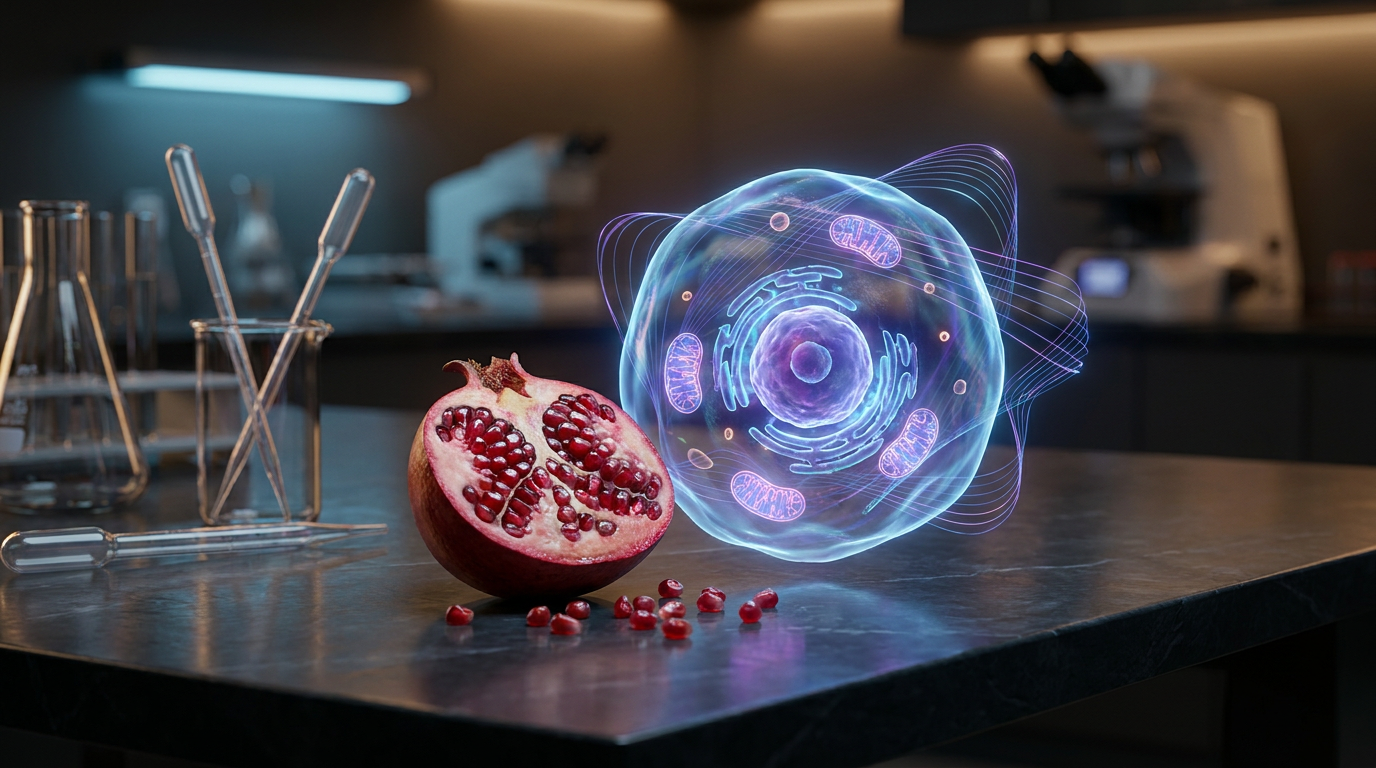
Urolithin A is not a vitamin, a mineral, or a traditional drug. It is a "postbiotic"—a byproduct created when specific gut bacteria digest ellagitannins, which are complex plant compounds found abundantly in pomegranates, walnuts, and certain berries. However, eating a bowl of raspberries does not guarantee a cellular upgrade.[3][6]
Human biology features a frustrating bottleneck: the microbiome lottery. Clinical research indicates that only 30 to 40 percent of the global population possesses the specific gut flora required to convert dietary ellagitannins into Urolithin A. For the remaining majority, the precursor compounds simply pass through the digestive tract un-converted, leaving the cellular benefits entirely on the table.[3]

For those who can produce it—or those who take it via direct supplementation—Urolithin A performs a highly specific biological task. It activates a process called "mitophagy." Mitophagy is the cell's internal recycling program. It identifies old, damaged, or dysfunctional mitochondria, breaks them down, and clears them out to make room for fresh, highly efficient replacements.[4][6]
In youth, mitophagy operates seamlessly. But as humans age, the process becomes sluggish. Damaged mitochondria begin to accumulate inside cells, leaking reactive oxygen species and failing to produce adequate ATP (cellular energy). This mitochondrial gridlock is now recognized as a primary driver of age-related muscle loss, fatigue, and tissue degradation. By artificially restarting mitophagy, Urolithin A effectively clears the gridlock.[4]

The most visible evidence of this cellular cleanup has emerged in skeletal muscle. Muscles are incredibly energy-hungry, making them highly sensitive to mitochondrial decline. In a landmark double-blind, placebo-controlled trial, older adults (aged 65 to 90) were given 1,000 milligrams of Urolithin A daily for four months.[2]
The results challenged long-held assumptions about aging and frailty. Without any changes to their diet or exercise routines, the participants taking Urolithin A demonstrated a 17 percent increase in leg muscle endurance and a 26 percent increase in hand muscle endurance. The compound essentially mimicked the cellular effects of aerobic exercise, forcing the muscles to rebuild their energy grids.[2]

The results challenged long-held assumptions about aging and frailty.
These benefits are not restricted to the elderly. Ongoing trials registered with the National Institutes of Health are currently tracking middle-aged adults (aged 40 to 65) with low baseline physical activity. Early data suggests that daily supplementation improves VO2 peak and muscular strength in this demographic as well, acting as a metabolic bridge for those struggling with age-related metabolic slowdown.[5]
Beyond muscle, the most recent breakthroughs center on the immune system. As humans age, the immune system undergoes a structural decline known as "inflammaging"—a state of chronic, low-grade inflammation coupled with a reduced ability to fight off novel infections. A major factor in this decline is the exhaustion of T cells.[1][6]
A 2025 study published in Nature Aging revealed that Urolithin A can fundamentally alter this trajectory. When healthy adults were given 1,000 milligrams of UA daily for four weeks, researchers observed a significant expansion of "naïve CD8+ T cells." These are fresh, versatile immune cells that have not yet been programmed by past infections, making them crucial for identifying and destroying new viruses or emerging cancer cells.[1]
Furthermore, the Urolithin A supplementation changed how these immune cells fueled themselves. Instead of relying heavily on glucose—a hallmark of exhausted, aging cells—the T cells shifted to a "cleaner" metabolic burn, utilizing fatty acids and amino acids. This metabolic flexibility is a signature of youthful, resilient immune function.[1]
Despite the profound biomarker improvements, researchers urge a measured perspective. The central uncertainty surrounding Urolithin A is its ultimate impact on human lifespan. While the compound has been proven to extend the lifespans of nematode worms and mice in laboratory settings, human biology is vastly more complex. Current clinical trials prove that UA improves healthspan—the quality of daily physical and immune function—but decades of longitudinal data are required to know if it actually adds years to a human life.[4][6]

The commercial market has not waited for those decades to pass. Direct Urolithin A supplements, primarily under the patented Mitopure label, have surged in popularity among longevity enthusiasts. Because these supplements deliver the postbiotic directly, they bypass the need for specific gut bacteria, guaranteeing absorption.[6]
However, a parallel scientific effort is exploring a more foundational approach: "synbiotics." Rather than taking synthetic Urolithin A indefinitely, some researchers are developing combinations of human milk oligosaccharides (HMOs), ellagic acid, and targeted probiotics. The goal is to permanently seed the gut with the necessary microbial machinery, allowing patients to generate their own Urolithin A naturally from a diet rich in berries and nuts.[3][6]
Whether delivered via a lab-synthesized capsule or a carefully cultivated microbiome, Urolithin A represents a paradigm shift. It moves the conversation away from masking the symptoms of aging and toward repairing the microscopic engines that dictate how we feel, move, and heal.[6]
Viewpoints in depth
Longevity Researchers
View Urolithin A as a validated tool to target the cellular hallmarks of aging, specifically mitochondrial dysfunction.
For scientists focused on the biological mechanisms of aging, Urolithin A represents a major proof-of-concept. Rather than treating the downstream symptoms of aging—such as joint pain or fatigue—this camp emphasizes interventions that fix the root cause. By proving that a single compound can safely restart mitophagy in humans, researchers view UA as a foundational tool for maintaining cellular energy grids and delaying the onset of age-related frailty.
Clinical Skeptics
Acknowledge the biomarker improvements but caution that translating 4-month trials into decades of extended human lifespan is premature.
Evidence-based medicine demands long-term data. While skeptics do not dispute the impressive short-term gains in muscle endurance or T-cell counts, they warn against the longevity industry's tendency to over-extrapolate. A four-month trial showing improved cellular biomarkers does not guarantee that a patient will live to be 100. This camp advocates for decades-long longitudinal studies to ensure that chronic, lifelong supplementation does not carry unforeseen risks or diminishing returns.
Microbiome Optimizers
Argue against lifelong synthetic supplementation, preferring to seed the gut with probiotics to restore natural Urolithin A production.
This perspective views the reliance on synthetic, lab-made Urolithin A as a temporary crutch. Instead of bypassing the gut microbiome, these experts argue we should fix it. By utilizing targeted probiotics, prebiotics, and human milk oligosaccharides (HMOs), this camp aims to permanently alter the digestive tract's ecosystem. If successful, patients could naturally synthesize their own therapeutic doses of Urolithin A simply by eating a diet rich in berries, walnuts, and pomegranates.
What we don't know
- Whether Urolithin A supplementation actually extends maximum human lifespan, as it does in animal models.
- The long-term safety profile of taking high-dose synthetic Urolithin A every day for decades.
- Exactly which combinations of probiotic strains are most effective at permanently restoring natural Urolithin A production in non-producers.
Key terms
- Urolithin A
- A postbiotic compound produced by gut bacteria that helps cells clear out damaged mitochondria.
- Mitophagy
- The cellular recycling process that identifies and breaks down old, dysfunctional mitochondria to maintain energy efficiency.
- Ellagitannins
- Complex plant compounds found in pomegranates and berries that serve as the raw material for Urolithin A production.
- Naïve T cells
- Fresh immune cells that have not yet encountered a pathogen, making them crucial for fighting off new infections or emerging cancer cells.
- Inflammaging
- Chronic, low-grade inflammation that develops with advanced age and accelerates tissue damage and immune decline.
Frequently asked
What foods contain Urolithin A?
No foods contain Urolithin A directly. Foods like pomegranates, walnuts, and berries contain ellagitannins, which specific gut bacteria can convert into Urolithin A.
How do I know if I produce it naturally?
Currently, determining your producer status requires specialized laboratory testing of blood or urine after consuming a high dose of pomegranate juice.
Is Urolithin A safe to take?
Clinical trials lasting up to six months have shown a favorable safety profile with no serious adverse effects, though decades-long safety data does not yet exist.
Can I just eat more pomegranates?
Only if you are among the 30 to 40 percent of people with the right gut bacteria. If you lack the required microbiome, the precursor compounds will pass through your system unconverted.
Sources
Source coverage
6 outlets
3 viewpoints surfaced





[1]Nature AgingLongevity Researchers
Urolithin A mitigates age-related immune system decline by expanding naïve T cells
Read on Nature Aging →[2]Cell Reports MedicineLongevity Researchers
Urolithin A improves muscle strength and exercise performance in older adults
Read on Cell Reports Medicine →[3]Clinical Nutrition InsightMicrobiome Optimizers
The microbiome lottery: Why only 30% of humans produce Urolithin A
Read on Clinical Nutrition Insight →[4]National Institute on AgingLongevity Researchers
Understanding Mitophagy and Cellular Aging
Read on National Institute on Aging →[5]ClinicalTrials.govClinical Skeptics
The Effect of Urolithin A Supplementation on Muscle Strength in Healthy Middle-Aged Adults
Read on ClinicalTrials.gov →[6]Factlen Editorial TeamMicrobiome Optimizers
Synthesis by Factlen editorial team
Read on Factlen Editorial Team →

More in health
See all 7 stories →Exercise Mimetics
The Science of 'Exercise in a Pill': How New Longevity Drugs Mimic Physical Activity
7 sources

Brain Health
How Deep Sleep Washes the Brain: The Science of the Glymphatic System
7 sources

Vaccine Research
Shingles Vaccine Linked to 24% Lower Risk of Dementia in Major New Study
7 sources

Gut-Brain Axis
How Psychobiotics and the Gut-Brain Axis Are Reshaping Mental Health Treatment
8 sources
Every angle. Every day.
Get health stories with full source coverage and perspective breakdowns delivered to your inbox.