
How Embodied AI is Moving Humanoid Robots from the Lab to the Factory Floor
A new generation of vision-language-action models is allowing robots to learn physical tasks by watching humans, bypassing decades of brittle programming. This breakthrough in embodied AI promises to take over dangerous industrial work and alleviate severe global labor shortages.
By Factlen Editorial Team
- Embodied AI Researchers
- Focus on the software breakthroughs, arguing that scaling neural networks and simulation data will inevitably solve remaining physical edge cases.
- Industrial Operators
- View humanoids as a necessary tool to combat severe labor shortages, prioritizing safety, reliability, and immediate return on investment.
- Hardware Engineers
- Emphasize the physical constraints of the real world, focusing on battery density, actuator durability, and the limits of sim-to-real transfer.
What's not represented
- · Labor Union Representatives
- · Factory Floor Workers
Why this matters
If robots can generalize physical tasks the way large language models generalize text, industries from manufacturing to eldercare could see massive productivity boosts. This technology offers a tangible solution to the demographic crisis of shrinking workforces while removing humans from the most dangerous and physically degrading jobs.
Key points
- Vision-Language-Action (VLA) models allow robots to learn physical tasks by watching humans, replacing brittle, hardcoded programming.
- Cheaper, lighter electric actuators have replaced bulky hydraulic systems, making commercial humanoids economically viable.
- Major automakers are currently piloting these robots to perform ergonomically taxing tasks like tote moving and part insertion.
- The technology aims to address a projected shortfall of over 2 million manufacturing workers in the US by 2030.
- A major remaining hurdle is the 'Data Wall'—the lack of abundant physical training data compared to the text data used for LLMs.
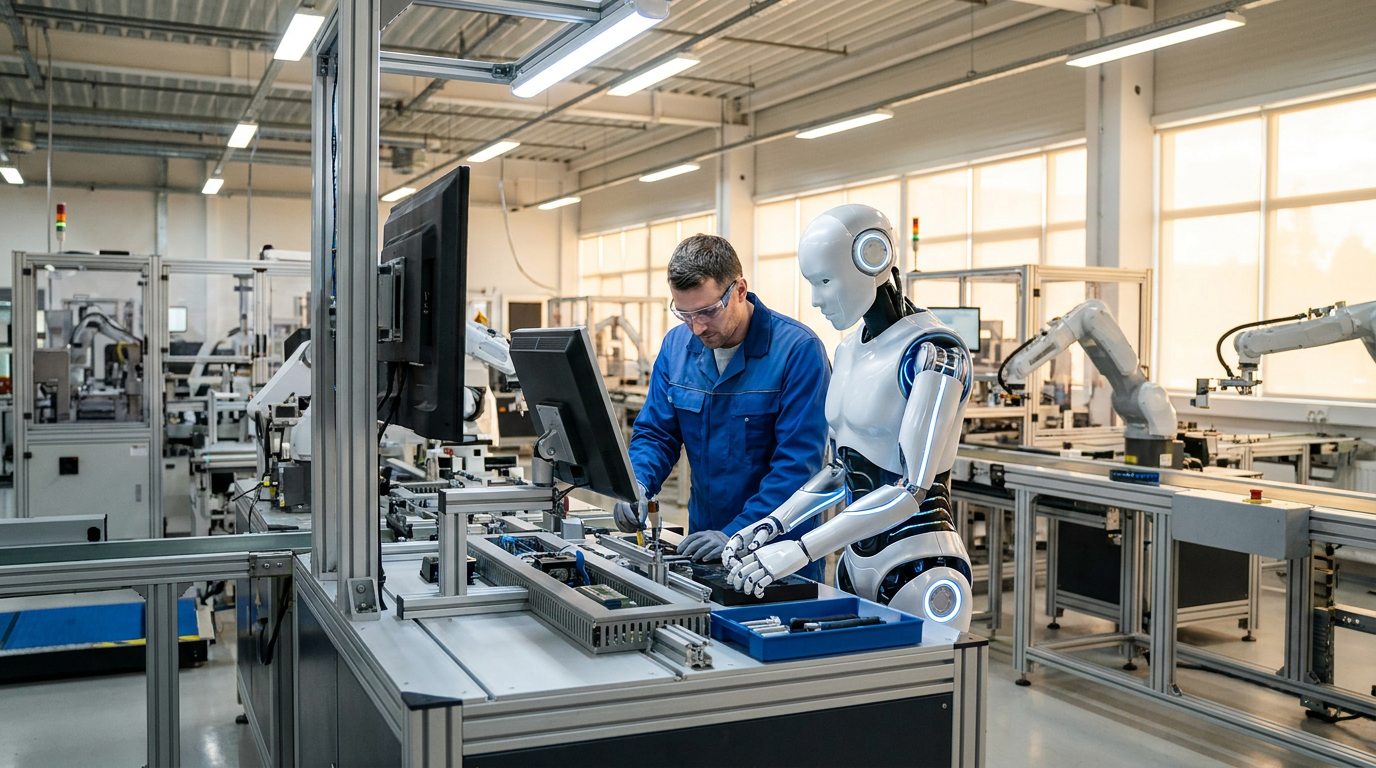
For decades, the public perception of robotics has been defined by a stark dichotomy. On one hand, highly produced research videos showcase bipedal machines performing flawless parkour routines. On the other, the reality of industrial automation has remained stubbornly rigid: robotic arms bolted to factory floors, blindly repeating the exact same pre-programmed motion thousands of times a day. If a part was shifted by a single centimeter, the multi-million-dollar system would fail. This brittleness kept robots confined to highly structured environments, leaving the vast majority of physical work to human hands. But over the past twenty-four months, a fundamental breakthrough in artificial intelligence has begun to bridge this gap, moving humanoid robots out of the research lab and onto active commercial assembly lines.[1][6]
The catalyst for this shift is not a sudden leap in mechanical engineering, but rather the arrival of "embodied AI." Just as large language models learned to understand text by ingesting the internet, a new class of neural networks is learning to understand the physical world. These systems, known as Vision-Language-Action (VLA) models, allow a robot to look at a scene through its cameras, process a spoken command like "pick up the dropped gear," and translate that intent directly into the precise motor torques required to move its arms and fingers.[2][4]
This represents a radical departure from classical robotics. Historically, engineers had to write explicit code for every possible edge case—a nearly impossible task in a messy, unpredictable world. Now, researchers are utilizing "end-to-end" learning. By feeding the neural network thousands of hours of video showing humans performing tasks, the model develops an intuitive grasp of physics, geometry, and object manipulation. It learns that glass is fragile, that heavy objects require a wider stance to lift, and that a dropped tool needs to be picked up before the primary task can continue.[2][6]

The mechanism behind this is surprisingly elegant. A VLA model takes in two primary streams of data: visual input from the robot's cameras and natural language instructions from a human operator. The neural network processes these inputs simultaneously, mapping the visual geometry of the room against the semantic meaning of the words. The output of the model is not text, but a high-frequency stream of joint commands—often updating at 10 to 100 times per second—that dictate exactly how much electrical current should be sent to each of the robot's actuators.[2][4]
This software revolution has perfectly coincided with a quiet maturation in robotics hardware. The hydraulic systems that powered early bipedal robots were powerful but loud, prone to leaking, and incredibly expensive to maintain. Today's commercial humanoids rely almost entirely on electric actuators. These electric motors have benefited from years of supply chain optimization driven by the electric vehicle and drone industries, resulting in components that are lighter, cheaper, and vastly more energy-efficient.[1][3]

The convergence of VLA models and affordable electric actuators has unlocked the holy grail of robotics: general-purpose utility. Instead of buying a custom-built machine that can only weld a specific car door, a factory manager can now purchase a humanoid robot that can move totes in the morning, insert wiring harnesses in the afternoon, and sweep the floor at night. Because the robot's physical form mimics a human, it can seamlessly drop into workspaces that were designed for human bodies, using the same tools, walking up the same stairs, and reaching the same shelves.[3][6]
The convergence of VLA models and affordable electric actuators has unlocked the holy grail of robotics: general-purpose utility.
The economic imperative driving this adoption is severe. The National Association of Manufacturers projects that by 2030, the United States alone could face a shortfall of over 2 million manufacturing workers, putting trillions of dollars of economic output at risk. As older generations retire and younger workers increasingly opt for digital or service-sector careers, factories are struggling to fill roles that are physically demanding, repetitive, or dangerous. Humanoid robots are no longer viewed as a novelty to replace cheap labor, but as a critical necessity to keep supply chains functioning in the face of a demographic cliff.[5][6]
Major automakers have become the primary proving grounds for this technology. Over the past year, companies like BMW, Mercedes-Benz, and Hyundai have initiated pilot programs deploying bipedal robots directly onto active factory floors. These early deployments are highly supervised and focused on "brownfield" tasks—jobs in existing facilities that are too ergonomically taxing for humans but too unstructured for traditional automation. The robots are currently tasked with moving heavy bins of parts, inspecting chassis alignments, and performing repetitive insertions that frequently cause repetitive strain injuries in human workers.[1][3]
Despite the rapid progress, the industry still faces a massive hurdle known as the "Data Wall." Large language models achieved their intelligence by training on trillions of words scraped from the internet. There is no equivalent internet for physical actions. To train a robot to fold a shirt or assemble an engine, researchers need high-quality data of those specific physical trajectories. Currently, this data is painstakingly gathered through teleoperation, where human operators wear VR headsets and haptic gloves to manually pilot the robots through tasks, recording the sensory data and joint movements to feed back into the neural network.[2][4]
This data scarcity means that while robots are becoming highly capable at specific industrial tasks, they are still far from being universally adaptable consumer products. Moravec's paradox—the observation that high-level reasoning requires very little computation, but low-level sensorimotor skills require enormous computational resources—remains a fundamental law of robotics. An AI can write a flawless Shakespearean sonnet in milliseconds, but teaching a robot to reliably crack an egg without shattering the yolk still requires cutting-edge engineering.[2][6]

Safety and power management also present ongoing engineering challenges. A commercial humanoid robot typically weighs between 120 and 160 pounds and carries a payload of up to 55 pounds. Ensuring that these machines can safely operate alongside human workers without the need for protective cages requires highly advanced force-feedback sensors and fail-safe software protocols. Furthermore, current battery technology limits untethered operation to roughly two to four hours of continuous heavy lifting, meaning factories must design complex charging logistics or swap-station workflows to keep the robots running through a full shift.[1][3]
To accelerate development, tech giants are building massive simulation environments. Platforms like NVIDIA's Project GR00T allow developers to train virtual robots inside physically accurate digital twins of real-world factories. In these simulations, thousands of virtual robots can practice tasks simultaneously, experiencing millions of simulated years of trial and error in a matter of days. Once the neural network masters the task in the digital world, the "brain" is downloaded into the physical robot, a process known as sim-to-real transfer.[4][6]

As sim-to-real transfer improves and the pool of teleoperation data grows, the capabilities of embodied AI are compounding at a staggering rate. Industry analysts expect that within the next three years, the cost of a general-purpose humanoid robot will drop below the annual fully-loaded cost of a human factory worker. This economic crossover point will likely trigger a massive wave of adoption, moving the technology out of pilot programs and into standard industrial procurement.[3][5]
The ultimate promise of embodied AI extends far beyond the factory floor. The same vision-language-action models that allow a robot to assemble a car engine today are the foundational stepping stones toward machines that can perform household chores, assist the elderly with mobility, and respond to disaster zones too hazardous for human first responders. By solving the control problem, engineers are finally giving artificial intelligence a physical body, fundamentally expanding the boundaries of how technology can assist humanity.[4][6]
How we got here
Mid-2023
Google DeepMind introduces RT-2, proving that vision-language-action models can successfully control robotic arms.
Early 2024
Startups like Figure and Agility Robotics demonstrate humanoids performing autonomous tasks using end-to-end neural networks.
Late 2024
NVIDIA announces Project GR00T, providing a foundational platform and simulation environment for humanoid robot developers.
2025
Major automakers including BMW and Mercedes-Benz begin active pilot programs deploying humanoids on factory floors.
2026
VLA models reach real-time inference speeds, allowing robots to dynamically react to dropped objects and changing environments.
Viewpoints in depth
Embodied AI Researchers
Focus on the software breakthroughs, arguing that scaling neural networks and simulation data will inevitably solve remaining physical edge cases.
For AI researchers, the hardware of the robot is increasingly viewed as a solved commodity; the true frontier is the software 'brain.' This camp argues that just as large language models exhibited emergent reasoning capabilities when scaled up, VLA models will exhibit emergent physical generalization. They point to the success of sim-to-real transfer, where robots learn complex physics in digital twins before ever touching the real world. Their primary focus is overcoming the 'Data Wall' by building massive teleoperation pipelines and utilizing self-supervised learning, believing that once enough physical data is ingested, robots will intuitively understand how to manipulate novel objects they have never seen before.
Industrial Operators
View humanoids as a necessary tool to combat severe labor shortages, prioritizing safety, reliability, and immediate return on investment.
Factory managers and supply chain executives view embodied AI through a strictly pragmatic lens. Facing a demographic cliff of retiring workers and a younger generation uninterested in manual labor, they see humanoids as a critical lifeline. This camp is less interested in whether a robot can backflip or fold laundry, and entirely focused on whether it can reliably move a 40-pound tote for eight hours without breaking down or injuring a human coworker. They emphasize the need for seamless integration into existing workflows, robust fail-safes, and a clear path to an ROI that beats the fully-loaded cost of human labor within a two-to-three-year window.
Hardware Engineers
Emphasize the physical constraints of the real world, focusing on battery density, actuator durability, and the limits of sim-to-real transfer.
While acknowledging the massive leaps in AI software, hardware engineers caution that the physical world is unforgiving. This perspective highlights the ongoing challenges of battery density, noting that untethered bipedal robots still struggle to complete a full factory shift without recharging. They also focus on the durability of electric actuators, which must withstand millions of micro-impacts and thermal stress without degrading. Furthermore, they argue that sim-to-real transfer is not a magic bullet; digital simulations often fail to capture the chaotic friction, unexpected lighting, and material degradation found in a real-world manufacturing environment, meaning physical testing remains paramount.
What we don't know
- How quickly the 'Data Wall' can be overcome to allow robots to generalize tasks outside of highly repetitive factory environments.
- Whether battery technology will improve fast enough to allow for full 8-hour untethered shifts without complex charging logistics.
- How the economics of humanoid robots will scale once they move from limited pilot programs to mass production.
Key terms
- Embodied AI
- Artificial intelligence that interacts with the physical world through a robotic body, rather than just processing digital text or images.
- Vision-Language-Action (VLA) Model
- A neural network architecture that translates visual inputs and spoken commands directly into physical motor controls.
- Moravec's Paradox
- The observation in AI research that high-level reasoning requires very little computation, but low-level sensorimotor skills require enormous computational resources.
- Teleoperation
- The process of a human remotely controlling a robot using VR and haptic suits to generate training data for the AI model.
- Sim-to-Real Transfer
- The process of training an AI model in a virtual, physics-accurate simulation and then successfully deploying that trained 'brain' into a physical robot.
Frequently asked
Will these humanoid robots replace human jobs?
Currently, they are being deployed to fill severe labor shortages in roles that are dangerous, ergonomically taxing, or highly repetitive. The goal is to automate tasks that factories already struggle to hire humans for.
Why build robots in a humanoid shape?
The human world—stairs, tools, doorways, and assembly lines—was designed for the human body. A bipedal, two-armed robot can drop into existing infrastructure without requiring expensive factory redesigns.
How long can these robots operate on a single charge?
Most current commercial humanoid models can operate untethered for two to four hours of continuous heavy lifting, requiring factories to implement charging rotations or battery-swap protocols.
What is a Vision-Language-Action model?
It is an AI system that simultaneously processes what a robot sees (vision) and what it is told to do (language) to directly calculate the physical movements (action) required to complete a task.
Sources
Source coverage
6 outlets
3 viewpoints surfaced






[1]IEEE SpectrumHardware Engineers
The Year of the Humanoid: How AI Solved the Control Problem
Read on IEEE Spectrum →[2]arXivEmbodied AI Researchers
Vision-Language-Action Models for Generalist Robots: A Comprehensive Review
Read on arXiv →[3]MIT Technology ReviewIndustrial Operators
Why Factories are Finally Ready for General-Purpose Robots
Read on MIT Technology Review →[4]NVIDIA Technical BlogEmbodied AI Researchers
Project GR00T and the Future of Foundation Models for Robotics
Read on NVIDIA Technical Blog →[5]National Association of ManufacturersIndustrial Operators
2026 Manufacturing Labor Shortage and Automation Report
Read on National Association of Manufacturers →[6]Factlen Editorial Team
Synthesis by Factlen editorial team
Read on Factlen Editorial Team →

Every angle. Every day.
Get technology stories with full source coverage and perspective breakdowns delivered to your inbox.