
The Science of Contrast Therapy: How Alternating Hot and Cold Water Accelerates Muscle Recovery
Contrast water therapy leverages the body's vascular system to flush metabolic waste and accelerate muscle repair. While highly effective for reducing acute soreness, athletes must balance immediate recovery against long-term muscle adaptation.
By Factlen Editorial Team
- Performance Optimizers
- Focus on immediate recovery, reducing soreness, and restoring strength quickly for upcoming competitions.
- Adaptation Advocates
- Focus on long-term muscle growth and strength gains, warning against blunting the necessary inflammatory response.
- Sports Scientists
- Focus on the periodization of recovery, matching the modality to the specific training phase and physiological goals.
What's not represented
- · Casual Gym-Goers
- · Physical Therapists
Why this matters
Understanding when to use heat, cold, or both can mean the difference between maximizing your training gains and inadvertently blunting your muscle growth. Applying the wrong recovery modality at the wrong time can actively work against your fitness goals.
Key points
- Cold water immersion triggers vasoconstriction, reducing inflammation and numbing acute muscle pain.
- Heat therapy triggers vasodilation, increasing blood flow to deliver nutrients and relax stiff connective tissues.
- Alternating hot and cold creates a vascular pump that flushes metabolic waste from fatigued muscles.
- Contrast therapy significantly reduces perceived muscle soreness for up to 96 hours post-exercise.
- Regular use of cold therapy after lifting can blunt the inflammatory signals needed for long-term muscle growth.
- Athletes should periodize recovery, using contrast therapy in-season and active rest during hypertrophy phases.
The pursuit of peak physical fitness is often misunderstood as a process that happens entirely during the workout. In reality, exercise is merely the stimulus—the actual physiological improvements occur during the recovery phase. As training intensities have increased, so too has the search for modalities that can accelerate this repair process. Among the most popular and heavily debated of these methods is Contrast Water Therapy (CWT), a technique that alternates between hot and cold water immersion to manipulate the body's circulatory system.[6]
Once reserved for elite professional athletes with access to specialized training facilities, contrast therapy has rapidly entered the commercial mainstream. Recovery studios featuring side-by-side infrared saunas and cold plunges are proliferating in major cities, promising to banish Delayed Onset Muscle Soreness (DOMS) and restore fatigued muscles in record time. But behind the marketing claims lies a complex physiological mechanism that requires careful timing to be truly effective.[6]
To understand contrast therapy, one must first isolate its components, starting with cold water immersion. When the body is exposed to extreme cold, it immediately triggers vasoconstriction—the narrowing of blood vessels. This physiological response serves as a survival mechanism to preserve core temperature, but for an athlete, it acts as a powerful localized intervention. By restricting blood flow to the extremities, cold therapy physically limits the volume of fluid and inflammatory cells that can rush into micro-torn muscle tissues, effectively putting the brakes on acute swelling.[3]
Beyond fluid restriction, cold exposure slows down the metabolic activity of the tissues and reduces the conduction velocity of nerve signals. This creates a temporary analgesic, or numbing, effect that interrupts the pain-spasm cycle often experienced after strenuous exercise. A comprehensive meta-analysis published in Sports Medicine reviewed twenty-eight studies and confirmed that cold water immersion is consistently superior to active recovery and passive rest for alleviating the subjective feeling of muscle soreness in the days following a heavy workout.[3]

Heat therapy, or thermotherapy, operates on the exact opposite principle. Exposure to elevated temperatures induces vasodilation, causing the blood vessels to expand and open wide. This expansion dramatically increases local blood flow, turning the circulatory system into a high-speed delivery network. The rush of oxygen-rich blood carries essential nutrients, glucose, and amino acids directly to the fatigued muscles, providing the raw materials necessary for cellular repair and glycogen resynthesis.[5]
Heat therapy, or thermotherapy, operates on the exact opposite principle.
Furthermore, heat alters the physical properties of the body's connective tissues. It increases the extensibility of collagen and fascia, reducing joint stiffness and relaxing muscle spasms. This makes heat therapy particularly valuable in the later stages of the recovery cycle, typically 24 to 48 hours post-exercise, when acute swelling has subsided but deep muscular stiffness remains. By improving tissue pliability, heat helps restore a full range of motion, allowing athletes to return to their training regimens without biomechanical compensations.[5]
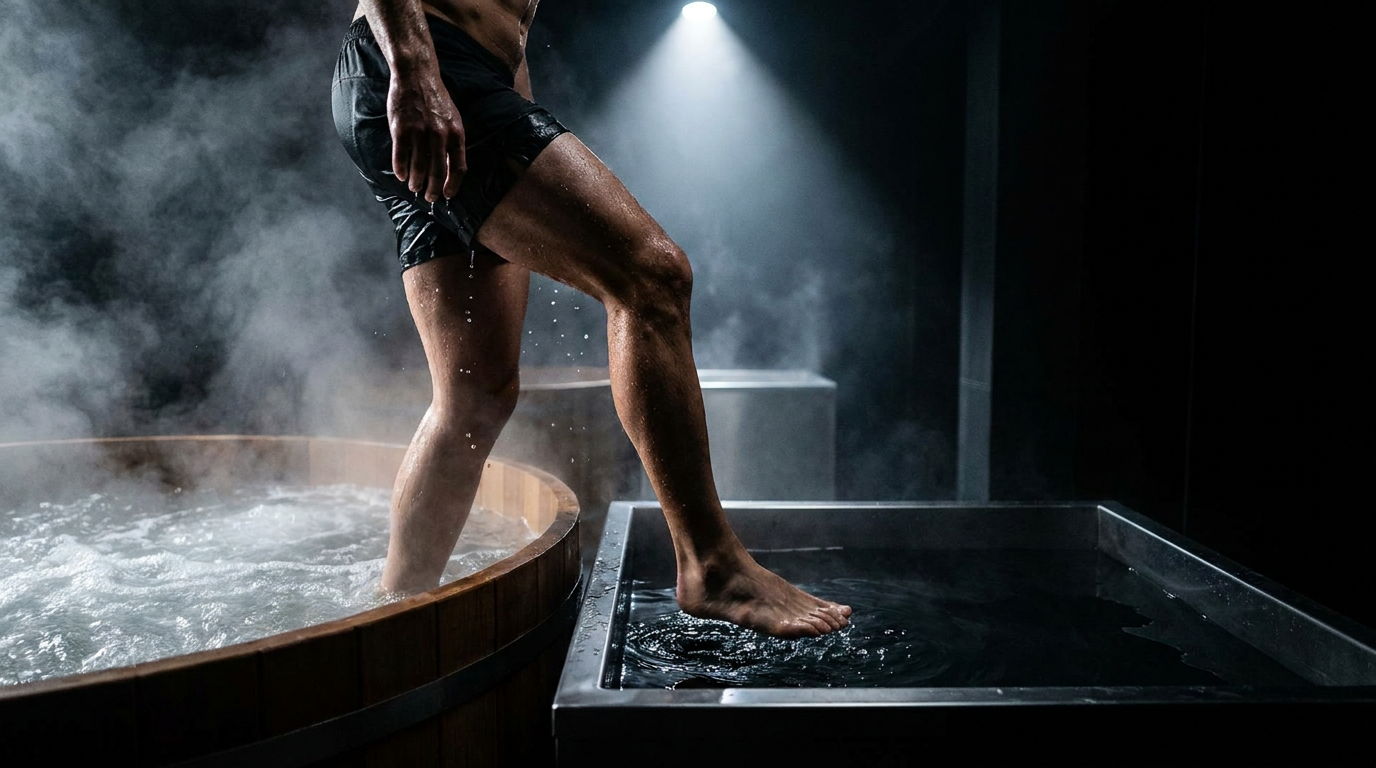
Contrast Water Therapy attempts to harness the benefits of both extremes by rapidly alternating between them. The theory behind CWT is that the rapid transition from heat-induced vasodilation to cold-induced vasoconstriction creates a physiological pumping action within the vascular system. This vascular pump is believed to forcefully flush out accumulated metabolic waste products—such as hydrogen ions and inorganic phosphates—while simultaneously drawing in fresh, nutrient-dense blood with each cycle.[1][6]
The clinical evidence supporting this vascular pump theory is robust, particularly regarding symptom management. A comprehensive systematic review published in PLoS ONE analyzed pooled data from multiple controlled trials and found that Contrast Water Therapy resulted in significantly greater improvements in muscle soreness compared to passive recovery. These benefits were observed across a prolonged timeline, providing relief at intervals ranging from under six hours to a full 96 hours post-exercise.[1]

The same review noted that CWT also significantly reduced the loss of muscle strength during the recovery window. When athletes undergo intense, muscle-damaging exercise, their maximal force output drops precipitously and can remain depressed for days. By utilizing contrast therapy, athletes were able to restore their baseline strength metrics much faster than those who simply rested, making the modality highly attractive for competitors engaged in multi-day tournaments or high-frequency training blocks.[1][2]
However, the aggressive reduction of inflammation through cold and contrast therapy comes with a significant physiological trade-off. Inflammation is often demonized in fitness circles, but acute inflammation is actually a vital biological signal. The micro-tears and subsequent inflammatory cascade triggered by lifting weights are exactly what signal the body's satellite cells to begin the process of muscle hypertrophy—the building of new, stronger muscle tissue.[4]
Research published in The Journal of Physiology has demonstrated that regular application of cold water immersion after resistance training can actually attenuate long-term gains in muscle mass and strength. By artificially blunting the inflammatory response and cellular stress signals, athletes inadvertently quiet the very alarms that tell the body to grow. While the muscles feel less sore, they also receive a weaker stimulus for adaptation, meaning the athlete may recover faster but grow less over the course of a training cycle.[4]

This paradox has led sports scientists to recommend a periodized approach to recovery modalities. During the off-season or dedicated hypertrophy phases—where the primary goal is building muscle and maximizing physiological adaptation—athletes are increasingly advised to embrace the soreness and rely on active recovery or passive rest. Conversely, during the competitive season, when immediate performance and readiness are paramount and long-term adaptation is secondary, Contrast Water Therapy remains one of the most effective tools available for keeping athletes on the field.[6]
Viewpoints in depth
Performance Optimizers
Athletes and coaches focused on immediate readiness and symptom management.
For athletes in the middle of a competitive season or a multi-day tournament, the primary goal is immediate readiness. This camp relies heavily on the analgesic and anti-inflammatory properties of cold and contrast therapy to manage Delayed Onset Muscle Soreness (DOMS). By forcefully flushing metabolic waste and reducing acute swelling, they ensure that an athlete can return to the field the next day with restored maximal force output, prioritizing short-term performance over long-term physiological adaptation.
Adaptation Advocates
Strength coaches and bodybuilders focused on maximizing long-term muscle growth.
This perspective views post-workout inflammation not as an enemy to be vanquished, but as a crucial biological signal. Because the micro-tears and subsequent cellular stress from lifting weights are what trigger satellite cells to build new muscle, this camp argues that artificially blunting that response with cold water immersion is counterproductive. They advocate for active recovery or passive rest during off-season hypertrophy phases, accepting temporary soreness as the necessary price for long-term strength gains.
Sports Scientists
Researchers advocating for the strategic periodization of recovery modalities.
Rather than declaring one method universally superior, sports scientists emphasize context. They argue that recovery modalities should be periodized just like training programs. During phases where the goal is building muscle mass, they advise against frequent cold exposure. However, during peaking phases or intense competitive blocks where the goal is simply surviving the schedule without a drop in performance, they view Contrast Water Therapy as an indispensable tool for maintaining athletic output.
What we don't know
- The exact optimal ratio of hot-to-cold time for specific types of athletes, such as endurance runners versus powerlifters.
- Whether the psychological placebo effect of feeling 'refreshed' after a cold plunge contributes more to perceived recovery than the actual physiological changes.
- The long-term effects of daily contrast therapy on cardiovascular health in non-athletic populations.
Key terms
- Vasoconstriction
- The narrowing of blood vessels, typically in response to cold, which restricts blood flow and reduces swelling.
- Vasodilation
- The widening of blood vessels, typically in response to heat, which increases blood flow and nutrient delivery to tissues.
- Delayed Onset Muscle Soreness (DOMS)
- The deep muscle pain and stiffness that typically peaks 24 to 72 hours after intense or unaccustomed exercise.
- Hypertrophy
- The enlargement of an organ or tissue, specifically the increase in muscle mass achieved through resistance training.
- Contrast Water Therapy (CWT)
- A recovery modality that involves rapidly alternating between hot and cold water immersion to stimulate circulation.
Frequently asked
Should I end a contrast therapy session on hot or cold?
It depends on your goal. Ending on cold ensures blood vessels remain constricted, minimizing lingering inflammation. Ending on hot promotes vasodilation, which is better for relaxing stiff muscles and improving flexibility.
Does contrast therapy help build muscle?
No. In fact, relying heavily on cold or contrast therapy after resistance training can actually blunt the inflammatory signals your body needs to trigger muscle growth (hypertrophy).
How long should each hot and cold interval be?
Most clinical protocols alternate between 1 to 2 minutes of cold exposure and 3 to 4 minutes of heat exposure, repeating the cycle 3 to 4 times for optimal vascular pumping.
Sources
Source coverage
6 outlets
3 viewpoints surfaced






[1]PLoS ONEPerformance Optimizers
Contrast Water Therapy and Exercise Induced Muscle Damage: A Systematic Review and Meta-Analysis
Read on PLoS ONE →[2]Journal of Strength and Conditioning ResearchPerformance Optimizers
Effects of Cold Water Immersion and Contrast Water Therapy for Recovery From Team Sport: A Systematic Review and Meta-analysis
Read on Journal of Strength and Conditioning Research →[3]Sports MedicinePerformance Optimizers
Impact of Cold-Water Immersion Compared with Other Recovery Modalities on Athletic Performance Following Acute Strenuous Exercise in Physically Active Participants: A Systematic Review, Meta-Analysis, and Meta-Regression
Read on Sports Medicine →[4]The Journal of PhysiologyAdaptation Advocates
Post-exercise cold water immersion attenuates acute anabolic signalling and long-term adaptations in muscle to strength training
Read on The Journal of Physiology →[5]National Institutes of HealthSports Scientists
Local Heat Therapy to Accelerate Recovery After Exercise-Induced Muscle Damage
Read on National Institutes of Health →[6]Factlen Editorial TeamSports Scientists
Synthesis by Factlen editorial team
Read on Factlen Editorial Team →
Every angle. Every day.
Get fitness stories with full source coverage and perspective breakdowns delivered to your inbox.