
The Rise of Astrotourism: Why Travelers Are Chasing the Dark in 2026
As light pollution erases the night sky for billions, a booming travel trend is turning pristine darkness into a highly sought-after natural resource and an economic engine for rural communities.
By Factlen Editorial Team
- Rural Destination Managers
- They view astrotourism as a low-cost, high-return economic engine that revitalizes remote towns.
- Conservationists & Astronomers
- They prioritize the protection of the night sky as a critical ecological and scientific resource.
- The Luxury Hospitality Sector
- They see pristine darkness as the ultimate premium amenity for travelers seeking escape and exclusivity.
- Socioeconomic Researchers
- They focus on ensuring that the financial benefits of astrotourism are equitably distributed to local populations.
What's not represented
- · Indigenous Starlore Guides
- · Lighting Manufacturers
Why this matters
With 80% of North Americans unable to see the Milky Way from home, the preservation of dark skies offers a rare dual benefit: it protects nocturnal ecosystems while providing a sustainable, low-infrastructure economic lifeline to remote rural towns.
Key points
- More than 60% of travelers in 2026 express interest in visiting dark sky destinations.
- Light pollution has rendered the Milky Way invisible to roughly 80% of North Americans.
- Astrotourism provides a low-infrastructure economic engine for rural communities, driving high-value overnight stays.
- Dark sky certifications require strict lighting ordinances that simultaneously protect nocturnal wildlife from artificial light disruption.
- Luxury hotels are capitalizing on the trend by building private observatories and hiring resident astronomers.
When NASA’s Artemis II crew splashed down in the Pacific Ocean in April 2026, completing the first crewed journey to the vicinity of the moon in more than half a century, it sparked a renewed global fascination with the cosmos. Millions of people tracked the mission, scrolled through deep-space imagery, and looked up at the night sky with fresh curiosity. But for a rapidly growing demographic of travelers, that sense of wonder is no longer satisfied by a screen. They are packing their bags and heading into the wilderness, driving a massive surge in a travel sector that relies entirely on the absence of light.
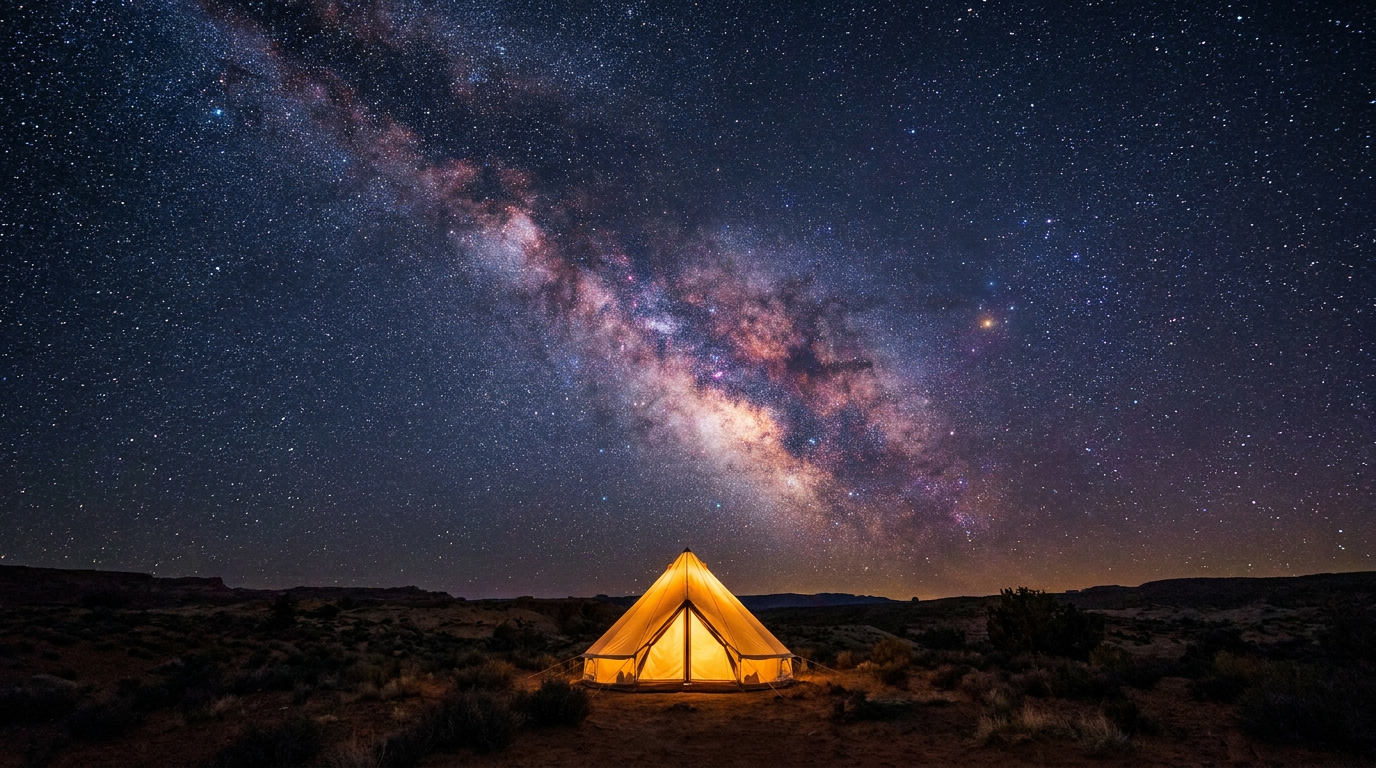
Astrotourism—travel centered on experiencing pristine night skies, stargazing, and celestial events—has quietly evolved from a niche hobby for amateur astronomers into one of the defining travel trends of 2026. According to recent industry data, more than 60 percent of travelers now express a specific interest in visiting dark sky destinations, treating the night not as a pause between daytime activities, but as the primary environment to explore. This shift is transforming remote deserts, isolated mountain towns, and expansive national parks into highly sought-after global destinations.[3]
The urgency driving this trend is rooted in a profound environmental loss: darkness is rapidly becoming a finite natural resource. The proliferation of artificial lighting has fundamentally altered the nocturnal landscape across the developed world. Today, an estimated 99 percent of people in the United States and Europe live under skies polluted by artificial skyglow. For roughly 80 percent of North Americans, the Milky Way is completely invisible from their homes, obscured by a permanent, hazy dome of urban light.[2]
For many travelers, the pursuit of a truly dark sky is about more than just aesthetics; it is a search for scale and perspective in an increasingly hyper-connected, over-stimulated world. The hospitality industry has dubbed this broader movement "hushpitality," catering to guests who want to escape sensory overload. Standing under a canopy of thousands of visible stars offers a visceral reminder of humanity's place in the universe, providing a psychological reset that traditional beach vacations or city breaks struggle to match.[1]

But finding genuine darkness requires more than just driving away from the city. It requires coordinated, rigorous conservation, a movement spearheaded by DarkSky International. The organization manages a strict certification program that designates International Dark Sky Places, ranging from urban parks to massive, remote sanctuaries. Achieving this certification is not a simple rubber-stamp process; it demands years of community effort, including comprehensive light meter readings, the passing of strict municipal lighting ordinances, and the retrofitting of thousands of non-compliant streetlights.[4]
The scale of these protected areas is expanding dramatically to meet traveler demand. In March 2024, a massive 2.5-million-acre expanse in southeastern Oregon was certified as the world’s largest International Dark Sky Sanctuary. The Oregon Outback designation was the result of a four-year collaboration between tourism boards, the U.S. Forest Service, indigenous tribes, and local ranchers, all of whom agreed to a shared lighting management plan to protect the region's nocturnal heritage.[5]
For rural communities, the economic logic of astrotourism is undeniable. Traditional tourism development often requires staggering capital investments—new airports, widened highways, and sprawling resort complexes. Astrotourism flips this paradigm entirely. The primary asset is the preservation of the natural environment exactly as it is. By simply protecting their darkness, remote towns can attract a steady stream of high-value visitors without compromising their rural character or straining local infrastructure.[7]

For rural communities, the economic logic of astrotourism is undeniable.
The financial impact of these visitors is substantial. Because stargazing inherently requires being on location late at night, astrotourists are almost guaranteed to book overnight accommodations. Economic studies of dark sky tourism on the Colorado Plateau—a region spanning parts of Utah, Arizona, Colorado, and New Mexico—projected that nonlocal tourists drawn by the night sky would spend $5.8 billion over a ten-year period. These overnight visitors typically spend up to three times as much in the local economy as day-trippers, supporting restaurants, local guides, and boutique lodging.[7]
Furthermore, astrotourism elegantly solves one of the tourism industry's most persistent challenges: seasonality. In many rural destinations, the tourist economy booms in the summer and collapses in the winter. However, stargazing conditions are often superior during the colder months, when the crisp, dry air reduces atmospheric distortion and the nights are significantly longer. This provides a vital, year-round economic lifeline to communities that previously struggled to survive the off-season.
The socioeconomic benefits extend far beyond North America. In Sutherland, South Africa, the establishment of the Southern African Large Telescope (SALT) and the surrounding dark sky protections have catalyzed local development. The influx of astronomical researchers and astrotourists has driven a dramatic increase in local guesthouses and hospitality jobs, providing a crucial counterweight to rural unemployment and demonstrating how scientific infrastructure can democratize tourism revenue in developing regions.[6]

Recognizing the immense value of pristine skies, the luxury hospitality sector is aggressively pivoting to capture the high-end astrotourism market. Hotels are no longer satisfied with simply placing a decorative telescope in the corner of a suite. From the arid expanses of Chile's Atacama Desert to the remote atolls of the Maldives, luxury properties are building permanent, state-of-the-art observatories. Many are hiring resident astronomers to guide guests through the cosmos, and some are even redesigning their architecture to feature glass-ceiling beds, allowing guests to stargaze from under the covers.[1]
While the economic and experiential benefits are clear, the quiet triumph of the astrotourism boom is its ecological co-benefits. Artificial light at night is a potent, often overlooked pollutant that wreaks havoc on natural ecosystems. It disorients migrating birds, leading to fatal collisions, disrupts the reproductive cycles of nocturnal insects, and alters the hunting patterns of predators. By attaching a powerful economic incentive to the reduction of light pollution, astrotourism acts as a massive, self-funding conservation mechanism for nocturnal wildlife.[4][8]
Yet, the rapid growth of the sector presents a paradox: the threat of loving the dark to death. If thousands of tourists flock to a remote dark sky park, the headlights from their rental cars, the glow of their smartphones, and the necessary expansion of local lodging could inadvertently introduce the very light pollution they traveled so far to escape. Managing this influx requires a delicate balance between accessibility and preservation.

To mitigate these risks, certified dark sky destinations are implementing innovative crowd-management and infrastructure strategies. Many parks now require visitors to use centralized shuttle systems to eliminate headlight glare, while resorts enforce strict "red light only" policies on their grounds to preserve guests' night vision and protect local wildlife. The goal is to ensure that the human footprint remains virtually invisible once the sun goes down.
As the trend matures, there is also a growing movement to decolonize the night sky. For decades, amateur astronomy has been dominated by Greco-Roman constellations and Western scientific narratives. Today, indigenous-led astrotourism is reclaiming the narrative, offering travelers the opportunity to learn local starlore, traditional navigation techniques, and the cultural significance of the cosmos from the communities whose ancestors have read the night sky for millennia.
Ultimately, the rise of astrotourism in 2026 represents a profound shift in how we value the natural world. It is a recognition that looking up into a vast, unpolluted universe is not a luxury, but a fundamental human experience that is rapidly slipping away. By traveling to the dark, tourists are doing more than just chasing a beautiful view; they are actively funding the preservation of the night sky, ensuring that the stars remain visible for generations to come.[8]
How we got here
2001
The International Dark-Sky Association certifies the world's first International Dark Sky Place.
2016
A global light pollution atlas reveals that 80% of North Americans can no longer see the Milky Way from home.
March 2024
The Oregon Outback is certified as the world's largest International Dark Sky Sanctuary, protecting 2.5 million acres.
April 2026
NASA's Artemis II lunar flyby sparks renewed global interest in space and the cosmos.
August 2026
A total solar eclipse sweeping across Greenland, Iceland, and Spain drives a massive spike in international astrotourism bookings.
Viewpoints in depth
Rural Destination Managers
They view astrotourism as a low-cost, high-return economic engine that revitalizes remote towns.
For rural communities, traditional tourism often demands massive infrastructure investments—paved roads, large airports, and sprawling resorts. Astrotourism flips this model. The primary asset is the absence of development. Destination marketing organizations emphasize that stargazers stay overnight, spending up to three times more than day-trippers, and often visit during the colder off-season months, providing year-round economic stability to towns that previously relied on brief summer peaks.
Conservationists & Astronomers
They prioritize the protection of the night sky as a critical ecological and scientific resource.
This camp views the tourism boom as a Trojan horse for conservation. By attaching a dollar value to darkness, they can incentivize municipalities to pass strict lighting ordinances. Their primary concern is that artificial light disrupts nocturnal wildlife, bird migrations, and human circadian rhythms. For astronomers, preserving these dark zones is an existential necessity for ground-based observation, ensuring that the cosmos remains visible to future generations.
The Luxury Hospitality Sector
They see pristine darkness as the ultimate premium amenity for travelers seeking escape and exclusivity.
High-end resorts are capitalizing on the scarcity of natural darkness by branding it as a luxury experience. They argue that modern travelers are over-stimulated and seek "hushpitality"—environments that offer profound quiet and cosmic perspective. By investing in private observatories, resident astronomers, and specialized architecture, they are transforming the night sky from a passive backdrop into a highly monetizable, exclusive wellness experience.
Socioeconomic Researchers
They focus on ensuring that the financial benefits of astrotourism are equitably distributed to local populations.
While acknowledging the economic potential, researchers warn against the gentrification of the night sky. They point out that astronomical facilities and dark sky reserves are often located in impoverished rural areas. Their goal is to ensure that the influx of tourism dollars doesn't just enrich outside hospitality developers, but actively creates local jobs, funds community education, and respects indigenous cultural heritage and starlore.
What we don't know
- Whether rural infrastructure can handle the sudden influx of tourists without inadvertently creating new light pollution.
- How long the current peak in aurora visibility driven by the solar maximum will sustain mainstream interest in astrotourism.
- If the hospitality industry's push for luxury stargazing will price out average travelers from accessing certified dark sky reserves.
Key terms
- Astrotourism
- Travel centered on experiencing dark skies, stargazing, and celestial events, often in remote areas free from artificial light.
- Light Pollution
- The inappropriate or excessive use of artificial light, which obscures the night sky, disrupts ecosystems, and wastes energy.
- Dark Sky Sanctuary
- A public or private land that has an exceptional quality of starry nights and a nocturnal environment protected for its scientific, natural, or educational value.
- Skyglow
- The brightening of the night sky over inhabited areas, caused by artificial light scattering in the atmosphere.
- Hushpitality
- A hospitality trend catering to travelers seeking environments that offer profound quiet, privacy, and an escape from sensory overload.
Frequently asked
Do I need a telescope to participate in astrotourism?
No. While some luxury resorts offer observatory access, the primary draw of astrotourism is experiencing the vastness of a naturally dark sky and the Milky Way with the naked eye.
Why is 2026 a particularly good year for stargazing?
The sun is currently experiencing a 'solar maximum,' a period of peak magnetic activity that produces more frequent and intense auroras, often visible at unusually low latitudes.
How does a town become a certified Dark Sky Community?
Communities must pass strict outdoor lighting ordinances, retrofit non-compliant streetlights to eliminate upward glare, and demonstrate ongoing citizen education and support for night sky preservation.
Sources
Source coverage
8 outlets
4 viewpoints surfaced








[1]ForbesThe Luxury Hospitality Sector
The Rise Of Astrotourism: 25 Hotels Leading The Stargazing Trend
Read on Forbes →[2]National GeographicConservationists & Astronomers
Dark Sky Tourism is on the rise in the US
Read on National Geographic →[3]Booking.comThe Luxury Hospitality Sector
2025/2026 Travel Predictions: The Rise of Noctourism
Read on Booking.com →[4]DarkSky InternationalConservationists & Astronomers
International Dark Sky Places Program
Read on DarkSky International →[5]Travel OregonRural Destination Managers
Designating the World's Largest International Dark Sky Sanctuary
Read on Travel Oregon →[6]arXivSocioeconomic Researchers
Astronomy as a driver for sustainable local socio-economic development
Read on arXiv →[7]Miles PartnershipRural Destination Managers
Studying Dark Sky Tourism's Potential Economic Impacts
Read on Miles Partnership →[8]Factlen Editorial TeamSocioeconomic Researchers
Synthesis by Factlen editorial team
Read on Factlen Editorial Team →
Every angle. Every day.
Get travel stories with full source coverage and perspective breakdowns delivered to your inbox.