
Snoo vs. Cradlewise: The 2026 Smart Bassinet Trade-Off Analysis
As smart bassinets dominate modern nurseries, parents face a high-stakes choice between the Snoo's FDA-authorized short-term intervention and the Cradlewise's two-year convertible investment.
By Factlen Editorial Team
- The Long-Term Investors
- This viewpoint values longevity and integrated technology, arguing that the Cradlewise's two-year lifespan justifies its higher upfront cost.
- The Short-Term Interventionists
- This camp prioritizes immediate, proven relief during the grueling newborn phase, favoring the Snoo's FDA-authorized safety and flexible rental model.
- The Data Skeptics
- This perspective warns that smart bassinets can increase parental anxiety by over-quantifying natural infant sleep patterns.
What's not represented
- · Budget-Conscious Families
- · Families with Multiples (Twins)
Why this matters
For sleep-deprived new parents, choosing the right smart bassinet is a high-stakes financial and emotional decision. Understanding the precise trade-offs between short-term interventions and long-term investments can save families thousands of dollars while ensuring their infant sleeps safely.
Key points
- The Snoo offers a 6-month, FDA-authorized sleep solution with a side-to-side rocking motion and a flexible rental program.
- The Cradlewise provides a 24-month investment that converts to a mini-crib, featuring an up-and-down bounce and built-in camera.
- Both premium bassinets meet the AAP's strict 2026 safe sleep guidelines for a firm, flat, and non-inclined surface.
- Snoo recently introduced a $20 monthly subscription for its app features, altering its long-term value calculation.
- Cradlewise uses predictive technology to soothe babies before they fully wake, but lacks a short-term rental option.
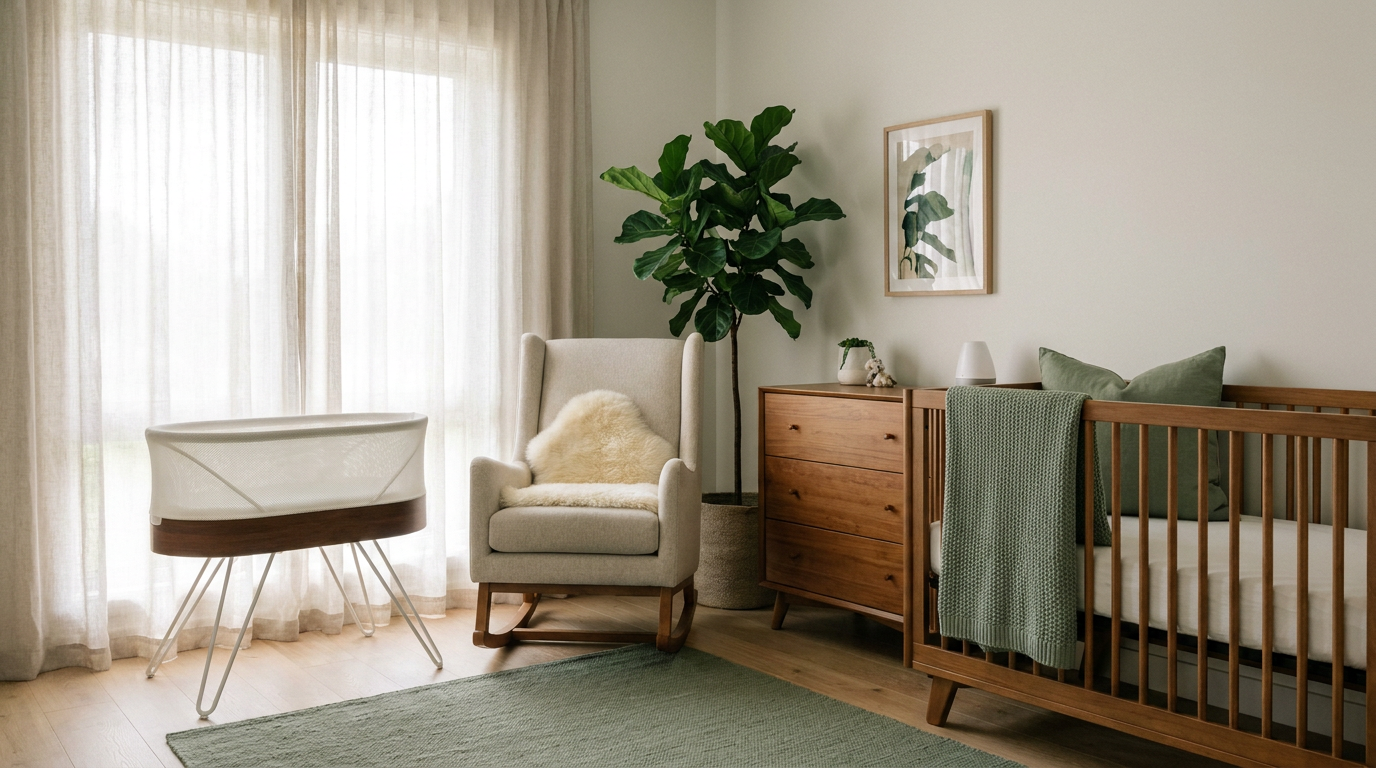
For sleep-deprived new parents, the quest for a full night of rest often leads to the high-tech world of smart bassinets. The market is currently dominated by two premium options: the Snoo Smart Sleeper and the Cradlewise Smart Crib. Both devices promise to buy exhausted families a few extra hours of sleep using active soothing technology, but they take fundamentally different approaches to the nursery. While traditional bassinets serve as simple, static sleep surfaces, these modern smart cribs utilize sensors, microphones, and motorized movements to detect when an infant is stirring and automatically intervene. As parents weigh the steep financial investments required for these devices, understanding the precise trade-offs between short-term interventions and long-term furniture investments has become a critical part of modern registry planning.[1][5]
The core philosophical difference between the two devices lies in their timeline and mechanical approach. The Snoo is designed strictly as a short-term, medical-grade intervention that lasts only for the first six months of a baby's life. It utilizes a side-to-side rocking motion intended to mimic the womb, and it requires a specialized swaddle that clips securely into the sides of the bassinet. In contrast, the Cradlewise is built as a long-term piece of convertible furniture. It transitions from a bassinet into a mini-crib, accommodating children up to 24 months old or 33 pounds. Rather than rocking side-to-side, the Cradlewise employs an up-and-down bouncing motion designed to replicate the feeling of a parent gently jiggling their baby in their arms.[1][3]
When analyzing the Snoo, the arguments for it center heavily on its proven track record and unparalleled regulatory backing. It holds the distinction of being the first and only bassinet to receive FDA De Novo authorization for its ability to keep sleeping infants safely on their backs, which remains the primary preventable positional sleep risk for newborns. For highly anxious first-time parents, this medical-grade safety feature offers profound peace of mind. Furthermore, the Snoo benefits from a highly flexible rental program. Priced at approximately $159 per month, the rental option makes the device highly accessible for families who cannot afford the steep $1,695 retail price tag, allowing them to utilize the technology only for the exact months they need it.[2][4]

The evidence against the Snoo focuses on its strict six-month usage cliff and recent shifts in its software monetization strategy. Once a baby develops the strength to push up on their hands and knees, the Snoo's swaddle restraint becomes a potential hazard, forcing a sometimes-difficult transition to a traditional, stationary crib. Additionally, the manufacturer recently placed several premium app features—including detailed sleep tracking and advanced motion adjustments—behind a $20 monthly subscription paywall. This new recurring fee has frustrated many parents and significantly altered the long-term value calculation, especially for families hoping to reuse the device for multiple children or sell it on the secondary market.[2][4][6]
Turning to the Cradlewise, the arguments for it highlight its exceptional longevity and deeply integrated technology suite. Because the unit converts to a mini-crib and supports toddlers for up to two years, the $1,999 upfront cost is effectively amortized over a much longer period of continuous use. It also features a built-in night vision camera and an integrated white noise machine, which eliminates the need for parents to research and purchase a separate baby monitor system. Crucially, its predictive technology is designed to begin bouncing the moment a baby stirs, often soothing the infant back into a deep sleep before they fully wake up and begin crying.[3][5][6]
Turning to the Cradlewise, the arguments for it highlight its exceptional longevity and deeply integrated technology suite.
The evidence against the Cradlewise involves its steep initial barrier to entry and its substantial physical footprint. Unlike its competitor, there is no short-term rental option available, meaning parents must commit to the full purchase price before knowing whether their specific baby will actually tolerate the up-and-down bouncing motion. Furthermore, the unit is significantly heavier and more complex to assemble than the Snoo. It requires a dedicated, permanent space in the bedroom or nursery from day one, making it less ideal for families living in tight quarters or those who prefer a lightweight, easily movable bassinet for the early newborn days.[1][5]

Regardless of the technology, both devices must be evaluated through the rigorous lens of the American Academy of Pediatrics' 2026 safe sleep guidelines. The AAP strictly mandates that infants sleep on a firm, flat, non-inclined surface that is entirely free of loose blankets, pillows, bumper pads, or weighted sleepwear. Both the Snoo and the Cradlewise meet these stringent federal safety standards, providing the required flat surface and breathable mesh sides. By adhering to these baseline rules, both smart cribs successfully avoid the severe hazards associated with recalled inclined sleepers, ensuring that the active soothing mechanisms do not compromise fundamental airway safety.[7][8]
However, pediatricians and sleep consultants frequently warn against the data anxiety that these smart devices can inadvertently induce. While both bassinets heavily emphasize sleep analytics, daily charts, and app notifications, tracking every micro-wakeup can lead to obsessive checking and increased parental stress. The data provided by these apps rarely changes the biological reality that newborns require time to develop mature sleep cycles, which typically takes about four months. Medical professionals remind parents that while technology can assist in soothing, it cannot override a baby's natural developmental timeline, and families should be cautious about letting sleep data dictate their emotional well-being.[4][8]
Ultimately, the Snoo fits well when parents want a proven, FDA-authorized safety device for the high-anxiety newborn phase and prefer to manage their costs through a short-term rental. It is ideal for families who already plan to transition their baby to a standard wooden crib at six months and want the peace of mind that comes with the secure swaddle system. Conversely, the Snoo does not fit when parents are fundamentally opposed to paying monthly app subscriptions, or when they want a single, continuous sleep solution that lasts well into toddlerhood without requiring a disruptive transition.[1][2]

On the other hand, the Cradlewise fits well when parents value a comprehensive 'one-and-done' investment that grows alongside their child for two full years. It is perfectly suited for tech-forward families who want an integrated camera monitor and prefer a natural up-and-down bouncing motion over side-to-side rocking. The Cradlewise does not fit when families are on a strict short-term budget, lack the physical space for a heavier convertible crib, or want the financial flexibility to simply return the device if their baby rejects the automated soothing.[3][6]
How we got here
2016
Happiest Baby launches the Snoo, popularizing the smart bassinet category.
2020
Cradlewise enters the market with a built-in monitor and an extended 24-month lifespan.
2022
The AAP updates safe sleep guidelines to explicitly warn against inclined sleepers, reinforcing the need for flat surfaces.
2024
Snoo introduces a controversial monthly subscription for its premium app features, altering its long-term value.
2026
Both brands dominate the premium nursery market as parents weigh subscription costs against long-term furniture investments.
Viewpoints in depth
The Short-Term Interventionists
This camp prioritizes immediate, proven relief during the grueling newborn phase, favoring the Snoo's FDA-authorized safety and flexible rental model.
Proponents argue that the first six months of a baby's life are uniquely exhausting and require a specialized, medical-grade tool. They point to the Snoo's FDA De Novo authorization as the ultimate peace of mind for safe back-sleeping. For this group, the ability to rent the device for $159 a month makes it a highly efficient, short-term intervention that can be easily returned once the baby is ready for a standard wooden crib, avoiding the commitment of a massive piece of tech furniture.
The Long-Term Investors
This viewpoint values longevity and integrated technology, arguing that the Cradlewise's two-year lifespan justifies its higher upfront cost.
Advocates for this approach emphasize the financial and practical benefits of a 'one-and-done' sleep solution. By converting from a bassinet to a mini-crib, the Cradlewise eliminates the dreaded six-month transition phase where babies often regress in their sleep habits. Furthermore, this camp highlights that the built-in camera and white noise machine save parents from buying redundant gadgets, making the $1,999 price tag a better overall value when amortized over 24 months of continuous use.
The Data Skeptics
This perspective warns that smart bassinets can increase parental anxiety by over-quantifying infant sleep.
Pediatricians and sleep consultants in this camp caution that the relentless tracking of sleep data—a core feature of both the Snoo and Cradlewise apps—often does more harm than good for parents' mental health. They argue that newborns naturally wake frequently and that obsessing over daily sleep charts cannot change biological development. This group advocates for adhering to simple AAP safe sleep guidelines—a firm, flat, bare surface—without relying on expensive technology to solve natural infant sleep patterns.
What we don't know
- Whether the up-and-down bounce of the Cradlewise or the side-to-side rock of the Snoo will be more effective for any specific infant.
- How the secondary resale market for the Snoo will be impacted long-term by the introduction of mandatory app subscriptions.
- If future AAP guidelines will address the psychological impact of sleep-tracking data on parental anxiety.
Key terms
- FDA De Novo authorization
- A regulatory pathway for novel medical devices, granted to the Snoo for its ability to keep infants safely on their backs.
- Active soothing
- Technology that detects a baby's cries or movements and automatically responds with motion and sound to calm them.
- Sleep regression
- Periods when a baby who has been sleeping well suddenly wakes frequently, often occurring around four months of age as sleep cycles mature.
- Safe Sleep Guidelines
- A set of evidence-based rules from the AAP emphasizing a firm, flat, bare sleep surface to reduce infant mortality risks.
Frequently asked
Can you rent the Cradlewise?
No, unlike the Snoo, the Cradlewise is currently only available for purchase, though the company occasionally offers discounts for planning orders in advance.
Do these bassinets meet AAP safe sleep guidelines?
Yes, both the Snoo and the Cradlewise provide a firm, flat, non-inclined sleep surface that aligns with the strict 2026 AAP safe sleep recommendations.
What happens when the baby outgrows the Snoo?
Because the Snoo is only designed for the first six months, parents must transition their baby to a standard crib once the infant can roll over or push up on their hands and knees.
Does the Snoo require a monthly subscription?
Yes, Happiest Baby recently introduced a monthly subscription fee (approximately $20) to access premium app features like detailed sleep tracking and advanced motion settings.
Sources
Source coverage
8 outlets
3 viewpoints surfaced








[1]BabylistThe Short-Term Interventionists
Cradlewise vs SNOO: Which Smart Crib Is Best?
Read on Babylist →[2]FathercraftThe Short-Term Interventionists
SNOO vs. Cradlewise: I've tested both… on the same kid
Read on Fathercraft →[3]One Smart CribThe Long-Term Investors
Cradlewise vs SNOO: Which Smart Crib Is Best? (2026)
Read on One Smart Crib →[4]Baby Gear NerdThe Data Skeptics
Snoo vs Cradlewise: Key Smart Bassinet Features
Read on Baby Gear Nerd →[5]PoppylistThe Long-Term Investors
Cradlewise vs. SNOO: Which Smart Sleeper is Best?
Read on Poppylist →[6]Sara LaughedThe Long-Term Investors
Cradlewise Review: 6 Months with the Smart Crib
Read on Sara Laughed →[7]American Academy of PediatricsThe Data Skeptics
AAP Safe Sleep Recommendations
Read on American Academy of Pediatrics →[8]PostpartumGThe Data Skeptics
The Full 2026 AAP Safe Sleep Recommendations
Read on PostpartumG →

More in shopping
See all 5 stories →
Every angle. Every day.
Get shopping stories with full source coverage and perspective breakdowns delivered to your inbox.