
The Invisible Camera: How AI and Next-Gen Tech are Revolutionizing Wildlife Documentaries
Modern nature documentaries are capturing unprecedented animal behavior by removing the human footprint. Breakthroughs in disturbance-aware drones, thermal imaging, and AI are allowing filmmakers to observe the natural world without altering it.
By Factlen Editorial Team
- Wildlife Cinematographers
- Focus on visual fidelity, storytelling, and capturing unprecedented behavior without altering it.
- Conservation Ecologists
- Focus on utilizing non-invasive camera and drone technology to gather accurate population data and monitor ecosystems safely.
- Technology Developers
- Focus on pushing the boundaries of AI, sensor resolution, and drone stabilization to meet the demands of both filmmakers and consumers.
- Factlen Editorial
- Focus on synthesizing the intersection of technological advancement and natural preservation.
What's not represented
- · Amateur Drone Operators
- · Indigenous Guides and Trackers
Why this matters
As technology erases the barrier between humans and the wild, we gain an unprecedented, unfiltered view of the natural world. This shift not only revolutionizes entertainment but provides crucial, non-invasive tools for global conservation efforts.
Key points
- Modern wildlife documentaries are utilizing AI and robotics to film animals without altering their natural behavior.
- Disturbance-aware drones use reinforcement learning to maintain a stress-free distance from sensitive species.
- Military-grade thermal imaging and ultra-sensitive sensors allow crews to film nocturnal hunts in absolute darkness.
- High frame rates of up to 600 fps reveal split-second biomechanics invisible to the naked eye.
- These non-invasive cinematic tools are increasingly being adopted by biologists for safe, accurate ecological monitoring.
The intimacy of modern nature documentaries borders on the miraculous. Viewers can watch the whiskers of a snow leopard twitch in pitch-black darkness, or see a hummingbird's wings frozen in mid-dive. These sequences feel so close and so personal that the camera itself seems to vanish.[6]
For decades, achieving this level of intimacy presented a fundamental paradox for wildlife filmmakers: getting close enough to capture compelling behavior often meant invading the animal's space. The presence of human crews, loud helicopters, and bright artificial lights inevitably altered the very natural behaviors the documentaries sought to record.[2][6]
Today, the industry is undergoing a profound technological revolution aimed at solving this paradox. Driven by advancements in artificial intelligence, ultra-high-resolution sensors, and autonomous robotics, the focus has shifted entirely toward non-invasive filmmaking. The goal is no longer just to get the shot, but to get it without the subject ever knowing they are being watched.[1][6]
The most visible shift has been in the sky. Historically, sweeping aerial shots required helicopters equipped with heavy, stabilized camera rigs. While these provided epic landscapes, the deafening rotor noise would scatter herds and disrupt hunts from miles away. Drones offered a quieter alternative, but early models still caused visible stress to sensitive species.[4][5]

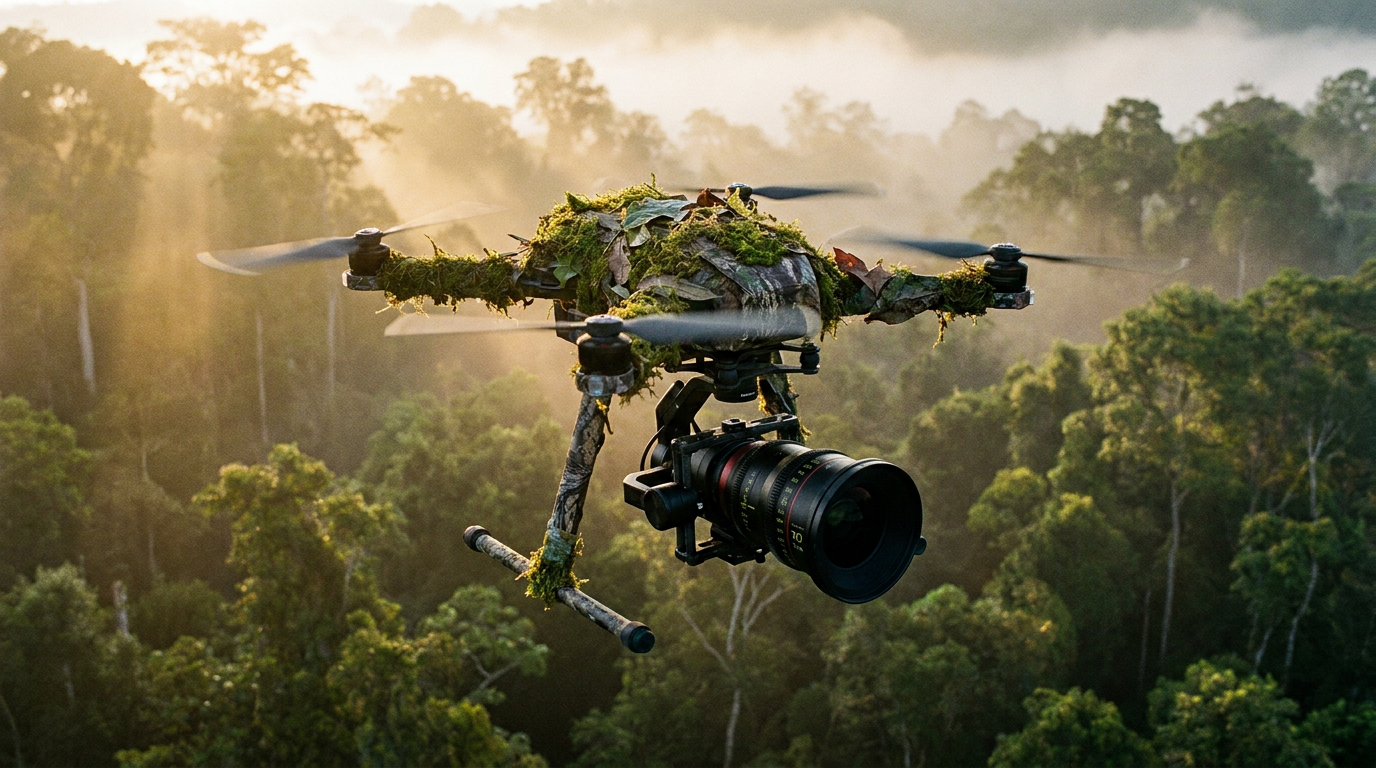
Enter the era of "disturbance-aware" robotics. Recent engineering breakthroughs, highlighted in 2025 academic reviews, have introduced reinforcement learning frameworks that teach drone fleets to read animal body language. These AI-piloted systems analyze the movement patterns of the species below them, autonomously adjusting their flight paths to remain firmly outside the animal's "flight or fight" radius.[1]
Whether tracking a flock of birds or a solitary predator, these smart drones maintain an optimal, stress-free distance. They achieve this while carrying increasingly powerful payloads. The integration of 12K resolution cameras into commercial and cinematic drones allows operators to fly hundreds of feet away from their subjects while still cropping in digitally to achieve a crisp, intimate close-up.[1][3]
The revolution extends far beyond daylight hours. Nighttime filming has historically been the most intrusive form of wildlife cinematography, relying on bright artificial floodlights or early infrared systems that required external, glowing illuminators. These setups inevitably blinded nocturnal creatures or alerted prey to the presence of predators.[5][6]
Modern crews have abandoned these intrusive methods in favor of military-grade thermal imaging and ultra-sensitive digital sensors. Cameras equipped with massive, light-gathering pixels can now shoot in what appears to the human eye as absolute pitch blackness, utilizing only ambient starlight or the faint glow of the moon.[4][5]
Modern crews have abandoned these intrusive methods in favor of military-grade thermal imaging and ultra-sensitive digital sensors.
Thermal cameras, which detect the heat emitted by an animal's body rather than the light reflecting off it, have also reached unprecedented levels of detail. Filmmakers can now capture the exact heat gradients of a leopard stalking through a city or a lion hunting on the savannah, revealing complex nocturnal ecosystems without casting a single shadow.[5]

On the ground, the challenge of remaining invisible is met with advanced stabilization and remote-control technology. Heavy-duty gimbals and Steadicams—tools originally perfected on Hollywood film sets—have been adapted for the rugged terrain of the wilderness. These rigs allow operators to track fast-moving animals smoothly without the jarring, shaky footage that once plagued handheld nature videography.[5]
For the macro world of insects and amphibians, specialized remote-controlled rigs navigate the forest floor. These miniature rovers carry high-quality macro lenses right up to the edge of a pond or a leaf, allowing the human operator to sit hundreds of yards away. This eliminates the micro-vibrations caused by human footsteps, which are often enough to send tiny subjects fleeing.[5][6]
Time itself is also being manipulated to reveal hidden behaviors. High frame rate (HFR) cinematography is now a standard tool in the wildlife filmmaker's kit. By shooting at 120 to 600 frames per second, cinematographers can stretch a two-second burst of action—like an osprey diving for a fish—into a majestic, minute-long sequence. This allows audiences to analyze biomechanics that are entirely invisible to the naked eye.[5]
Beyond the hardware, professional cinematographers are adopting strict new rules of engagement. Industry veterans emphasize the importance of locking off the camera and letting the animal move through the frame, rather than aggressively panning and tilting to chase the action. This patient, observational approach prioritizes authentic narrative over forced spectacle.[5][6]
The impact of this technological leap extends far beyond the entertainment value of streaming platforms. The same non-invasive tools developed for high-end documentaries are quietly transforming the field of ecological conservation. Biologists and researchers are increasingly adopting these cinematic techniques to monitor fragile ecosystems.[1][2]

For example, thermal drone setups are now routinely used to conduct population surveys in dense, impenetrable forests. Researchers can accurately assess the density of ungulates or track endangered predators from the sky without ever needing to dart, capture, or tag the animals—a process that is historically stressful and dangerous for the wildlife.[1]
Despite these incredible advancements, the democratization of this technology presents new challenges. As high-end drones and telephoto lenses become more affordable for the consumer market, there is a growing risk of amateur operators harassing wildlife. Without the ethical training and patience of professional crews, the very tools designed to protect animals can easily become a source of stress.[3][4]
Furthermore, the sheer volume of data generated by continuous AI monitoring and 12K video files requires massive storage and processing power. Managing terabytes of footage in remote, off-grid locations remains a significant logistical hurdle for documentary teams spending months in the field.[3][6]

Ultimately, the driving philosophy behind all of these innovations is to make the human observer disappear entirely. By removing our physical footprint, our noise, and our light from the frame, we are finally able to witness the natural world exactly as it is—unfiltered, undisturbed, and more vibrant than ever before.[2][6]
How we got here
Early 2000s
Documentaries transition to digital HD and adopt helicopter-mounted stabilization gimbals.
2014-2017
Ultra-sensitive digital sensors allow for unprecedented low-light and infrared nighttime filming.
2023-2024
Drones become the industry standard, replacing helicopters for quieter, closer aerial shots.
2025
Researchers debut disturbance-aware AI frameworks that teach drones to autonomously avoid stressing animals.
2026
12K resolution cameras and military-grade thermal imaging become widely integrated into non-invasive wildlife productions.
Viewpoints in depth
Wildlife Cinematographers
Prioritizing authentic storytelling and visual fidelity through patience and technology.
For professional wildlife filmmakers, the ultimate goal is to capture authentic, unmediated behavior. They view new technologies not as a crutch, but as a way to extend their patience. By utilizing remote rigs, ultra-telephoto lenses, and high frame rates, cinematographers can lock off their cameras and allow the natural drama to unfold without their physical presence altering the outcome. The focus remains strictly on narrative over spectacle.
Conservation Ecologists
Leveraging cinematic tools for non-invasive species monitoring and data collection.
Biologists and researchers see documentary technology as a massive leap forward for conservation science. Traditional methods of estimating animal populations often involved capturing, tranquilizing, and tagging subjects—a process that carries inherent risks. By adopting thermal imaging and disturbance-aware drones, ecologists can now conduct highly accurate, stress-free surveys of endangered species, turning cinematic tools into vital instruments for ecological preservation.
Technology Developers
Pushing the boundaries of hardware and AI to meet the demands of extreme environments.
For the engineers building these systems, the wilderness presents the ultimate stress test. Developers are focused on miniaturizing 12K sensors, extending battery life in freezing conditions, and refining the reinforcement learning algorithms that allow drones to fly autonomously. Their challenge is balancing the insatiable demand for higher resolution and smarter AI with the physical constraints of operating in the world's most remote, off-grid locations.
What we don't know
- How the proliferation of cheap, high-resolution consumer drones will impact wildlife harassment regulations.
- Whether the massive data storage requirements of 12K continuous monitoring can be sustainably managed in remote locations.
- How quickly disturbance-aware AI algorithms can be adapted to recognize the body language of highly obscure or unstudied species.
Key terms
- Disturbance-aware AI
- Algorithms that allow drones to read animal body language and autonomously maintain a safe distance.
- Thermal Imaging
- Camera technology that detects the heat emitted by an object rather than the light reflecting off it.
- High Frame Rate (HFR)
- Shooting video at speeds like 120 or 600 frames per second to create ultra-smooth slow motion.
- Reinforcement Learning
- A type of machine learning where an AI learns to make decisions by performing actions and receiving feedback.
- Gimbal
- A pivoted support system that allows a camera to remain perfectly stable regardless of the movement of its operator.
Frequently asked
How do filmmakers shoot in pitch black?
Crews use military-grade thermal imaging and ultra-sensitive digital sensors that can capture clear footage using only ambient starlight or the heat emitted by the animals.
Do drones scare the animals?
Historically, yes. However, new 'disturbance-aware' drones use AI to read animal body language and autonomously adjust their flight paths to avoid causing stress.
Why does documentary footage look so smooth?
Filmmakers use advanced stabilization gimbals and Steadicams—technology originally developed for Hollywood—to isolate the camera from the operator's movements.
How are tiny insects filmed without shaking?
Cinematographers use specialized remote-controlled rovers equipped with macro lenses, allowing them to film from a distance without their footsteps causing micro-vibrations.
Sources
Source coverage
6 outlets
4 viewpoints surfaced






[1]ResearchGateConservation Ecologists
CineWild: Balancing Art and Robotics for Ethical Wildlife Documentary Filmmaking
Read on ResearchGate →[2]Sanctuary Nature FoundationConservation Ecologists
A Changing Landscape: Technology and Wildlife Filmmaking
Read on Sanctuary Nature Foundation →[3]Market Research FutureTechnology Developers
Consumer Drone Market Future Outlook 2025-2035
Read on Market Research Future →[4]Extreme Aerial ProductionsTechnology Developers
Drone photography trends 2025
Read on Extreme Aerial Productions →[5]British CinematographerWildlife Cinematographers
Focus on Wild Filming: Techniques and Technology
Read on British Cinematographer →[6]Factlen Editorial TeamFactlen Editorial
Synthesis by Factlen editorial team
Read on Factlen Editorial Team →
Every angle. Every day.
Get entertainment stories with full source coverage and perspective breakdowns delivered to your inbox.