
From 1997 to 2026: How the WNBA Built a Blueprint for Women's Sports Growth
As the WNBA celebrates its 30th season, a historic new collective bargaining agreement, record viewership, and league expansion have transformed the economics of professional women's basketball.
By Factlen Editorial Team
- Players & Union Leadership
- Focused on securing fair compensation, better travel, and a larger share of the league's growing revenue.
- League Executives & Owners
- Focused on scaling the business through schedule expansion, new franchises, and lucrative media rights deals.
- Media & Broadcast Partners
- Focused on the WNBA as a high-growth live sports property that attracts younger, diverse audiences.
What's not represented
- · International basketball federations losing talent to the WNBA's extended schedule
- · Cities that bid for expansion teams but were rejected
Why this matters
The WNBA's explosive financial and cultural growth proves that sustained investment in women's sports yields massive commercial returns. The league's new economic model—featuring half-million-dollar rookie salaries and prime-time broadcast dominance—sets a new baseline for female athletes globally.
Key points
- The WNBA is celebrating its 30th season with a historic rematch of its 1997 inaugural game.
- A new collective bargaining agreement has drastically increased player pay, with top rookies earning $500,000.
- The league features a record 216 nationally televised games in 2026 across multiple major networks.
- Viewership remains historically high, with the 2026 Draft averaging 1.5 million viewers.
- The regular season will expand to a record 50 games per team beginning in 2027.
- The league expanded to 15 teams in 2026, including its first international franchise in Toronto.
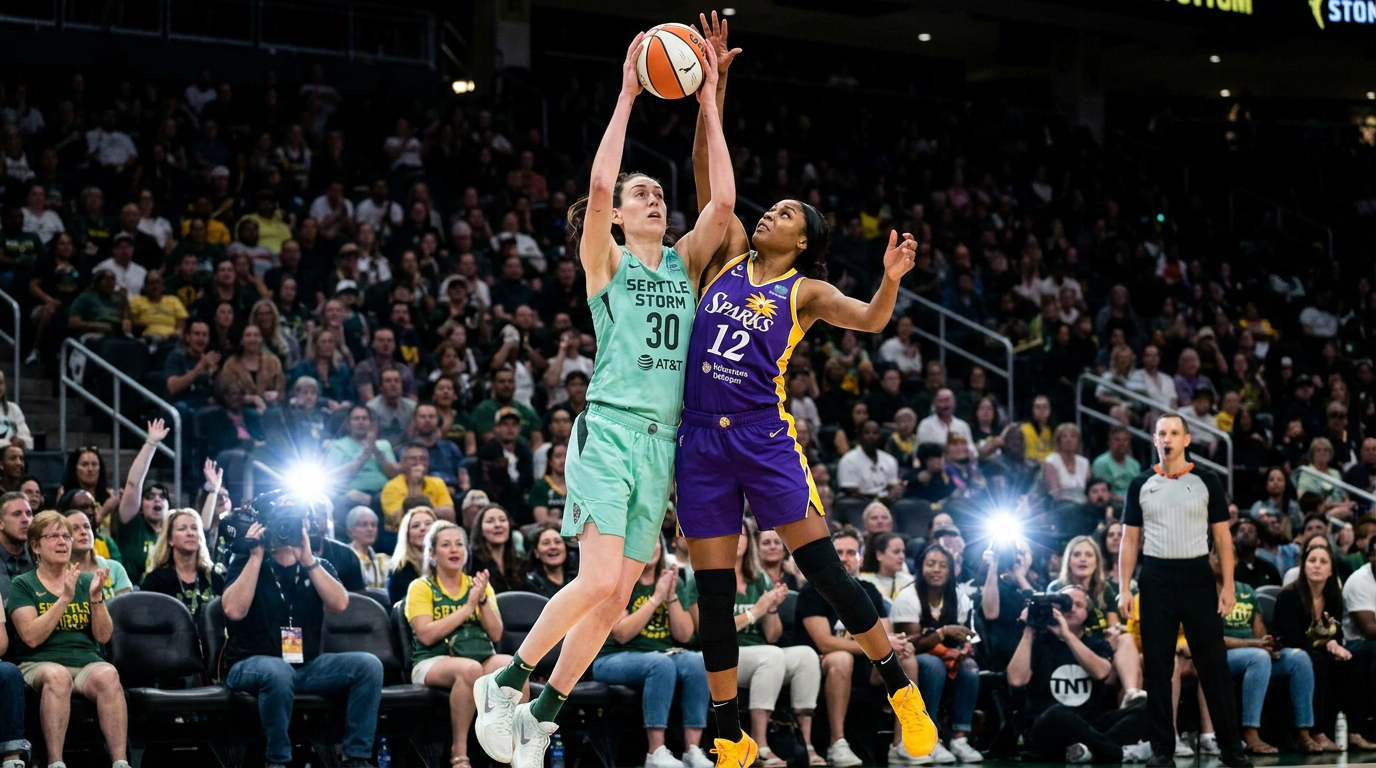
On Sunday night in Los Angeles, Nneka Ogwumike sank a buzzer-beating three-pointer to lift the Sparks past the New York Liberty in a thrilling finish. But the significance of the game extended far beyond the final score. The matchup was a deliberate 30-year anniversary rematch of the very first game in Women's National Basketball Association (WNBA) history, played between the same two original franchises on June 21, 1997.[1][2]
When the Liberty and Sparks first tipped off three decades ago at the Great Western Forum, the league was an eight-team experiment with an uncertain future. Today, as the WNBA celebrates its 30th season in 2026, it stands as a commercial juggernaut and a definitive blueprint for the explosive growth of women's sports properties worldwide.[2][4]
The contrast between the league's inaugural season and its current iteration is stark. In 1997, teams played a brief 28-game schedule, and player salaries were modest enough that many athletes had to play overseas during the offseason to make a living. By 2026, the league has expanded to 15 teams—including recent additions in Toronto, Portland, and Golden State—and operates under a transformative new collective bargaining agreement.[5][7]
That new collective bargaining agreement (CBA), ratified in March 2026, fundamentally rewrites the economic reality for professional women's basketball players. Following a period of intense negotiation, the agreement introduced unprecedented salary bumps across the board. Top draft picks in 2026 are earning rookie salaries of $500,000, a staggering increase from the roughly $78,000 baseline that existed just a season prior.[3][7]

This financial leap is entirely underwritten by a massive surge in viewership and media rights valuations. The 2026 season features a record 216 nationally televised games across a sprawling network of broadcast partners, including ABC/ESPN, NBC/Peacock, CBS, Prime Video, and ION. It is the most robust media footprint in the history of women's basketball.[4]
Industry analysts note that this expanded distribution is not just about sheer volume; it is about accessibility and prime-time placement. Consistent, high-visibility broadcast windows have created a powerful flywheel effect: more visibility leads to higher ratings, which in turn drives greater advertising revenue, corporate sponsorship, and franchise valuations.[4]
Industry analysts note that this expanded distribution is not just about sheer volume; it is about accessibility and prime-time placement.
The ratings data thoroughly validates this aggressive media strategy. The 2026 WNBA Draft averaged 1.5 million viewers on ESPN, making it the second-most watched draft in league history, trailing only the Caitlin Clark-led phenomenon of 2024. Crucially, the audience is diversifying, with significant year-over-year growth among younger demographics, Black viewers, and Hispanic viewers.[3][8]

Regular-season viewership has maintained this intense momentum. Early-season matchups in 2026 have consistently drawn multi-million viewer audiences, with a recent prime-time game peaking at over 3 million viewers on CBS. This sustained engagement proves that the recent spike in interest was not a fleeting trend tied to a single draft class, but a permanent structural shift in sports consumption.[8][9]
To capitalize on this insatiable demand, the WNBA is rapidly scaling its on-court operations. League Commissioner Cathy Engelbert recently announced that the regular season will expand to 50 games per team beginning in 2027. This marks the longest schedule in the league's history and reflects a deep confidence that the market can absorb—and indeed, is demanding—more inventory.[5][6]
Expansion franchises have also proven to be lucrative engines for the league's war chest. The Portland Fire and Toronto Tempo, both debuting in 2026, paid record expansion fees to enter the league. Toronto's inclusion marks the WNBA's first foray outside the United States, signaling international ambitions that were scarcely imaginable during the league's early survival years.[7]

The influx of capital has allowed the league to address long-standing player grievances that plagued previous eras. Beyond base salaries, the new CBA mandates improved travel conditions, enhanced maternity and family benefits, and better practice facilities. These structural improvements are designed to treat the athletes as premier professionals, matching the elite product they deliver on the court.[7]
Yet, the journey to this point has not been without friction. The negotiations leading up to the 2026 CBA were notoriously tense, with the players' union authorizing a strike vote in late 2025 before a deal was finally struck in March. The players successfully argued that their compensation needed to reflect the league's soaring valuations and record-breaking media deals.[7]
Ultimately, the 30th anniversary season serves as both a celebration of survival and a launchpad for the future. When Ogwumike's shot fell through the net on Sunday, it echoed a legacy built by pioneers like Lisa Leslie and Rebecca Lobo, while being broadcast to an audience size they could only have dreamed of three decades ago.[1][2]

How we got here
June 1997
The WNBA tips off its inaugural season with eight teams playing a 28-game schedule.
April 2024
A historic draft class drives record-breaking viewership, fundamentally altering the league's trajectory.
October 2025
The players' union opts out of the existing collective bargaining agreement, demanding a larger share of revenue.
March 2026
A transformative new CBA is ratified, introducing massive salary increases and improved working conditions.
June 2026
The league announces an expansion to a 50-game regular season starting in 2027.
Viewpoints in depth
Players & Union Leadership
Athletes view the 2026 season as the long-overdue realization of their true market value.
For the Women's National Basketball Players Association (WNBPA), the 2026 season is the culmination of years of aggressive negotiation. After opting out of the previous CBA and authorizing a strike vote, players successfully argued that the league's surging media rights and expansion fees needed to be reflected in their paychecks. The resulting agreement—featuring $500,000 rookie salaries and improved travel standards—is seen not as a gift, but as a hard-won correction to decades of under-compensation.
League Executives & Owners
Ownership focuses on scaling the business through expanded inventory and new markets.
From the perspective of the commissioner's office and team owners, the current era is about capitalizing on unprecedented momentum. By expanding the schedule to 50 games in 2027 and adding franchises in Toronto and Portland, the league is creating more 'inventory' to sell to broadcast partners and sponsors. Executives argue that this aggressive scaling is necessary to sustain the higher salaries demanded by the players and to cement the WNBA's status as a top-tier global sports property.
Media & Broadcast Partners
Networks see the WNBA as a reliable, high-growth anchor for live sports programming.
Broadcasters like ESPN, CBS, and Prime Video view the WNBA as one of the few remaining growth assets in live television. With 216 nationally televised games in 2026, networks are using the league to anchor their summer programming slates. Media analysts point out that the WNBA delivers highly coveted demographics—particularly younger viewers and diverse audiences—making it an increasingly premium product for advertisers.
What we don't know
- How the physical toll of a 50-game schedule in 2027 will impact player health and career longevity.
- Whether the league will continue to expand beyond 16 teams before the end of the decade.
Key terms
- Collective Bargaining Agreement (CBA)
- A legal contract between the league and the players' union that dictates salaries, benefits, and working conditions.
- Expansion Fee
- The multi-million dollar price paid by new ownership groups to purchase the rights to start a new franchise in the league.
- WNBPA
- The Women's National Basketball Players Association, the labor union representing the athletes.
- Flywheel Effect
- A business concept where increased visibility leads to higher revenue, which is then reinvested to create even more visibility.
Frequently asked
When does the WNBA 50-game schedule begin?
The expanded 50-game regular season will officially begin in the 2027 season. The league is playing 44 games in 2026.
Who are the newest WNBA expansion teams?
The league expanded to 15 teams in 2026 with the addition of the Portland Fire and the Toronto Tempo, following the Golden State Valkyries' debut.
How much do WNBA rookies make under the new CBA?
Under the agreement ratified in 2026, top draft picks earn a rookie salary of $500,000, a massive increase from previous years.
Sources
Source coverage
9 outlets
3 viewpoints surfaced









[1]ESPNMedia & Broadcast Partners
Ogwumike's shot lifts Sparks on 'emotional' night
Read on ESPN →[2]Sports IllustratedMedia & Broadcast Partners
Liberty's 2026 Schedule Includes Historic Matchup vs. Sparks
Read on Sports Illustrated →[3]Front Office SportsMedia & Broadcast Partners
2026 WNBA Draft Was Second-Most Watched in Event History
Read on Front Office Sports →[4]TogethxrMedia & Broadcast Partners
The 2026 WNBA Season is Built to Be Seen
Read on Togethxr →[5]Associated PressLeague Executives & Owners
WNBA to expand to 50-game schedule for teams next season
Read on Associated Press →[6]WNBA.comLeague Executives & Owners
WNBA Announces Expansion To 50-Game Regular Season
Read on WNBA.com →[7]WikipediaPlayers & Union Leadership
2026 WNBA season
Read on Wikipedia →[8]The GISTMedia & Broadcast Partners
Nielsen, ESPN share WNBA viewership insights that illustrate league's growth
Read on The GIST →[9]Sports Media WatchMedia & Broadcast Partners
Fever still running hot: Near-milestone audience for Clark and co. against Liberty
Read on Sports Media Watch →

Every angle. Every day.
Get sports stories with full source coverage and perspective breakdowns delivered to your inbox.