
How the Cruise Industry is Engineering the 'Zero-Emission' Ship of the Future
Faced with tightening environmental regulations, cruise lines are overhauling how their massive vessels are powered. From liquefied natural gas and hydrogen fuel cells to retractable solar sails, here is the technology driving the industry toward a net-zero future.
By Factlen Editorial Team
- Maritime Engineers & Shipbuilders
- Focus on the technical feasibility of scaling fuel cells, battery storage, and hull efficiency to meet net-zero targets.
- Environmental Regulators
- Emphasize strict mandates to force the industry away from heavy fuel oil and mitigate local air pollution.
- Cruise Operators
- Balance the demand for sustainable travel with the massive capital expenditure required to retrofit fleets and build experimental vessels.
- Port Authorities
- Face the logistical and financial burden of upgrading local electrical grids to supply massive amounts of shore power to docked ships.
Why this matters
Cruise ships have historically relied on heavy fuel oil, contributing significantly to global maritime pollution. The rapid adoption of green technologies not only cleans the air in port cities but also serves as a testing ground for decarbonizing the broader global shipping industry.
The modern cruise ship is an engineering marvel, effectively functioning as a floating city that must generate its own power, process its own waste, and propel thousands of people across the ocean. For decades, the sheer scale of this energy demand meant relying on Heavy Fuel Oil (HFO), a dense, sulfur-rich fossil fuel that made the maritime industry a significant contributor to global air pollution. Today, however, the cruise sector is undergoing a radical transformation.[7]
Driven by the International Maritime Organization's net-zero targets for 2050 and tightening regional regulations, cruise lines are systematically abandoning traditional bunker fuels. The transition is not a simple engine swap; it requires a fundamental redesign of how ships store energy, manage propulsion, and interact with the ports they visit.[1]
The immediate bridge to a cleaner future has been Liquefied Natural Gas (LNG). According to the Cruise Lines International Association, a growing percentage of the global fleet is now utilizing LNG for primary propulsion, representing a massive capital shift in shipbuilding. LNG is currently the most mature and immediately deployable alternative fuel available at a commercial scale.[1]
The environmental math behind LNG is compelling. Combusting liquefied natural gas virtually eliminates sulfur oxide emissions and reduces nitrogen oxides by up to 85%. Crucially, it also cuts carbon dioxide output by roughly 20% to 25% compared to traditional marine fuels, providing an immediate reduction in the industry's greenhouse gas footprint.[2]

However, LNG is not a perfect solution. Its primary vulnerability is "methane slip"—the escape of unburned methane gas through the engine exhaust. Because methane is a highly potent greenhouse gas, maritime engineers are racing to deploy advanced containment systems and next-generation engine designs to eradicate slip, ensuring that LNG remains a viable transition fuel rather than an environmental liability.[2]
Beyond the mechanics of ocean propulsion, the industry faces a secondary, highly visible challenge: port emissions. When a ship docks, it must keep its "hotel load" running to power lighting, air conditioning, refrigeration, and entertainment for thousands of guests. Historically, this meant idling massive auxiliary diesel engines mere hundreds of yards from dense coastal cities.[7]
To eliminate this local pollution, the European Union has deployed a regulatory hammer. Under the Alternative Fuels Infrastructure Regulation (AFIR), part of the "Fit for 55" package, all major EU ports in the trans-European transport network must provide sufficient shore power facilities by 2030. Simultaneously, passenger ships will be legally required to plug in and shut down their engines.[4]
To eliminate this local pollution, the European Union has deployed a regulatory hammer.
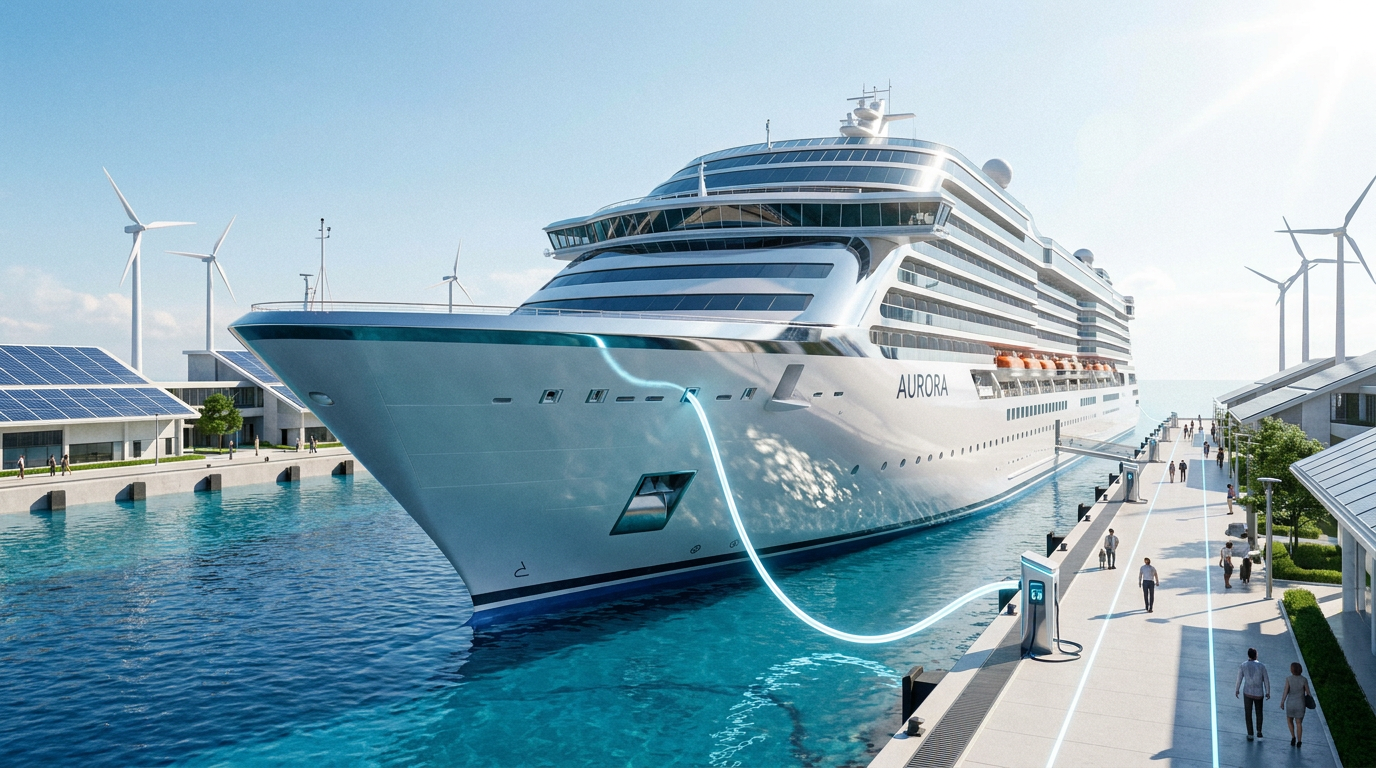
This process, known in the maritime industry as "cold ironing," allows a vessel to draw its hotel power directly from the local electrical grid. When that grid is powered by renewable energy, the ship's port stay becomes entirely emission-free.[4]
The bottleneck for cold ironing is not the ships, but the shore. The International Council on Clean Transportation estimates that the European Union must triple or quadruple its currently installed shore power capacity by the end of the decade to meet the impending regulatory demand, requiring massive infrastructure investments from port authorities.[5]
For destinations that cannot upgrade their grids fast enough, cruise lines are engineering onboard solutions to achieve zero-emission port stays. A leading breakthrough in this space is the integration of liquid hydrogen fuel cells, a technology currently being pioneered by MSC Cruises for its luxury Explora Journeys brand.[3]
The upcoming Explora V and VI vessels, scheduled for delivery in 2027 and 2028, will feature 6-megawatt hydrogen fuel cell systems. These cells convert liquid hydrogen directly into electricity through a chemical reaction, emitting absolutely nothing but pure water vapor. This will allow the massive ships to turn off their engines entirely while docked, maintaining full hotel operations without a plug.[3]

While fuel cells solve the port problem, the ultimate vision extends to zero-emission propulsion across the open ocean. Norwegian expedition operator Hurtigruten has unveiled "Sea Zero," an ambitious research and development project aiming to launch a fully emission-free cruise ship by 2030.[6]
Designed in partnership with shipbuilder VARD, the Sea Zero concept abandons combustion engines entirely. Instead, it relies on massive 60-megawatt-hour battery packs as its primary energy source, designed to be charged with renewable hydroelectric power while docked in Norwegian ports.[6]
Because batteries are incredibly heavy and offer less range than liquid fuels, the Sea Zero ship must drastically cut its overall energy consumption. The design incorporates air lubrication beneath the hull to reduce water friction and features retractable "OceanWings"—massive sails covered in solar panels that harness wind power to achieve a targeted 40% to 50% reduction in energy use.[6]

The primary uncertainty facing all of these next-generation technologies is the global supply chain. Hydrogen fuel cells are only truly clean if they utilize "green" hydrogen produced via renewable energy, a fuel source that is not yet available at the scale required by the global maritime industry.[7]
Similarly, while modern dual-fuel engines are built to accept sustainable bio-LNG or synthetic methanol without modification, the worldwide production of these alternative fuels remains a significant bottleneck that energy companies are only just beginning to address.[1][2]
Ultimately, the "zero-emission" cruise ship of the future will not rely on a single silver bullet. It will be a highly complex, hybrid marvel of advanced battery storage, hydrogen fuel cells, wind-assist technology, and grid connectivity, fundamentally reshaping the engineering and economics of maritime travel for the next century.[7]
Viewpoints in depth
Maritime Engineers' View
Engineers view the transition as a complex puzzle of energy density and spatial constraints.
Shipbuilders and marine engineers emphasize that there is no single replacement for the energy density of fossil fuels. Because batteries and hydrogen tanks require significantly more physical space than traditional fuel tanks, engineers are forced to rethink the entire architecture of a ship. Their focus is heavily weighted toward extreme efficiency gains—such as air lubrication under the hull and wind-assist sails—to reduce the total energy demand before applying alternative power sources.
Environmental Regulators' View
Regulators prioritize immediate, enforceable reductions in local air pollution and greenhouse gases.
For bodies like the European Commission, voluntary industry targets are no longer sufficient. Regulators are deploying strict legal mandates, such as the 2030 shore power requirement, to force the maritime sector's hand. They view the elimination of sulfur oxides, nitrogen oxides, and particulate matter in coastal cities as an urgent public health priority, utilizing heavy fines and port-access restrictions to ensure compliance.
Port Authorities' View
Ports face the immense infrastructural challenge of supplying the power these new ships demand.
While cruise lines can build new ships, port authorities are constrained by local municipal electrical grids. Supplying shore power to a single mega-cruise ship is equivalent to powering a small town. Port operators argue that without massive public subsidies and grid upgrades, they will be unable to meet the 2030 mandates, creating a bottleneck where ships are ready to plug in but the shore lacks the capacity to support them.
What we don't know
- Whether global ports can upgrade their electrical grids fast enough to meet the 2030 shore power mandates.
- How quickly 'green' hydrogen—produced entirely from renewable energy—can be scaled to meet maritime demand.
- The exact cost impact these multi-billion-dollar technological shifts will have on consumer ticket prices.
Sources
Source coverage
7 outlets
4 viewpoints surfaced







[1]Cruise Lines International Association (CLIA)Cruise Operators
Global Cruise Industry Environmental Technologies and Practices Report
Read on Cruise Lines International Association (CLIA) →[2]Lloyd's RegisterMaritime Engineers & Shipbuilders
Fuel for Thought: LNG for Cruise
Read on Lloyd's Register →[3]Seatrade Cruise NewsCruise Operators
MSC, Fincantieri firm orders for hydrogen-powered Explora V and VI
Read on Seatrade Cruise News →[4]European CommissionEnvironmental Regulators
FuelEU Maritime and Alternative Fuels Infrastructure Regulation
Read on European Commission →[5]International Council on Clean TransportationPort Authorities
Shore power needs and CO2 emissions reductions of ships in European Union ports
Read on International Council on Clean Transportation →[6]VARDMaritime Engineers & Shipbuilders
VARD design Hurtigruten's project to create the First Zero-Emission Cruise Ship
Read on VARD →[7]Factlen Editorial Team
Synthesis by Factlen editorial team
Read on Factlen Editorial Team →

Every angle. Every day.
Get travel stories with full source coverage and perspective breakdowns delivered to your inbox.