
The Rise of the 'Iron Path': How Via Ferrata is Democratizing the High Alpine
Once a World War I military tactic, the via ferrata is experiencing a global boom, allowing everyday hikers to safely scale sheer cliffs using specialized shock-absorbing gear.
By Factlen Editorial Team
- Adventure Tourism Advocates
- Believe via ferratas democratize the mountains and provide safe, accessible thrills for the general public.
- Safety & Gear Engineers
- Focus on the strict physics of fall factors and the necessity of progressive-tear shock absorbers.
- Traditional Mountaineers
- Weigh the benefits of concentrated recreation against the environmental impact of bolting iron into pristine rock.
What's not represented
- · Local search and rescue teams who respond to via ferrata emergencies
- · Environmental conservation groups monitoring alpine rock habitats
Why this matters
Via ferratas are transforming adventure tourism by making previously inaccessible, high-altitude terrain safely navigable for non-climbers. Understanding the specialized gear and physics behind these routes is essential for anyone looking to safely participate in this booming outdoor trend.
Key points
- Via ferratas use steel cables and iron rungs to allow non-climbers to navigate steep alpine terrain safely.
- The routes originated in the Italian Dolomites during World War I to move troops across mountain ridges.
- A specialized progressive-tear shock absorber is required to prevent severe injury during a high-impact fall.
- North America is experiencing a rapid boom in via ferrata construction at ski resorts and mountain towns.
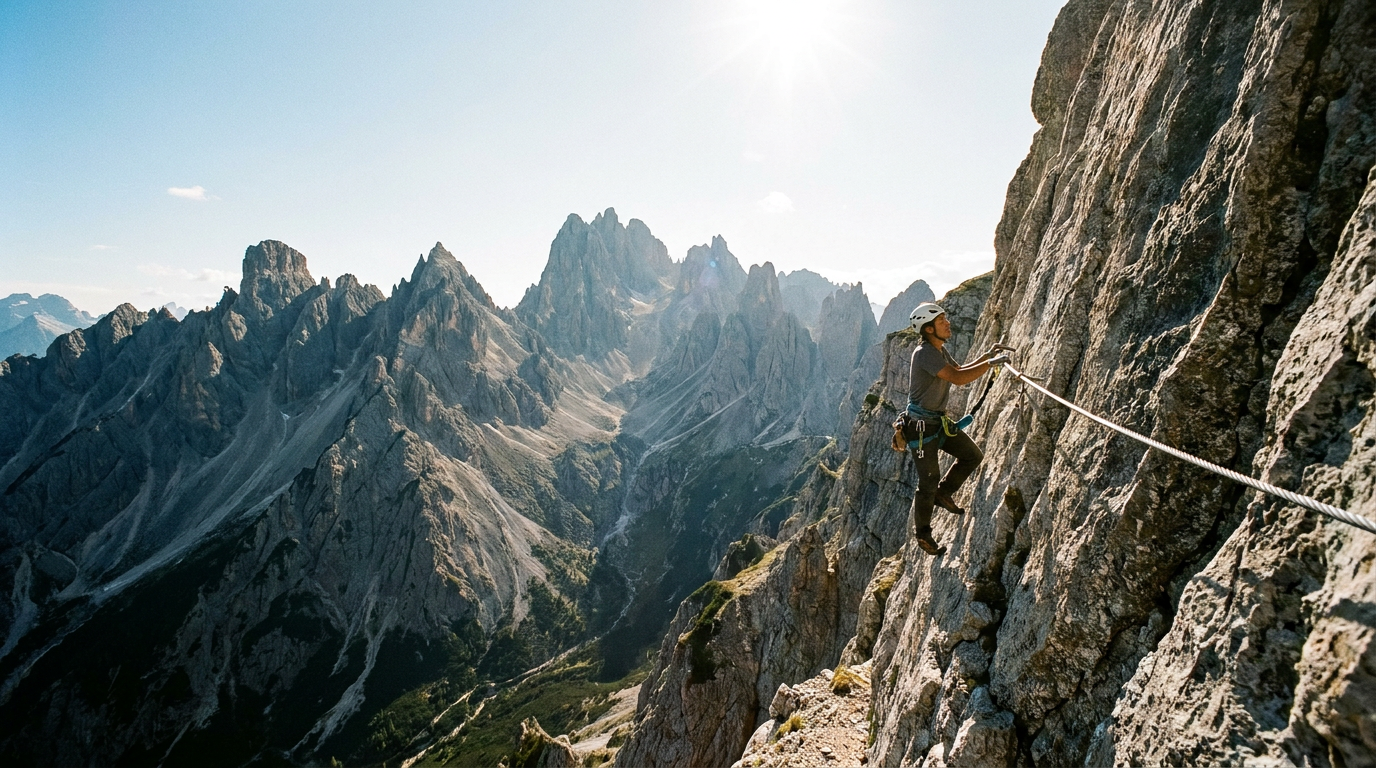
Imagine clinging to a sheer rock face 1,000 feet above a valley floor, your boots resting on a slender iron rung. For decades, this kind of extreme vertical exposure was strictly reserved for elite rock climbers with years of technical training. Today, however, a rapidly expanding network of steel cables and iron steps is opening the high alpine to everyday hikers. This is the world of the via ferrata—Italian for "iron path"—and it is currently driving one of the fastest-growing segments in adventure travel.[6]
A via ferrata is a protected climbing route built directly into a mountain. It consists of a steel cable running continuously along the rock, anchored at regular intervals, supplemented by iron rungs, carved steps, ladders, and suspension bridges. Climbers wear a standard harness and helmet, but the magic lies in a specialized piece of equipment called a via ferrata lanyard, which keeps them permanently tethered to the mountain.[1][4]
While the concept has been a staple of European alpinism for decades, it is currently experiencing a massive boom in North America. Over the last few years, resorts and mountain towns across the United States and Canada have invested heavily in building these routes to attract summer tourism. From the sheer canyon walls of Telluride and Ouray in Colorado to the 155-year-old Mohonk Mountain House in New York, via ferratas are transforming how North Americans interact with vertical terrain.[2]

To understand the modern via ferrata, you have to look back to the brutal mountain warfare of World War I. Between 1915 and 1917, Italian and Austro-Hungarian troops fought a grueling war of attrition in the jagged peaks of the Dolomites. To move soldiers, artillery, and supplies across treacherous, high-altitude ridges, military engineers bolted rudimentary ladders and steel cables into the rock faces.[5]
After the war ended, these military installations were largely abandoned. However, in the 1930s and again after World War II, the Italian Alpine Club began restoring the old routes and building new ones to attract tourists. The Dolomites remain the spiritual home of the via ferrata, boasting over 600 routes where climbers can still pass by century-old dugouts, trenches, and military lookouts.[1][5]

The transition from military utility to modern recreational sport required a complete reimagining of safety gear. In traditional rock climbing, a falling climber is caught by a dynamic, stretchy rope managed by a partner below. On a via ferrata, there is no partner belaying you, and you are clipped directly to a static steel cable. This creates a unique and highly dangerous physics problem known as a high "fall factor."[4]
The transition from military utility to modern recreational sport required a complete reimagining of safety gear.
If a climber slips on a via ferrata, they will slide down the steel cable until their carabiner hits the nearest metal anchor point. Because the lanyard attaching the climber to the cable is very short—usually less than three feet—the sudden, jarring stop generates massive kinetic energy. Without a specialized mechanism to dissipate this energy, the impact force would easily snap the equipment or cause severe spinal injuries to the climber.[3][4]
The engineering solution to this problem is the progressive-tear shock absorber, the critical core of every modern via ferrata set. Housed in a small pouch attached to the climber's harness, the shock absorber contains a length of strong textile webbing that has been folded over itself and stitched together with highly specific, calibrated seams.[3][4]
In the event of a fall, the sudden load pulls on this webbing package. Instead of the climber's body taking the brunt of the impact, the specialized seams begin to tear open in a controlled, progressive manner. This tearing action absorbs the kinetic energy of the fall, decelerating the climber and extending the braking distance. Under the strict European safety standard (EN 958), this mechanism must limit the maximum impact force on the human body to less than 6 kilonewtons (kN).[3]

Connected to this shock absorber are two elasticated arms, each ending in a specialized, auto-locking carabiner. The golden rule of via ferrata climbing is simple: at least one carabiner must be clipped to the steel cable at all times. When a climber reaches an anchor point where the cable is bolted to the rock, they unclip one carabiner, move it past the anchor, and clip it to the next section of cable before moving the second one.[4]
This foolproof "Y-lanyard" system has democratized access to some of the world's most spectacular environments. Beyond Europe and North America, ambitious routes are being installed globally. In Oman, a luxury resort offers a via ferrata that traverses the country's highest peak, ending with a tightrope walk 65 feet above a canyon. In Peru's Sacred Valley, climbers scale a 1,000-foot vertical cliff face on iron rungs before descending via a high-speed zipline.[1][2]

For adventure tourism operators, via ferratas represent a perfect middle ground. They offer the visceral thrill and breathtaking exposure of technical mountaineering, but require only basic hiking fitness, a head for heights, and a brief safety orientation. It allows groups of mixed athletic abilities to share a high-alpine experience, working together to navigate suspension bridges and vertical pitches.[2][6]
While some traditional mountaineers occasionally debate the ethics of bolting iron rungs into pristine wilderness, the overwhelming consensus is that via ferratas, when properly managed, concentrate impact in designated areas while fostering a deep appreciation for alpine environments. As engineering standards continue to improve and new routes open worldwide, the "iron path" is ensuring that the view from the top is no longer reserved for the elite few.[6]
How we got here
1915-1917
Italian and Austrian troops build the first extensive via ferrata networks in the Dolomites during WWI.
1930s
The Italian Alpine Club begins restoring military routes for civilian recreational use.
2001
The first modern via ferrata course in the United States opens in Kentucky's Red River Gorge.
2020s
A massive boom in North American via ferrata construction begins, expanding to major resorts in Colorado, New York, and Canada.
Viewpoints in depth
Adventure Tourism Operators
Viewing via ferratas as a way to democratize mountaineering and boost local economies.
For local economies and resort operators, via ferratas are a highly effective way to draw summer tourism and make the mountains accessible. They argue that by providing a controlled, guided environment, they can offer the psychological thrill of rock climbing to everyday hikers without the years of technical training required for traditional alpinism.
Safety and Gear Engineers
Focusing on strict equipment standards and mitigating user error.
Engineers and safety regulators focus heavily on the physics of the 'fall factor.' Their primary concern is ensuring that the progressive-tear shock absorbers meet strict European (EN 958) standards, keeping impact forces below 6 kN. They emphasize that while the gear is highly engineered, user education—specifically the rule to never unclip both carabiners at once—remains the critical variable in preventing fatalities.
Traditional Mountaineers
Balancing wilderness preservation with bolted infrastructure.
Some climbing purists and conservationists express concern over the 'sanitization' of the alpine environment. They argue that bolting iron rungs and cables into pristine rock faces permanently alters the wilderness. However, many accept via ferratas if they are restricted to designated, high-traffic zones, as they concentrate human impact rather than dispersing it across fragile backcountry ecosystems.
What we don't know
- How the influx of inexperienced hikers on high-altitude routes will impact search and rescue resources over the next decade.
- Whether North American land management agencies will eventually allow via ferratas in federally protected wilderness areas, or restrict them to private resort land.
Key terms
- Via Ferrata
- Italian for 'iron path,' a protected mountain route equipped with fixed cables, ladders, and rungs.
- Fall Factor
- A climbing physics term describing the ratio of a fall's length to the amount of rope available to catch it; via ferratas have uniquely high fall factors.
- Shock Absorber
- A specialized pouch of folded, stitched webbing that tears open progressively to absorb the kinetic energy of a fall.
- Anchor Point
- The heavy metal stakes drilled into the rock face that secure the steel cable at regular intervals.
Frequently asked
Do I need rock climbing experience to do a via ferrata?
No. While you need basic hiking fitness and a tolerance for heights, the fixed iron rungs and cables remove the need for technical rock climbing skills.
Can I use a regular climbing rope and carabiners?
Absolutely not. Standard climbing gear cannot absorb the massive impact forces generated by a short fall on a steel cable. You must use a specialized via ferrata lanyard with a shock absorber.
What happens to the gear if I fall?
If you fall and the shock absorber deploys (tears open) to catch you, the entire via ferrata lanyard is permanently destroyed and must be replaced before you can climb again.
Sources
Source coverage
6 outlets
3 viewpoints surfaced






[1]National GeographicTraditional Mountaineers
11 Thrilling Via Ferrata Hikes Around the World
Read on National Geographic →[2]Outside MagazineAdventure Tourism Advocates
The Best Via Ferratas in the World
Read on Outside Magazine →[3]EdelridSafety & Gear Engineers
How does a via ferrata set work?
Read on Edelrid →[4]Alpine TrekSafety & Gear Engineers
Via Ferrata Equipment: What do you really need?
Read on Alpine Trek →[5]Via Ferrata DolomitesTraditional Mountaineers
The History of the Via Ferrata in the Dolomites
Read on Via Ferrata Dolomites →[6]Factlen Editorial TeamAdventure Tourism Advocates
Synthesis by Factlen editorial team
Read on Factlen Editorial Team →
Every angle. Every day.
Get travel stories with full source coverage and perspective breakdowns delivered to your inbox.