
Supreme Court Unanimously Strikes Down Federal Gun Ban for Marijuana Users
In a 9-0 decision, the Supreme Court ruled that prosecuting individuals solely for possessing a firearm while using marijuana violates the Second Amendment. The landmark ruling significantly curtails a decades-old federal law and unites gun-rights advocates and civil liberties groups.
By Factlen Editorial Team
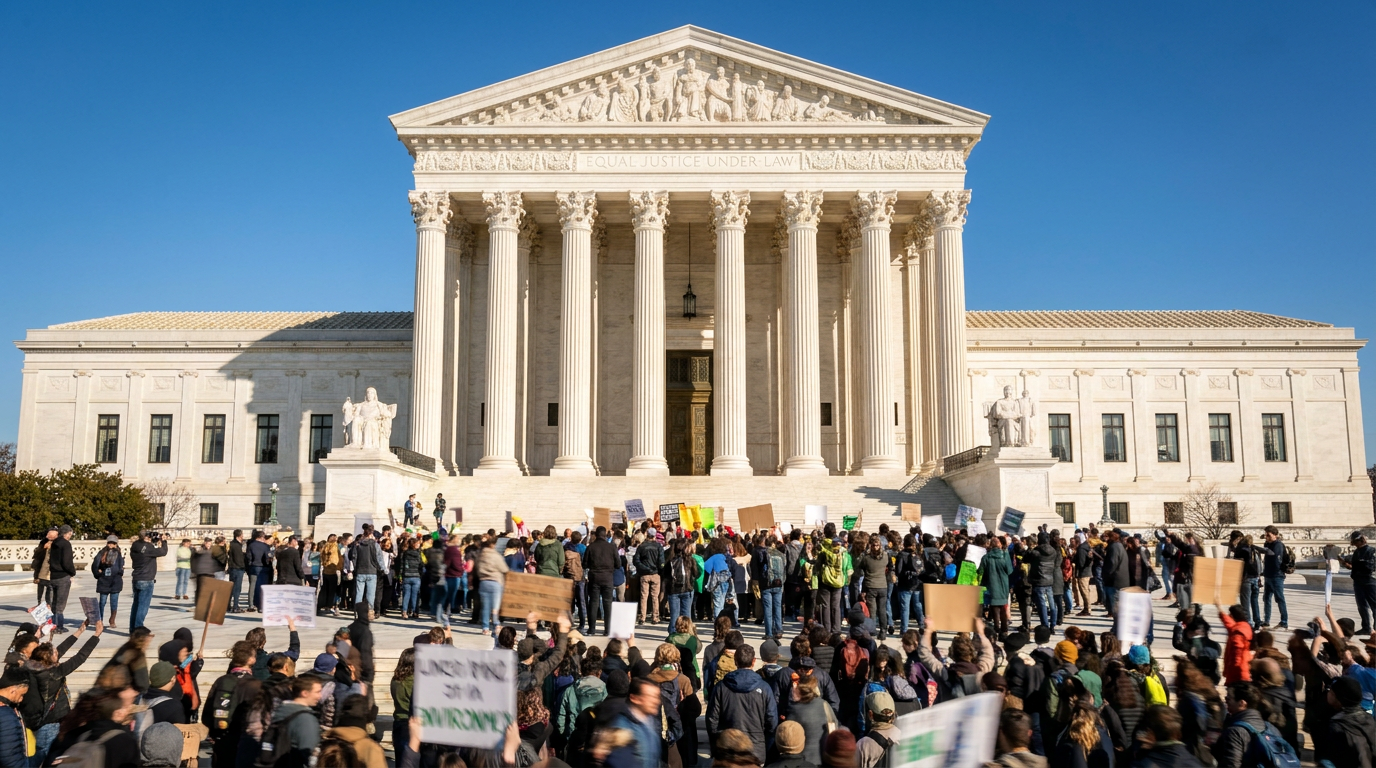
- Second Amendment Advocates
- View the decision as a necessary enforcement of strict constitutional limits on the government's ability to disarm citizens.
- Neutral Legal Observers
- Focus on the legal mechanics of the ruling and its implications for federal law enforcement and future Second Amendment cases.
- Civil Liberties Advocates
- Argue the ban was an arbitrary overreach that criminalized millions of non-violent Americans.
- Cannabis Policy Watchers
- Highlight the contradiction between the government's defense of the gun ban and its recent moves to reschedule marijuana.
What's not represented
- · Gun violence prevention organizations
Why this matters
This ruling effectively invalidates a core provision of the 1968 Gun Control Act for millions of Americans who use marijuana, fundamentally altering how federal law enforcement handles the intersection of drug use and firearm ownership. It also signals the Supreme Court's continued willingness to strike down historical gun restrictions under rigorous Second Amendment standards.
Key points
- The Supreme Court ruled 9-0 that prosecuting marijuana users solely for possessing a firearm violates the Second Amendment.
- The decision curtails 18 U.S.C. § 922(g)(3), a federal law banning 'unlawful users' of controlled substances from owning guns.
- Justice Neil Gorsuch wrote that the government cannot automatically designate all marijuana users as dangerous without individualized proof.
- The case involved a Texas man who faced up to 15 years in prison after admitting to using marijuana every other day.
- The ruling united traditional political adversaries, drawing support from both the NRA and the ACLU.
- The ATF announced it is reviewing the decision and will issue new guidance for federal firearm background checks.
The Supreme Court has unanimously ruled that the federal government cannot strip individuals of their Second Amendment rights solely because they use marijuana. In a 9-0 decision issued Thursday in United States v. Hemani, the justices struck down the application of a decades-old federal law that made it a felony for an "unlawful user" of a controlled substance to possess a firearm.[1][2][8]
The ruling marks a significant curtailment of 18 U.S.C. § 922(g)(3), a core provision of the 1968 Gun Control Act. Writing for the Court, Justice Neil Gorsuch stated that the government's attempt to automatically disarm anyone who regularly uses marijuana is "inconsistent with the Second Amendment." The decision severely limits federal authority to confiscate weapons from drug users unless the government can prove they pose a specific, individualized danger to others.[1][3][8]
The case originated in Texas, where Ali Danial Hemani, a dual U.S.-Pakistani citizen, was investigated by federal agents in 2022 for suspected terrorism-related activities. During a search of his family's Dallas-area home, Hemani cooperated fully with authorities. He surrendered a 9mm Glock pistol and approximately 60 grams of marijuana, and he voluntarily admitted to law enforcement that he used the drug "about every other day."[2][6][7]
No terrorism charges were ever filed against Hemani, and the government found no evidence linking him to violent extremism. Instead, more than six months after the initial search, the Justice Department indicted him solely for possessing a firearm while being an unlawful user of a controlled substance. Under the strict parameters of the statute, Hemani faced up to 15 years in federal prison and the permanent loss of his gun rights.[6][8]

Hemani's legal team moved to dismiss the indictment, arguing that the charge violated his constitutional rights under the Second Amendment. The U.S. Court of Appeals for the Fifth Circuit agreed, dismissing the charge and holding that the firearm ban could not be constitutionally applied to individuals who are not actively under the influence of drugs at the time they possess a weapon.[6][7]
Hemani's legal team moved to dismiss the indictment, arguing that the charge violated his constitutional rights under the Second Amendment.
The Justice Department appealed the dismissal to the Supreme Court, arguing that the 1968 law was a necessary public safety measure. Federal prosecutors contended that drug users are categorically more likely to engage in risky or violent behavior, drawing historical parallels to early American laws that disarmed "habitual drunkards."[6][8][9]
The Supreme Court firmly rejected that comparison. The justices found the historical analogy far too imprecise to justify stripping Second Amendment rights from tens of millions of Americans who use marijuana. Justice Gorsuch noted that while drugs and guns can create a dangerous mix, the government failed to prove that Hemani's marijuana use made him a threat to society.[3][7][9]

"The government construes §922(g)(3) to automatically ban an individual from possessing a gun from the moment he becomes an unlawful user of any controlled substance... regardless of what controlled substance an individual uses, in what amounts, [or] whether his drug use has ever made him a danger to himself or others," Gorsuch wrote in the Court's opinion. He added that affording the government such broad power to designate groups as dangerous would risk allowing it to "quickly swallow" the Second Amendment.[4][7]
The ruling created an unusual political alliance, uniting traditional adversaries across the ideological spectrum. Both the National Rifle Association and the American Civil Liberties Union (ACLU) filed briefs supporting Hemani. The ACLU praised the decision, noting that with nearly half of Americans reporting marijuana use at some point in their lives, the ruling "curbs the government's ability to impose arbitrary and discriminatory penalties."[1][3][5]
The decision represents a notable loss for the Trump administration, which had defended the 1968 law despite its broader efforts to reclassify marijuana at the federal level. The Court's opinion highlighted this contradiction, noting that the government's stance in the case was "at odds with its own regulatory actions" regarding cannabis, referencing the recent push to reschedule the drug.[1][4]

In the wake of the ruling, the Bureau of Alcohol, Tobacco, Firearms and Explosives (ATF)—the agency responsible for enforcing federal gun laws—announced it is reviewing the decision and assessing its immediate impact. The ATF stated that "additional guidance will be provided soon," as the ruling directly affects how federal background checks and Form 4473 firearm purchases are processed for millions of Americans living in states where marijuana is legal.[4]
Legal experts anticipate the ruling will trigger a wave of post-conviction relief petitions from individuals previously convicted under the statute solely for marijuana use. While the decision leaves intact other firearm restrictions—such as those barring convicted felons or individuals adjudicated as mentally ill from owning guns—it solidifies the Court's recent precedent that gun regulations must strictly align with the nation's historical tradition of firearm regulation.[6][8][9]
How we got here
1968
Congress passes the Gun Control Act, including § 922(g)(3), which bans unlawful drug users from possessing firearms.
2022
Federal agents search the Texas home of Ali Danial Hemani, finding a 9mm pistol and marijuana.
2023
The Justice Department indicts Hemani solely for possessing a firearm as an unlawful drug user.
2024
The U.S. Court of Appeals for the Fifth Circuit dismisses Hemani's indictment, ruling the statute unconstitutional as applied to him.
June 18, 2026
The Supreme Court unanimously affirms the dismissal, striking down the federal gun ban for marijuana users.
Viewpoints in depth
Civil Liberties Advocates
Argue that the federal ban was overly broad and criminalized millions of non-violent Americans.
Organizations like the ACLU argue that the government cannot strip citizens of fundamental constitutional rights based on categorical assumptions. They emphasize that nearly half of all Americans have used marijuana, and automatically designating this massive group as 'dangerous' without due process invites arbitrary and discriminatory enforcement. For civil liberties groups, the ruling is a victory against government overreach and the lingering effects of the war on drugs.
Second Amendment Advocates
View the ruling as a necessary enforcement of the rigorous historical standards required to restrict gun ownership.
Gun-rights organizations, including the NRA, see the decision as a vindication of the Supreme Court's recent Second Amendment jurisprudence. They argue that historical laws disarming 'habitual drunkards'—which the government cited as an analogue—were fundamentally different from a blanket ban on anyone who uses a controlled substance. These advocates maintain that unless an individual is actively intoxicated while armed or proven to be a specific danger, their right to keep and bear arms cannot be infringed.
Federal Prosecutors
Warn that the ruling complicates efforts to keep firearms out of the hands of potentially dangerous individuals.
The Justice Department argued that the 1968 Gun Control Act was designed to prevent gun violence by keeping weapons away from individuals whose judgment may be impaired by illegal drugs. Prosecutors contended that drug users are categorically more likely to engage in risky behavior. With the statute now severely curtailed, federal law enforcement must meet a much higher burden—proving specific, individualized dangerousness—before disarming a drug user, which they argue could hinder preventive law enforcement efforts.
What we don't know
- How the ATF will modify federal background check forms (Form 4473) for firearm purchases in states where marijuana is legal.
- Whether the ruling will be extended to users of other controlled substances beyond marijuana.
- How many previously convicted individuals will successfully petition to have their sentences vacated or reduced based on this decision.
Key terms
- 18 U.S.C. § 922(g)(3)
- A provision of the federal Gun Control Act of 1968 that makes it a felony for an 'unlawful user' of a controlled substance to possess a firearm.
- Second Amendment
- The provision of the U.S. Constitution that protects the right of the people to keep and bear arms.
- As-applied challenge
- A legal claim arguing that a law is unconstitutional in the specific context of the defendant's case, rather than unconstitutional in all circumstances.
- Form 4473
- The federal background check document that individuals must complete when purchasing a firearm from a licensed dealer.
Frequently asked
Does this mean anyone can use drugs and own a gun?
No. The ruling specifically addressed marijuana use and emphasized that the government can still disarm individuals if it proves they are actively intoxicated while armed or pose a specific, individualized danger.
Does this ruling legalize marijuana federally?
No. Marijuana remains a controlled substance under federal law, though the administration recently moved to reschedule it. This ruling only addresses the intersection of drug use and firearm possession.
What happens to people already convicted under this law?
Legal experts expect that individuals convicted solely under this provision for marijuana use—without other aggravating factors—may be able to petition courts to vacate their convictions or reduce their sentences.
Can felons now own guns?
No. The Supreme Court explicitly noted that this ruling does not cast doubt on other provisions of federal law that ban convicted felons or individuals adjudicated as mentally ill from possessing firearms.
Sources
Source coverage
9 outlets
4 viewpoints surfaced








[1]AP NewsNeutral Legal Observers
Supreme Court sides with a Texas man who says it's not a crime for marijuana users to have guns
Read on AP News →[2]The Texas TribuneNeutral Legal Observers
U.S. Supreme Court unanimously sides with Texas man, rules it's not a crime for marijuana users to have guns
Read on The Texas Tribune →[3]JURISTNeutral Legal Observers
US Supreme Court limits federal authority to disarm marijuana users
Read on JURIST →[4]Marijuana MomentCannabis Policy Watchers
ATF Plans To Issue 'Guidance' After Supreme Court Strikes Down Gun Ban For Marijuana Consumers
Read on Marijuana Moment →[5]ACLUCivil Liberties Advocates
Supreme Court Rejects Prosecution of Gun Owner Who Uses Marijuana
Read on ACLU →[6]Clark HillSecond Amendment Advocates
Supreme Court Rules Federal Gun Ban For Marijuana Users Unconstitutional
Read on Clark Hill →[7]National Constitution CenterSecond Amendment Advocates
Supreme Court rules in favor of man facing gun ban for using marijuana
Read on National Constitution Center →[8]U.S. Supreme CourtNeutral Legal Observers
United States v. Hemani
Read on U.S. Supreme Court →[9]Independent InstituteSecond Amendment Advocates
Supreme Court Unanimously Strikes Down Gun Ban for Marijuana Users
Read on Independent Institute →

More in news politics
See all 7 stories →Middle East Diplomacy
US and Iran Agree to 60-Day Roadmap in Swiss Talks Despite Tense Opening
6 sources

Middle East Peace
US and Iran Establish 60-Day Roadmap and De-confliction Mechanisms in Swiss Peace Talks
8 sources

US-Iran Relations
US and Iran Agree to 60-Day Roadmap for Final Peace Deal Following Tense Switzerland Summit
7 sources

US-Iran Diplomacy
US and Iran Agree to 60-Day Peace Roadmap Following High-Level Swiss Summit
7 sources

Every angle. Every day.
Get news politics stories with full source coverage and perspective breakdowns delivered to your inbox.