
How Neuroaesthetics and Biophilic Design Physically Alter Your Brain
Cognitive scientists and architects are bridging the gap between neuroscience and interior design, proving that specific shapes, lighting, and natural elements actively lower stress hormones and improve mental health.
By Factlen Editorial Team
- Neuroaesthetics Researchers
- Scientists mapping the brain's real-time response to spatial environments.
- Biophilic Design Advocates
- Designers and evolutionary biologists focused on the human need for nature.
- Evidence-Based Architects
- Practitioners applying cognitive science to real-world building projects.
- Factlen Editorial Synthesis
- Synthesizing the intersection of neuroscience and practical home design.
What's not represented
- · Low-income homeowners facing financial barriers to architectural modifications
- · Neurodivergent individuals whose sensory needs differ from the neurotypical baseline
Why this matters
Understanding how your physical environment alters your brain chemistry empowers you to design a home that actively reduces stress and cognitive fatigue. By applying the science of neuroaesthetics, you can transform your living space from a mere shelter into a biological tool for better mental health and focus.
Key points
- Neuroaesthetics is the science of how interior spaces physically alter brain waves and nervous systems.
- Viewing beautiful, open spaces activates the brain's reward center, releasing neurochemicals that promote well-being.
- Curvilinear shapes and rounded furniture activate pleasure centers, while sharp angles can trigger threat-detection responses.
- Biophilic design—integrating nature into buildings—has been shown to boost productivity by up to 15%.
- Natural light is a biological necessity that regulates circadian rhythms and triggers mood-elevating serotonin.
Have you ever walked into a room and felt your shoulders instantly drop, or conversely, stepped into a space that immediately made your chest tighten with unexplained anxiety? For decades, interior designers attributed these visceral reactions to an intuitive sense of good taste or the vague concept of a room's energy. But today, cognitive scientists are proving that our reactions to our physical surroundings are not merely subjective—they are deeply rooted in measurable neurobiology.[1]
Welcome to the rapidly expanding field of neuroaesthetics, a discipline that sits at the fascinating intersection of neuroscience, psychology, and architecture. Rather than asking what looks trendy in a magazine, neuroaesthetics asks a much more profound question: how do the shapes, colors, textures, and lighting of a room physically alter our brain waves and nervous systems in real time?[4]
The premise is both simple and revolutionary. The human brain is constantly scanning its environment, processing sensory inputs, and adjusting our physiological state accordingly to keep us safe and optimized. When we design spaces that align with the brain's evolutionary preferences, we can actively lower stress hormones, improve cognitive focus, and foster long-term emotional resilience.[1][7]
To understand exactly how this mechanism works, researchers have begun putting participants into functional magnetic resonance imaging machines and showing them various interior spaces. The findings are striking and consistent across diverse populations. When people view spaces they find beautiful—often those characterized by high ceilings, large windows, and open layouts—a specific region called the ventromedial prefrontal cortex lights up with activity.[3]

This region of the brain is a critical component of our internal reward system. It is the exact same area activated by eating a delicious meal, listening to a favorite piece of music, or experiencing a warm social connection. Essentially, the brain processes a well-designed room as a tangible, biological reward, releasing neurochemicals that promote a profound sense of well-being and safety.[3]
According to researchers mapping these phenomena, human-building interactions are mediated by three large-scale neural networks working in tandem. The sensory-motor system processes the raw physical features like light intensity and surface texture; the knowledge-meaning network interprets the cultural or personal significance of the space; and the emotion-valuation system ultimately decides whether the environment feels pleasant, restorative, or threatening.[2]
One of the most potent triggers for that emotion-valuation system is the fundamental geometry of a room. Studies utilizing electroencephalography have shown that curvilinear spaces—rooms featuring rounded edges, arched doorways, or circular furniture—reliably activate brain areas associated with pleasure and comfort. Sharp, jagged angles, on the other hand, can subtly trigger the amygdala, the brain's ancient threat-detection center, keeping the nervous system on low-level alert.[2][6]
One of the most potent triggers for that emotion-valuation system is the fundamental geometry of a room.
Lighting serves as another critical lever in neuroaesthetic design. Natural light is not just an aesthetic preference; it is a strict biological necessity. Exposure to daylight triggers the release of serotonin, a neurotransmitter that elevates mood and sharpens focus. Furthermore, the color temperature of light dictates our circadian rhythms, with cool blue light signaling the brain to be alert, and warm amber light cueing the body to produce melatonin for restorative sleep.[6][7]
Beyond geometry and light, the brain is highly sensitive to visual clutter. In neuroaesthetic terms, a messy room is a high-load environment. Every out-of-place object acts as a visual stimulus competing for the brain's limited processing bandwidth. This chronic sensory overload has been shown to elevate cortisol levels, leaving occupants feeling chronically fatigued, easily distracted, and emotionally depleted even when they are supposedly resting.[1]

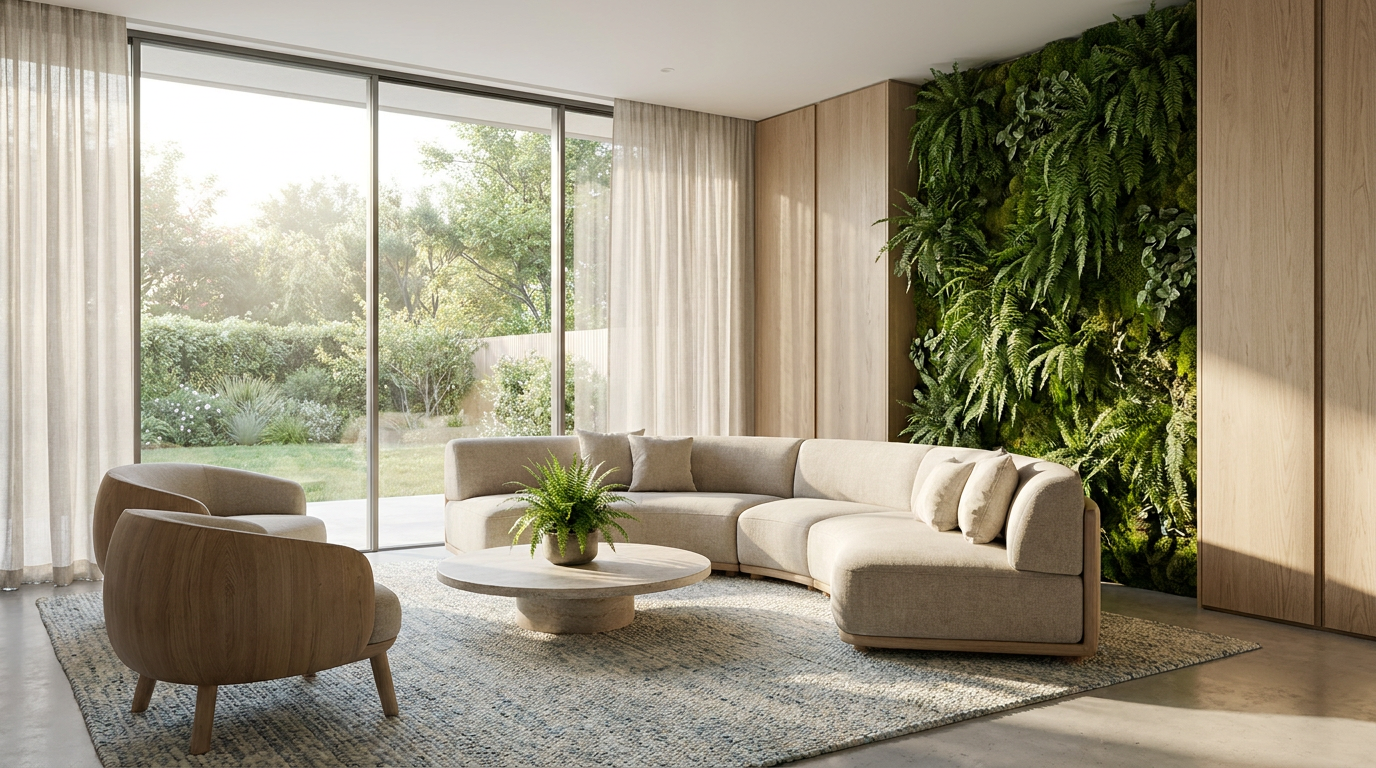
The most heavily researched and widely implemented branch of this field is biophilic design—the practice of intentionally integrating nature into the built environment. Evolutionary biologists argue that because humans spent the vast majority of our history living in natural landscapes, our nervous systems are hardwired to relax in the presence of greenery, flowing water, and natural materials like raw wood and textured stone.[5][7]
This concept is heavily supported by Attention Restoration Theory, which posits that the intense, directed focus required for modern screen work rapidly depletes our cognitive reserves. Natural stimuli, however, provide what psychologists call soft fascination—a gentle, effortless engagement that allows the brain's directed attention mechanisms to rest, recover, and reset.[7]
The empirical evidence for biophilic design is remarkably robust. Studies utilizing functional near-infrared spectroscopy have demonstrated that subjects working in environments with natural elements show significantly faster cognitive restoration after fatiguing tasks. In practical terms, research has found that introducing living plants and natural light into barren office spaces can increase worker productivity and creative problem-solving by up to 15 percent.[5][7]

However, the human brain is remarkably discerning when it comes to nature. While simulated nature—such as photographs of forests or artificial plastic plants—can provide minor reductions in heart rate, researchers have found they do not replicate the full neurological benefits of the real thing. The brain's complex processing of three-dimensional space and parallax requires authentic, living elements to trigger a complete restorative physiological response.[1][2]
The applications of this science are rapidly expanding far beyond high-end corporate offices. In healthcare, foundational studies have proven that hospital patients with views of nature heal faster and require fewer pain medications than those staring at brick walls. In education, classrooms designed with dynamic daylighting and natural textures have been directly linked to improved student concentration and greater emotional stability.[7]
Now, this evidence-based approach is fundamentally reshaping residential interior design. As the boundaries between home, work, and sanctuary continue to blur, homeowners are increasingly seeking low-tech neuroaesthetic solutions. This means prioritizing tactile, natural materials that stimulate the somatosensory cortex, designing layouts that offer both a clear view and a safe enclosure, and curating color palettes that soothe rather than stimulate.[4][6]
While the field is advancing quickly, researchers readily acknowledge that there is still much to learn. Aesthetic appreciation is not entirely universal; cultural backgrounds, personal memories, and individual neurodivergence play significant roles in how a space is perceived. What feels like a calming, minimalist sanctuary to one person might feel sterile, under-stimulating, and anxiety-inducing to another.[2][4]
Future studies aim to map these individual differences more precisely, moving toward a future of highly personalized neuroarchitecture. But the overarching consensus is already clear: our buildings are not passive containers for our lives. They are active participants in our mental health, and by designing them with empathy and science, we can transform our homes into powerful engines of human flourishing.[1][4]

How we got here
1984
Roger Ulrich publishes a foundational study showing hospital patients with nature views recover faster and require less pain medication.
1990
Neurobiologist Semir Zeki discovers that perceiving beauty activates specific, consistent brain areas, laying the groundwork for neuroaesthetics.
2000s
The term 'neuroaesthetics' is formally coined, bridging neuroscience and the study of art, beauty, and architecture.
2014
Functional imaging studies confirm that aesthetically pleasing spaces actively regulate the orbitofrontal cortex and emotional responses.
2026
Neuroarchitecture principles become mainstream in residential interior design as homeowners prioritize mental health post-pandemic.
Viewpoints in depth
Neuroaesthetics Researchers
Scientists mapping the brain's real-time response to spatial environments.
This camp focuses on empirical, neurological data. Using fMRI and EEG technology, they argue that our reaction to architecture is not a matter of subjective taste, but a hardwired biological response. They emphasize that specific geometric shapes, ceiling heights, and light temperatures reliably activate the brain's reward and threat-detection circuitry across diverse populations, proving that beauty has a measurable biological function.
Biophilic Design Advocates
Designers and evolutionary biologists focused on the human need for nature.
Rooted in evolutionary theory, this perspective argues that the human nervous system is optimized for the natural world. They advocate for Attention Restoration Theory, highlighting that the cognitive fatigue of modern, sterile environments can only be cured by reintroducing organic elements—such as living walls, natural wood grains, and dynamic daylight—which provide the 'soft fascination' necessary for mental recovery.
Evidence-Based Architects
Practitioners applying cognitive science to real-world building projects.
For these professionals, neuroaesthetics is a practical toolkit for improving human outcomes. They focus on measurable results: faster healing times in hospitals, higher test scores in schools, and reduced absenteeism in corporate offices. They argue that designing for mental health is no longer a luxury or an afterthought, but a fundamental responsibility of the architectural profession.
Traditional Interior Designers
Creatives who prioritize personal expression, culture, and subjective beauty.
While acknowledging the science, this camp cautions against reducing interior design to a purely biological formula. They argue that cultural context, personal memories, and individual artistic expression are just as important as universal neurological triggers. A space might not perfectly align with biophilic principles, but if it reflects the homeowner's unique identity and history, it can still serve as a profound source of comfort and joy.
What we don't know
- How individual neurodivergence (such as ADHD or autism) alters the brain's baseline response to specific architectural stimuli.
- The exact threshold at which visual complexity transitions from being 'pleasantly stimulating' to 'cognitively overwhelming'.
- How deeply cultural backgrounds and personal memories can override universal biological preferences for certain shapes and colors.
Key terms
- Neuroaesthetics
- The scientific study of how the brain perceives, processes, and responds to beauty, art, and spatial environments.
- Biophilic Design
- An architectural approach that connects occupants to the natural environment through direct and indirect nature cues, such as plants, water, and natural light.
- Attention Restoration Theory (ART)
- The psychological theory that exposure to natural environments helps the brain recover from the cognitive fatigue caused by intense, directed focus.
- Ventromedial Prefrontal Cortex
- A region of the brain involved in processing risk, fear, and the biological reward of experiencing something beautiful or comforting.
- Somatosensory Cortex
- The part of the brain that processes tactile sensations, which is positively stimulated by natural textures like wood and stone.
Frequently asked
Can interior design really change my brain chemistry?
Yes. Studies using fMRI machines show that specific architectural features, like natural light and curved shapes, actively trigger the brain's reward systems and reduce stress hormones like cortisol.
What is the easiest way to apply neuroaesthetics at home?
Maximizing natural light, decluttering to reduce visual cognitive load, and introducing living plants or natural wood textures are the most immediate, low-cost interventions.
Do fake plants offer the same mental health benefits?
No. While simulated nature can slightly lower heart rates, neurological studies show that the brain's complex spatial processing requires authentic, living elements to trigger a full restorative response.
Sources
Source coverage
7 outlets
4 viewpoints surfaced







[1]Factlen Editorial TeamFactlen Editorial Synthesis
Synthesis by Factlen editorial team
Read on Factlen Editorial Team →[2]University of PennsylvaniaNeuroaesthetics Researchers
The Neuroaesthetics of Architectural Spaces
Read on University of Pennsylvania →[3]BrainFactsNeuroaesthetics Researchers
How Architecture Affects Your Brain
Read on BrainFacts →[4]ArchDailyEvidence-Based Architects
Neuroaesthetics and Neuroarchitecture: Designing for the Mind
Read on ArchDaily →[5]MDPIBiophilic Design Advocates
Restorative Effects of Biophilic Design Patterns on Cognitive Performance
Read on MDPI →[6]Connections by FinsaEvidence-Based Architects
What is neuroaesthetics and how can it be applied in interior design?
Read on Connections by Finsa →[7]Biophilic InnovationsBiophilic Design Advocates
Health benefits of biophilic design: what the evidence supports
Read on Biophilic Innovations →

Every angle. Every day.
Get home stories with full source coverage and perspective breakdowns delivered to your inbox.