
Northwestern Engineers Print Artificial Neurons That Communicate Directly With Living Brain Cells
Researchers have developed 3D-printed artificial neurons capable of two-way communication with biological tissue, marking a major milestone for neuroprosthetics and energy-efficient AI.
By Factlen Editorial Team
- Medical Researchers
- Focused on the clinical applications for treating neurological damage and advancing prosthetics.
- AI Hardware Engineers
- Focused on solving the escalating energy crisis of modern computing through neuromorphic design.
- Bioethicists
- Focused on the long-term implications of merging human cognition with artificial hardware.
What's not represented
- · Patients with neurological disorders
- · Data center operators
Why this matters
This breakthrough bridges the gap between electronics and biology, paving the way for advanced medical implants that can restore lost sensory or motor functions. It also offers a blueprint to drastically reduce the massive energy consumption of modern artificial intelligence by mimicking the brain's extreme efficiency.
Key points
- Northwestern engineers successfully 3D-printed artificial neurons that communicate with living brain cells.
- The devices use flexible polymers and electronic inks to match the exact spike timing of biological neurons.
- The breakthrough paves the way for advanced neuroprosthetics and treatments for neurological disorders.
- The technology also offers a blueprint for neuromorphic computing to drastically cut AI energy consumption.
Engineers at Northwestern University have achieved a major milestone in bio-integrated electronics by developing 3D-printed artificial neurons capable of two-way communication with living biological brain cells. Unlike previous synthetic models that merely imitated neural structures, these flexible, low-cost devices generate electrical signals realistic enough to actively trigger responses in biological tissue. The breakthrough, published in the journal Nature Nanotechnology, represents a significant leap toward seamless brain-machine interfaces and a new paradigm for energy-efficient computing.[1][2][3][4]
To validate the technology, the engineering team, led by materials science professor Mark C. Hersam, collaborated with neurobiology professor Indira M. Raman. The researchers connected their printed artificial neurons to slices of mouse cerebellum tissue. When the artificial devices fired electrical spikes, the living biological neurons responded exactly as if the signals were coming from a natural peer. The artificial voltage spikes matched the precise timing, duration, and shape required to successfully activate real neural circuits.[1][2][3][5]
Achieving this level of biocompatibility has historically been a massive hurdle for neuroscientists and engineers. Previous attempts to build artificial neurons using organic materials resulted in devices that spiked too slowly to communicate with the brain. Conversely, devices built with metal oxides fired too rapidly, missing the narrow temporal window required for biological interaction. The Northwestern team managed to hit the exact "Goldilocks" timescale and spike shape necessary for direct, real-time communication with living tissue.[1][4][5]

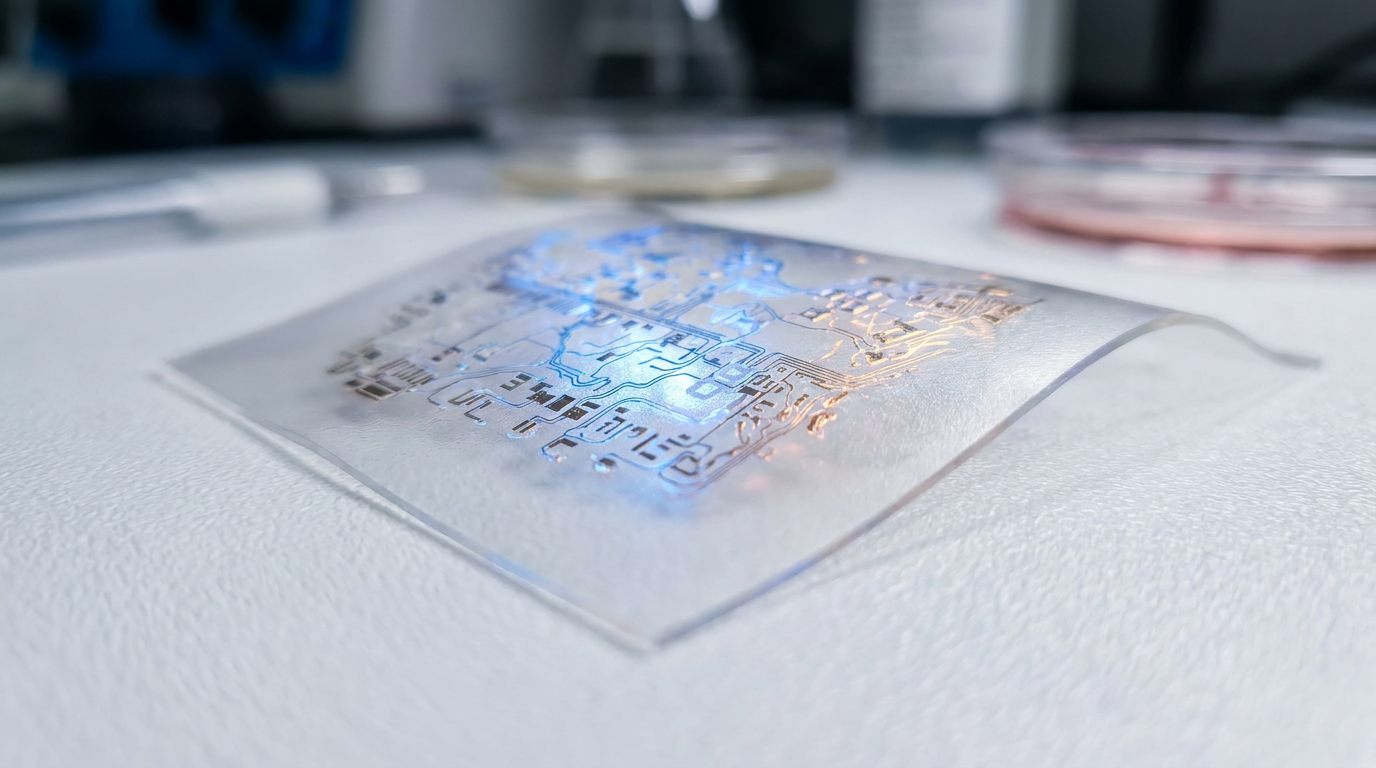
The foundation of this advance lies in a novel fabrication technique that moves away from the rigid silicon chips that dominate modern computing. The researchers utilized a specialized process called aerosol jet printing to deposit custom electronic inks onto a soft, flexible polymer substrate. These inks were formulated from nanoscale flakes of molybdenum disulfide, which acts as a semiconductor, and graphene, which serves as an electrical conductor. The resulting structure closely mimics the soft, three-dimensional, and dynamic nature of the human brain.[2][3][4][5]
The foundation of this advance lies in a novel fabrication technique that moves away from the rigid silicon chips that dominate modern computing.
The critical breakthrough in the neurons' signaling capability actually stemmed from an intentional manufacturing imperfection. The electronic ink contains a stabilizing polymer that researchers typically burn off entirely after printing to prevent it from interfering with electrical currents. However, the Northwestern team discovered that by leaving some of this polymer intact and partially decomposing it with an electrical current, they could create localized pathways that produce sudden, neuron-like electrical responses.[1][4][5]
This localized decomposition allowed the artificial neurons to generate a rich, complex range of electrical signals. Instead of producing simple, uniform, one-off pulses like traditional digital transistors, the printed devices can output single spikes, continuous firing, and complex bursting patterns. This signaling diversity is how real biological neurons encode vast amounts of information and perform sophisticated functions, a capability that has now been successfully replicated in a synthetic medium.[1][4]

The medical implications of this technology are vast. By establishing a functional communication bridge between living and artificial systems, researchers are laying the groundwork for advanced neuroprosthetics. Future applications could include prosthetic limbs that offer precise motor control and real-time sensory feedback, or neural implants designed to restore lost hearing and vision. Furthermore, the technology opens new avenues for treating neurodegenerative conditions like Alzheimer's disease or paralysis by replacing or supporting damaged neural circuits.[1][3][6]
Beyond healthcare, the printed neurons offer a potential solution to the escalating energy crisis driven by artificial intelligence. Modern AI models require massive data centers that consume extraordinary amounts of electricity and water for cooling. The human brain, by contrast, is approximately 100,000 times—or five orders of magnitude—more energy-efficient than a standard digital computer. By replicating the brain's structural and signaling efficiencies, neuromorphic computing hardware could eventually process complex AI tasks using a fraction of the power required today.[2][3][4]

Traditional silicon achieves computational complexity by packing billions of identical, rigid devices onto a single chip. The brain operates on the opposite principle, utilizing diverse, specialized neurons arranged in constantly adapting networks. The Northwestern team's printable, flexible neurons represent a crucial step toward building hardware that actually operates like a brain, rather than just simulating one in software. As the technology scales, researchers hope to move from mouse models to human tissue testing, bringing the worlds of biology and advanced computing closer together than ever before.[1][4][5][6]
How we got here
2021–2025
Researchers struggle to match the exact temporal spike rate required for artificial materials to communicate with biological tissue.
April 15, 2026
Northwestern University publishes its breakthrough in Nature Nanotechnology, demonstrating two-way communication in mouse tissue.
June 2026
The breakthrough gains widespread traction across the AI and medical communities as a dual solution for neuroprosthetics and AI energy consumption.
Viewpoints in depth
Medical Researchers
Focused on the clinical applications for treating neurological damage.
For neurobiologists, the ability to match the exact spike timing and shape of biological neurons is the holy grail of bioelectronics. This camp views the Northwestern breakthrough as the foundational step toward next-generation neuroprosthetics. If artificial neurons can seamlessly integrate with living tissue without being rejected or misinterpreting signals, researchers could eventually bypass damaged spinal cords, restore vision, or build prosthetic limbs that offer true sensory feedback.
AI Hardware Engineers
Focused on solving the escalating energy crisis of modern computing.
Computer scientists view this development through the lens of efficiency and scale. The current trajectory of AI development is constrained by the massive power and cooling requirements of silicon-based data centers. By shifting toward neuromorphic hardware—systems that physically mimic the brain's heterogeneous, low-power network rather than just simulating it in software—engineers believe they can unlock more advanced AI capabilities while slashing energy consumption by orders of magnitude.
Bioethicists
Focused on the long-term implications of merging human cognition with artificial hardware.
While acknowledging the medical benefits, bioethicists emphasize the need for early governance frameworks. As brain-machine interfaces move from science fiction to laboratory reality, questions arise about cognitive privacy, the security of neural implants, and the philosophical implications of integrating synthetic components into the human brain. This camp advocates for parallel advancements in ethical guidelines to ensure the technology is used safely and equitably.
What we don't know
- How long it will take to scale the manufacturing of these printed neurons for commercial use.
- Whether the human immune system will accept or reject these specific polymer materials over long-term implantation.
- When the first human clinical trials for these specific artificial neurons might begin.
Key terms
- Neuromorphic computing
- Computer engineering that models hardware after the structure and function of the human brain to achieve high efficiency.
- Aerosol jet printing
- A manufacturing technique that deposits fine mists of electronic inks to print highly precise, flexible circuits.
- Molybdenum disulfide
- A nanomaterial used as a semiconductor in the printed artificial neurons to help conduct electrical signals.
- Brain-machine interface
- A direct communication pathway between a biological brain and an external device, such as a prosthetic limb or computer.
Frequently asked
Can these artificial neurons be implanted in humans right now?
Not yet. The technology has been successfully tested on mouse brain tissue in a laboratory setting, but human trials and clinical applications are still years away.
How does this help with artificial intelligence?
Modern AI requires massive, energy-hungry data centers. By mimicking the brain's extreme energy efficiency, this hardware could drastically reduce the power needed to run AI models.
What makes these printed neurons different from silicon chips?
Silicon chips are rigid and rely on billions of identical transistors. These printed neurons are soft, flexible, and can generate complex, varied signaling patterns just like real brain cells.
Sources
Source coverage
6 outlets
3 viewpoints surfaced






[1]Northwestern NowMedical Researchers
Printed neurons communicate with living brain cells
Read on Northwestern Now →[2]Neuroscience NewsMedical Researchers
Printable Artificial Neurons That 'Talk' to Living Brain Cells
Read on Neuroscience News →[3]ScienceDailyMedical Researchers
Artificial neurons successfully communicate with living brain cells
Read on ScienceDaily →[4]Singularity HubAI Hardware Engineers
Printed Neurons That Mimic Brain Cells Could Slash AI's Energy Bill
Read on Singularity Hub →[5]VoxelMattersAI Hardware Engineers
Northwestern University researchers print artificial neurons that communicate with living brain cells
Read on VoxelMatters →[6]AI Nexus WorldAI Hardware Engineers
Northwestern University Researchers Print Artificial Neurons That Communicate With Biological Cells
Read on AI Nexus World →

Every angle. Every day.
Get ai stories with full source coverage and perspective breakdowns delivered to your inbox.