
The Economics Behind Europe's 2026 Sleeper Train Revival
Europe is experiencing a massive resurgence in overnight rail travel, but the industry is splitting sharply between ultra-luxury 'palaces on rails' and fragile, state-subsidized commercial routes.
By Factlen Editorial Team
- Public Rail Advocates
- Argue that night trains are essential green infrastructure that must be subsidized by the state to replace short-haul flights.
- Ultra-Luxury Operators
- View the sleeper train as a high-margin, experiential 'hotel on rails' where the journey itself is the destination.
- Industry Realists
- Point out that without state backing, the brutal economics of track access charges make mid-tier night trains nearly impossible to sustain.
What's not represented
- · Budget travelers priced out of the market
- · Airlines losing short-haul market share
Why this matters
As airlines face increasing pressure over carbon emissions, the revival of the sleeper train offers a highly anticipated, sustainable alternative for crossing Europe. However, the brutal economics of rail infrastructure mean travelers will either pay a massive premium for luxury or rely on routes that are vulnerable to sudden political cuts.
Key points
- Accor's Orient Express and Arsenale's La Dolce Vita are launching ultra-luxury routes in late 2026, with tickets exceeding $4,100.
- State-backed operators like ÖBB continue to expand standard night trains, citing a 51x reduction in carbon emissions compared to flying.
- The mid-tier market has struggled, highlighted by the 2024 collapse of the highly anticipated startup Midnight Trains.
- High track access charges remain the primary economic barrier for independent night train operators in Europe.
The romance of the European sleeper train is experiencing a renaissance in 2026, driven by a potent mix of climate consciousness and a post-pandemic thirst for slow travel. After decades of decline at the hands of budget airlines, the night train is back. But the revival is splitting into two distinct tracks: ultra-luxury "palaces on rails" catering to the global elite, and state-backed commercial routes fighting brutal economic headwinds to replace short-haul flights.
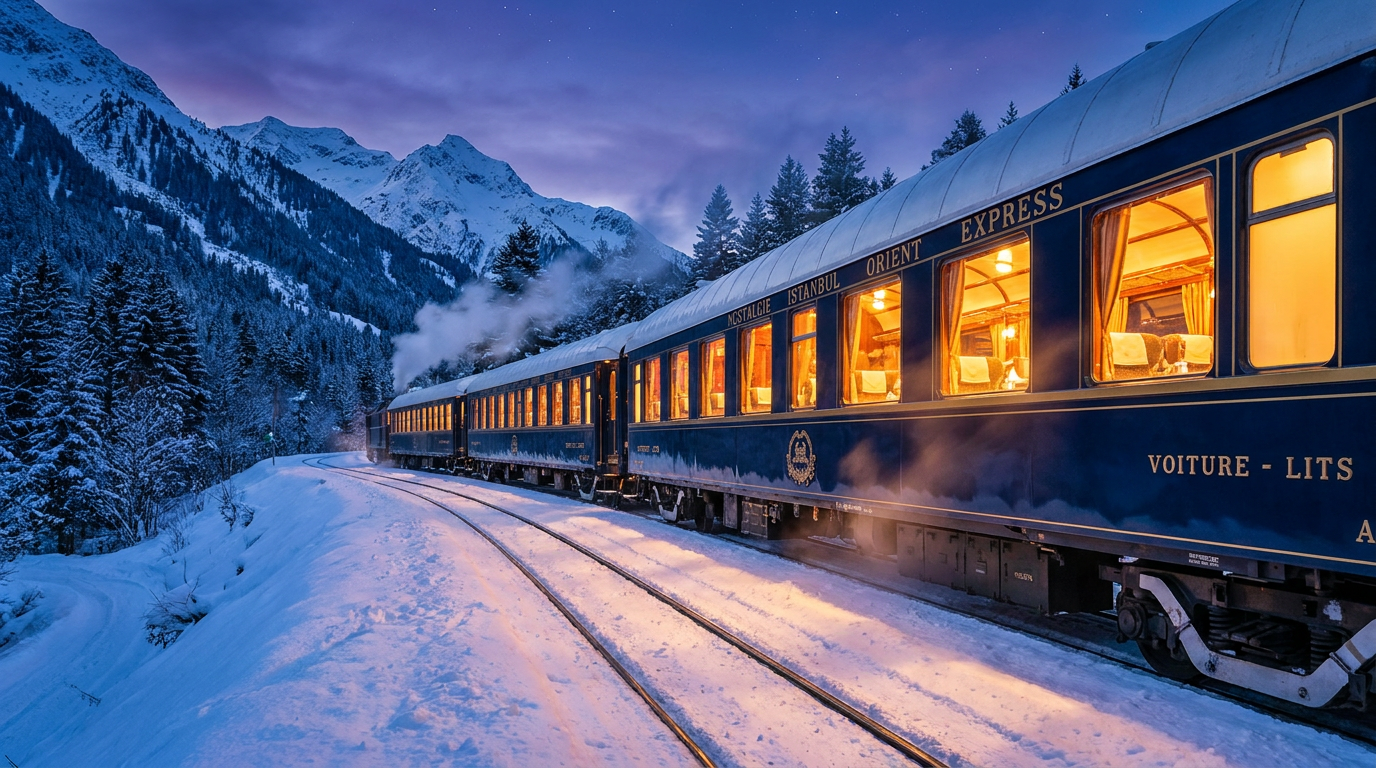
The most visible symbol of this resurgence is the return of the Orient Express. In late 2026, hospitality giant Accor is officially resurrecting the legendary Paris-to-Istanbul route, utilizing 17 meticulously restored carriages from the 1920s and 1930s.[2][5]
Accor, which purchased a 50 percent stake in the Orient Express brand, is not alone in targeting the ultra-high-net-worth traveler. The Arsenale Group's "La Dolce Vita Orient Express" is launching its own lavish itineraries across Italy, featuring 1960s-inspired interiors by Milan's Dimorestudio.[5]
By October 2026, La Dolce Vita will also inaugurate a five-day, four-night journey from Rome to Istanbul, crossing the Carpathian Mountains with menus designed by three-Michelin-starred chef Heinz Beck. Tickets for these experiences routinely exceed $4,100 per night, transforming the train from a mere conveyance into the primary destination.[2][5]

Belmond, owned by LVMH, has similarly expanded its footprint, launching the Britannic Explorer in 2025 to tour England and Wales, and adding new carriages to its Venice Simplon-Orient-Express. For these operators, the business model is insulated from the typical margins of public transit. They sell exclusivity, heritage, and a five-star hotel experience that happens to move.[1]
But away from the champagne cars and mahogany paneling, the broader commercial night train industry faces a much more precarious reality. The fundamental mechanism of European rail relies on "Track Access Charges"—tolls paid by train operators to national infrastructure managers for every kilometer traveled.[4]
Because sleeper trains are heavy, carry fewer passengers than daytime high-speed trains, and occupy tracks for long durations, their per-passenger track access charges are disproportionately high. This creates a brutal economic environment for startups attempting to build a "missing middle" of premium, private-cabin night trains for everyday professionals.[1][4]
The most high-profile casualty of this dynamic was Midnight Trains, a heavily hyped French startup that promised a "hotel on rails" network radiating from Paris. Despite raising venture capital and securing European Union backing, the company folded in May 2024 without operating a single service. The math simply did not work without state subsidies.[1]

The most high-profile casualty of this dynamic was Midnight Trains, a heavily hyped French startup that promised a "hotel on rails" network radiating from Paris.
A new venture, Nox Mobility, founded by former FlixTrain executives, is now attempting to thread that same needle, targeting a 2027 launch from Berlin with all-private rooms starting around $86. Industry analysts remain cautious, noting that the structural barriers that killed Midnight Trains—high track tolls and fragmented national rail bureaucracies—remain firmly in place.[1]
Consequently, the survival of the standard European sleeper network remains heavily dependent on state intervention. Austria's national operator, ÖBB, has become the undisputed backbone of the continent's night network with its Nightjet service.[3]
ÖBB has invested heavily in the sector, rolling out 33 new custom-built Siemens trainsets worth roughly €600 million. These modern trains feature mini-cabins for solo travelers and expanded digital services, aiming to make the 12-hour journey a viable alternative to a two-hour flight plus airport security.[3]
The environmental argument for this state support is overwhelming. According to ÖBB, traveling on a Nightjet emits, on average, 51 times less carbon dioxide than taking the equivalent flight. This stark climate math has prompted countries like France and Austria to ban certain short-haul domestic flights where a rail alternative exists, theoretically funneling passengers toward the tracks.[3]
Yet, even with climate mandates, political support is fickle. In a stark illustration of the sector's vulnerability, the French government abruptly withdrew its subsidy for the Paris-Vienna and Paris-Berlin Nightjet routes in late 2025.[4]
Without that financial backstop, ÖBB could not absorb the operating costs, and the routes were canceled in December 2025, despite boasting excellent passenger occupancy rates. Rail advocates point to this as proof that night trains cannot survive purely on ticket sales; they require long-term, stable political frameworks that treat them as essential green infrastructure rather than standalone profit centers.[4]

Despite these setbacks, independent operators are still finding ways to expand. European Sleeper, a Belgian-Dutch cooperative funded largely by citizen investors, has successfully carved out niche international routes that state railways abandoned.[1][6]
In September 2026, European Sleeper is launching its most ambitious route yet: a service connecting Brussels and Amsterdam to Milan, traversing the Swiss Alps via the Simplon Pass. The service splits and combines train portions in Cologne, demonstrating the complex logistical choreography required to run cross-border night trains.[1][6]
Ultimately, the 2026 landscape of European sleeper trains is a tale of two extremes. If you have $4,100 to spend, the continent has never offered more opulent, meticulously designed rail journeys.[2][5]

But for the climate-conscious traveler looking to cross borders while they sleep for under $200, the network remains a fragile patchwork. The demand is undeniably there, but until the European Union standardizes track access charges and secures permanent funding, the everyday night train will remain a romantic ideal battling a difficult economic reality.[1][4]
How we got here
Dec 2021
ÖBB Nightjet restores the Paris-Vienna sleeper route after years of dormancy.
May 2024
Midnight Trains, a highly anticipated private sleeper startup, collapses before launching.
Dec 2025
France withdraws subsidies, forcing the cancellation of the Paris-Vienna and Paris-Berlin Nightjet routes.
Sep 2026
European Sleeper launches a new cooperative-funded route from Amsterdam to Milan.
Oct 2026
Accor's La Dolce Vita Orient Express inaugurates its Rome-to-Istanbul journey.
Viewpoints in depth
The Ultra-Luxury Operators
Selling exclusivity and heritage over pure transportation.
For brands like Accor and Belmond, the economics of public transit are irrelevant. By charging thousands of dollars per night, they bypass the tight margins that plague standard rail. These operators view their trains as five-star hotels that happen to move, catering to a post-pandemic elite that prioritizes 'slow travel,' privacy, and meticulous design over speed. Their primary competition is not the budget airline, but the luxury yacht or the private jet.
The Public Rail Advocates
Fighting for state subsidies to make green travel accessible.
Environmental groups and state operators like ÖBB argue that the free market cannot support a robust night train network. Because sleeper trains are heavy and carry fewer passengers than daytime trains, their track access tolls are prohibitively high. Advocates argue that governments must step in with permanent subsidies, viewing night trains not as profit centers, but as essential public infrastructure necessary to meet the European Union's aggressive carbon-reduction targets.
The Industry Realists
Warning that the 'missing middle' is an economic trap.
Financial analysts and rail veterans point to the collapse of startups like Midnight Trains as proof that the mid-tier market is fundamentally broken. While consumers say they want private, affordable sleeper cabins, the math of track access charges and rolling stock investment makes it nearly impossible for independent companies to deliver that product without going bankrupt. Until the EU standardizes and lowers track tolls for night trains, realists argue the industry will remain polarized between the ultra-rich and the heavily subsidized.
What we don't know
- Whether the European Union will intervene to standardize and lower track access charges specifically for night trains.
- If new startups like Nox Mobility can succeed in the mid-tier market where well-funded predecessors like Midnight Trains failed.
- How long state governments will continue to subsidize standard night routes in the face of shifting political priorities.
Key terms
- Track Access Charges
- Tolls paid by train operators to national infrastructure managers for the right to run trains on their rails, often calculated by weight and distance.
- Open Access Operator
- A private railway company that runs services on state-owned infrastructure without a government contract, relying entirely on ticket sales.
- CIWL
- Compagnie Internationale des Wagons-Lits, the historic Belgian company that originally operated the Orient Express and pioneered the luxury sleeper car.
Frequently asked
Why are standard night trains so expensive to run?
Sleeper trains are heavy, carry fewer passengers than daytime trains, and occupy tracks for long periods. This results in high track access tolls paid to national infrastructure managers, which severely eats into profit margins.
Did the startup Midnight Trains ever launch?
No. Despite significant hype, venture funding, and EU backing, the French startup folded in May 2024 before operating a single route, largely due to insurmountable infrastructure costs.
Is the Orient Express a single train?
No. The historic brand is now split. Hospitality group Accor operates restored 1920s carriages and the new La Dolce Vita trains, while Belmond runs the separate Venice Simplon-Orient-Express.
Sources
Source coverage
6 outlets
3 viewpoints surfaced






[1]ObserverIndustry Realists
The Golden Age of European Night Trains Returns
Read on Observer →[2]Time OutUltra-Luxury Operators
A re-imagined Orient Express rail journey to Istanbul is launching this year
Read on Time Out →[3]RoadbookPublic Rail Advocates
The return of European sleeper trains
Read on Roadbook →[4]HourrailPublic Rail Advocates
Towards a new hope: can night trains really be saved?
Read on Hourrail →[5]Orient Express OfficialUltra-Luxury Operators
La Dolce Vita Orient Express Unveiled
Read on Orient Express Official →[6]European SleeperPublic Rail Advocates
New Route to Milan 2026
Read on European Sleeper →


Every angle. Every day.
Get travel stories with full source coverage and perspective breakdowns delivered to your inbox.