
The Hive Mind: How V2X Communication is Rewriting the Rules of Autonomous Driving
To achieve true autonomy, self-driving cars can no longer rely solely on their own sensors. Vehicle-to-Everything (V2X) technology allows them to talk to each other, traffic lights, and pedestrians in real time.
By Factlen Editorial Team
- Automotive & Telecom Engineers
- Focus on the technical superiority of 5G C-V2X, the necessity of ultra-low latency, and the shift away from older Wi-Fi standards.
- Transportation & Safety Officials
- Focus on the macro benefits of V2X—reducing the 80% of crashes caused by unimpaired drivers, smoothing traffic flow, and protecting pedestrians.
- Privacy & Security Analysts
- Focus on the risks of a fully connected grid, emphasizing the need for robust encryption, spoofing prevention, and strict data anonymization.
What's not represented
- · Local municipal budget directors facing the cost of infrastructure upgrades
- · Drivers of classic or non-connected vehicles
Why this matters
V2X represents the leap from individual self-driving cars to a cooperative transportation network. By allowing vehicles to 'see' through buildings and anticipate hazards before they happen, this technology is projected to drastically reduce traffic fatalities and urban congestion.
Key points
- V2X technology allows autonomous and human-driven vehicles to communicate with each other and city infrastructure in real time.
- Vehicle-to-Vehicle (V2V) communication enables cars to react to hazards that are physically blocked from their line of sight.
- Smart traffic lights broadcast timing data, allowing vehicles to adjust speeds to catch green lights and reduce braking.
- The industry is coalescing around 5G-powered Cellular V2X (C-V2X), which offers one-millisecond latency for safety-critical messages.
- Widespread adoption could reduce unimpaired driver crashes by up to 80%, according to the U.S. Department of Transportation.
- Engineers are deploying rotating security certificates to ensure V2X data remains anonymous and immune to spoofing.
For the past decade, the autonomous vehicle industry has been obsessed with line-of-sight. Engineers have bolted increasingly sophisticated arrays of LiDAR, radar, and high-definition cameras onto cars, training neural networks to interpret the world exactly as a human driver would: by looking at it. But this approach has a fundamental limitation. If a box truck is blocking the view of the road ahead, the most advanced sensor suite in the world is effectively blind to what lies beyond it.[6]
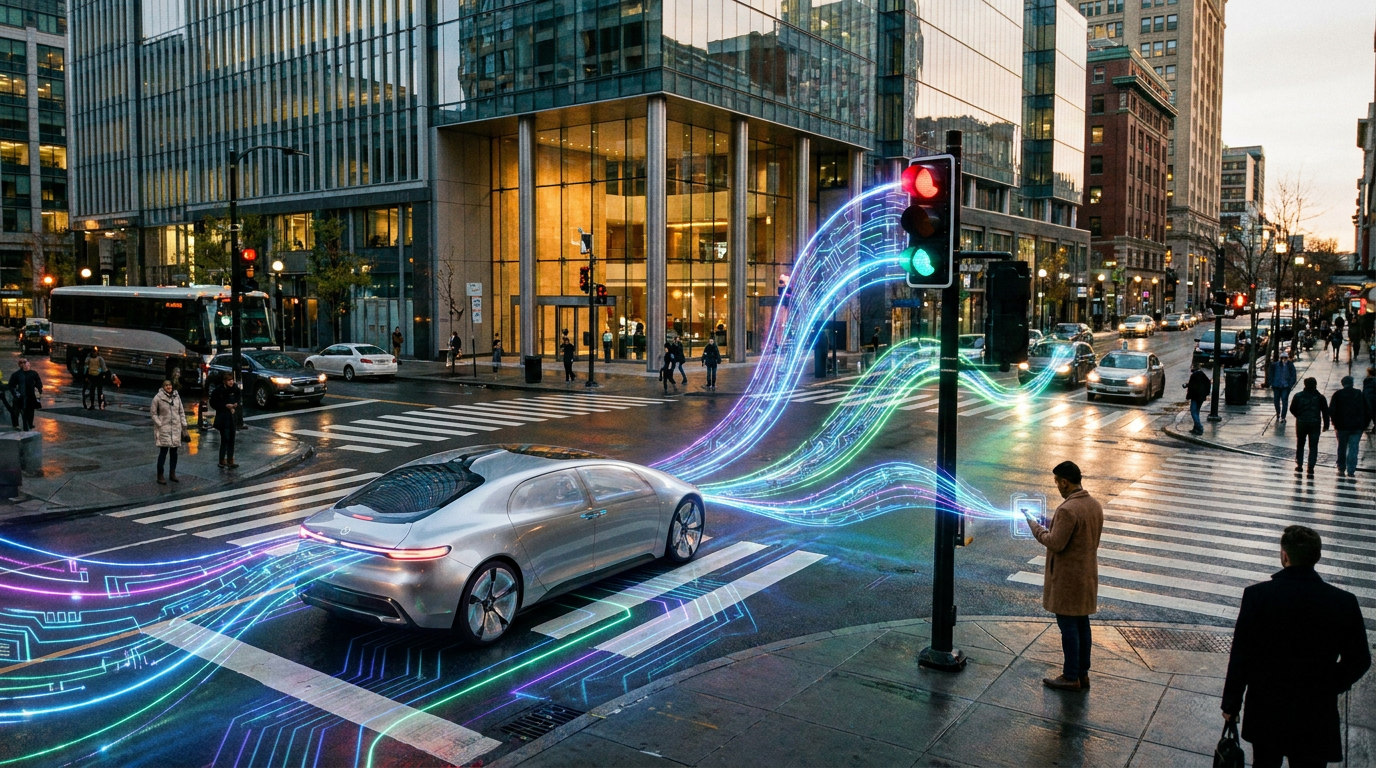
The solution to this physics problem is not better cameras, but a fundamental shift in how vehicles interact with their environment. Enter Vehicle-to-Everything (V2X) communication. Instead of treating every car as an isolated robot trying to solve the puzzle of traffic on its own, V2X turns the roadway into a cooperative hive mind. Vehicles, traffic lights, and even pedestrians continuously broadcast their status, creating a shared, invisible map of the world.[1][2]
V2X is an umbrella term for a suite of wireless protocols operating in the 5.9 GHz band. The most critical of these is Vehicle-to-Vehicle (V2V) communication. In a V2V-enabled world, cars broadcast their exact GPS position, speed, heading, and braking status omnidirectionally, hundreds of times per second.[2][5]
The safety implications of V2V are profound. Consider the 'invisible brake' scenario: you are driving on the highway, and three cars ahead of you, a driver slams on their brakes. In a traditional setup, your car's sensors wouldn't react until the vehicle immediately in front of you started braking. With V2V, the lead car's emergency braking signal is instantly received by your vehicle, allowing your car to decelerate before the brake lights ahead even illuminate.[4][5]

Beyond talking to each other, vehicles must also talk to the city. This is Vehicle-to-Infrastructure (V2I) communication. The most immediate application is at signalized intersections. Smart traffic lights broadcast their Signal Phase and Timing (SPaT) data, telling approaching vehicles exactly when the light will turn red or green.[1][2]
For an autonomous vehicle—or even a human-driven electric vehicle with advanced cruise control—SPaT data is a game-changer. Instead of rushing to a red light only to slam on the brakes, the vehicle can subtly adjust its cruising speed to arrive exactly as the light turns green. This 'green wave' routing dramatically reduces brake wear, conserves battery power, and smooths out urban traffic flow.[3][5]
V2I also enables emergency vehicle preemption. When an ambulance or fire engine approaches an intersection, its V2X system can securely request priority. The traffic management system instantly turns the light green for the emergency vehicle and red for cross-traffic, safely clearing the intersection and shaving critical seconds off response times.[1][4]
When an ambulance or fire engine approaches an intersection, its V2X system can securely request priority.
The most vulnerable participants in the traffic ecosystem are also being integrated through Vehicle-to-Pedestrian (V2P) technology. By leveraging the cellular chips in smartphones or wearable devices, pedestrians and cyclists can broadcast their presence to nearby vehicles. If a child steps into a crosswalk while hidden behind a parked delivery van, an approaching car's V2X system receives the alert and triggers automatic emergency braking long before the cameras detect a human.[1][3]

Tying this all together is Vehicle-to-Network (V2N) communication, which connects the car to the broader cloud. While V2V and V2I handle split-second, localized safety decisions, V2N handles macro-level logistics: rerouting fleets around distant construction zones, downloading over-the-air software updates, and feeding anonymized traffic density data back to city planners.[3][5]
The technological foundation making this possible is Cellular V2X (C-V2X), which has largely won the standards war against older, Wi-Fi-based DSRC protocols. Backed by the 3rd Generation Partnership Project (3GPP)—the global body behind mobile networks—C-V2X leverages existing cellular infrastructure while adding a crucial 'direct mode' that allows cars to talk to each other even in dead zones without cell towers.[3][4]
The rollout of 5G networks has been the catalyst for C-V2X. 5G introduces Ultra-Reliable Low-Latency Communication (URLLC), which can push data packets with an end-to-end latency of just one millisecond. At highway speeds, a fraction of a second translates to dozens of feet of travel; 5G ensures that safety-critical messages arrive instantaneously.[4]
The potential impact is staggering. The U.S. Department of Transportation estimates that widespread V2X adoption could reduce unimpaired driver crashes by up to 80%. By eliminating the element of surprise from driving, V2X targets the root cause of most collisions: human error and limited visibility.[1][2]

However, scaling this technology presents monumental challenges. The most obvious is infrastructure cost. Upgrading millions of intersections with V2X roadside units requires massive investment from local and state governments, many of which are already operating on tight transportation budgets.[2][6]
Security and privacy are equally daunting hurdles. If a malicious actor could spoof V2X signals—broadcasting fake 'hard brake' warnings or phantom pedestrians—they could paralyze a city's traffic grid. To prevent this, the industry is deploying complex Public Key Infrastructure (PKI), where vehicles use rotating, anonymous security certificates to authenticate messages without revealing their permanent identity.[6]

This anonymization is critical to winning public trust. Drivers must be assured that broadcasting their vehicle's telemetry will not become a tool for mass surveillance or automated speeding tickets. The system is designed to share 'what' is happening on the road, not 'who' is doing it.[6]
As the automotive industry pushes toward Level 4 and Level 5 autonomy, the consensus is clear: sensors alone are not enough. A truly safe autonomous future requires vehicles that don't just observe their environment, but actively converse with it. The era of the isolated automobile is ending, making way for a synchronized, intelligent mobility network.[5][6]
How we got here
1999
The FCC allocates the 5.9 GHz band for intelligent transportation systems, sparking early DSRC research.
2017
The 3GPP completes Release 14, introducing Cellular V2X (C-V2X) as a cellular-based rival to Wi-Fi systems.
2020
The FCC reallocates a portion of the 5.9 GHz band exclusively for C-V2X, signaling a regulatory shift toward cellular tech.
2024
China incorporates C-V2X into its official NCAP vehicle safety evaluations, accelerating global adoption.
2026
5G-powered C-V2X becomes a foundational standard in new luxury and autonomous vehicle platforms.
Viewpoints in depth
Automotive & Telecom Engineers
Focus on the technical superiority of 5G C-V2X and the necessity of ultra-low latency.
For the engineers building the next generation of autonomous systems, the shift to 5G Cellular V2X (C-V2X) is a non-negotiable requirement for safety. They argue that older Wi-Fi-based DSRC systems simply cannot handle the density of data required in a modern smart city. By leveraging 5G's Ultra-Reliable Low-Latency Communication (URLLC), C-V2X guarantees that a braking signal from a car hundreds of feet ahead will arrive in exactly one millisecond. This camp emphasizes that true Level 5 autonomy—where a car can operate anywhere without human intervention—is mathematically impossible using line-of-sight sensors alone; the vehicle must be able to 'see' around corners via the network.
Transportation & Safety Officials
Focus on the macro benefits of V2X, including massive crash reductions and smoother traffic flow.
Public sector transportation officials view V2X as the most significant leap in road safety since the seatbelt. The U.S. Department of Transportation and various research institutes point to data showing that V2X could eliminate up to 80% of crashes caused by unimpaired drivers. Beyond safety, city planners are highly motivated by the efficiency gains. By allowing vehicles to synchronize with traffic lights and each other, V2X can drastically reduce the stop-and-go accordion effect that causes urban gridlock, thereby lowering emissions and reducing wear on city infrastructure.
Privacy & Security Analysts
Focus on the risks of a fully connected grid, emphasizing the need for robust encryption and strict data anonymization.
Cybersecurity experts and privacy advocates warn that turning every car into a broadcasting node creates an unprecedented attack surface. Their primary concern is 'spoofing'—a scenario where a hacker injects fake V2V signals into the network to trigger phantom emergency braking, potentially causing massive pileups. Furthermore, privacy advocates are deeply concerned about the surveillance potential of a system that tracks vehicle movements in real time. This camp insists that deployment must be gated by the implementation of strict Public Key Infrastructure (PKI), ensuring that vehicles broadcast only rotating, anonymous tokens rather than permanent identifiers.
What we don't know
- How quickly cash-strapped local municipalities will be able to afford the installation of V2X roadside units at every intersection.
- Whether older, non-connected vehicles will pose a persistent hazard to the V2X ecosystem during the multi-decade transition period.
- How the legal liability framework will adapt if a crash is caused by a delayed or spoofed V2X signal rather than a sensor failure.
Key terms
- V2X (Vehicle-to-Everything)
- The overarching term for a vehicle's ability to communicate wirelessly with its environment, including other cars, infrastructure, and pedestrians.
- C-V2X (Cellular V2X)
- A communication standard that uses cellular network technology (like 4G LTE and 5G) to connect vehicles.
- SPaT (Signal Phase and Timing)
- Data broadcast by smart traffic lights indicating their current color and the exact time remaining until the next change.
- URLLC (Ultra-Reliable Low-Latency Communication)
- A feature of 5G networks that ensures data packets are delivered almost instantly without failure, critical for highway-speed safety.
- DSRC (Dedicated Short-Range Communications)
- An older, Wi-Fi-based standard for vehicle communication that is largely being replaced by C-V2X.
Frequently asked
Does V2X require a 5G cell tower to work?
No. C-V2X includes a 'direct mode' (PC5) that allows vehicles to talk directly to each other and nearby infrastructure without relying on a cellular network.
Can someone track my car using V2X signals?
V2X systems are designed with privacy in mind, using rotating, anonymous security certificates rather than broadcasting a vehicle's permanent ID or license plate.
Will older cars benefit from V2X?
While they won't transmit data, older cars benefit indirectly because V2X-equipped vehicles smooth out traffic flow and reduce the likelihood of multi-car pileups.
How does V2X help with electric vehicle range?
By communicating with traffic lights to avoid unnecessary stops and starts, V2X allows EVs to maintain momentum, which significantly conserves battery power.
Sources
Source coverage
6 outlets
3 viewpoints surfaced






[1]U.S. Department of TransportationTransportation & Safety Officials
Vehicle-to-Everything (V2X) Technology – Benefits for Arterials and Signalized Intersections
Read on U.S. Department of Transportation →[2]Southwest Research InstituteTransportation & Safety Officials
What are V2X technologies?
Read on Southwest Research Institute →[3]5G Automotive AssociationAutomotive & Telecom Engineers
C-V2X explained: Connected Mobility
Read on 5G Automotive Association →[4]SynopsysAutomotive & Telecom Engineers
5G Automotive Technology in Urban Traffic
Read on Synopsys →[5]Digi InternationalAutomotive & Telecom Engineers
C-V2X Definition and Applications
Read on Digi International →[6]Factlen Editorial TeamPrivacy & Security Analysts
Synthesis by Factlen editorial team
Read on Factlen Editorial Team →
Every angle. Every day.
Get automotive stories with full source coverage and perspective breakdowns delivered to your inbox.